

Vessel data management in luxury marinas is the systematic process of collecting, integrating, and governing detailed vessel and berth records to support flawless operations and premium client service. The role of vessel data management in luxury marinas extends well beyond simple record-keeping. It determines whether a 90-foot superyacht gets assigned the right slip on arrival, whether compliance documents are current, and whether the dockmaster has a single operational view instead of three disconnected spreadsheets. Platforms like Atlantis-marina, AIS-integrated tracking systems, and standardized berth booking workflows are the infrastructure that makes this possible. Marinas that treat vessel data as a living operational asset consistently outperform those that treat it as static paperwork.
How does structured vessel data improve luxury marina service?
Structured vessel data is the foundation of accurate slip allocation and pre-arrival readiness. Berth reservation workflows cannot compute availability accurately without complete vessel fields such as length, beam, draft, vessel type, registration details, and booking history stored in a unified system rather than across disconnected forms. For a luxury marina, that gap between a 65-foot and a 72-foot vessel record is the difference between a smooth arrival and an embarrassing reassignment at the dock.
The data model for effective boat data handling covers three interconnected layers:
- Vessel attributes: length overall, beam, draft, vessel type, propulsion, fuel requirements, and electrical load
- Documentation records: registration certificates, insurance policies, safety compliance records, and radio licenses that support compliance and premium communications
- Berth-side parameters: slip dimensions, draft limits, utility connections, weight ratings, and seasonal availability rules
Each layer must stay synchronized. A vessel that added a generator since its last visit changes its electrical load requirements. A berth that underwent maintenance may have a temporary draft restriction. Treating vessel data as static rather than as a living schema causes arrival-day surprises that no luxury marina can afford.
Pro Tip: Assign a data steward role within your operations team. This person owns update workflows and audits vessel records quarterly. Without explicit ownership, records drift and the compatibility logic your booking system depends on quietly breaks down.

Experts identify data completeness and a single operational view as the two factors most responsible for reducing manual coordination and accelerating berth assignment decisions. When dockmasters work from one authoritative record instead of cross-referencing email threads and paper files, assignment speed increases and conflict rates drop.
What is the role of AIS and real-time vessel tracking in luxury marinas?
AIS, or Automatic Identification System, is the maritime standard for broadcasting vessel position, speed, course, and identity data. In luxury marina operations, AIS integration transforms reactive dockmaster work into proactive arrival coordination. When a 100-foot motor yacht is 45 minutes out, the team can pre-position staff, confirm slip readiness, and notify concierge services before the vessel reaches the breakwater.
The operational benefits of AIS integration include:
- Real-time vessel position updated at average frequencies around 20 seconds per vessel, giving dockmasters accurate situational awareness
- ETA forecasting based on current speed and course, enabling coordinated arrivals without radio back-and-forth
- Geofencing alerts that distinguish vessels entering the marina approach channel from vessels simply passing offshore
- Multi-source data fusion that combines satellite AIS, terrestrial receivers, and GPS feeds to eliminate coverage gaps in sheltered anchorages
The biggest technical challenge in AIS integration is not the data volume. It is normalization. Multiple formats and inconsistent sampling rates across different AIS feed providers degrade data quality if left unaddressed. Techniques like Kalman filtering for trajectory validation and duplicate record suppression are standard practice for any marina serious about operational reliability.
Pro Tip: Do not rely on a single AIS data feed. Fuse at least two sources, one terrestrial and one satellite, and apply dynamic geofencing to your marina's specific approach zone. This eliminates the false arrival alerts that erode staff trust in the system over time.
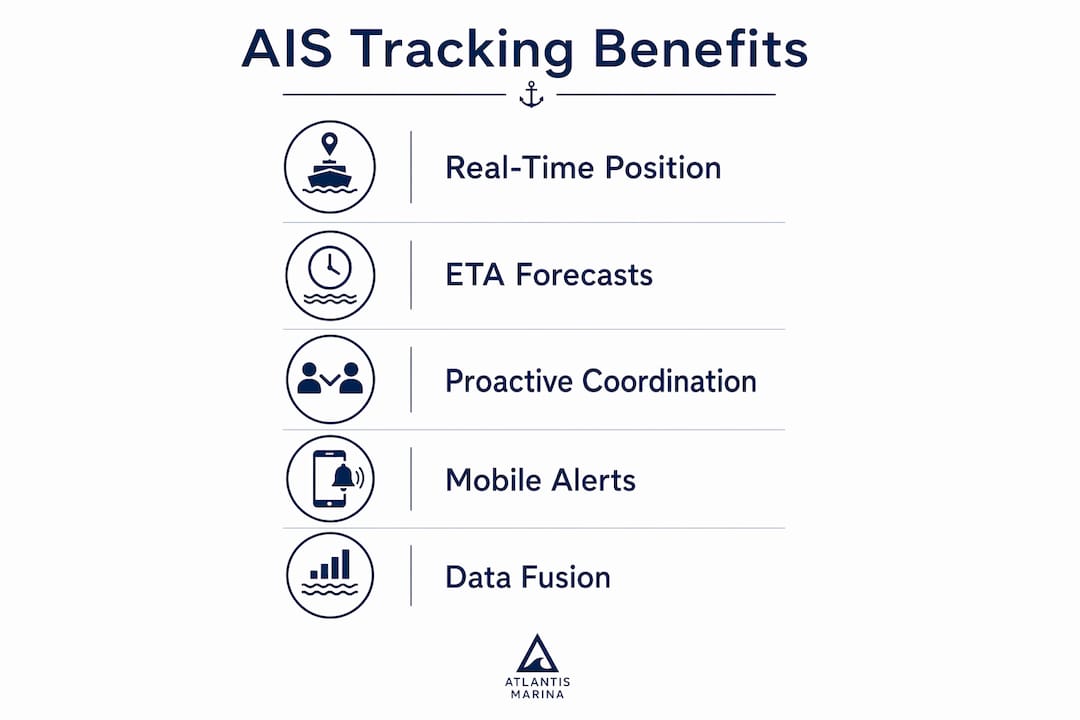
Smart alert systems that complement AIS tracking, such as mobile dockmaster notifications, close the loop between data and action. The data is only as useful as the workflow it triggers.
How does data governance affect vessel data management in luxury marinas?
Data governance in luxury marina operations is more complex than most operators anticipate. Marina systems touch personally identifiable information (PII), payment card data, and vessel movement patterns that reveal ownership details and lifestyle behaviors. Without explicit governance and monitoring, expanding data flows between systems increase attack surfaces and trigger regulatory scrutiny under PCI DSS, state breach notification laws, and privacy regulations.
The sensitive data categories that luxury marinas routinely handle include:
- PII: guest names, contact information, and identification documents
- Payment data: credit card numbers and recurring billing records subject to PCI DSS standards
- Location intelligence: vessel movement histories that reveal owner schedules and travel patterns
- Compliance documents: insurance certificates, registration records, and safety inspection results
Vessel and boater data are more sensitive than many marina operators assume because location and movement data reveal ownership and lifestyle details that high-net-worth clients expect to remain private. A breach involving a superyacht owner's movement history carries reputational consequences far beyond the regulatory fine.
Best practices for marina data governance follow a clear framework. Map every data flow between your booking system, billing platform, AIS integration, and customer portal. Apply role-based access controls so dockmaster staff see operational data while billing staff access financial records. Vet third-party vendors for their own security posture before granting API access. Invisible integrations and misconfigurations cause more vulnerabilities than the main application interface, which is why continuous monitoring matters more than a one-time security audit.
Pro Tip: Run a data flow mapping exercise before onboarding any new software integration. Document every system that touches vessel or guest data, who can access it, and under what conditions. This single exercise typically surfaces three to five governance gaps that would otherwise remain invisible.
The marina customer portal is a particularly important governance touchpoint. Guests upload insurance documents, registration certificates, and payment information through this interface. The portal must enforce encryption, access controls, and audit logging to meet both regulatory requirements and the privacy expectations of luxury clientele.
What standards support vessel information sharing across marinas?
Standardized data exchange is the mechanism that allows vessel information to move accurately between ports, marinas, and maritime authorities without manual re-entry or format translation. The Port Call Optimization (PCO) framework, developed with input from the International Association of Ports and Harbors (IAPH), establishes a minimum dataset approach that prioritizes the highest-value data fields for operational coordination.
The table below summarizes the core data categories from the PCO minimum dataset and their application in luxury marina contexts:
| Data category | PCO standard element | Luxury marina application |
|---|---|---|
| Location identification | Standardized terminal and berth IDs | Accurate slip assignment and port reporting |
| Time data | Planned arrival and departure timestamps aligned with ISO standards | ETA coordination and berth turnover planning |
| Vessel identity | IMO number, MMSI, vessel name | AIS cross-referencing and compliance verification |
| Cargo and service needs | Declared service requirements | Pre-arrival provisioning and utility setup |
A key minimum dataset includes terminal and berth identification with planned arrival and departure timestamps aligned with IMO, IHO, and ISO location and time standards. This standardization reduces the manual reconciliation work that occurs when vessels move between ports using different data formats.
The practical benefit for luxury marinas is consistency. When a yacht traveling from Monaco to Miami carries a standardized vessel record, the receiving marina can pre-populate its booking system, verify compliance documents, and assign a berth without starting from scratch. Standardizing on a minimum universal port call dataset lowers operational errors and reduces delays, which directly supports the premium arrival experience that luxury clients expect.
How does integrated vessel data management improve the guest experience?
Effective vessel data management produces measurable improvements in the guest-facing experience at every touchpoint. The connection between back-end data quality and front-end service quality is direct and consistent.
Unified vessel profiles support faster check-in because staff already have the vessel's dimensions, documentation status, and service preferences on file before the boat arrives. Accurate berth assignment reduces conflicts and last-minute moves that frustrate guests and create operational chaos. Digital portals give guests transparency into their reservation status, billing, and document submissions without requiring a phone call to the marina office. Compliance-aligned workflows mean that insurance and registration verification happens automatically rather than as a manual checklist on arrival day. Analytics drawn from historical vessel and occupancy data allow marina managers to identify peak demand periods, optimize slip pricing, and personalize service offerings for repeat guests.
The marina reservations software layer is where data quality translates most directly into guest experience. When the reservation system holds accurate vessel dimensions, berth compatibility logic runs automatically. The guest receives a confirmed slip assignment rather than a provisional one, and the dockmaster team receives a clean work order rather than a list of questions to resolve before the vessel arrives.
Key takeaways
Effective vessel data management in luxury marinas requires structured data models, normalized AIS integration, and continuous governance across every system that touches vessel or guest records.
| Point | Details |
|---|---|
| Structured data drives accuracy | Complete vessel and berth records are required for correct slip allocation and conflict-free arrivals. |
| AIS integration requires normalization | Multi-source data fusion and trajectory validation prevent false alerts and coverage gaps. |
| Governance covers the full ecosystem | Role-based access, vendor vetting, and continuous monitoring protect sensitive PII and payment data. |
| Standards reduce coordination friction | PCO minimum datasets and ISO-aligned timestamps allow accurate vessel data exchange across ports and marinas. |
| Data quality directly shapes guest experience | Unified profiles, digital portals, and analytics convert operational accuracy into premium service delivery. |
Why most marinas underestimate the data challenge
I have spent years working alongside marina operators who are genuinely committed to delivering a premium experience. The gap I see most often is not ambition. It is the assumption that vessel data management is a software problem you solve once and move on from.
The reality is that vessel records are not static. Boats get modified, insurance policies expire, and berth conditions change. The marinas that run the smoothest operations treat their vessel data schema as something that requires active maintenance, not just initial setup. They assign ownership, build update workflows, and audit records on a schedule.
The AIS integration challenge surprises almost everyone the first time. The data volume is manageable. The normalization work is not. When you fuse terrestrial and satellite feeds with different sampling rates and message formats, you need filtering logic that most off-the-shelf systems do not provide out of the box. Marinas that skip this step end up with false arrival alerts, and staff stop trusting the system within weeks.
The governance piece is the most underestimated workload of all. Most operators focus on the main application and forget that every integration, every API connection to a billing system or document portal, is another potential vulnerability. The attack surface grows with every new connection, and the regulatory exposure grows with it.
My recommendation is to start with an integration-first architecture. Map your data flows before you select your tools. Build governance into the design rather than retrofitting it after a near-miss. And adopt the PCO minimum dataset standards now, even if you are not yet exchanging data with other ports. The standards future-proof your schema and make every future integration faster and cleaner.
— John
See how Atlantis-marina handles vessel data for luxury marinas
Atlantis-marina, developed by Atlantis Control Systems, brings vessel records, berth assignments, AIS-compatible tracking workflows, and compliance documentation into a single cloud-based platform built for modern marina operations. The marina management software connects slip management, online reservations, billing, and customer communication so your team works from one authoritative data source rather than fragmented systems.
The platform's customer portal lets guests submit vessel information, upload insurance and registration documents, and manage payments before arrival, reducing check-in friction and keeping compliance records current automatically. The marina management solution also supports occupancy analytics and facility reporting, giving decision-makers the operational visibility needed to optimize berth utilization and personalize service for high-value guests. Request a demo to see how Atlantis-marina fits your facility's specific data and operational requirements.
FAQ
What is vessel data management in a marina context?
Vessel data management is the process of collecting, storing, and governing detailed records about vessels, berths, and associated documentation within a marina's operational systems. It covers vessel dimensions, compliance documents, booking history, and real-time tracking data used to support accurate slip assignment and guest services.
Why does data completeness matter for berth assignments?
Berth reservation systems cannot compute availability or compatibility accurately without complete vessel fields such as length, beam, and draft. Incomplete records lead to incorrect assignments, arrival-day conflicts, and a degraded guest experience.
How does AIS integration benefit luxury marina operations?
AIS integration gives dockmasters real-time vessel positions and ETA forecasts, enabling proactive arrival coordination. Normalized and validated AIS data streams reduce false arrival alerts and improve operational reliability across the marina.
What regulations apply to marina vessel data handling?
Luxury marinas handling payment data must comply with PCI DSS standards. State breach notification laws and privacy regulations apply to PII and location data. Expanding data flows between systems increase regulatory exposure without explicit governance controls in place.
What is the Port Call Optimization minimum dataset?
The PCO minimum dataset is a standardized set of high-value port call data fields, including berth identification and planned arrival and departure timestamps, aligned with IMO, IHO, and ISO standards. Adopting it improves coordination accuracy and reduces manual data reconciliation between ports and marinas.