

Running a yacht club involves far more financial complexity than most members realize. A proper yacht club billing system explained in full goes well beyond collecting annual dues. It covers point-of-sale charges at the bar, utility consumption at each berth, event registration fees, and recurring membership renewals, all of which need to flow accurately into a single member account. When these processes run through disconnected tools, the result is manual reconciliation, delayed invoices, and frustrated staff. This guide breaks down how modern club billing systems work, what to look for, and how to get one running correctly.
Table of Contents
Key Takeaways
| Point | Details |
|---|---|
| Billing covers more than dues | A complete system handles POS charges, utilities, events, and renewals in one unified account. |
| Integration prevents reconciliation errors | Real-time data sync across membership, POS, and utilities eliminates manual matching and billing delays. |
| Automation reduces follow-up workload | Automated dues collection stops late-payment chasing that can drag on for months without a proper system. |
| Member portals improve cash flow | Self-service payment options and advance notifications increase on-time payments and member satisfaction. |
| Implementation requires careful data mapping | Connecting POS to billing accounts correctly from day one prevents downstream errors and audit headaches. |
How a yacht club billing system actually works
The industry term for what most clubs need is integrated club management billing, though “yacht club billing system” captures the practical scope well. At its core, the system is a financial layer that sits across every revenue-generating touchpoint in your club and consolidates charges into individual member accounts.
Here is what that typically includes:
-
Membership dues: Annual or monthly fees billed on a set schedule, often with tiered pricing based on membership category (full, social, junior, corporate). Renewal notices, payment references, and due dates all need to be automated. The Gustavia Yacht Club’s 2026 renewal process uses bank transfer IBANs and specific payment reference codes to match incoming payments to the correct member account automatically.
-
Point-of-sale charges: Bar tabs, restaurant bills, fuel purchases, and ship store transactions need to post directly to a member’s account in real time rather than being manually reconciled at month’s end.
-
Utility billing: Marinas and yacht clubs with berths must meter electricity, water, and sometimes pump-out usage per slip and bill accordingly. For a facility with 80 or more berths, manually extracting meter data and matching it to berth assignments is a significant operational burden.
-
Event fees: Race entry fees, gala tickets, and sailing school registrations should flow into the same billing system so members see one consolidated statement rather than receiving separate invoices from multiple departments.
-
Club card top-ups and gift contributions: Some clubs allow members to preload a club card for on-site spending. Managing this alongside other charges requires a system that tracks balances and transactions in real time.
The convergence of these streams into a single member account is what separates a true billing system from a patchwork of spreadsheets and standalone software tools. When all five charge types live in one database, your finance team can produce accurate end-of-month statements without a single manual lookup.
Integrated vs. fragmented billing approaches
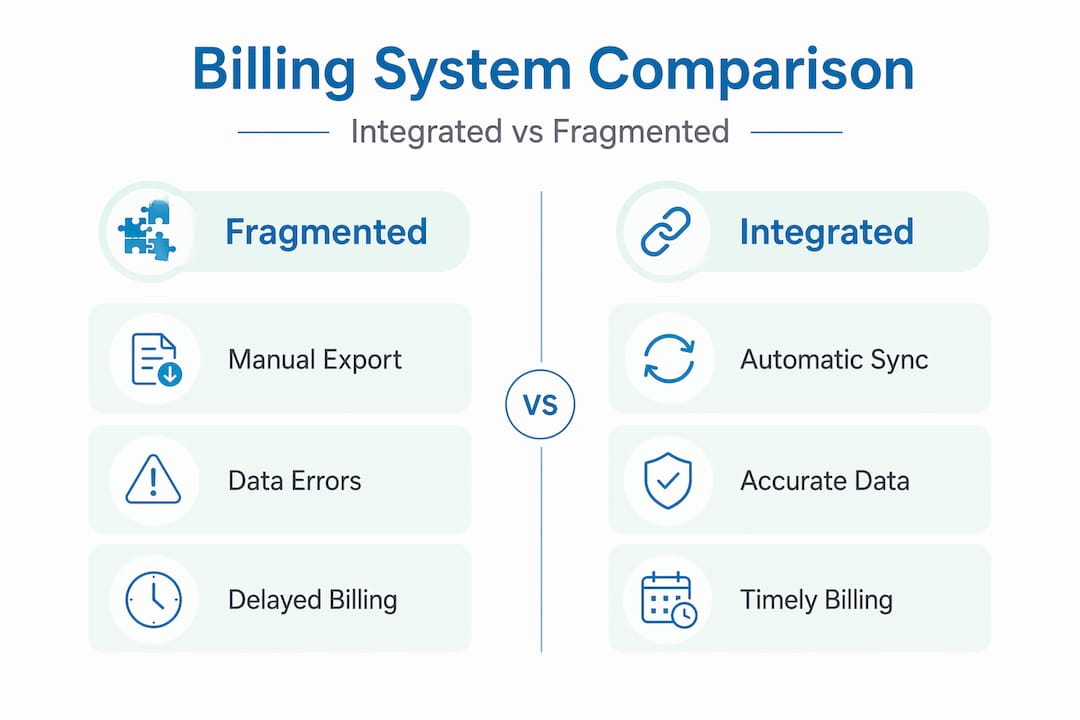
The practical difference between an integrated billing setup and a fragmented one becomes obvious at month’s end. With fragmented tools, staff export data from the POS, cross-reference it against the membership database, manually enter utility readings, and then try to reconcile everything before statements go out. Errors are common. Disputes follow.
| Factor | Fragmented approach | Integrated system |
|---|---|---|
| POS to member account | Manual export and import | Automatic real-time posting |
| Utility billing | Manual meter reads and data entry | Automated metering and charge generation |
| Dues collection | Manual invoicing and follow-up | Scheduled automated billing with reminders |
| Audit trail | Scattered across multiple systems | Single auditable ledger per member |
| Staff time at month’s end | High, error-prone | Low, exception-based review |
The Tahoe Yacht Club case illustrates what happens when a club moves from fragmented to integrated. Before switching to a centralized platform, the club was following up on January 1 dues payments as late as August of the same year. That is eight months of administrative drag on a single billing cycle. After consolidating into one system, dues collection timelines shortened dramatically and staff time shifted from chasing payments to serving members.
Pro Tip: Before evaluating any billing software, map your current revenue streams on paper. List every charge type your club generates and confirm the software you’re considering handles all of them natively, not through a third-party workaround.
Member-facing portals and payment automation
A billing system is only as effective as the payment experience it creates for members. Modern clubs are moving toward self-service portals that give members full visibility into their accounts and multiple ways to pay.
The Royal Irish Yacht Club’s member portal is a strong example. Members can pay dues, top up club cards, prepay for events, and even purchase gift options, all from a single online interface. This kind of consolidated payment portal reduces inbound calls to the office, speeds up collections, and gives members the transparency they expect from a premium club experience.

On the automation side, direct debit workflows have become a standard feature in well-run clubs. The Royal Tay Yacht Club uses GoCardless with a three-working-day advance notification sent to members before each collection. This approach does two things at once: it gives members time to flag any disputes before the payment processes, and it removes the club from holding sensitive financial data directly. The advance notification model balances the club’s cash flow needs against member protections in a way that manual invoicing never can.
Here is what a well-designed member payment portal should support:
-
Online dues payment with multiple methods (credit card, ACH, bank transfer)
-
Direct debit authorization and management
-
Real-time account balance and charge history
-
Event ticket purchase and registration
-
Club card top-up and balance tracking
-
Automated payment receipts and statements
Security is not optional in this context. Any system processing member payment data must comply with PCI DSS standards. Clubs using Stripe-based processors, for example, go through a compliance verification process that includes banking information setup and identity verification. This step is often overlooked during implementation and can delay go-live by weeks if not addressed early.
Pro Tip: Set up a test member account during implementation and run a full billing cycle through it before going live. Pay dues, post a bar charge, and verify the statement reflects both correctly. This single test catches most integration failures before they reach real members.
How to evaluate and implement a billing system
Choosing the right system requires more than reading feature lists. Here is a practical framework for yacht club managers approaching this decision.
-
Audit your current charge types. List every fee your club collects across all departments. If a system cannot handle even one of those natively, you will rebuild the manual reconciliation problem you are trying to solve.
-
Test the POS-to-billing data flow. Ask vendors to demonstrate how a bar charge posts to a member account in real time. POS charges flowing automatically to member accounts is a core requirement, not a bonus feature. If the demo requires any manual step, that step will become your staff’s problem every month.
-
Confirm utility metering integration. If your club has berths with metered power or water, verify the system can ingest meter data and generate charges automatically. This is one of the highest-labor manual tasks in marina billing and one of the easiest to automate with the right platform.
-
Assess onboarding requirements. Payment processing setup involves banking information, identity verification, and compliance checks. Platforms using processors like Stripe require this upfront. Build four to six weeks into your implementation timeline for this step alone.
-
Plan member communication before launch. Members who receive a new portal login without context will call the office. Prepare a short email explaining what is changing, what they need to do, and who to contact with questions. Send it two weeks before go-live, not the day of.
-
Train staff on exception handling, not just normal workflows. Every billing system will eventually produce a charge dispute or a failed payment. Staff need to know how to resolve these inside the system rather than reverting to spreadsheets.
One statistic worth keeping in mind: clubs that automate dues collection report significantly shorter collection cycles compared to those relying on manual invoicing. The operational drag of manual follow-up is not just a time cost. It affects cash flow, budget accuracy, and the overall financial health of the club throughout the year.
My take on billing modernization
I’ve worked with enough club administrators to know that the biggest resistance to billing system upgrades rarely comes from the technology. It comes from the belief that “our members are used to how we do things.” That argument has a shelf life, and it’s getting shorter.
What I’ve seen repeatedly is that the hidden cost of manual billing isn’t the staff hours alone. It’s the data fragmentation. When your POS lives in one system, your membership database in another, and your utilities in a spreadsheet, you don’t just have an efficiency problem. You have a visibility problem. No one in leadership has a real-time picture of the club’s financial position at any given moment.
The clubs that modernize billing first tend to see a ripple effect. Finance gets cleaner data. Management gets better reporting. Members get a better experience. And staff stop spending the last week of every month in reconciliation mode.
My advice: don’t evaluate billing software by its feature count. Evaluate it by how well it handles the transition from your current state. Ask vendors specifically about data migration, POS integration testing, and what happens when a payment fails. Those three questions will tell you more than any demo.
The goal isn’t a perfect system on day one. It’s a system that gives you control and grows with your club.
— John
See how Atlantis-marina handles club billing
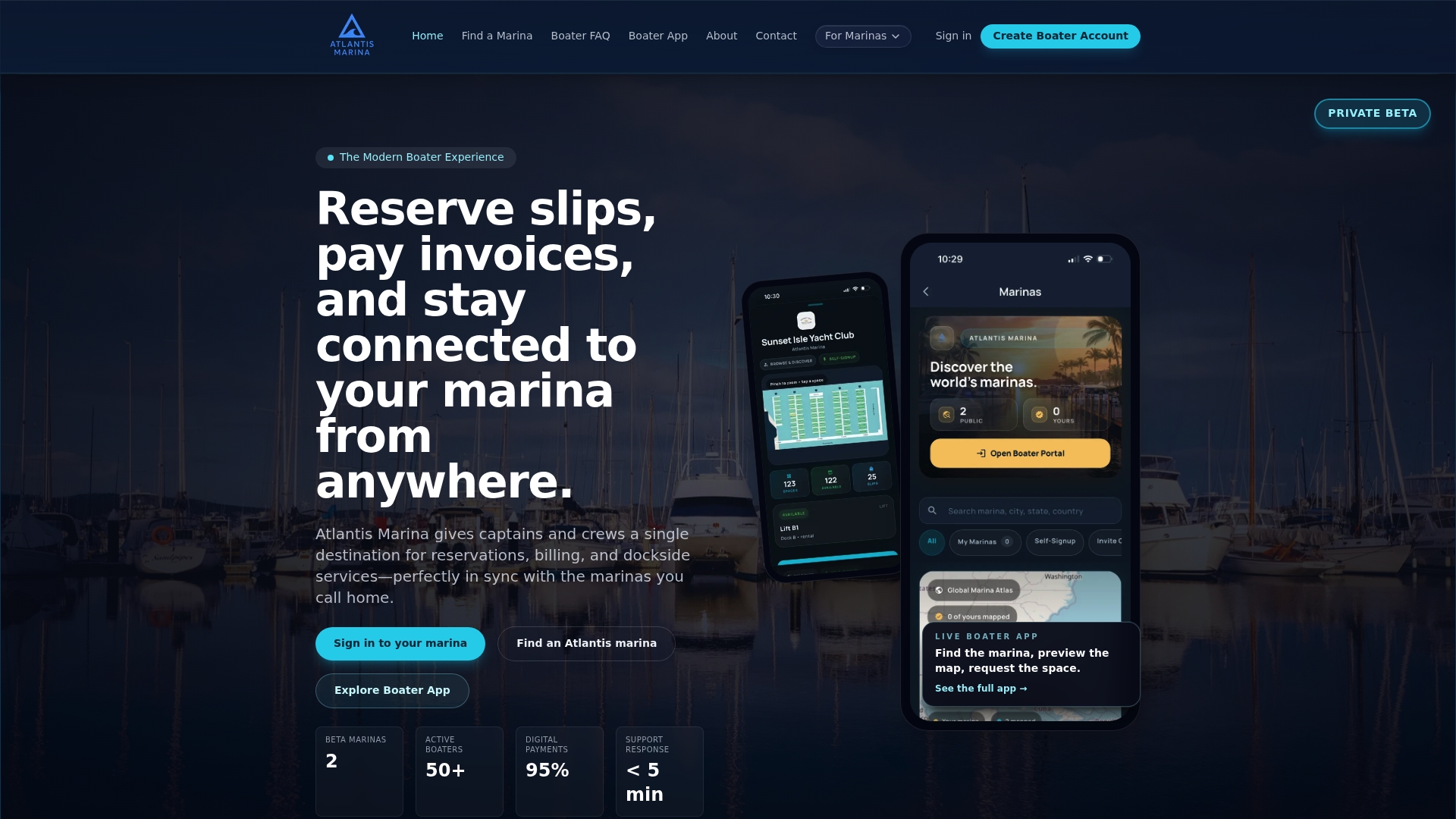
Atlantis-marina was built for exactly the operational complexity this article describes. The platform connects membership billing, POS transactions through the ship store integration, utility charges, and member account management into a single cloud-based system. There is no manual reconciliation at month’s end because the data flows in real time from every touchpoint to the member’s account.
For clubs evaluating their options, Atlantis-marina offers a boater account portal that gives members full visibility into charges, payment history, and upcoming dues. The platform is designed for marinas and yacht clubs that want to move away from fragmented workflows without rebuilding their entire operation from scratch. Reach out to the Atlantis-marina team through the marina management page to discuss your club’s specific billing setup and get a walkthrough of how the system handles your charge types.
FAQ
What does a yacht club billing system include?
A yacht club billing system covers membership dues, point-of-sale charges, utility billing, event fees, and club card management, all consolidated into individual member accounts. The best systems handle all of these natively without requiring manual reconciliation between separate tools.
How does POS integration work in club billing?
POS charges from the bar, restaurant, or ship store post automatically to the member’s account in real time, eliminating the need for manual data exports and imports at month’s end.
What is direct debit billing for yacht clubs?
Direct debit billing automatically collects dues or fees from a member’s bank account on a set schedule. Clubs like Royal Tay Yacht Club send advance notifications three working days before each collection, giving members time to review charges before funds are withdrawn.
How long does it take to implement a yacht club billing system?
Implementation typically takes four to twelve weeks depending on the complexity of your charge types, the number of members, and the time required for payment processor compliance verification and staff training.
What should managers test before going live with a new billing system?
Run a complete billing cycle through a test member account before launch. Post a POS charge, generate a dues invoice, and confirm both appear correctly on the member statement. This process catches most integration failures before they affect real members.