
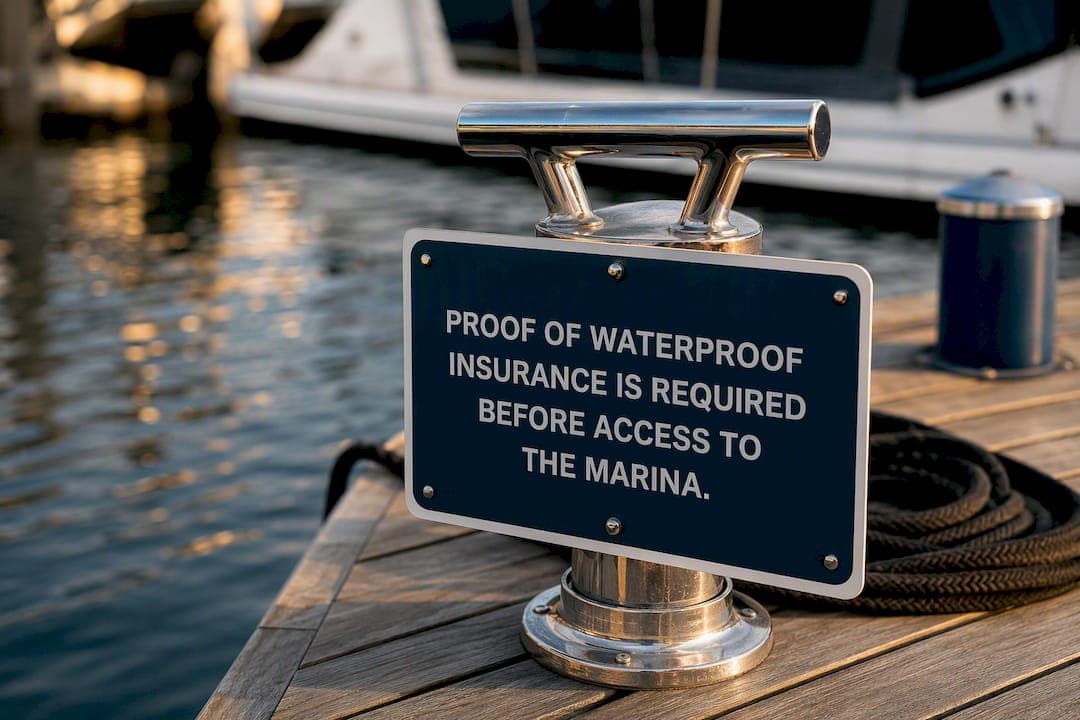
Every marina should require four things before a vessel touches a slip: liability coverage at a limit matched to the facility's risk, an additional insured endorsement naming the marina, a 30-day advance notice of cancellation, and hull coverage when the vessel carries a lien. Facilities with fuel docks or haul-out services need a pollution liability endorsement too.
The immediate action for dock staff is simple: do not release a slip, lift, or launch until a compliant certificate of insurance (COI) and endorsement are on file and verified. Start a renewal-tracking workflow the same day, because the San Francisco Recreation & Parks model insurance document and Meridian Risk Management's analysis of marina liability trends both treat ongoing verification, not a one-time check, as the standard. Atlantis Marina automates that tracking so nothing slips through during a busy season.
Minimum policy elements to require:
- General liability with a limit set to your facility's traffic and risk exposure
- Additional insured endorsement naming the marina, not just certificate holder status
- Advance notice of cancellation or material change, confirmed on the COI
- Hull/physical damage coverage when the vessel is financed
- Pollution liability endorsement where fuel sales or haul-out services exist
Key Takeaways
Enforcing boat insurance requirements comes down to three habits: setting the right minimum coverage, verifying it before granting access, and tracking renewals automatically instead of manually.
| Point | Details |
|---|---|
| Require additional insured status | Certificate-holder-only status doesn't give the marina direct defense or claim rights. |
| Enforce the 30-day notice clause | Confirm it's printed on the COI itself, not just promised by the boater. |
| Match limits to risk | High-traffic harbors and fuel-dock facilities warrant higher liability and pollution limits than standard slips. |
| Verify at every trigger point | Recheck coverage before first use, at renewal, and on any vessel or ownership change. |
| Automate renewal tracking | Digital alerts catch lapses before they become access disputes or claims gaps. |
Table of Contents
- Boat Insurance Requirements: Minimum Coverage and Endorsements to Set
- How Do You Write Insurance Clauses Into a Moorage Agreement?
- What Is the COI Verification and Recordkeeping Workflow?
- Enforcing Boat Insurance Regulations When Boaters Don't Comply
- Special Exposures That Raise Boat Insurance Requirements
- Insurance Verification Checklist for Slip Tenants
- How Atlantis Marina Automates Insurance Requirement Enforcement
- What the Research Actually Supports
- Sources
- FAQ
Boat Insurance Requirements: Minimum Coverage and Endorsements to Set
Liability limits should scale with how the slip gets used. A regional example from Chesapeake Bay marinas shows common requirements of $300,000 to $500,000 in liability for standard vessels, with larger boats often pushed to $500,000 or $1 million. High-traffic harbors and commercial-adjacent facilities are trending higher still.
Some transient boater requirements now approach multi-million dollar levels in high-risk locations, according to Meridian Risk Management, and policy wording, not just the limit number, determines whether your marina is actually covered when a claim hits.
Additional insured status matters more than most dockmasters realize. A certificate that only lists your marina as "certificate holder" gives you notice of a policy's existence, nothing more. Insurance Checker's analysis of marina insurance requirements explains that additional insured status gives the marina direct defense rights and the ability to tender a claim straight to the boater's insurer, a real difference when a slip fire or fuel spill triggers competing claims.
Coverage checklist to enforce:
- Confirm the cancellation notice clause is printed on the COI, not just promised verbally
- Require hull coverage at agreed or actual value for any financed vessel
- Add pollution liability wherever fuel docks or bottom work exist, since general liability policies routinely exclude pollution
- Confirm the policy covers navigable waters and admiralty jurisdiction, not an inland-only restriction
How Do You Write Insurance Clauses Into a Moorage Agreement?
Vague clause language is the single most common gap dockmasters inherit from old templates. A clause needs to name the marina and its affiliated entities exactly as they appear on your business license, specify the additional insured endorsement by name, state the required limits and deductibles, confirm the policy territory (including admiralty coverage), and address lender or hull financing where applicable.
Model language used by larger marina groups typically includes the right to deny access outright for noncompliance, a detail worth copying directly. Sample clauses:
- Liability clause: "Tenant shall maintain commercial general liability insurance with limits no less than [$X], naming Marina and its affiliates as additional insureds."
- Hull clause: "For financed vessels, Tenant shall maintain hull coverage at agreed value, with lienholder named as loss payee."
- Pollution clause: "Tenant engaged in fueling or haul-out activity shall maintain pollution liability coverage of no less than [$X]."
- Notice clause: "Tenant's insurer shall provide Marina no less than 30 days' written notice prior to cancellation or material change."
The two most common contract failures are accepting certificate-holder-only status instead of additional insured wording, and leaving cancellation notice as a verbal assurance rather than a printed policy term. Both gaps surface only after a claim, when it's too late to fix them.
Fix both by requiring the exact endorsement language in writing before signature, drawing from the Safe Harbor style general terms and conditions many larger marina groups already use.
What Is the COI Verification and Recordkeeping Workflow?
Collect a COI at three points: before first use, at every renewal, and whenever a vessel changes ownership or the tenant switches insurers. Marinas that only collect a certificate once, at move-in, are the ones that discover a lapsed policy after an incident, not before.
- Request the COI and endorsement page before issuing a slip assignment or access credential.
- Verify five fields: named insured matches the boater, additional insured names the marina correctly, liability limit meets your minimum, effective and expiry dates are current, and the endorsement excludes an inland-only restriction if you sit on navigable water.
- Log the certificate in a digital system rather than a paper folder, since manual tracking is where most lapses go unnoticed until renewal season arrives.
- Set an automated alert 30 days ahead of expiration, matching the same notice window insurers owe you.
- For transient boaters, require the COI before arrival confirmation, and deny dockage on-site if the document doesn't clear verification.
Pro Tip: Run a quarterly spot audit of five random slip files even if your system tracks expirations automatically. Automated alerts catch dates; they don't catch a boater who swapped insurers and forgot to update the additional insured wording.
Facilities that move from spreadsheets to digital uploads with automated reminders report catching near-term expirations before they become access disputes, which is the entire point of the workflow.
Enforcing Boat Insurance Regulations When Boaters Don't Comply
Enforcement works best when it's graduated and documented, not improvised in the moment a problem surfaces.
- First notice: written warning citing the specific missing document or expired date, with a 10 to 14 day cure period.
- Second step: suspend launch, lift, or berthing privileges until the COI clears verification.
- Final step: decline renewal at the contract's natural term if noncompliance repeats.
- Document every communication and deadline, since that record is what protects you if a dispute reaches counsel.
- Escalate to legal counsel or your own insurer only after the graduated steps fail, not as a first response.
Consistent enforcement does more than resolve one boater's paperwork gap. It protects your own facility's loss history, and insurers notice which marinas hold the line on documentation.
Special Exposures That Raise Boat Insurance Requirements
Certain operations demand different endorsement language, not just higher limits.
- Fuel docks: require pollution liability and wreck removal endorsements, since standard general liability rarely covers a spill.
- Boatyard and haul-out work: verify the contractor's own liability, workers' compensation, and auto liability before equipment touches the water.
- On-site contractors: require a COI naming your marina as additional insured before any vendor begins work, no exceptions for "just this once."
- Financed vessels: require hull coverage at agreed or actual cash value, and confirm lender notification requirements are met on the policy itself.
A facility like A & B Marina in Key West, with heavy transient traffic and active fueling operations, illustrates why pollution endorsements can't be an afterthought layered on later. The exposure exists from day one of operations.
Insurance Verification Checklist for Slip Tenants
Dock staff need one reference table during walks and renewal audits, whether printed or pulled up on a tablet.
| Field | What to Verify |
|---|---|
| Boater name & vessel description | Matches the slip assignment and registration on file |
| Insurer & policy number | Current and matches the COI, not an expired prior policy |
| Liability limit | Meets or exceeds your facility's minimum requirement |
| Additional insured status | Confirmed "Y," not certificate-holder-only |
| Effective/expiry dates | Active, with 30-day renewal alert set |
| Pollution endorsement | "Y" required for fuel dock or haul-out access |
| Lender/lienholder noted | Confirmed where the vessel is financed |
Sync these fields to your operations platform so expiry dates trigger automated alerts instead of relying on someone remembering to check a folder.
How Atlantis Marina Automates Insurance Requirement Enforcement
Atlantis Marina turns this entire workflow into automated infrastructure instead of a manual checklist someone has to remember.
- Collect COIs and endorsement documents at booking through document upload paired with Atlantis E-Sign contract signing.
- Trigger automatic 30-day renewal reminders to tenants before coverage lapses.
- Run dock walk and incident records from one operations dashboard, with QuickBooks Online sync keeping billing and compliance data connected.
- Apply the same verification rule to every tenant, removing the inconsistency that creates legal exposure.
Explore the full marina management software platform, review pricing and plans, or see how smart lift control ties access permissions to verified accounts.
What the Research Actually Supports
The conventional advice in this space treats a COI as a compliance formality, something to file and forget once it clears the mailbox. That's backward. The document is only useful the moment it's verified against five specific fields, and it becomes worthless again the day it expires unnoticed.
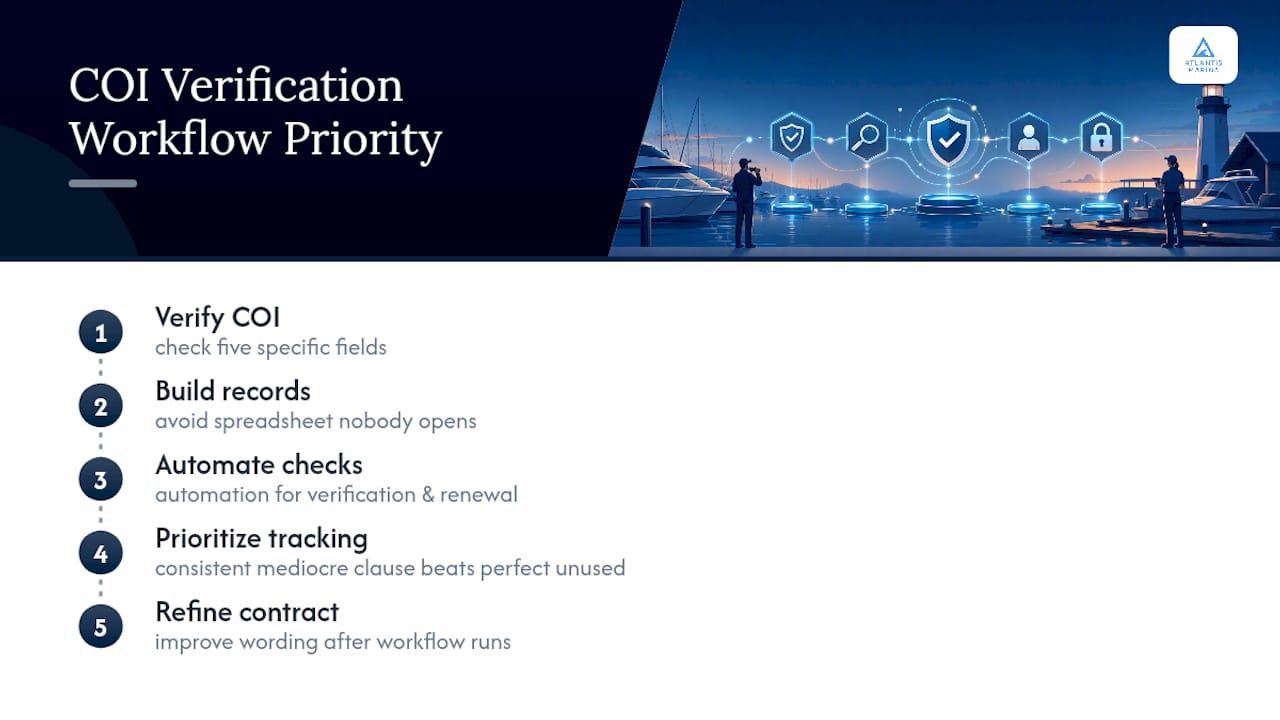
Where most marinas underinvest is recordkeeping infrastructure. Facilities spend real effort negotiating the right liability limit, then track it on a spreadsheet nobody opens until a claim forces the question. Automation isn't a luxury add-on here; it's the difference between a policy requirement that actually protects the facility and one that exists only on paper until the day it's tested.
If you do one thing after reading this, make it recordkeeping, not clause language. Even a mediocre clause enforced consistently beats a perfect clause nobody tracks. Get the verification and renewal workflow running first, then refine the contract wording around it.
— John R
Sources
- Insurance requirements (San Francisco Recreation & Parks) — model insurance requirement document
- Why marinas are raising liability requirements — Meridian Risk Management
- Why marinas require additional insured status — Insurance Checker
FAQ
What Are the Minimum Boat Insurance Requirements Marinas Should Set?
Marinas should require liability coverage matched to facility risk, an additional insured endorsement, 30-day cancellation notice, hull coverage for financed vessels, and pollution liability where fuel or haul-out services exist.
What's the Difference Between a COI and an Additional Insured Endorsement?
A COI simply proves a policy exists; the additional insured endorsement gives the marina direct defense rights and the ability to tender claims to the boater's insurer, protection certificate-holder status alone doesn't provide.
How Often Should a Marina Verify Insurance Certificates?
Verify before first use, at every policy renewal, and whenever a vessel transfers ownership or the tenant changes insurers, rather than relying on a single check at move-in.
What Happens if a Boater's Insurance Lapses?
Graduated enforcement applies: a written warning with a cure period, then suspension of launch or berthing privileges, then non-renewal if noncompliance continues.
Do Fuel Docks Need Different Insurance Requirements Than Standard Slips?
Yes. Fuel docks and haul-out facilities should require dedicated pollution liability and wreck removal endorsements, since standard general liability policies routinely exclude pollution incidents.