

What are the top boatyard management software platforms right now?
The three platforms that consistently lead the US market are Boatyard, Molo, and PierVantage, each built specifically for marine operations rather than adapted from generic business software. Atlantis Marina rounds out the field as a cloud-native platform that extends beyond traditional management into smart marina hardware and AI-assisted operations.
| Platform | Best For | Key Features | Pricing | Integration Options | User Experience | Customer Support |
|---|---|---|---|---|---|---|
| Boatyard | Boat repair shops and service-heavy boatyards | Job costing, ERP modules, inventory, work orders | Contact for pricing | QuickBooks, payment processors | Desktop and mobile access | Phone, email, onboarding |
| Molo | Marinas prioritizing booking ease and reporting | Reservations, invoicing, scheduling, analytics | Contact for pricing | Accounting and payment tools | Intuitive, clean interface | Responsive, live support |
| PierVantage | Boatyards needing deep financial and project tracking | True in-process billing, inventory control, project management | Contact for pricing | Accounting (A/R, A/P, G/L), POS | Cloud-based, accessible anywhere | Demo-led onboarding |
| Atlantis Marina | Marinas modernizing full operations with AI and smart hardware | Reservations, billing automation, AI assistant, boat lift control, dry stack, POS | Contact for pricing | QuickBooks Online, Stripe, ACH | Mobile-ready, QR workflows | Full onboarding, ongoing support |
All four platforms cover the core functions: booking and scheduling, invoicing, maintenance tracking, and reporting. The differences show up in depth of financial tools, hardware integration, and how much the interface gets out of your staff's way.
How do these platforms compare in depth?
Boatyard: built for service-first operations
Boatyard targets boatyards and marine repair shops where job management is the center of the operation. Its ERP modules handle inventory, job costing, and accounting integrations, which makes it a practical fit for operators who need to track labor hours, parts costs, and profit per job in one place. Mobile tools for scheduling, invoicing, and photo documentation keep technicians connected without returning to a desk. The platform connects with QuickBooks and common payment processors, so financial data flows without manual re-entry.

Molo: where booking meets reporting
Molo's reputation rests on an interface that marina staff actually want to use. Reservations, invoicing, and scheduling work together without requiring technical training, and the reporting tools give operators a clear picture of occupancy, revenue, and customer activity. For marinas where the front-desk experience matters as much as back-office accuracy, Molo's design philosophy pays off quickly.
PierVantage: financial depth for complex boatyards
PierVantage was built specifically for boatyards that need more than basic job tracking. Its true in-process billing captures revenue as work progresses rather than waiting for job completion, which improves cash flow visibility on long-haul projects. Inventory carrying cost analysis and job estimation accuracy are areas where PierVantage delivers measurable operational gains. The platform is fully cloud-based, so data stays secure and accessible even during weather events or equipment failures.
Pro Tip: Ask any vendor for a live demo using your own operational scenario, not a scripted walkthrough. How the software handles your specific workflow tells you more than any feature list.
Pricing across all three platforms is available on request. Transparent pricing and responsive demos are among the clearest trust signals when evaluating a vendor, so treat a vendor's willingness to share specifics early as meaningful data.
Key capabilities to verify during any demo:
- Work order creation and status tracking from mobile devices
- QuickBooks or accounting software sync without manual export
- Customer portal access for document uploads and payment
- Real-time reporting on occupancy, revenue, and job status
- Role-based access controls for staff with different responsibilities
What core features should every boatyard management platform include?
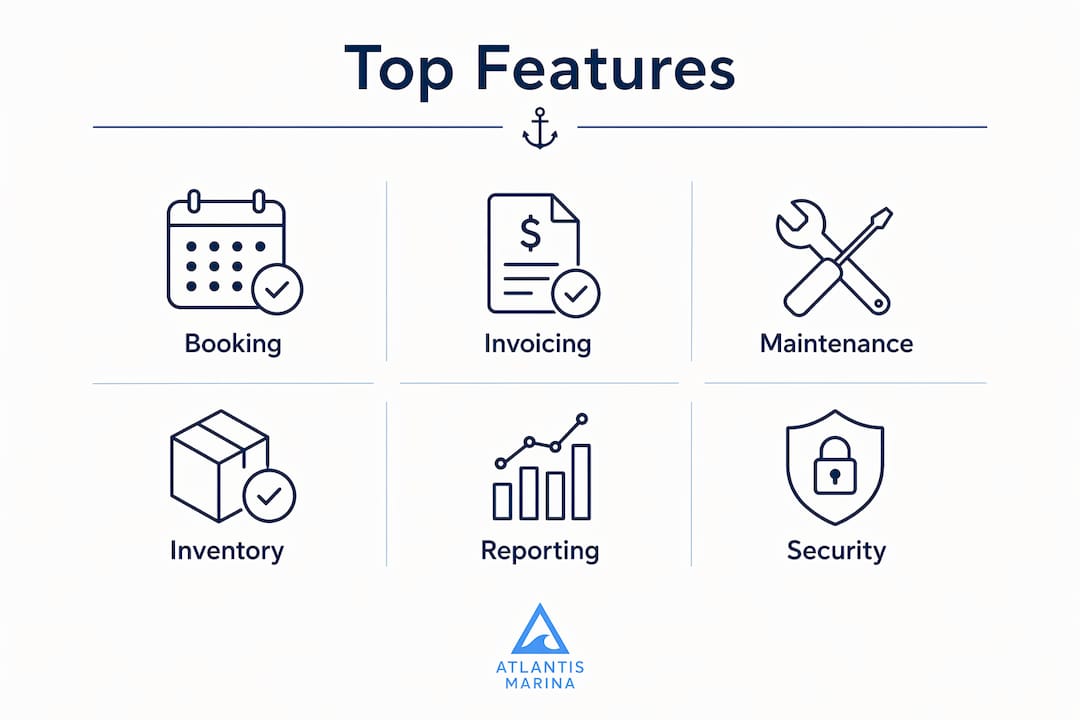
The baseline for any credible marine operations platform covers six functional areas. A gap in any one of them forces operators back to spreadsheets or paper for that piece of the workflow.
Booking and scheduling. The system should handle transient reservations, seasonal contracts, and waitlists from a single calendar view. Integrated marina management coordinates slip assignments, dry stack queues, and service appointments without double-booking.
Invoicing and billing. Automated billing tied directly to reservations and work orders eliminates the manual step between service delivery and payment collection. QuickBooks Online sync and payment processor compatibility are standard expectations for any platform in 2026, as covered in detail for marina accounting integrations.
Maintenance and repair tracking. Work orders should capture labor, parts, and time against each vessel record. Photo documentation and status updates keep customers informed without phone calls.
Inventory control. Ship store POS and parts inventory tied to work orders prevent the carrying cost problem that erodes margins on service operations.
Reporting and analytics. Real-time dashboards that surface occupancy rates, revenue by slip type, and job profitability give operators the data to make decisions rather than react to problems.
Security and cloud backup. Cloud hosting means data survives hardware failures, storms, and power outages. Role-based permissions protect sensitive financial and customer records.
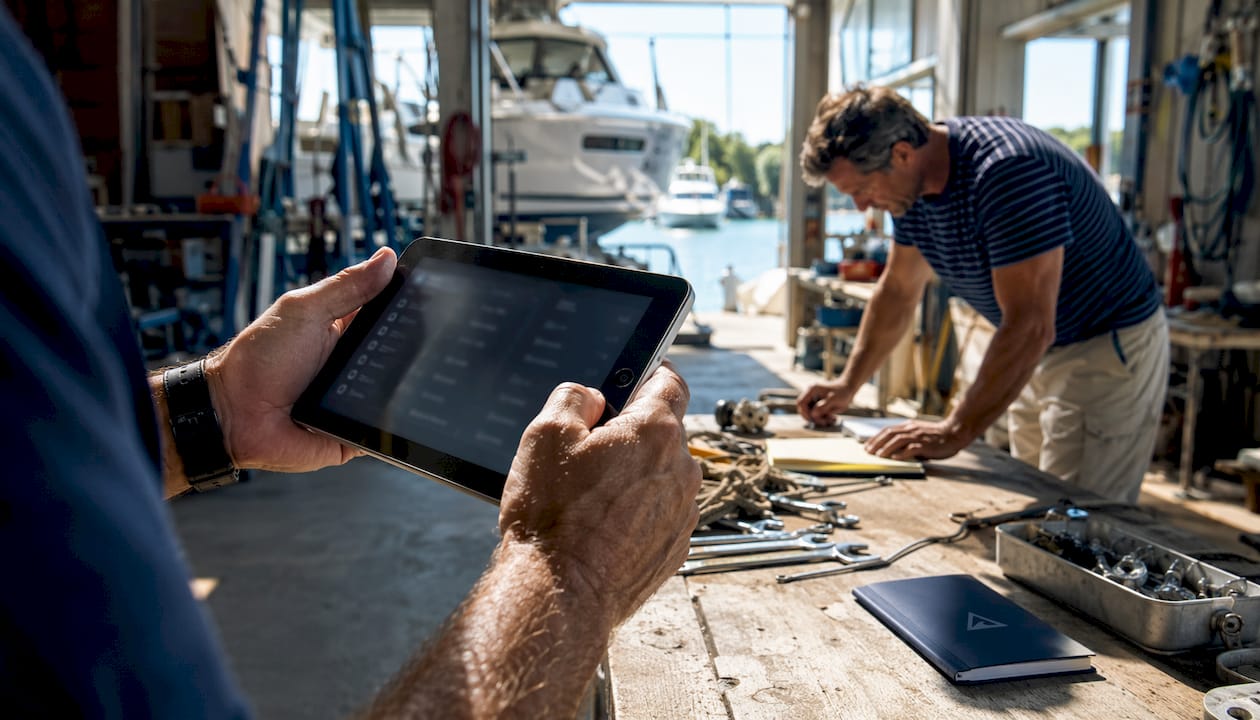
Mobile access ties all of this together. Staff using tablets or phones for job tracking, check-ins, and invoicing move faster and make fewer errors than staff returning to a fixed terminal for every update.
What do integrated platforms do that basic software cannot?
The real value of a fully integrated marine management platform shows up in the connection between departments. When inventory, billing, job costing, and customer records share a single database, the marina office stops being a data entry bottleneck and starts functioning as an operational hub. PierVantage frames this directly: integrated software increases profitability by reducing inventory carrying costs and improving job estimation accuracy, two metrics that compound over a full season.
Implementation is where most transitions stall. Moving from paper logs or legacy software to a cloud platform requires a clean data migration strategy. Fragmented legacy data introduced into a new system without validation creates errors that undermine staff trust in the platform from day one. Best practices for data migration emphasize mapping existing records, cleaning duplicates, and running parallel systems briefly before full cutover.
The trend shaping marine operations software in 2026 is AI-assisted workflows. Built-in AI assistants that answer boater questions, flag billing exceptions, and surface reorder alerts reduce the cognitive load on dockmaster staff during peak season. Combined with automation for contract signing, autopay, and SMS notifications, these tools shift staff time from administrative tasks to customer-facing work.
How do you choose the right boatyard management software?
Start with operational scope. A single-location repair shop has different needs than a multi-property marina group with dry stack, wet slips, and a ship store. The software that fits one may be overbuilt or underbuilt for the other.
Criteria to evaluate before committing:
- Operational fit. Does the platform cover your specific mix of wet slips, dry storage, service bays, and retail?
- Integration depth. Confirm that QuickBooks sync, payment processing, and any existing tools connect without custom development.
- Scalability. Can the platform add properties, users, or modules as the business grows without a full re-implementation?
- Demo and trial access. Vendors who offer live demos or trial periods give you real evidence of usability before purchase.
- Staff adoption. Involve the dockmaster and front-desk staff in the evaluation. A platform they find confusing will not deliver its promised efficiency gains.
- Vendor track record. Review client testimonials, ask for references from operations similar to yours, and check the vendor's product roadmap for evidence of ongoing development.
- Data migration support. Ask specifically how the vendor handles legacy data transfer and what validation steps they include.
The role of software integrations in 2026 extends beyond accounting. Payment processors, CRM tools, and hardware connections all reduce manual workload when they share data with the core platform. A marina that has to re-enter the same customer record in three systems has not actually modernized its operations.
Atlantis Marina offers a different path to modern waterfront operations
Running a marina in 2026 means managing more moving parts than any spreadsheet can handle. Boatyard, Molo, and PierVantage each solve specific operational problems well. Atlantis Marina takes a different approach: one cloud platform that connects marina management software, automated billing, AI assistance, and smart marine hardware under a single operating system.
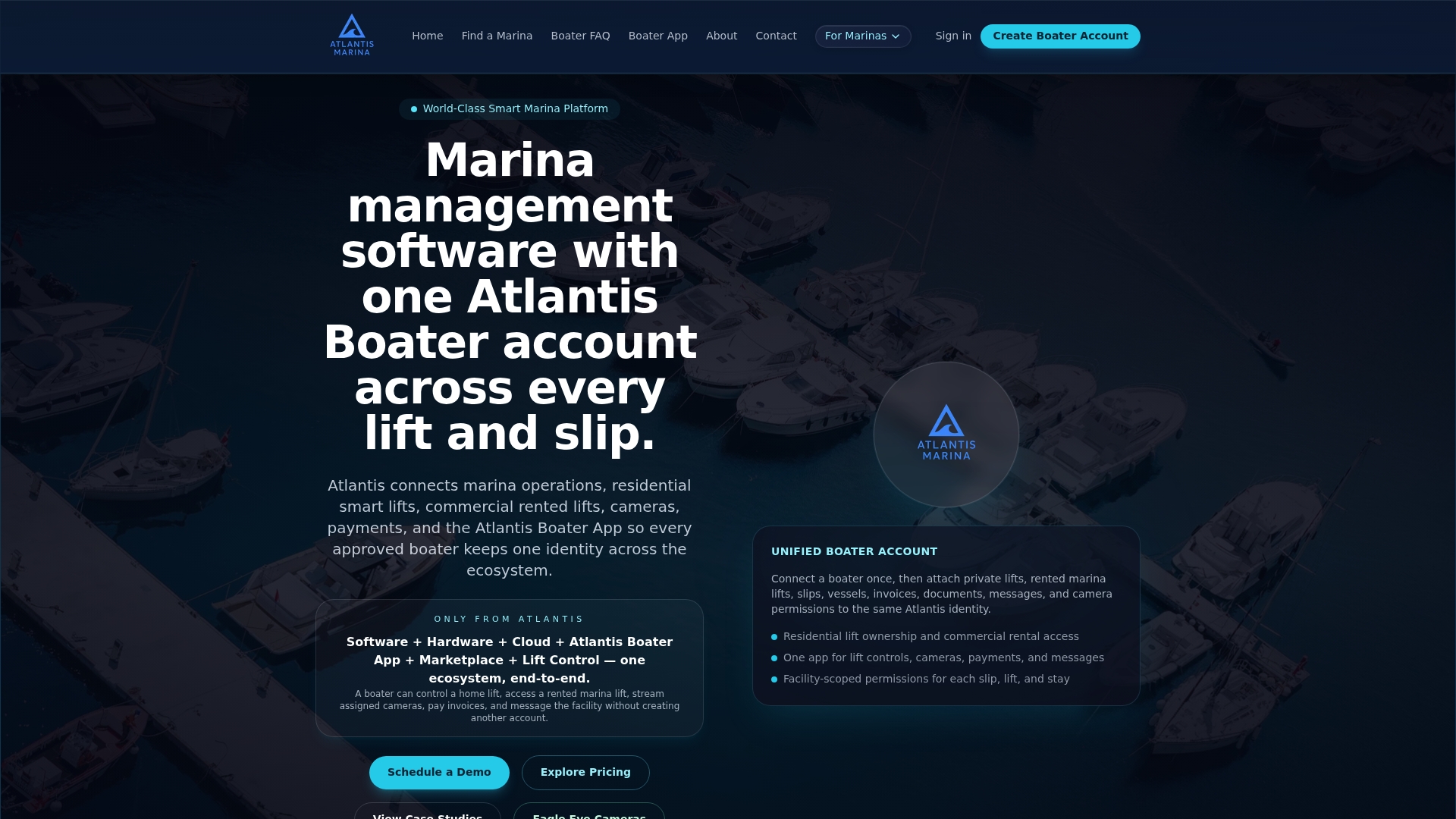
Where traditional platforms stop at software, Atlantis Marina extends into smart boat lift controllers, remote monitoring, sensor integrations, and QR-code workflows that connect every in-person interaction to the right customer account instantly. Automated billing through Stripe, ACH, and QuickBooks Online sync means revenue gets collected and recorded without manual entry. The Atlantis Bot AI assistant handles boater questions on your marina website and helps staff manage daily tasks with confirmed actions, not guesswork. For marinas ready to move beyond fragmented tools, the full platform overview shows how these capabilities work together across reservations, dry stack, service, and retail.
FAQ
What is boatyard management software?
Boatyard management software is a platform that centralizes reservations, invoicing, work orders, inventory, and reporting for marina and boatyard operations, replacing paper logs and disconnected spreadsheets with one connected system.
Which boatyard management software is best for repair-focused operations?
Boatyard and PierVantage both serve repair-heavy operations well. Boatyard excels at job costing and ERP workflows, while PierVantage adds true in-process billing and deep inventory cost analysis for larger boatyards.
Does boatyard management software integrate with QuickBooks?
Most leading platforms, including PierVantage and Atlantis Marina, offer QuickBooks integration. Atlantis Marina syncs with QuickBooks Online directly, keeping billing and accounting records aligned without manual export.
How long does it take to implement new marina management software?
Implementation timelines vary by operation size and data complexity. A clean data migration strategy and early staff involvement are the two factors that most reliably shorten the transition and prevent errors from legacy records.
Can boatyard software handle both wet slips and dry stack operations?
Yes. Platforms like Atlantis Marina manage wet slip assignments, dry stack queues, and launch scheduling from a single dashboard, making them practical for mixed-use facilities.
Key Takeaways
The right boatyard management software unifies reservations, billing, maintenance tracking, and reporting in one platform, eliminating the manual gaps that cost marinas time and revenue every season.
| Point | Details |
|---|---|
| Match software to operational scope | A repair-focused boatyard needs job costing and in-process billing; a full-service marina needs slip management, dry stack, and retail POS. |
| Integration depth determines real efficiency | QuickBooks sync, payment processing, and hardware connections must work without custom development to deliver actual time savings. |
| Data migration requires a plan | Cleaning legacy records before cutover prevents errors that erode staff trust in the new platform from day one. |
| AI and automation are now standard expectations | Built-in AI assistants, autopay, and automated notifications shift staff time from data entry to customer service. |
| Atlantis Marina covers the full waterfront | From slip reservations and automated billing to smart boat lift control and AI assistance, Atlantis Marina unifies operations beyond traditional management software. |