

Marina software integration is defined as the unification of multiple management systems, including billing, reservations, document tracking, hardware control, and customer records, into a single connected platform. The role of marina software integrations goes far beyond convenience. Operators who run unified systems report fewer billing errors, faster staff workflows, and measurably better customer experiences compared to those relying on disconnected tools. A modern marina management solution replaces spreadsheets, fragmented inboxes, and manual reconciliation with one operating system that keeps every department aligned in real time.
What is the role of marina software integrations in daily operations?
Marina software integration, often called Marina ERP (Enterprise Resource Planning) in the industry, connects every operational function under one shared database. The practical result is that data entered once flows automatically to billing, compliance tracking, and customer records without any manual re-entry.
Switching to a unified Marina ERP can reduce administrative billing time by 30–50% and eliminates errors caused by double-entry between CRM and accounting systems. That time savings translates directly into fewer staff hours spent on reconciliation and more time spent serving boaters.
The operational benefits extend across every department:
- Slip and reservation management: Availability updates in real time across all channels, so staff and boaters always see accurate occupancy.
- Billing automation: Charges for slips, fuel, utilities, and services generate automatically based on usage data, not manual entry.
- Document compliance: Integrated document management tracks insurance and registration expirations, then notifies boaters automatically before deadlines pass.
- Service workflows: Work orders connect to vessel records and billing, so completed jobs post to the correct account without a second step.
- Payments: Payment integrations collect and reconcile revenue from slips, the ship store, and fuel in one ledger.
Modern Marina ERP platforms integrate slip assignments, fuel billing, utility billing, service work orders, inventory, and the general ledger into one system. That level of coverage means operators get a complete financial picture without pulling data from five different apps.
Pro Tip: Audit your current tech stack before selecting a platform. Count every tool your team logs into daily. If the number exceeds three, you are likely carrying hidden reconciliation overhead that a unified system would eliminate.
How does smart hardware connect to marina software?
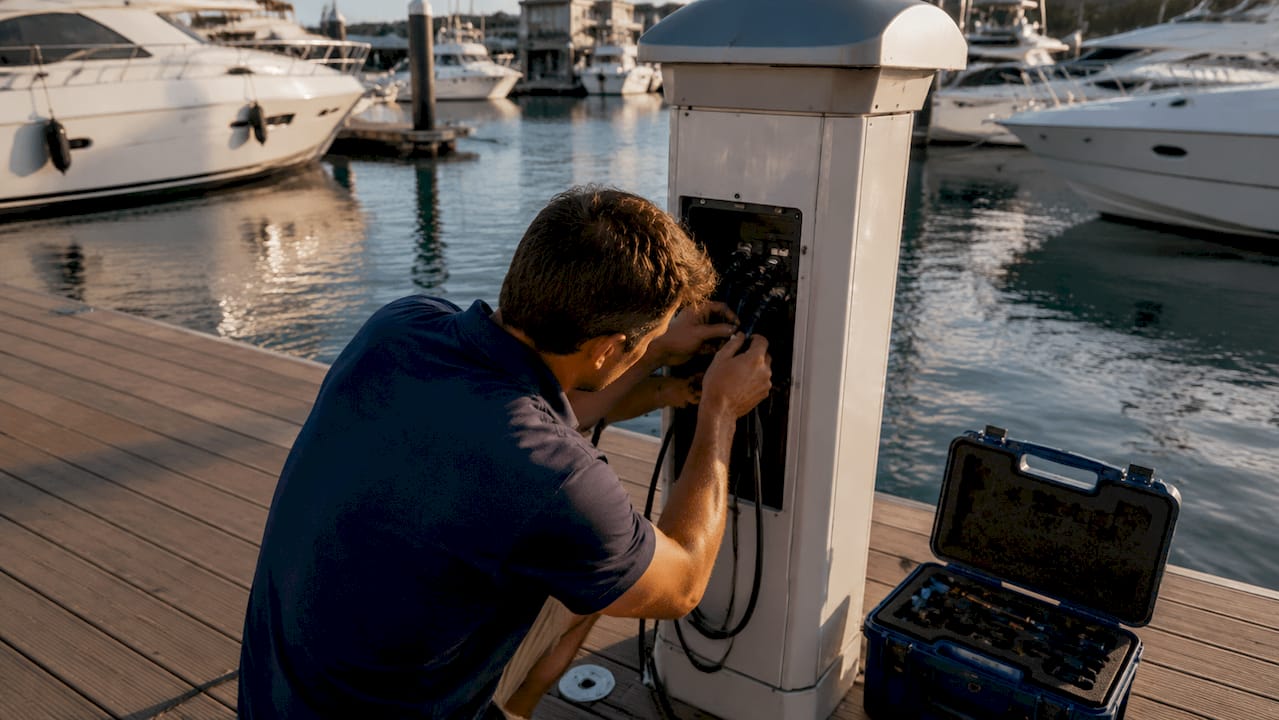
Smart marina hardware integration, sometimes called connected marina hardware integration, refers to physical devices at the dock that send data directly into the management platform. The most impactful example is the IoT-enabled power pedestal.
IoT-connected power pedestals automatically capture utility usage and submit it to the billing system, capturing 100% of billable consumption and virtually eliminating revenue leakage. Before this technology, marinas routinely lost revenue to unmetered or manually estimated utility charges.
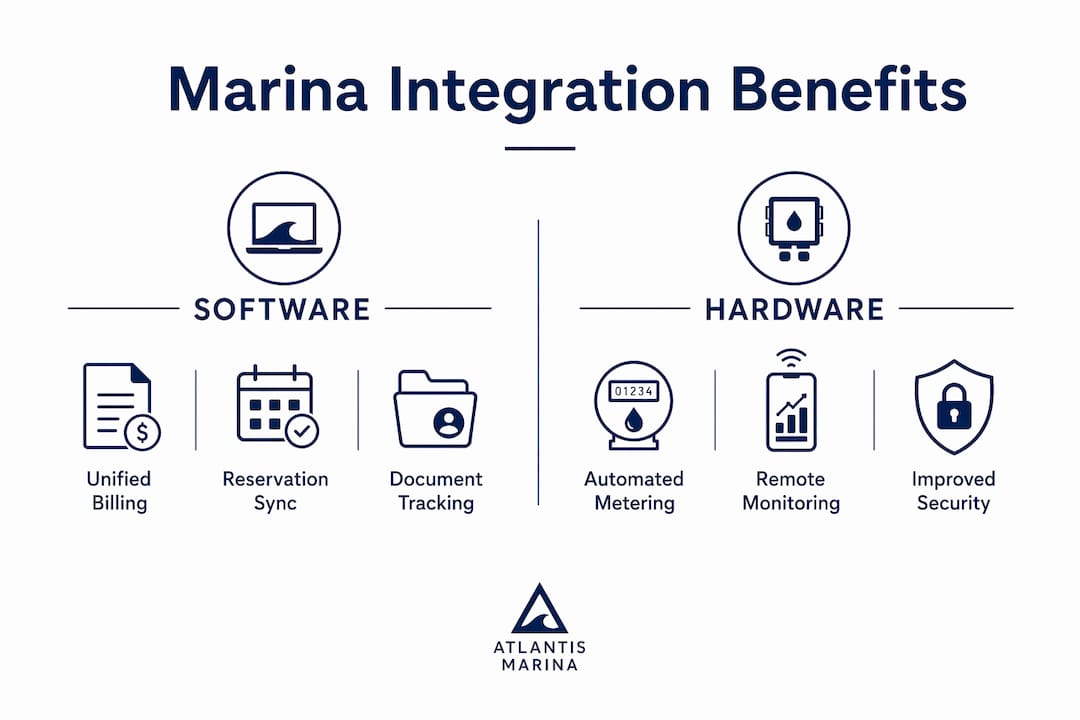
The table below shows the most common smart marina hardware integration types and their direct operational benefits.
| Hardware Type | Integration Function | Key Benefit |
|---|---|---|
| IoT power pedestals | Automated meter-to-cash billing | Captures 100% of utility revenue |
| Access control systems | Gate and dock access tied to reservations | Reduces unauthorized entry |
| Security cameras | Live feed and recording linked to vessel records | Improves incident documentation |
| Boat lift controllers | Remote operation and status monitoring | Reduces staff dispatch trips |
| Environmental sensors | Water level, weather, and fuel tank monitoring | Supports proactive maintenance |
Reliable hardware integration depends on the right connectivity infrastructure. Wi-Fi alone often fails to support large marina IoT deployments because of the challenging RF environment near water, metal hulls, and dense dock structures. LoRaWAN or mesh networking provides the coverage and reliability that marine environments demand.
Phased smart marina adoption is the proven approach for operators who want to scale without disruption. Start with utility monitoring and access control, which deliver the fastest return. Then add cameras, sensors, and lift controllers as the network infrastructure matures.
Pro Tip: When evaluating smart marina hardware, ask vendors whether their devices support open communication standards such as OCPP or OPC UA. Open standards prevent vendor lock-in and make future hardware additions far less expensive.
Atlantis Marina supports smart boat lift controllers, remote monitoring, AUX device control, sensor integrations, and camera integrations within a single platform. That native connection between software and hardware is what separates a true smart marina platform from a basic management tool.
What are the most common pitfalls in marina software integrations?
The most frequent mistake marina operators make is treating integration as a one-time project rather than an ongoing design constraint. Fragmented apps that sync through APIs create what the industry calls "integration debt," a hidden operational cost that compounds over time.
Integration debt is the accumulated overhead of manual reconciliation between multiple unsynchronized software tools, and it wastes 10–20% of admin time. That figure surprises most operators because the cost is invisible until someone measures it directly.
Common pitfalls and how to address them:
- Fragmented customer records: When boater data lives in separate billing, reservation, and CRM tools, staff waste time searching for the right record. A unified boater database eliminates this by maintaining one source of truth.
- API sync lag: API-based connections between apps introduce delays and occasional errors. A shared database platform removes the sync step entirely.
- Wireless dead zones: Marinas that deploy IoT hardware without first auditing their wireless coverage discover that devices drop offline in areas with poor signal. LoRaWAN or mesh networks solve this before it becomes a problem.
- Unsecured customer data: Customer data privacy must be a design constraint from the start. Fragmented systems create multiple points of exposure that a single secure platform avoids.
- Skipping document automation: Marinas that track insurance and registration manually face compliance gaps. Automated expiration alerts reduce legal exposure without adding staff workload.
The underlying pattern across all these pitfalls is the same. Operators add tools to solve individual problems without considering how those tools share data. The result is a system that looks connected on the surface but breaks down at every handoff point.
Best practices for selecting and implementing marina software integrations
The single most important selection criterion is whether the platform uses a native unified database or relies on API connections to third-party tools. A unified platform with a shared database is the gold standard for accuracy and operational transparency. API syncing is a compromise, not a solution.
Operators evaluating marina management systems should apply these practices:
- Prioritize native integration: Choose a platform where billing, reservations, documents, and hardware control share one database. Avoid platforms that require middleware to connect their own modules.
- Verify open standards support: Confirm that the platform and its hardware partners support recognized protocols. This protects your investment as technology evolves.
- Plan for multi-property scale: If you operate or plan to operate more than one location, confirm the platform supports multi-marina management from a single login.
- Implement in phases: Start with the modules that address your highest-cost pain points, typically billing and reservations, then add hardware integrations and advanced features.
- Evaluate the operations dashboard: The dashboard is where staff spend most of their time. A well-designed dashboard surfaces occupancy, billing status, and compliance alerts without requiring staff to navigate multiple screens.
Pro Tip: Before signing any contract, ask the vendor to walk you through a complete data flow: a boater reserves a slip, checks in, uses shore power, and pays. If any step in that flow requires manual entry or a separate login, you have found a gap that will cost you time every single day.
Automated alerts for expiring vessel documents are a concrete example of how a well-integrated system reduces operational and legal risk without adding staff workload. That kind of automation is only possible when document management, customer records, and notification systems share the same platform.
The customer portal is another integration point that operators often underestimate. When boaters can upload documents, make payments, and review reservations through a self-service portal, staff handle fewer inbound requests and compliance gaps close automatically.
Key Takeaways
A unified marina platform with a shared database is the most effective foundation for accurate billing, compliance, and customer service across all marina operations.
| Point | Details |
|---|---|
| Unified database beats API syncing | A shared database eliminates sync lag and double-entry errors that API connections introduce. |
| IoT hardware captures lost revenue | Connected power pedestals automate meter-to-cash billing and recover utility revenue that manual tracking misses. |
| Integration debt is a real cost | Disconnected tools waste 10–20% of admin time on manual reconciliation that a unified system eliminates. |
| Phased hardware adoption reduces risk | Start with utility monitoring and access control, then expand to cameras and sensors as infrastructure matures. |
| Open standards prevent lock-in | Hardware and software that support protocols like OCPP or OPC UA protect your investment as technology changes. |
Why integration depth matters more than feature count
After years of working with marina operators across different facility sizes, the pattern is consistent. Operators who evaluate software by counting features end up disappointed. Operators who evaluate software by tracing data flows end up satisfied.
The reason is straightforward. A platform with 40 features that do not share data is operationally worse than a platform with 20 features that do. Every gap between modules is a place where staff must intervene manually, and manual intervention is where errors, delays, and revenue leakage originate.
The shift toward smart marina hardware integration makes this even more consequential. When a power pedestal, a gate controller, and a billing system all need to agree on what happened at slip 14 last Tuesday, the only reliable architecture is a shared database. API connections between those three systems will eventually disagree, and staff will spend time figuring out which one is right.
The future of marina operations points clearly toward AI-assisted workflows, as outlined in AI marina operations use cases for 2026. AI tools that surface occupancy predictions, flag compliance gaps, and automate pricing adjustments only work when they have access to clean, unified data. Fragmented systems produce fragmented data, and AI cannot fix that upstream problem.
My honest recommendation: treat integration architecture as the first decision, not the last. Choose the platform whose data model you trust, then build your hardware and workflow stack on top of it.
— John R
Atlantis Marina's unified platform for connected operations
Atlantis Marina brings together slip management, billing, document tracking, reservations, customer records, and smart hardware control in one cloud-based system built for marina operators who need everything to work together without manual workarounds.
The platform supports IoT hardware connections, QR-code-based check-in workflows, automated billing for utilities and slips, and a mobile-friendly boater portal that reduces staff workload on routine requests. Whether you operate a single dock or a multi-property group, Atlantis Marina gives your team a single operating system instead of a stack of disconnected tools. Visit the Atlantis Marina platform to see how the integrated system fits your facility's needs.
FAQ
What is marina software integration?
Marina software integration is the connection of billing, reservations, document management, hardware control, and customer records into one unified platform. A shared database model provides the highest accuracy and eliminates the errors that API-based syncing between separate tools introduces.
How do IoT power pedestals integrate with marina billing?
IoT-connected power pedestals automatically capture utility usage and send that data directly to the billing system, capturing 100% of billable consumption without manual meter reading or data entry.
What is integration debt in marina management?
Integration debt is the hidden administrative cost of running multiple unsynchronized software tools. Manual reconciliation between disconnected systems wastes 10–20% of admin time and creates ongoing billing and compliance errors.
What connectivity infrastructure does smart marina hardware require?
Large marina IoT deployments require LoRaWAN or mesh networking rather than standard Wi-Fi. Marine environments present RF challenges from metal hulls and dock structures that standard wireless networks cannot reliably overcome.
How should marina operators start implementing software integrations?
Operators should begin with a unified platform that covers billing, reservations, and document management, then add hardware integrations in phases. Starting with utility monitoring and access control delivers the fastest return and builds the infrastructure foundation for additional smart devices.