

Marina vessel registration tracking is the ongoing process of monitoring a vessel's registration numbers, certificate status, and renewal deadlines to maintain legal compliance and operational readiness. For marina operators and vessel owners, this means knowing exactly which documents are current, which are approaching expiry, and which jurisdictional requirements apply to each vessel in your fleet or facility. Systems like Transport Canada's Vessel Registration Query System, the Philippines' MARINA-BEST blockchain platform, and Service NSW's online status checker represent the range of tools now available to support this process. Getting it right protects vessels from inspection failures, port detentions, and liability exposure.
What is marina vessel registration tracking and why it matters
Marina vessel registration tracking is defined as the continuous management of a vessel's official identifiers, compliance certificates, and registration renewal cycles across one or more jurisdictions. The industry term for the broader practice is vessel compliance management, and the two phrases are used together throughout this guide to reflect both the SEO context and standard maritime terminology.
Legal compliance status for a vessel is reported as current, expired, or cancelled, and each status carries distinct operational and legal consequences. An expired registration does not just create a paperwork problem. It can ground a vessel, void insurance coverage, and expose the operator to fines. Tracking is the mechanism that prevents those outcomes by converting reactive scrambling into proactive scheduling.

The core value of tracking is not just record-keeping. It is the ability to act before a deadline passes rather than after an inspector flags a lapse. For marina operators managing dozens or hundreds of vessels, that distinction is the difference between smooth operations and costly disruptions.
What records and identifiers are essential in vessel registration tracking
Effective vessel compliance management starts with the right identifiers. Every lookup, audit, and renewal action depends on having accurate, correctly formatted registration data on file.
The primary identifiers you need to track include:
- Registration number: The state or national number assigned at registration. In Canada, small vessel numbers begin with the prefix "C," while large vessels carry a six-digit Official Number prefixed by "O.N."
- Hull Identification Number (HIN): A standardized 12-character code permanently affixed to the vessel, used for ownership history and theft checks.
- Certificate of Registry: The primary legal document proving nationality and ownership, required for international voyages and flag state compliance.
- Safety certificates: Depending on vessel class and route, these include Load Line Certificates, Safety Equipment Certificates, and SOLAS compliance records.
- Insurance documentation: Many marinas require proof of current liability coverage as a condition of berth assignment.
- Expiry and renewal dates: Each document carries its own renewal cycle, and tracking these independently is the most common point of failure for operators relying on manual systems.
Incorrectly formatted identifiers cause silent failures in automated tracking systems. A registration number entered with spaces or dots instead of the required format will return no results in a query system, and an expiry reminder tied to that record will never fire. Identifier validation before data entry is a non-negotiable first step.
Pro Tip: Store the exact format required by each jurisdiction's query system alongside the identifier itself. For Service NSW, that means no spaces or dots in the registration number field. For Transport Canada, it means knowing whether you are working with a "C" prefix or an "O.N." prefix before you run any lookup.
How do registration tracking processes vary by jurisdiction?
Registration workflows differ significantly across countries, and tracking systems must reflect those differences. A one-size approach fails the moment a vessel crosses a flag state boundary.
| Jurisdiction | System / Authority | Key tracking requirement | Status outputs |
|---|---|---|---|
| Canada | Transport Canada Vessel Registration Query System | Lookup by official number, vessel name, or owner; transcript requests for history | Active, cancelled, historical |
| Netherlands | ILT (Inspectie Leefomgeving en Transport) | Sequential registration in property register, then flag register | Pre-approval vs. final Certificate of Registry |
| New South Wales, Australia | Service NSW online vessel check | Registration number input returns current legal status | Current, expired, cancelled |
| Philippines | MARINA (Maritime Industry Authority) via MARINA-BEST | Online blockchain submission with real-time tracking | Submitted, under review, registered |
The Netherlands example is particularly instructive. The ILT requires vessels to complete property registration before flag registration, and vessels without final flag registration cannot legally fly the Dutch flag. This means tracking must distinguish between a vessel that has cleared the property register and one that has received its Certificate of Registry. Treating both as "registered" is an operational error with real legal consequences.
The Philippines' MARINA-BEST system takes a different approach. Owners submit notarized builder certificates, affidavits, and identification copies through a blockchain-enabled platform, and the system tracks each document's status in real time. Noncompliance excludes vessels from registration entirely. This model demonstrates how digitizing registration workflows increases transparency and reduces the delays that plague paper-based processes.
Canada's Transport Canada system allows historical transcript lookups, which is valuable for vessels with ownership changes or disputed registration histories. Knowing how to request a transcript, not just a current status check, is a skill that marina operators handling transient vessels should build into their intake process.
What technologies support effective vessel registration tracking?
Modern vessel compliance management relies on a layered set of digital tools, from government query portals to private maritime intelligence networks to integrated marina management platforms.
The most widely used tools fall into three categories:
- Government query portals: Service NSW's vessel check, Transport Canada's Vessel Registration Query System, and similar national databases provide authoritative status lookups. These are the ground-truth sources for any tracking workflow.
- Blockchain-enabled compliance platforms: MARINA-BEST in the Philippines stores not just registration documents but also submission metadata, allowing operators and regulators to reconcile outstanding requirements quickly. This metadata layer is what separates a document repository from a true tracking system.
- Marina management software: Platforms that centralize vessel records, automate renewal reminders, and flag expiring certificates give marina operators a single dashboard view across their entire fleet. The Atlantis-marina boater account platform allows vessel owners to upload registration documents and insurance certificates directly, reducing the manual data entry burden on marina staff.
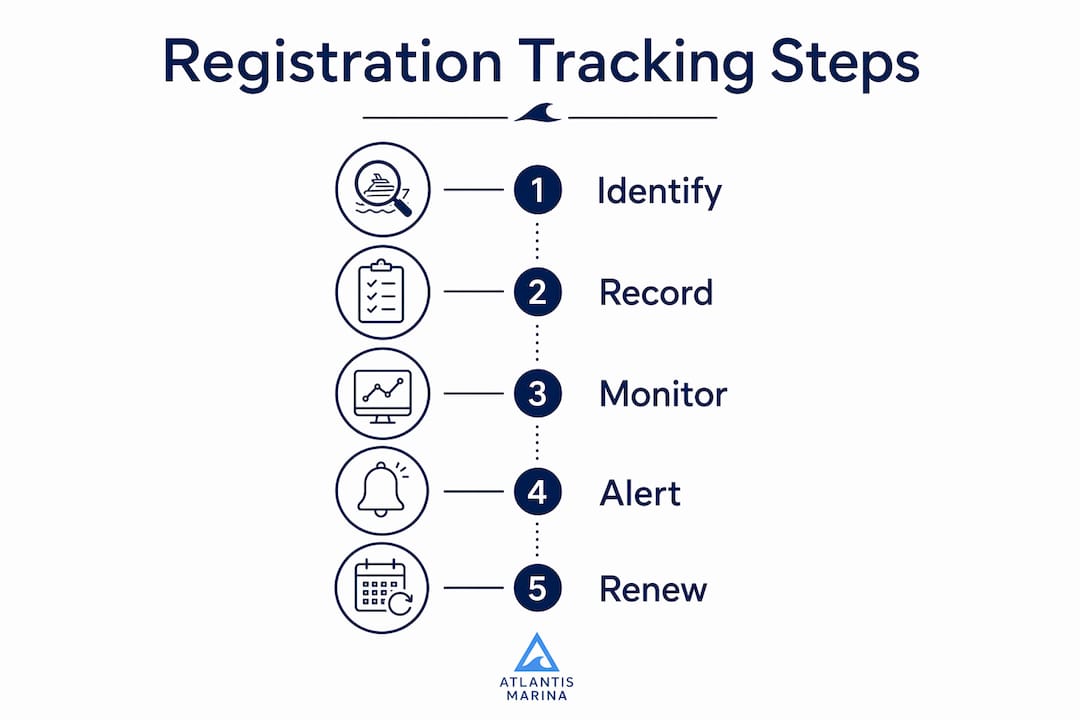
Automated reminders are the single highest-impact feature in any tracking system. A reminder sent 90, 60, and 30 days before a certificate expires converts a reactive compliance problem into a scheduled task. Without automation, operators rely on staff memory or spreadsheet audits, both of which fail under operational pressure.
Pro Tip: When evaluating any tracking platform, ask specifically whether it stores submission metadata alongside the documents themselves. A system that only stores the PDF of a registration certificate cannot tell you when it was submitted, who submitted it, or what was outstanding at the time of submission. That metadata is what makes audit responses fast and accurate.
Best practices for maintaining accurate vessel registration records
Accurate registration tracking does not happen by accident. It requires deliberate process design, consistent data hygiene, and coordination with the regulatory agencies that issue and renew certificates.
- Track flag and local compliance separately. Dual tracking of flag registry documentation and local marina compliance paperwork is the standard for any vessel operating across jurisdictions. Many operators track only marina paperwork and discover expired flag registrations during port inspections. Both layers must be current.
- Validate identifiers before entering them into any system. Format errors in registration numbers cause silent failures in automated workflows. Confirm the correct prefix, length, and character format for each jurisdiction before data entry.
- Build a renewal calendar with staggered alerts. Expiry dates for registration certificates, safety certificates, and insurance documents rarely align. A single annual review is not sufficient. Set alerts at 90, 60, and 30 days for each document type independently.
- Require complete documentation at the point of digital submission. Incomplete submissions create tracking gaps that are difficult to close retroactively. Platforms like MARINA-BEST enforce document completeness before accepting a submission, and marina operators should apply the same standard to their own intake workflows.
- Establish a direct contact at each relevant regulatory agency. Transport Canada, ILT, Service NSW, and MARINA each have specific processes for updates, corrections, and compliance notices. Knowing who to call when a record needs correction saves significant time during inspections or ownership transfers.
Pro Tip: Create a master vessel compliance register that lists every document, its issuing authority, its current expiry date, and the date your next renewal action is due. Review it monthly. This single habit eliminates the majority of compliance lapses that marina operators experience.
Key takeaways
Marina vessel registration tracking requires dual management of flag registry documents and local marina compliance records, supported by validated identifiers and automated renewal alerts.
| Point | Details |
|---|---|
| Dual compliance tracking | Track both flag/registry certificates and local marina paperwork independently to avoid inspection failures. |
| Identifier validation | Confirm correct format, prefix, and length for each jurisdiction before entering data into any tracking system. |
| Jurisdiction-specific workflows | Multi-step processes like the Netherlands' ILT require tracking pre-approval gates separately from final certificate issuance. |
| Metadata storage | Store submission metadata alongside documents to support fast audit responses and workflow reconciliation. |
| Automated renewal alerts | Set staggered alerts at 90, 60, and 30 days per document type to convert reactive compliance into scheduled tasks. |
Why the industry is finally getting serious about registration tracking
Having worked alongside marina operators for years, I have watched the same compliance failure repeat itself with frustrating regularity. A vessel arrives, paperwork looks fine at intake, and six months later an inspector finds an expired Certificate of Registry that nobody flagged because the marina was only tracking its own berth agreement. The operator is embarrassed, the vessel owner is fined, and the relationship suffers. This is not a knowledge problem. It is a systems problem.
The emergence of blockchain-based platforms like MARINA-BEST and the expansion of government query portals represent a genuine shift in how registration compliance can be managed. For the first time, operators have access to real-time status data that does not require a phone call to a government office. That is meaningful progress. But the technology only works if the underlying data is clean, and that requires the unglamorous work of identifier validation and document completeness checks that most operators still skip.
The multi-jurisdiction complexity is not going away. If anything, it is increasing as vessels travel more widely and flag state requirements become more specific. The operators who will handle this well are not the ones with the most sophisticated software. They are the ones who have built disciplined data practices around whatever tools they use. Software accelerates good habits. It cannot substitute for them.
— John
How Atlantis-marina simplifies vessel registration compliance
Atlantis-marina is built for marina operators who need to manage vessel records, compliance documents, and renewal workflows without maintaining a separate spreadsheet for every task. The marina management platform centralizes vessel records, stores uploaded registration and insurance documents, and supports the dual tracking of flag registry and local compliance paperwork that inspections require. Boaters submit documents directly through the customer portal, reducing staff data entry and improving record completeness at intake. For marinas ready to move beyond manual workflows, Atlantis-marina provides the operational infrastructure to manage compliance at scale. Explore the full marina management solution to see how it fits your facility's needs.
FAQ
What is vessel registration tracking?
Vessel registration tracking is the ongoing process of monitoring a vessel's registration numbers, certificate status, and renewal deadlines to maintain legal compliance. It covers both flag registry documentation and local marina compliance records.
How do I check vessel registration status online?
Service NSW provides an online registration check that returns current, expired, or cancelled status when you enter the registration number without spaces or dots. Transport Canada's Vessel Registration Query System allows lookups by official number, vessel name, or owner.
What identifiers are required for vessel registration tracking?
The primary identifiers are the registration number, Hull Identification Number (HIN), and Certificate of Registry. In Canada, small vessel numbers begin with "C" and large vessel Official Numbers are six digits prefixed by "O.N."
Why does dual tracking of flag and local compliance matter?
Vessels must satisfy both flag state requirements and local marina compliance standards. Tracking only marina paperwork leaves flag registrations unmonitored, and expired flag certificates are a common cause of port inspection failures.
What is the MARINA-BEST system?
MARINA-BEST is a blockchain-enabled registration platform operated by the Philippines' Maritime Industry Authority (MARINA). It allows vessel owners to submit registration documents online and tracks compliance status in real time, including submission metadata for audit purposes.