
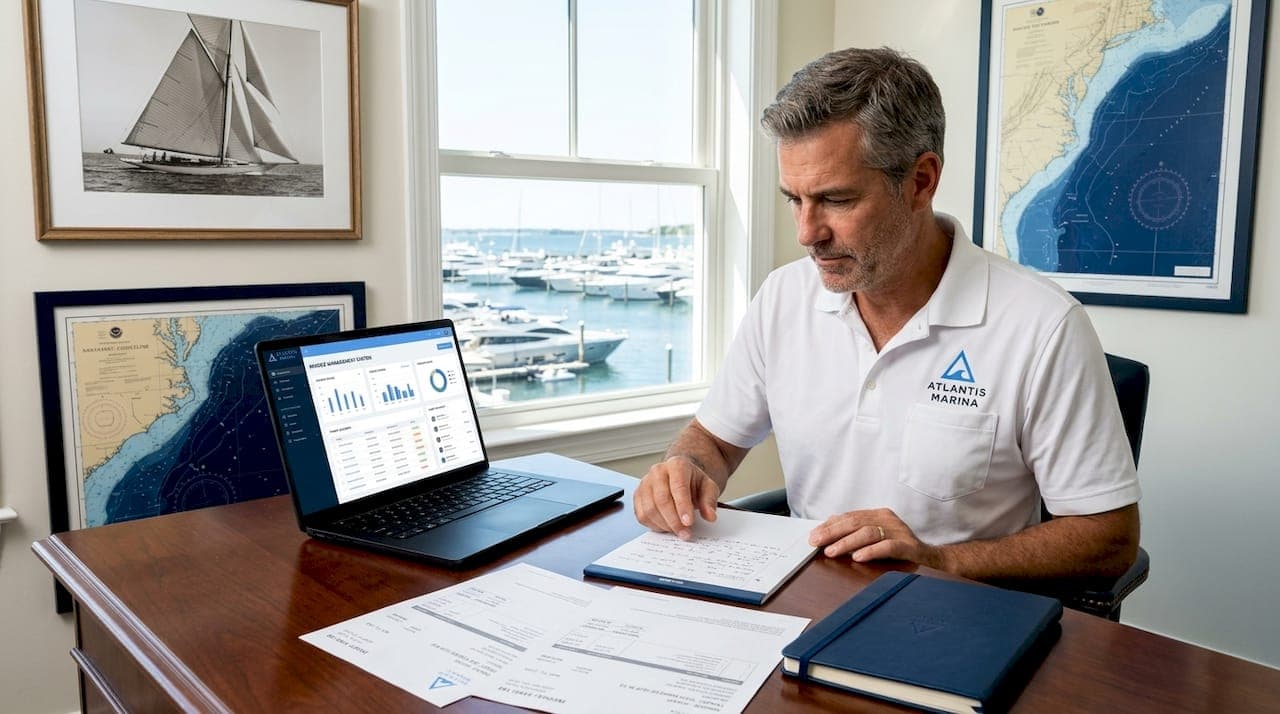
Recurring billing for marina tenants is an automated invoicing system that consolidates slip rental fees, utility charges, and service costs into a single, scheduled transaction processed on a fixed cycle. The industry term for this practice is automated recurring billing, and it sits at the center of every modern marina tenant payment system. Marinas that rely on manual invoicing face collection delays, billing disputes, and staff hours lost to data entry. Platforms like Atlantis-marina and similar marina management software have made automated billing accessible to independent operators and enterprise groups alike, turning a fragmented administrative task into a predictable revenue process.
What is recurring billing for marina tenants?
Recurring billing for marina tenants is defined as the automatic generation and collection of tenant invoices at scheduled intervals, typically monthly or seasonally, covering all charges tied to a slip agreement. The core value is predictability. Tenants know exactly when they will be charged, and marina managers know exactly when revenue will arrive.
The charges covered under a recurring billing cycle typically include three categories: base slip rental fees, utility consumption (shore power, water, pump-out services), and ancillary service fees such as dry storage, boat lift usage, or fuel account balances. Without a unified system, each of these categories can carry its own billing cycle, its own invoice, and its own dispute risk. That fragmentation is the root cause of most billing errors in marina operations.
Unified checkout systems consolidate slip rental, utility, and service charges into a single invoice, directly reducing payment disputes and administrative overhead. This matters because a tenant who receives three separate invoices in a single month is far more likely to question one of them than a tenant who receives one clear, itemized statement.
How integrated billing systems unify slip rental, utilities, and service charges
The practical challenge of billing marina tenants is that different charges follow different rhythms. Slip rental is typically monthly or seasonal. Shore power is metered and billed on consumption. Service orders are event-driven. When these run through separate systems or spreadsheets, the result is disjointed billing that increases manual work and multiplies the opportunities for error.
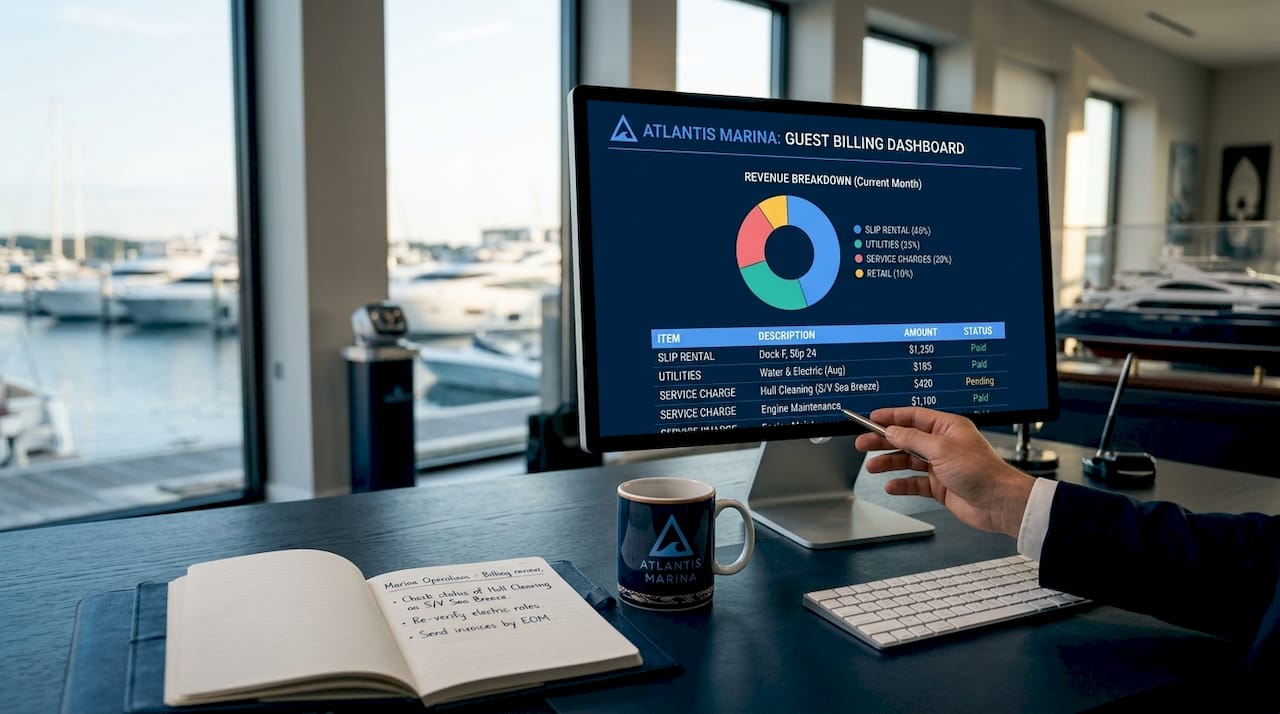
Integrated marina tenant payment systems solve this by posting all charges to a single tenant account in real time. When a service order is completed, it posts to the account. When the meter reads at month-end, it posts to the account. When the billing cycle runs, everything already in the account rolls into one invoice. The dockmaster never has to manually compile charges from multiple sources.
The operational benefits of this approach are concrete:
- Fewer disputes: Invoices that include slip fees, service orders, and utilities reduce tenant confusion because every line item is visible in one place.
- Faster collections: Tenants enrolled in autopay receive and pay a single charge rather than managing multiple payment events.
- Reduced admin time: Staff spend less time reconciling accounts and more time on dock operations.
- Cleaner records: A unified account history makes year-end reporting, lease renewals, and security deposit reconciliations straightforward.
Pro Tip: Set up your billing software to require a service order number before any charge posts to a tenant account. This one rule eliminates the most common source of disputed line items: charges that tenants do not recognize because they lack a reference.
The technology enabling this consolidation ranges from full marina management platforms like Atlantis-marina to specialized billing software for tenants in storage and marine facility contexts. The key requirement is that the system supports multiple charge types within one customer record, not just slip rental.
ACH vs. credit card: which payment method works best for marinas?
Payment method selection is one of the most financially consequential decisions in setting up recurring payments for boat slips. The processing cost difference between payment types is significant, and it compounds across hundreds of tenant transactions every month.
| Payment Method | Typical Processing Fee | Best Use Case | Tenant Acceptance |
|---|---|---|---|
| ACH / bank transfer | ~1.75% | Monthly recurring slip fees | High for enrolled autopay tenants |
| Credit card | ~3.99% | One-time or transient payments | High for convenience-focused tenants |
| Cash / check | 0% | Walk-in or seasonal tenants | Variable; creates manual reconciliation work |
Dual pricing strategies transparently shift credit card processing fees to tenants who choose to pay by card, while cash and ACH payers receive the base rate. This approach is used by storage and marine facility operators to protect margin without penalizing tenants who prefer lower-cost payment methods.
The financial logic is straightforward. A marina with 200 slip tenants paying an average of $600 per month generates $120,000 in monthly billing. At 3.99% on credit cards versus 1.75% on ACH, the fee difference is $2,688 per month, or over $32,000 per year. Dual pricing converts that cost from a fixed expense into a variable one that follows tenant payment behavior.
Pro Tip: When enrolling tenants in autopay, default the payment method to ACH and require an active choice to switch to credit card. Most tenants will stay with the default, and the fee savings accumulate without any friction in the tenant relationship.
Autopay enrollment and payment reminders improve on-time collections and reduce delinquencies. Marinas that combine autopay defaults with ACH incentives consistently report lower processing costs and fewer late payment follow-ups than those that leave payment method selection entirely to the tenant.
Compliance and transparency requirements for utility billing
Regulatory pressure on utility billing transparency is growing, and marina managers need to understand how it affects their billing workflows. The most direct example comes from Jersey City, where the city council approved RUBS disclosure mandates requiring landlords using Ratio Utility Billing Systems to disclose how utility charges are calculated and maintain detailed records accessible to tenants.
While marina slip agreements differ from residential leases, the regulatory direction is clear: tenants at all types of facilities are gaining the right to understand how shared utility costs are allocated to their accounts. Marinas that bill shore power, water, or pump-out services as flat fees or percentage allocations rather than metered actuals face the greatest exposure as these rules expand.
Detailed billing statements covering rent, utilities, and additional fees meet both tenant expectations and emerging regulatory standards. Practically, this means your billing software needs to support itemized invoice templates, not just a single line total.
Best practices for compliant utility billing in marina operations include:
- Meter-based billing where possible: Actual consumption data eliminates allocation disputes entirely.
- Written disclosure in lease agreements: State clearly how any shared or estimated utility charges are calculated.
- Retained billing records: Keep at least 24 months of utility billing history per tenant account, accessible on request.
- Audit trail in your billing software: Every charge adjustment should log the user, timestamp, and reason.
Proactive transparent billing aligns with emerging regulations and improves tenant relations, preventing the costly disputes that arise when tenants feel charges are arbitrary. The yacht club billing system model, which integrates rent, utilities, and service fees into unified invoices, offers a practical template for how this transparency works in a waterfront context.
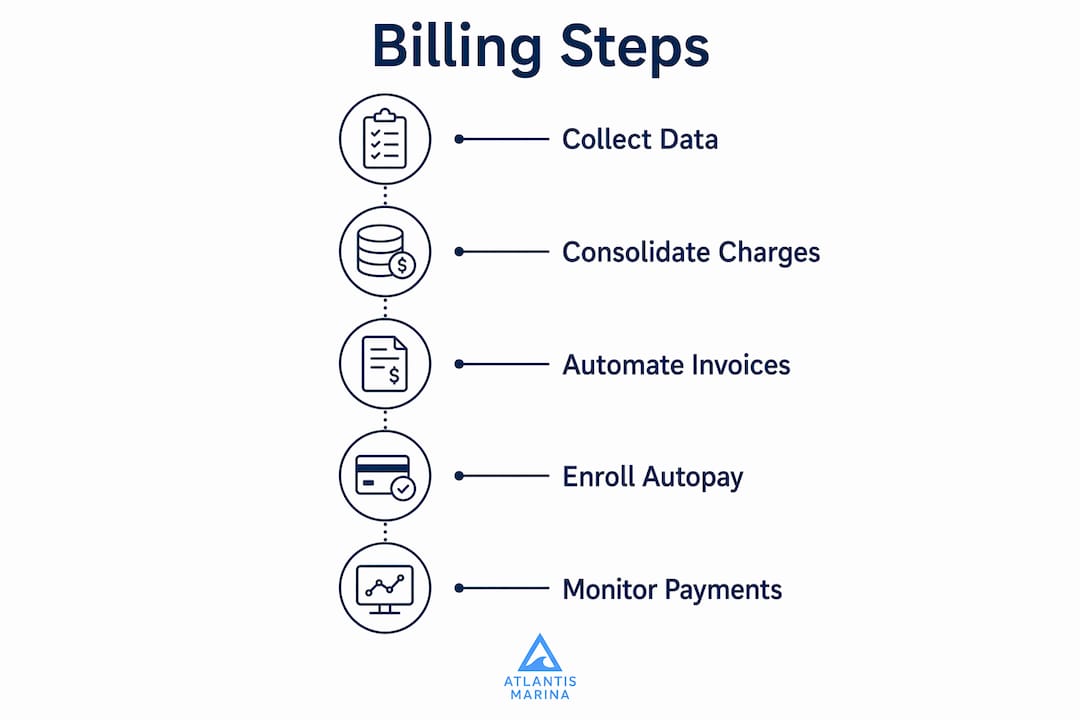
How to implement recurring billing for marina tenants step by step
Deploying an effective automated billing system for marinas requires more than selecting software. The system is only as accurate as the data it runs on, and most billing errors trace back to incomplete tenant records rather than software failures.
-
Audit and clean your tenant records. Every slip tenant account needs a current contract start date, billing cycle, rate schedule, and payment method on file. Incorrect master data leads to wrong charges or missed proration triggers in automatic billing. Run a full audit before activating any automation.
-
Configure your billing software to cover all charge types. Your marina billing software should handle slip rental, utility charges, and service fees within one tenant account. If you are using separate systems for any of these, consolidate before going live with recurring billing.
-
Set up autopay enrollment for all tenants. Send a direct communication to every tenant explaining the autopay process, the payment methods available, and any fee differences between options. Make enrollment easy by providing a link to your tenant portal.
-
Define proration and renewal rules explicitly. Mid-cycle move-ins, early departures, and lease renewals all require clear proration logic. Configure these rules in your billing software before the first billing cycle runs, not after the first complaint arrives.
-
Schedule billing cycle reviews quarterly. Rates change, tenants move, and service packages evolve. A quarterly review of active billing schedules catches configuration drift before it becomes a dispute.
-
Communicate billing changes in advance. Any rate adjustment or new fee requires written notice to tenants before the change appears on an invoice. Most marina lease agreements specify a notice period; build that into your billing calendar.
-
Enable mobile dockside payments for transient and partial payments. Flexible payment options improve convenience for tenants who need to settle a balance outside the normal billing cycle without disrupting the recurring schedule.
Pro Tip: Run a parallel billing cycle for the first month after switching to automated billing. Process invoices through both your old system and the new one, then compare outputs line by line. This catches configuration errors before they reach tenants.
Key takeaways
Recurring billing for marina tenants works when accurate tenant data, unified charge consolidation, and transparent itemization operate together within a single billing platform.
| Point | Details |
|---|---|
| Consolidate all charge types | Slip fees, utilities, and service orders belong in one tenant account to reduce disputes and errors. |
| Default autopay to ACH | ACH processing costs roughly half of credit card fees, compounding into significant annual savings. |
| Itemize every invoice | Transparent line-item billing meets emerging regulatory standards and reduces tenant disputes. |
| Audit tenant records first | Billing automation fails when contract dates, rates, or payment methods are incomplete or outdated. |
| Review billing cycles quarterly | Rate changes and tenant turnover require regular configuration checks to keep automated billing accurate. |
Why most marina billing problems are a data problem, not a software problem
After working with marina operators across a range of facility sizes, the pattern is consistent: when automated billing produces errors, the root cause is almost never the software. It is the tenant data the software is running on. A slip that changed hands six months ago but still carries the previous tenant's rate. A utility billing rule that was configured for a seasonal tenant but never updated when they converted to annual. A service order that was completed but never posted to the account because the workflow was not set up correctly.
The implication is that the most important step in any billing implementation is the one most managers want to skip: the data audit. Cleaning up tenant records before activating automation is tedious, but it is the only way to avoid the wave of billing corrections that follows a poorly prepared launch.
The second pattern worth noting is that fee transparency is not just a compliance issue. It is a tenant retention issue. Tenants who understand their invoices pay faster and dispute less. Tenants who receive a single line total with no breakdown call the office, question the charge, and sometimes withhold payment while waiting for clarification. The investment in itemized billing templates pays for itself in reduced administrative follow-up within the first quarter.
The third observation is about payment method defaults. Marinas that leave payment method selection entirely to the tenant end up with a mix of credit cards, checks, and cash that creates reconciliation work and unpredictable processing costs. Setting ACH as the default autopay method and requiring an active choice to use a card is a small configuration decision with a measurable financial outcome.
— John
See how Atlantis-marina handles recurring billing
Atlantis-marina is built to handle the full billing workflow that marina managers deal with every day, from slip rental and utility charges to service orders and autopay enrollment, all within one cloud-based platform.
The marina management software includes recurring billing configuration, itemized invoice templates, autopay enrollment tools, and a tenant portal where boaters can view statements and update payment methods. For marinas currently managing billing across spreadsheets or disconnected systems, Atlantis-marina consolidates those workflows into one place. Explore the billing and payment features or request a demo to see how the platform fits your facility's billing structure.
FAQ
What does recurring billing for marina tenants include?
Recurring billing for marina tenants covers slip rental fees, utility charges such as shore power and water, and any service fees tied to the tenant's account, all consolidated into one scheduled invoice processed automatically on a fixed cycle.
How often should marina tenants be billed?
Most marina operators bill tenants monthly, though seasonal leaseholders may be billed quarterly or annually. The billing cycle should match the terms of the slip agreement and be configured in the billing software before autopay is activated.
What is the difference between ACH and credit card billing for marina tenants?
ACH processing typically costs around 1.75% per transaction while credit card fees run closer to 3.99%. Marinas using dual pricing pass the credit card fee to tenants who choose that method, incentivizing lower-cost ACH payments and protecting operator margins.
Why do marina billing errors happen with automated systems?
Incorrect master data is the leading cause of automated billing errors. When tenant contract dates, rate schedules, or payment methods are outdated or incomplete, the billing system applies the wrong charges or misses proration triggers.
What billing transparency rules apply to marina utility charges?
Regulations like Jersey City's RUBS disclosure requirements require landlords to explain how utility costs are calculated and maintain accessible records. Marina operators billing shared utilities should adopt itemized invoicing and written disclosure in lease agreements to stay ahead of similar rules.