
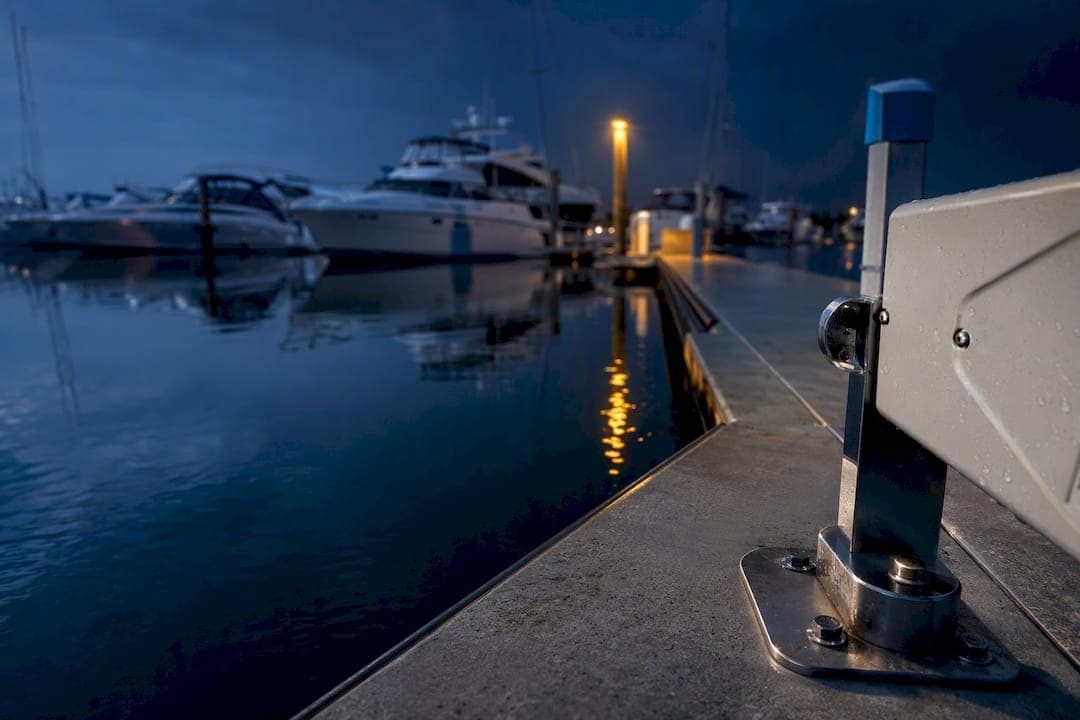
Remote marina monitoring means placing sensors on boats, docks, and utilities that report conditions in real time to a dashboard, wherever the dockmaster happens to be standing. The recommended approach is not a pile of standalone gadgets but an integration-capable platform that unifies bilge and water sensors, motion and shore power alerts, and billing into one operating system instead of five disconnected apps.
TL;DR:
- Marine-grade sensors with IP67 ratings and multi-year batteries are essential for reliable, salt-resistant monitoring rather than cheaper consumer gadgets.
- Cellular hubs are easiest to deploy for small marinas but can incur high recurring costs, while LoRaWAN suits larger sites with battery-powered sensors due to its long range and low power use.
- Integrating sensors into a single platform with open APIs and data export capabilities reduces response times, enhances operational efficiency, and prevents vendor lock-in.
- A phased rollout starting with a small pilot ensures coverage, proper alert calibration, and staff training before scaling the remote monitoring system.
- Using an all-in-one marina management dashboard that combines sensors, billing, and communication improves workflow and guest experience compared to disconnected point solutions.
Table of Contents
- What Does Remote Marina Monitoring Actually Cover?
- Which Sensors and Endpoints Should a Marina Choose?
- Cellular, LoRaWAN, or Wi-Fi: Which Network Fits Your Marina?
- How Does Remote Monitoring Improve Utility Billing?
- How Should You Evaluate a Remote Monitoring Vendor?
- What Does a Realistic Rollout Timeline Look Like?
- How Atlantis Marina Bridges Monitoring With Daily Operations
- Why Most Marinas Overthink the Sensor Layer and Underthink Integration
- Ready to See Remote Monitoring Inside a Real Marina Platform?
- Sources
- FAQ
What Does Remote Marina Monitoring Actually Cover?
Remote marina monitoring watches the things that flood boats, drain batteries, and generate liability claims. The core domains are bilge water levels, water intrusion or flooding at the dock, shore power and ground-fault conditions, ambient and bilge temperature, berth occupancy, and motion or security events around slips and gates.
Each domain feeds an alert workflow, not just a chart. A sensor trips, and the system pushes a notification through SMS, email, a mobile app, or an incident ticket inside the operations dashboard, so staff respond before a bilge pump failure becomes a sunk boat.
The payoff for operators shows up in three places:
- Fewer 2 a.m. dock walks because alerts replace manual rounds.
- Lower liability exposure when water intrusion or ground-fault events get caught within minutes instead of days.
- A better boater experience, since owners get notified about their own vessel instead of hearing about damage after the fact.
Which Sensors and Endpoints Should a Marina Choose?
Sensor selection comes down to matching the device to the failure mode you are trying to catch, not buying the biggest bundle a vendor offers. Bilge and water intrusion detectors sit at the lowest point of the hull and trigger on contact with water. Shore power monitors watch for ground-fault current, a leading cause of dock electrocution incidents and slip fires. Temperature probes flag freeze risk or an overheating battery bank. Motion and tilt sensors catch unauthorized boarding or a vessel listing. GPS trackers confirm a boat hasn't drifted or been moved without authorization, and berth-occupancy sensors tell the office which slips are actually empty right now, not just on paper.
A few specs separate a marine-grade sensor from a consumer gadget:
- IP rating: look for IP67 or better; anything less will not survive salt spray and dock wash-downs.
- Battery life: multi-year battery life beats a device you have to climb into a bilge to recharge every few months.
- Reporting interval: faster intervals catch fast-moving events like flooding, at the cost of battery draw.
- Connectivity type: cellular, LoRaWAN, or Wi-Fi, depending on your network plan.
- Mounting: floating docks flex and shift, so sensors need flexible cable runs and corrosion-resistant hardware, not rigid conduit meant for a building.
Retrofitting an older marina usually means wireless, battery-powered hubs rather than trenching new cable to every pedestal, which keeps installation cost down considerably.
Pro Tip: Before buying sensors in bulk, pilot one of each type on a single problem slip for a full billing cycle. You will learn more about false-alarm rates in your specific water conditions than any spec sheet will tell you.
Cellular, LoRaWAN, or Wi-Fi: Which Network Fits Your Marina?
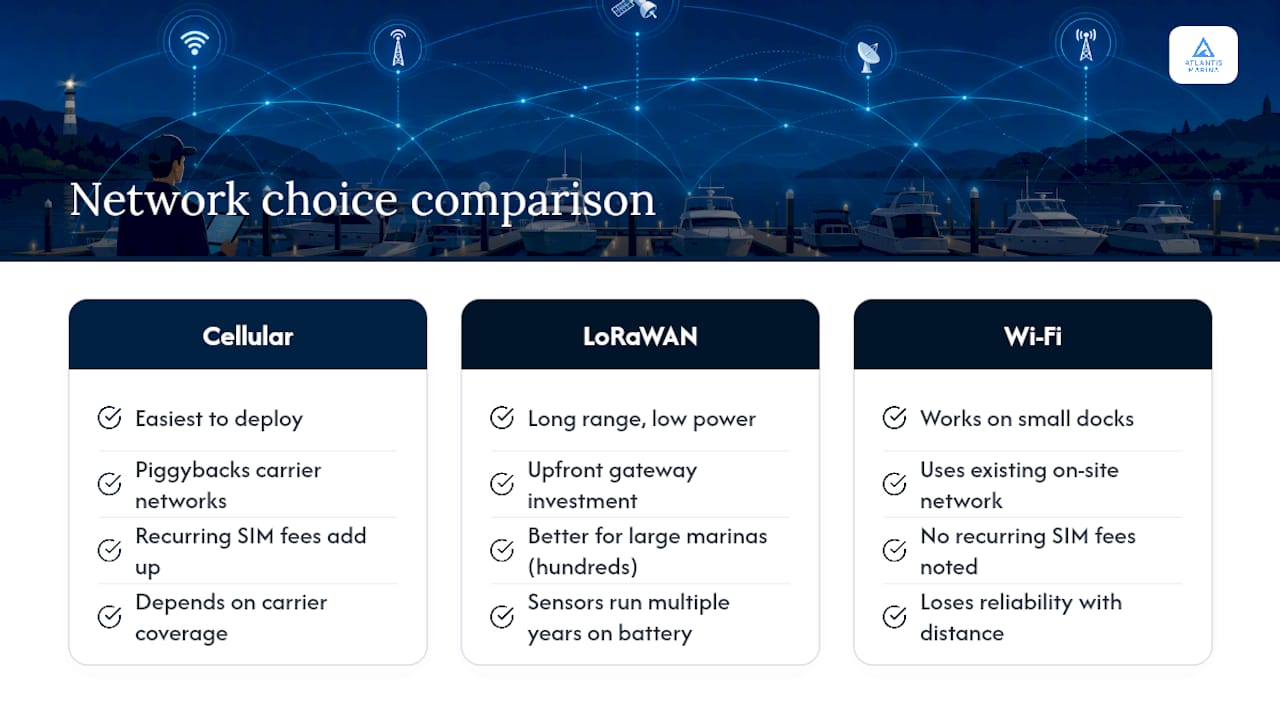
Connectivity choice drives both your upfront cost and your monthly bill, so it deserves as much thought as the sensors themselves. Cellular hubs are the easiest to deploy since they piggyback on existing carrier networks, but every hub carries a recurring SIM fee that adds up fast across a large site. LoRaWAN trades a bigger upfront gateway investment for long range and very low power draw, which makes it the better fit for larger marinas covering hundreds of slips, since sensors like ultrasonic occupancy detectors and submersible water probes can run for multiple years on battery power on that protocol. Wi-Fi works fine on small docks with strong existing coverage but loses reliability fast as distance and obstructions increase.
Gateway and antenna placement matters more over water than most operators expect. Even small changes in antenna height materially affect link quality on an exposed waterfront site, and a dual-path setup, local internet with cellular fallback, protects you when a storm knocks out your primary uplink.
Smaller marinas with a solid on-site network often do better starting with Wi-Fi or a simple cellular hub for faster deployment, then migrating to LoRaWAN only if they scale past what that setup can reliably cover.
How Does Remote Monitoring Improve Utility Billing?
Smart pedestals turn utility monitoring from a manual chore into an automated revenue system. A Remote Utility Monitoring setup retrofits existing pedestals to add wireless metering, ground-fault detection, and remote on/off control, meaning staff can cut power to an empty slip from a laptop instead of walking the dock.
The metering data doesn't stop at the utility bill. Once consumption numbers flow into your operations software automatically, invoicing stops depending on someone reading a dial and typing a number into a spreadsheet:
- Automated invoicing pulls actual usage instead of flat estimated rates.
- QuickBooks sync exports the numbers straight into your books, cutting reconciliation time.
- Guests see their own consumption, which cuts down on billing disputes at checkout.
- Ground-fault logs support compliance recordkeeping, and whole-site systems can generate energy and safety audit trails automatically.
The operational outcome is straightforward: fewer manual meter reads, more predictable revenue, and a guest who trusts the number on the invoice because they watched it accumulate in real time.
How Should You Evaluate a Remote Monitoring Vendor?
Procurement decisions in this category go wrong when operators buy on feature lists instead of operational fit. Work through this checklist before signing anything:
- Per-slip coverage: does the quoted price actually cover every slip you need monitored, or just a demo subset?
- API and integration: can the system push data into your existing marina management software, or does it live in its own silo?
- Data ownership and export: can you pull your own historical logs out in a usable format if you ever switch vendors?
- Maintenance and warranty: what happens when a sensor fails at month 14?
- Battery life claims: ask for real-world numbers, not lab conditions.
- Service-level agreements: what's the guaranteed alert latency, and what's the penalty if they miss it?
- Privacy and security: how is boater and payment data encrypted and stored?
- Total cost of ownership: add hardware, gateways, and every recurring subscription fee together, not just the sticker price on the sensor.
Ask any vendor for live access to a real dashboard, not a slide deck, along with pilot terms, sensor mean-time-between-failure data, and a concrete replacement policy.
Red flags are usually obvious once you know to look: no API means no integration path, ever. Opaque pricing hides recurring costs. A battery claim with no field data behind it. Anything without a marine IP rating. And any system that won't export your own logs on request.
Pro Tip: Ask every vendor the same question: "If I cancel next year, what data do I walk away with?" The answer tells you more about their business model than the whole rest of the demo.
What Does a Realistic Rollout Timeline Look Like?
Most successful rollouts follow the same shape: pilot small, verify everything, then scale. Start with a site survey to map dead zones and pedestal locations, then run the pilot on 5 to 10 slips before touching the rest of the marina.
- Confirm sensor coverage and alert delivery under real conditions, not just a bench test.
- Integrate the pilot data feed with your operations dashboard before expanding.
- Refine alert thresholds so staff aren't drowning in false positives.
- Train dockmaster and maintenance staff on the actual incident workflow, not just the app.
Get the dockmaster, IT or maintenance lead, and accounting all in the room early, since billing integration touches every one of them. Your main cost drivers will be sensors per slip, the number of gateways needed for coverage, whether the subscription is priced per device or per site, and how much custom integration work your existing software requires.
How Atlantis Marina Bridges Monitoring With Daily Operations
Sensor data is only useful if it lands somewhere staff actually work. Atlantis Marina's operations dashboard brings incident alerts, reservations, billing, and facility status into one screen, backed by Atlantis Bot for routine staff questions. Billing automation, including e-sign contracts, autopay, payment processing, and accounting sync, means metering data from smart pedestals can turn into paid invoices without manual entry. Camera and sensor integrations connect to the same boat lift alert system that notifies staff and boaters through the Atlantis Boater App.
Why Most Marinas Overthink the Sensor Layer and Underthink Integration
The marina industry talks about remote monitoring like it's a hardware problem: which sensor is most accurate, which battery lasts longest, which camera has the best night vision. That conversation misses what actually determines whether a system pays for itself.
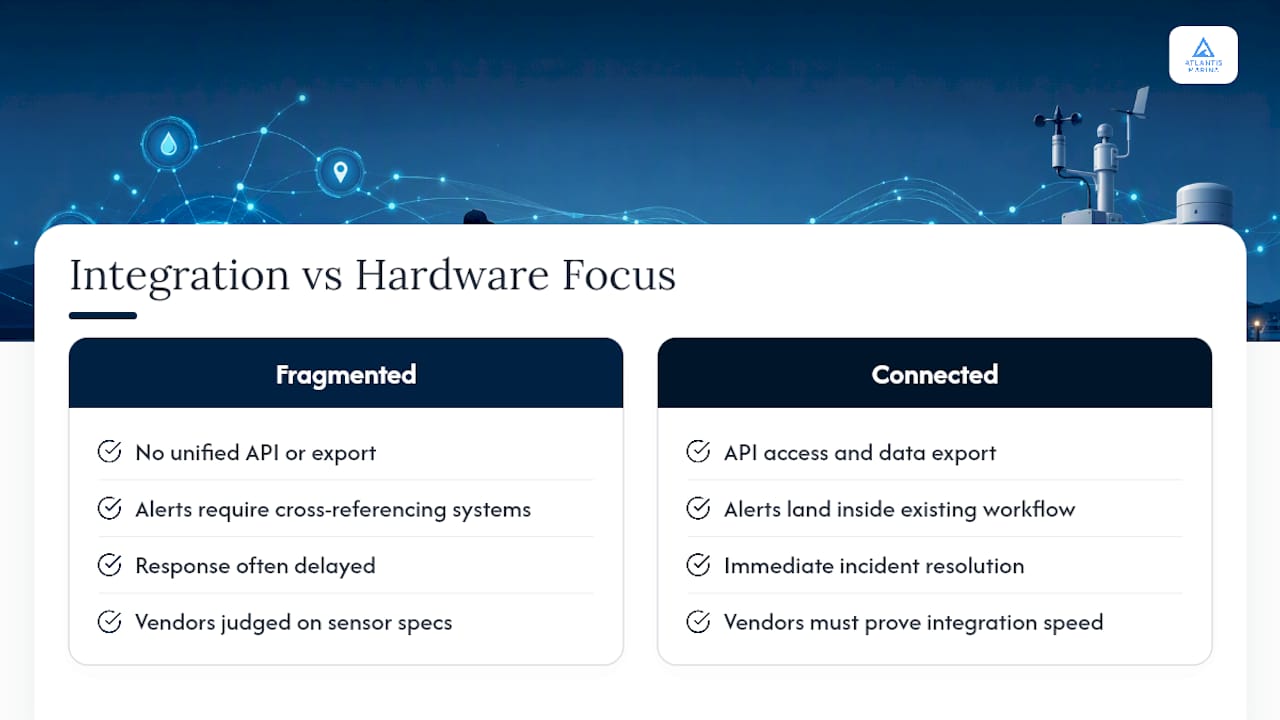
The real failure point isn't sensor accuracy. It's the gap between an alert firing and someone doing something useful with it. A bilge sensor that texts a dockmaster who's off shift for the weekend is functionally decorative. What matters is whether that alert lands inside a workflow that already has the boater's contact info, the vessel's insurance file, and a billing record attached, so the response is immediate instead of requiring someone to cross-reference three systems first.
That's why the vendor checklist earlier in this piece leads with API access and data export, not sensor specs. A marina running a fragmented stack of point solutions will always lag one running a single connected platform, no matter whose sensor is technically more sensitive. Pilot small, demand integration proof before you scale, and judge every vendor by how fast an alert turns into a resolved incident, not by how many sensor types are on the brochure.
— John R
Ready to See Remote Monitoring Inside a Real Marina Platform?
If you've been running bilge alerts in one app, billing in a spreadsheet, and boater messages through a text thread, the fix isn't one more standalone sensor subscription. It's putting all of it on one system that already knows which boat is in which slip and who owes what.
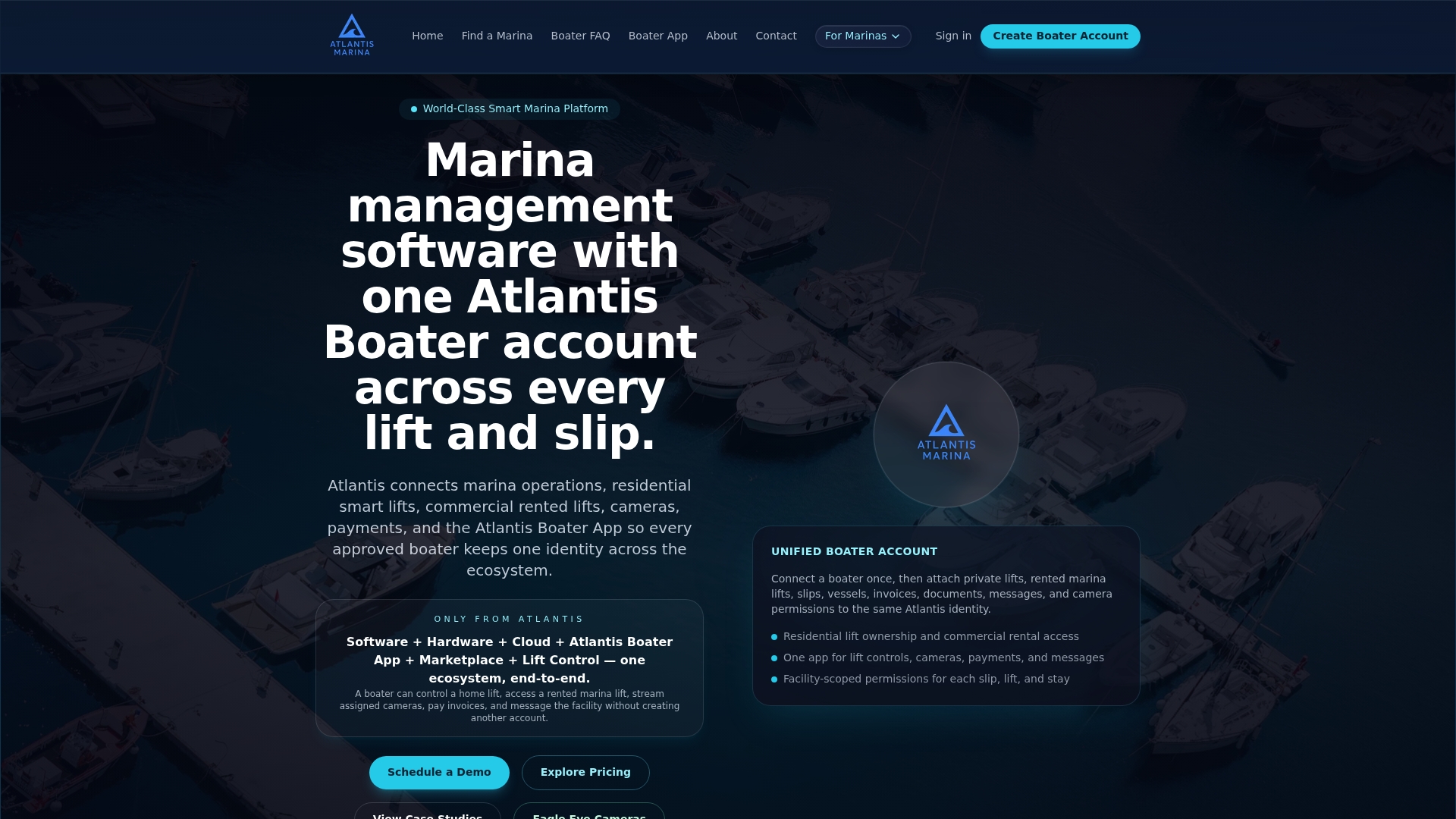
Some marina platforms connect sensor and camera integrations, smart pedestal billing, and boater communication inside the same dashboard used by dockmasters for reservations and payments. That's the difference over adding another disconnected monitoring app: one login, one incident record, and one invoice trail instead of five. Such platforms can fit small and mid-sized marinas modernizing manual workflows, as well as scale to multi-property marina groups running hundreds of slips.
Start with a site survey and a pilot on a handful of slips, the same phased approach outlined earlier, and see how alerts, billing, and boater self-service actually behave together before committing to a full rollout. Request a demo or site survey to see how it fits your marina's layout, and explore the boater app to see the self-service side your guests will use.
Sources
For deeper technical detail on the systems referenced throughout this guide, see whole-site marina monitoring architecture, wireless metering and remote utility control, and LoRaWAN-based smart port sensor deployments. For camera specification comparisons, the CCTV database is a useful independent reference.
- RUM | Remote Utility Monitoring | Wireless Metering
- Smart Port & Marina Monitoring: IoT Berth Management | merkaio
FAQ
What Is the Best Remote Boat Monitoring System?
There is no single best system for every marina. The strongest approach pairs marine-grade bilge, temperature, and shore power sensors with a platform, like Atlantis Marina, that routes those alerts into the same dashboard used for billing and boater communication.
What Methods Are Used for Marine Monitoring?
Marine monitoring typically combines bilge and water intrusion sensors, shore power and ground-fault detectors, temperature probes, motion or occupancy sensors, and GPS tracking, connected over cellular, LoRaWAN, or Wi-Fi networks to a central dashboard.
What Is the Best Marine Security Camera?
The right camera depends on dock layout and lighting, but independent testing notes that camera systems handle visual monitoring well while facing real limits in fog and heavy rain, so most marinas pair cameras with sensor-based alerts rather than relying on video alone.
What Are Good Security Systems for Boats?
Effective boat security usually layers bilge and water sensors, motion and tilt detectors, GPS tracking, and camera coverage at access points, all feeding one alert system so an issue on any single vessel doesn't get lost in a flood of separate apps.
How Much Does Remote Marina Monitoring Cost?
Costs vary by marina size and sensor count, but most vendors price the system as hardware plus a recurring subscription for data, alerts, and dashboard access, so total cost of ownership depends heavily on per-device versus per-site pricing structure.