

AI marina operations use cases are the practical, data-driven applications that automate slip management, maintenance forecasting, customer communication, and environmental compliance across modern waterfront facilities. The industry term for this category is intelligent marina management, and it covers everything from real-time berth allocation to IoT-connected dock sensors. As of Q1 2026, 68% of marina operators plan AI adoption, representing a 340% increase since 2022. Early adopters are already reporting 28% operational efficiency gains in the first year. This guide covers the highest-impact applications, with evidence-backed results you can take to your next planning meeting.
1. AI use cases in marina operations: what they cover
AI systems differ from legacy software by actively interpreting real-time data to make intelligent decisions, such as adjusting pricing, reallocating berths, and flagging maintenance needs before failures occur. Traditional marina software follows fixed rules. AI-powered platforms respond to conditions as they change, including weather shifts, demand spikes, and equipment wear patterns.
The core use case categories include berth and slip optimization, predictive maintenance, customer service automation, environmental monitoring, and dynamic revenue management. Each category delivers measurable results on its own. Together, they form the foundation of what the industry calls a smart marina technology stack.

Marinas that treat these applications as isolated tools miss the compounding benefit. When your berth allocation system shares data with your maintenance platform and your customer portal, the entire operation becomes more responsive and less dependent on manual intervention.
2. Predictive berthing and slip allocation
AI-enabled predictive berthing is the highest-ROI application most marina operators can deploy today. Slip utilization improves by 23–35% when AI factors in vessel dimensions, weather forecasts, tidal data, and real-time occupancy before assigning a berth. That same data layer reduces operational costs by up to 28%.
The check-in process is where operators feel this most directly. Manual check-in at many facilities runs over 13 minutes per vessel. AI-driven reservation and assignment systems bring that figure to under 3 minutes. For a busy transient dock on a summer weekend, that difference eliminates queues and reduces staff pressure significantly.
Key capabilities in this category include:
- Dynamic slip assignment based on vessel size, draft, and power requirements
- Weather-integrated scheduling that adjusts assignments ahead of storm events
- Waitlist automation that fills cancellations without staff involvement
- Conflict detection that flags double-bookings or incompatible vessel placements before they reach the dock
Pro Tip: Before deploying an AI berthing system, audit your slip measurement records and vessel size data. Clean, accurate historical data is the single biggest predictor of whether your AI recommendations will be reliable from day one.
3. Predictive maintenance for docks, lifts, and electrical systems
Predictive maintenance is the application that pays for AI adoption over the long term. AI forecasting extends dock and equipment lifespan by 20–30% by analyzing usage cycles, environmental exposure, and sensor readings to identify failure patterns before they cause downtime.
The financial case is straightforward. Emergency repairs cost two to three times more than planned maintenance. Electrical failures on a dock can ground multiple vessels and create liability exposure. AI systems that monitor load patterns, corrosion indicators, and mechanical wear give your maintenance team a work order before the problem becomes a crisis.
For boat lift operations specifically, smart lift control systems connected to an AI decision engine can track cycle counts, motor temperature, and load variance to predict when a component needs service. This is a direct application of the IoT-to-AI pipeline that leading marinas are building now.
Integration with existing property management systems is the main friction point. 64% of marina operators report legacy system integration challenges, with typical projects running 3–4 weeks and costing between $15,000 and $45,000. Budget for this before you commit to a platform.
4. AI-driven customer communication and service automation
AI chatbots and automated messaging systems handle 60–70% of routine guest inquiries, including questions about amenities, slip availability, pricing, and check-in procedures. That volume shift frees your dockmaster and front-desk staff to focus on complex service situations that require human judgment.
The 24/7 availability factor matters more than most operators initially expect. Transient boaters plan trips outside business hours. A chatbot that answers slip availability questions at 10 p.m. on a Friday converts inquiries that would otherwise go to a competitor with an online booking option.
Automated billing and communication tools reduce admin time by 12 hours per week on average. That is a meaningful labor recovery for a facility running lean on office staff.
Common queries that AI handles well include:
- Slip availability and reservation confirmation
- Fuel dock hours and pricing
- Amenity access and facility maps
- Payment status and invoice questions
- Weather-related schedule changes and notifications
Pro Tip: Set your chatbot to escalate any inquiry involving a complaint or a safety concern directly to a staff member. AI handles volume well, but human judgment protects your reputation in high-stakes moments.
For a detailed breakdown of the best tools in this category, the 2026 customer communication guide covers current platform options with feature comparisons.
5. Environmental monitoring and sustainability compliance
Environmental intelligence is an emerging AI use case in boating that most operators underestimate until a compliance issue forces their hand. Platforms like POSINODE provide real-time in-water telemetry that monitors pollutants, nutrients, and water quality indicators continuously, giving marinas the data they need to meet regulations like the Water Framework Directive proactively rather than reactively.
The shift from reactive to proactive environmental management is significant. Marinas that wait for a regulatory inspection to discover a water quality issue face fines, remediation costs, and reputational damage. Continuous AI monitoring surfaces problems early, when corrective action is still low-cost.
The table below shows how AI environmental monitoring compares to traditional compliance approaches:
| Capability | Traditional approach | AI-powered approach |
|---|---|---|
| Water quality monitoring | Periodic manual testing | Continuous real-time telemetry |
| Pollutant detection | Post-incident sampling | Proactive threshold alerts |
| Regulatory reporting | Manual data compilation | Automated compliance logs |
| Ecosystem protection | Reactive remediation | Predictive intervention |
Beyond compliance, sustainability credentials are a marketing asset. Yacht clubs and private marinas targeting premium clientele increasingly use environmental certifications and monitoring data as a differentiator in their membership and transient marketing.
6. AI for vessel tracking and marina security
AI for vessel tracking goes beyond knowing which slip a boat occupies. Computer vision systems connected to marina cameras can identify unauthorized vessel movements, flag unregistered arrivals, and generate automatic entry and exit logs without staff involvement.
Camera-integrated security systems paired with AI recognition reduce the manual monitoring burden on dockmasters and create an auditable record for insurance and liability purposes. For facilities with large transient traffic, this capability replaces hours of manual log entry each week.
Mobile alert systems extend this further. Dockmasters receive real-time notifications when a vessel enters a restricted area, when a boat lift activates outside scheduled hours, or when a sensor detects unusual electrical load on a dock pedestal. The smart marina mobile alert guide covers the alert types most relevant to active dockmaster workflows.
AI vessel tracking also supports dynamic pricing models. When your system knows real-time occupancy, historical demand by date and vessel type, and current weather conditions, it can recommend rate adjustments that maximize revenue during peak periods without manual analysis.
7. Dynamic pricing and revenue optimization
Dynamic pricing is the AI use case that most directly affects marina revenue per available slip. AI systems analyze historical occupancy, seasonal demand curves, local event calendars, and competitor availability to recommend rate adjustments in real time.
The logic mirrors what hotel revenue management systems have done for decades. A marina with 80% occupancy on a holiday weekend is leaving money on the table at flat-rate pricing. An AI pricing engine identifies that gap and adjusts transient rates accordingly, without requiring a manual review cycle.
Marina data analysis at this level requires clean historical records. Accurate seasonal occupancy data, vessel type breakdowns, and rate history are the inputs that make AI pricing recommendations reliable. Facilities that have digitized their records fully see faster and more accurate results from AI pricing tools than those migrating from paper-based systems.
Key takeaways
AI-powered intelligent marina management delivers the highest returns when berth allocation, predictive maintenance, customer automation, and environmental monitoring operate from a shared data foundation.
| Point | Details |
|---|---|
| Berth allocation ROI | AI slip assignment improves utilization by 23–35% and cuts check-in time to under 3 minutes. |
| Maintenance cost reduction | Predictive AI extends dock and equipment lifespan by 20–30%, reducing emergency repair costs. |
| Customer service efficiency | AI chatbots handle 60–70% of routine inquiries, saving staff time for complex service tasks. |
| Environmental compliance | Real-time telemetry platforms like POSINODE shift compliance from reactive to proactive management. |
| Integration planning | Budget $15,000–$45,000 and 3–4 weeks for legacy system integration before deploying AI tools. |
Why data quality determines your AI results
I have worked with marina operators across facility sizes, and the pattern is consistent: the operators who get the most out of AI are not the ones with the biggest budgets. They are the ones who cleaned up their data before they deployed anything.
AI predictive analytics for berth allocation, maintenance forecasting, and pricing all depend on accurate historical records. Vessel dimensions, slip measurements, seasonal occupancy rates, and maintenance logs need to be complete and consistent. When that foundation is solid, AI recommendations are reliable from the first week. When it is not, you spend months troubleshooting outputs that do not match reality.
The 64% of operators who report integration challenges are often dealing with two problems at once: legacy system friction and data quality issues. Separating those two problems and solving them in sequence makes the integration far more manageable.
My honest recommendation is to start with one use case, get your data right for that application, and measure the result before expanding. Predictive maintenance or automated customer communication are both good entry points because they have clear, measurable outputs and do not require a full platform overhaul to implement. The digital twin and full IoT integration vision is real and worth pursuing, but it is a second-phase goal, not a starting point.
— John
How Atlantis-marina supports AI-powered marina operations
Atlantis-marina, developed by Atlantis Control Systems, brings together slip management, reservations, billing, smart boat lift control, and customer communication in a single cloud-based platform built for modern waterfront operations.
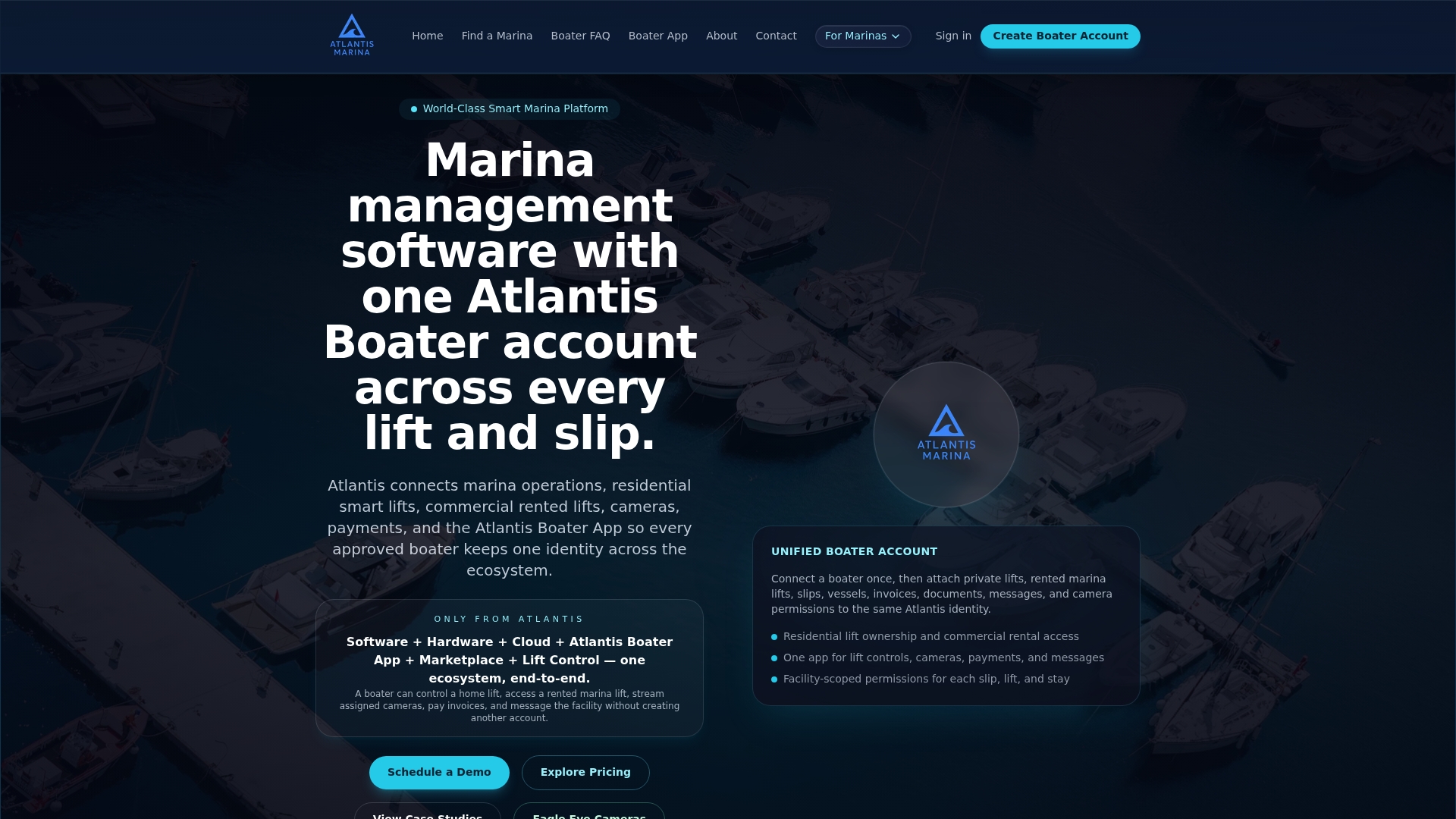
The platform is designed specifically for marina operators who want to move from fragmented manual workflows to connected, data-driven management without a multi-year IT project. From automated marina reservations to smart lift monitoring and integrated billing, Atlantis-marina covers the core AI use cases covered in this guide. If you are ready to see how the platform fits your facility, request a demo and talk through your specific operational priorities with the Atlantis-marina team.
FAQ
What are the top AI use cases for marina operations?
The top AI use cases in marina management include predictive berth allocation, equipment maintenance forecasting, automated customer communication, environmental water quality monitoring, and dynamic pricing. Each delivers measurable efficiency and cost benefits when deployed on clean operational data.
How much does AI integration cost for a marina?
Legacy system integration typically costs $15,000–$45,000 and takes 3–4 weeks, depending on the complexity of existing property management systems. Cloud-based platforms like Atlantis-marina reduce this burden by offering pre-built integrations and a unified data environment.
How does AI improve slip utilization at marinas?
AI-enabled predictive berthing improves slip utilization by 23–35% by factoring in vessel size, weather conditions, and real-time occupancy data to assign berths dynamically. This reduces conflicts, eliminates manual assignment errors, and maximizes revenue per available slip.
Can AI chatbots replace marina front-desk staff?
AI chatbots handle 60–70% of routine inquiries such as pricing, availability, and amenity questions, but they do not replace staff. They redirect staff time toward complex service tasks, complaint resolution, and high-value guest interactions that require human judgment.
What data does a marina need before deploying AI tools?
Clean historical records covering vessel dimensions, slip measurements, seasonal occupancy, and maintenance logs are the minimum requirement for reliable AI outputs. Poor data quality is the leading cause of AI recommendation failures in marina management deployments.