
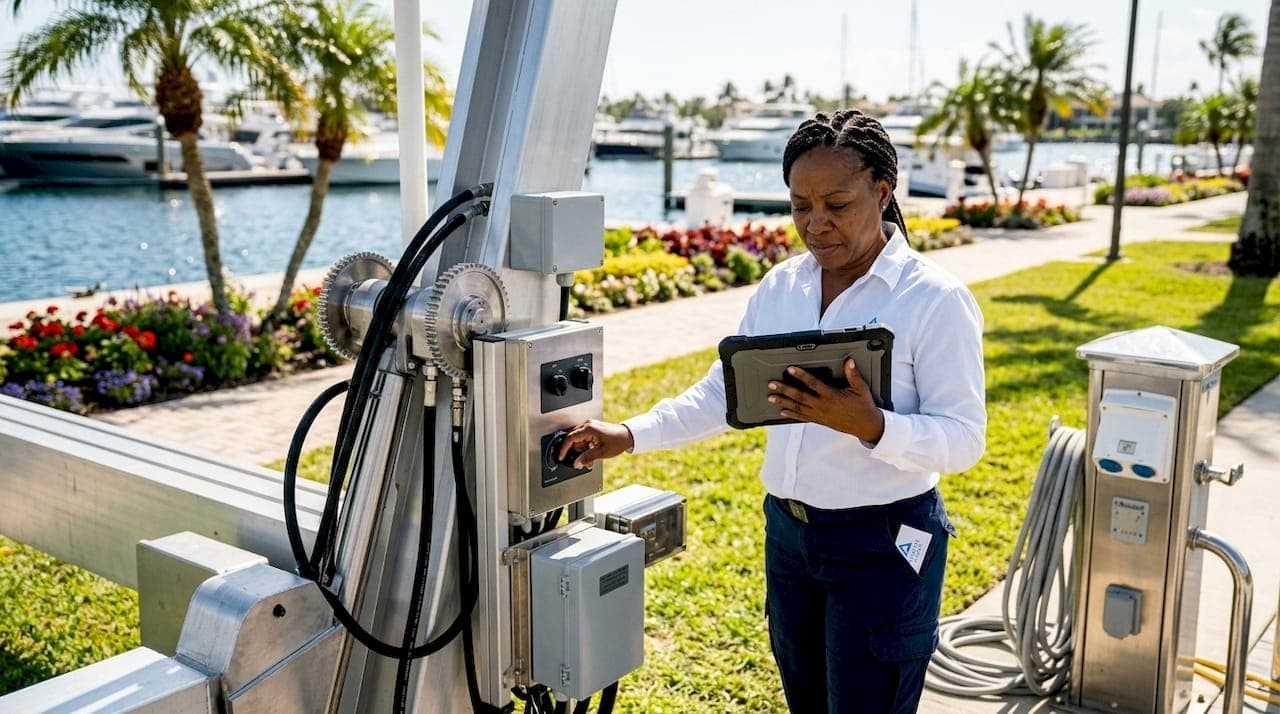
AUX device control in boat lifts is defined as the centralized management of auxiliary lift functions and connected equipment from the same control layer as the lift motor itself, rather than treating each device as a separate manual switch. For marina operators, dockmasters, and boat lift owners, the role of aux device control in boat lifts goes far beyond convenience. It directly affects safety compliance, operational efficiency, and the quality of experience tenants receive every time they use the facility. Atlantis Marina connects this control layer to CRM records, billing status, staff permissions, and facility workflows, turning a mechanical function into a fully managed marina asset.
What is the role of aux device control in boat lifts?
Aux device control gives marina operators a single point of authority over every auxiliary function tied to a boat lift. Instead of separate switches for dock lighting, alarms, access gates, or water pumps, one unified control layer manages all of them. That centralization is the foundation of safer, more auditable marina operations.
The practical impact is immediate. When a dockmaster can grant or revoke access to specific lift functions from a software dashboard, unauthorized operations drop. Tenants cannot activate equipment they have not been cleared to use. Staff can see exactly who triggered which function and when, creating an audit trail that protects the marina from liability disputes.
Atlantis Marina extends this control layer through its smart boat lift control platform, connecting the Atlantis Mini, Plus, or Retrofit PCB to telemetry, staff permissions, and the Boater App. The result is a system where every aux action is logged, permissioned, and visible in real time.
How does aux device control improve safety and reduce risk?
Safety is the most direct benefit of centralized auxiliary boat lift control. Smart remote control eliminates the repetitive dock-to-boat cycling that drives the majority of marina slips, falls, and improper docking incidents. Removing that physical exposure is the single most effective risk reduction a marina can make.

Permissioning adds a second layer of protection. When access to aux functions is tied to billing status, staff authorization, or tenant account standing, the lift simply will not respond to unauthorized commands. Atlantis Marina's Instant Pay reactivation feature takes this further: a tenant whose account lapses can restore lift access the moment payment clears, without staff intervention.
Premium control systems built for commercial marine environments use 30 Amp heavy-duty relays complying with Federal Requirements 29 CFR 1910.399. That standard governs electrical safety in marine settings and sets the baseline for FCC and ETL listed equipment. Meeting it is not optional for marinas operating in regulated jurisdictions.
Key safety features every marina operator should verify in an aux control system:
- Emergency stop: Immediate halt of all lift and auxiliary functions from any control point
- Manual override: Physical backup control in case of wireless signal loss or power interruption
- Secure activation: PIN, app login, or permissioned remote required before any function triggers
- Audit trail: Timestamped log of every command, user, and outcome stored in the management platform
- Camera integration: Live or recorded feed tied to lift activity for incident documentation
Pro Tip: Link your camera feeds directly to lift activity logs in Atlantis Marina's camera security module. When an incident occurs, you can pull the exact video timestamp that matches the control log entry, cutting investigation time significantly.
What efficiency gains come from automating auxiliary lift functions?
Automation is where aux device control pays for itself operationally. Scheduled auxiliary actions, such as dock lighting turning on at dusk or bilge alarms activating during storm windows, remove the need for staff to make manual rounds. That time goes back to higher-value tasks.
The efficiency gains compound when you replace mechanical limit switches with digital travel limits. Digital systems prevent cable wear drift and temperature-induced positioning errors, delivering zero-drift positioning that eliminates manual recalibration. A marina running 40 lifts with mechanical switches may recalibrate several times per season. Digital limits reduce that to near zero.
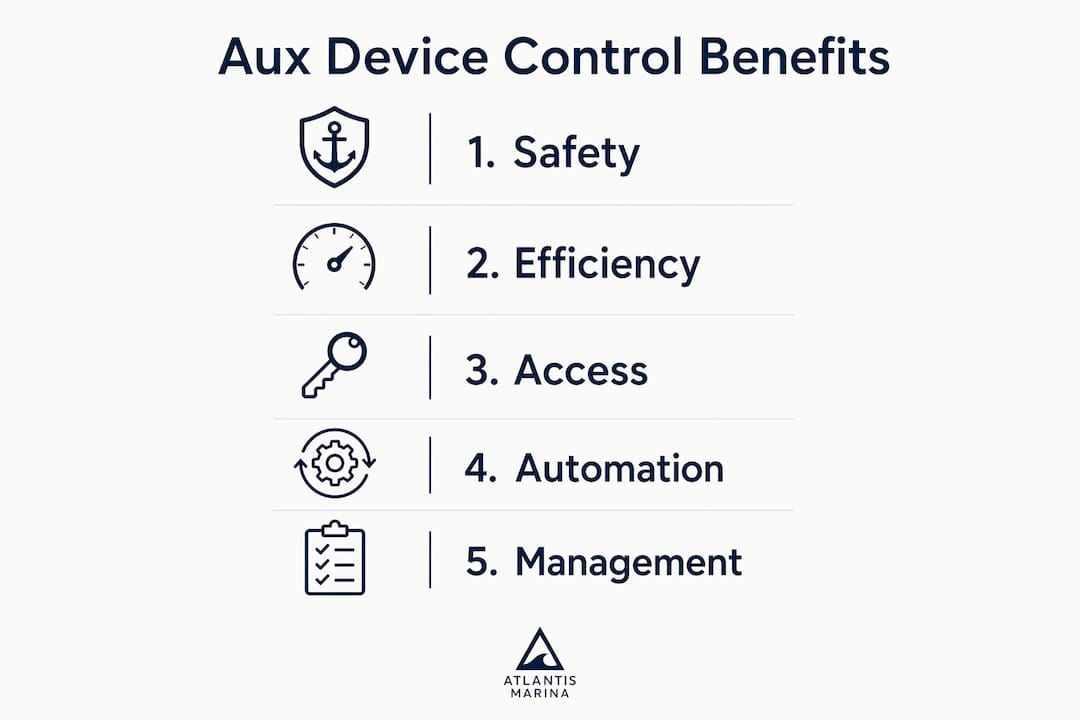
Wireless RF remotes extend operational reach without adding staff. Wireless control from dock, boat helm, or shoreline covers approximately 200 feet line of sight, which handles most slip configurations. For larger facilities or multi-building dry stack operations, Bluetooth and smartphone app control adds unlimited range through cellular and Wi-Fi, removing the distance constraint entirely.
The operational improvements stack up in a clear sequence:
- Scheduled auxiliary actions remove manual rounds for lighting, alarms, and pumps
- Digital travel limits eliminate recalibration labor and cable wear errors
- Wireless RF control covers standard slip distances without dockside trips
- Bluetooth and app control extends reach across the full facility via cellular
- Centralized diagnostics surface lift faults in the management dashboard before they become failures
| Control method | Operational range | Key advantage |
|---|---|---|
| Wired manual switch | On-site only | No wireless dependency |
| Wireless RF remote | ~200 feet line of sight | Eliminates dockside trips |
| Bluetooth app | Facility-wide via Wi-Fi | Multi-user, permissioned access |
| Cloud-connected platform | Unlimited via cellular | Full audit trail and remote management |
How does aux control enhance tenant experience and marina management?
Tenants judge a marina by how easy it is to use their slip. Aux device control directly shapes that experience. A tenant who can raise and lower their lift, trigger dock lighting, and check lift status from a smartphone app has a fundamentally different relationship with the marina than one who walks to a manual switch box in the rain.
Atlantis Marina ties aux control to the full tenant account record. Billing status, vessel information, reservation history, and lift permissions all live in one place. When a tenant's account is current, their lift access is active. When it lapses, access suspends automatically. Instant Pay reactivation restores it the moment the invoice clears, with no staff call required.
Maintenance alerts add another layer of tenant confidence. When a lift sensor detects an anomaly, the system flags it in the operations dashboard and can notify the tenant simultaneously. That proactive communication reduces complaints and builds trust.
Specific ways aux device control improves the tenant and management experience:
- User-friendly app control lets tenants operate lifts and auxiliary devices without visiting the dock
- Access tied to billing removes manual enforcement and reduces awkward staff-tenant conversations
- Maintenance alerts notify both staff and tenants when a lift needs attention
- Marina reservations integration links lift access to reservation windows, preventing use outside booked periods
- QR code workflows let staff quickly pull up a tenant's lift permissions, billing status, and vessel record during any dockside interaction
Technical overview of modern aux device control systems
Modern aux control hardware has closed the gap between residential and commercial-grade capability. Installation under 20 minutes is achievable by directly replacing manual wheel controls with direct-drive motor systems, with no welding or drilling required. That installation profile makes facility-wide upgrades practical without extended downtime.
Direct-drive motors paired with 30 Amp marine-grade relays handle the electrical demands of commercial lift cycles. Auto-stop and auto-run features prevent over-travel and reduce motor strain, extending equipment life. These are not luxury additions. They are the baseline for any lift operating in a commercial marina environment.
Connectivity options now span three tiers. Wired controls remain the most reliable in RF-congested environments. Wireless RF remotes suit most residential and mid-size commercial applications. Bluetooth and cloud-connected systems suit facilities where multi-user access and operational visibility are priorities, which describes virtually every commercial marina.
Pro Tip: When evaluating an aux control upgrade, check whether the system supports the Atlantis Retrofit PCB. It allows existing lift hardware to gain smart control capability without full motor replacement, which cuts upgrade cost and installation time for established facilities. See the dealer tool kit for compatibility details.
Key Takeaways
AUX device control is the operational backbone of a safe, efficient, and tenant-ready boat lift facility, and platforms like Atlantis Marina make it fully manageable from one dashboard.
| Point | Details |
|---|---|
| Centralized control improves safety | Permissioned access and audit trails prevent unauthorized lift operations and document every command. |
| Digital limits reduce maintenance labor | Zero-drift positioning eliminates seasonal recalibration caused by mechanical wear or temperature changes. |
| Wireless and app control cut dockside trips | RF remotes cover 200 feet; Bluetooth and cellular extend control across the full facility. |
| Billing integration automates access | Atlantis Marina links lift permissions to account status, with Instant Pay reactivation removing manual enforcement. |
| Smart upgrades install fast | Direct-drive motor replacements take under 20 minutes with no welding or drilling on major lift brands. |
Why aux control strategy matters more than most operators realize
I have worked with marina operations long enough to watch the same mistake repeat itself: facilities invest in new lifts but leave the control layer manual. The lift is new. The workflow is 1990. That gap is where accidents happen and tenants get frustrated.
The operators who get this right treat aux device control as a management function, not a hardware function. They ask who has access, when access is active, what the lift did last Tuesday, and whether the maintenance alert from slip 14 was resolved. Those are management questions. They require a management platform, not just a remote control.
What I find most compelling about the direction Atlantis Marina is taking is the connection between the control layer and the business layer. Billing, reservations, vessel records, and lift permissions are not separate systems. They are the same operational picture. When a tenant's payment clears and their lift activates automatically, that is not a technology trick. That is a marina running the way it should.
Phased upgrades are the practical path for most facilities. Start with the lifts that generate the most service calls or tenant complaints. Add digital limits and wireless control first. Then connect those lifts to the management platform. The ROI shows up in reduced staff time, fewer incidents, and measurably better tenant retention.
— John R
Atlantis Marina and smart boat lift management
Atlantis Marina connects smart lift controls with the full marina management stack: tenant accounts, billing, reservations, maintenance alerts, camera feeds, and staff permissions. Dockmasters get a single dashboard that shows lift status, access logs, and tenant account health in real time.
The platform supports the Atlantis Mini, Plus, and Retrofit PCB, making it compatible with existing lift hardware at most facilities. Billing-linked access, Instant Pay reactivation, and the Boater App give tenants a modern experience while giving staff complete operational control. Schedule a demo through the marina management platform to see how Atlantis Marina unifies aux device control with every other aspect of waterfront operations.
FAQ
What is aux device control in a boat lift?
Aux device control is the centralized management of auxiliary lift functions, such as lighting, alarms, and access gates, from the same control layer as the lift motor. It replaces separate manual switches with a unified, permissioned system.
How does aux control improve marina safety?
Centralized aux control reduces dockside trips, which are the primary cause of marina slips and falls. Systems built to 29 CFR 1910.399 standards add emergency stop, manual override, and secure activation to further reduce risk.
Can aux device control integrate with marina management software?
Atlantis Marina connects aux control directly to tenant billing, reservations, and staff permissions, so lift access activates and suspends automatically based on account status.
What is the installation time for a modern aux control upgrade?
Direct-drive motor systems replace manual wheel controls in 20 minutes or less on major lift brands, with no welding or drilling required.
What is the difference between RF and Bluetooth boat lift control?
Wireless RF remotes operate at approximately 200 feet line of sight and suit most standard slip configurations. Bluetooth and app-based control uses cellular and Wi-Fi for unlimited range and supports multi-user permissioned access across a full facility.