
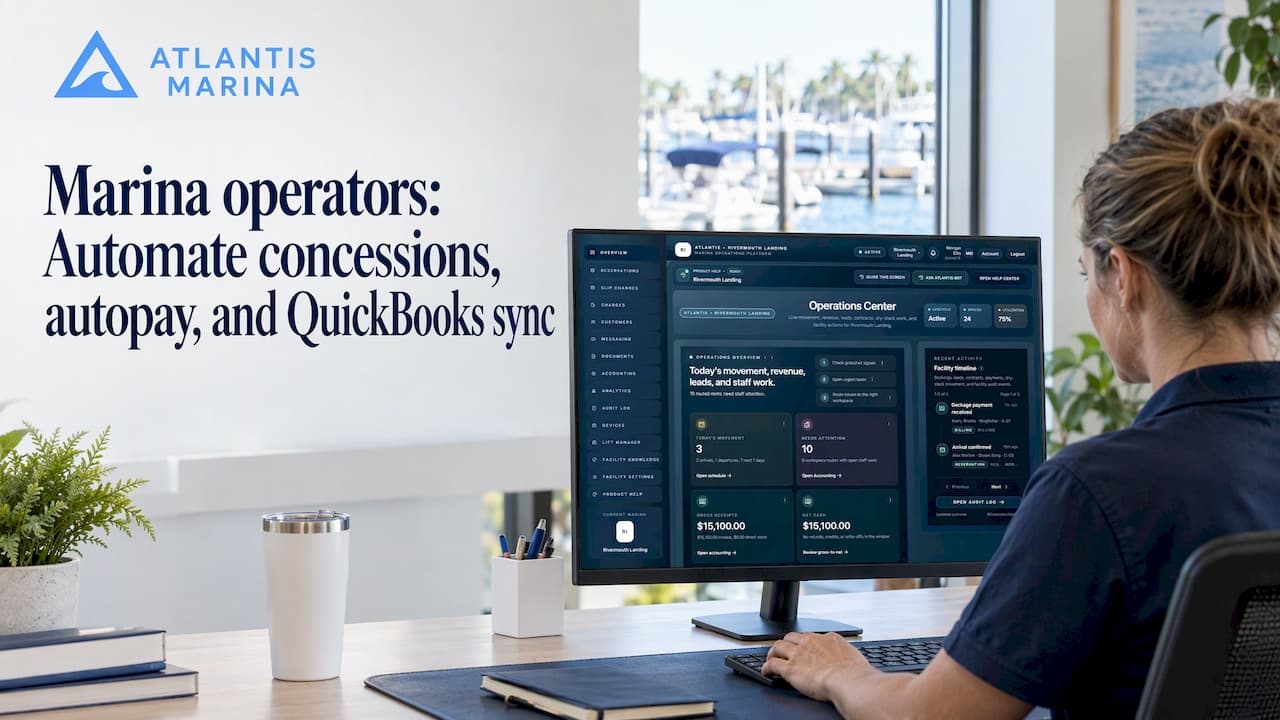
The fastest way to run reliable concessions and discounts is to tie ship-store POS, pricing rules, billing automation, and accounting into one connected system rather than juggling spreadsheets and a standalone register. We built Atlantis Marina around that exact workflow: a pricing engine, autopay and refund automation, QuickBooks sync, and QR-based account recognition that work together so discounts apply correctly the first time, every time.
TL;DR:
- Connecting POS, billing automation, and accounting systems reduces manual work and ensures discounts and updates apply correctly everywhere.
- Proper configuration of seasonal, membership, spend-threshold, and promo-code discounts is essential, with stacking rules set before launch to prevent conflicts.
- Automating contracts, autopay, refunds, and reconciliation minimizes errors and saves staff time, especially when integrated with QuickBooks Online.
- Synchronizing SKU data, membership flags, and QR code workflows between POS and billing systems prevents manual overrides and discount errors at checkout.
- Clear policies, SKU tagging, and verifying customer eligibility through digital passes help maintain consistent discount application and prevent billing disputes.
- ✓Ship store POS and customer accounts
- ✓Autopay, refunds, and adjustments
- ✓QuickBooks Online sync
- ✓QR-based account recognition
Table of Contents
- Core components every marina pricing system needs
- How to set up seasonal, membership, and promo-code discounts
- Automating contracts, autopay, refunds, and reconciliation
- Why POS, QR codes, and hardware need to work together
- Implementation checklist for a smooth rollout
- Legal and regulatory considerations for marina concessions and discounts
- Best practices for marketing marina discounts and concessions
- How to verify customer eligibility for marina discounts
- How concessions and discounts affect marina revenue
- Common types of concessions and discounts at marinas
- An operator's view on what actually breaks discount programs
- How Atlantis Marina supports concessions and discounts
- FAQ
- Sources
Core components every marina pricing system needs
Before you configure a single promo code, your platform needs the right modules in place. Each one feeds the next, so a gap in one creates manual work downstream.
- Ship-store POS that syncs SKUs, membership flags, and price-lists so staff never override prices by hand.
- A pricing rule engine that supports seasonal date ranges, member price-lists, SKU-level promos, and basket-level thresholds.
- A customer account model that tags slip-holders and members so recurring membership fees and discounted rates attach automatically.
- Billing automation that handles contracts, autopay, refunds, and adjustments with a clean audit log behind every change.
- Accounting sync, specifically QuickBooks, so revenue closes without a staff member re-entering transactions by hand.
We built our marina billing software to connect each of these pieces directly, and our ship-store POS integration keeps SKU data and pricing in sync with the same account records your billing team uses. When these systems share one database instead of five disconnected tools, a seasonal rate change or a new membership tier updates everywhere at once.
How to set up seasonal, membership, and promo-code discounts
Most marinas run the same four discount types, and each one needs its own configuration logic to avoid overlap errors.
- Seasonal pricing. Build a date-range price-list, schedule it to activate automatically, and confirm your reporting tags the transactions to that season so revenue attribution stays clean.
- Membership pricing. Flag member accounts at the profile level, then apply either a dedicated member price-list or a line-item discount at checkout, with recurring membership billing running separately from the discount itself.
- Spend-threshold discounts. Set basket-level rules, for example a percentage off once a purchase crosses a set dollar amount, and decide upfront whether that rule stacks with SKU-level promos or overrides them.
- Promo codes. Define whether a code is single-use or multi-use, set an expiration date, specify which price-lists it can override, and restrict it to an account segment if needed.
- Refunds and adjustments. Separate staff-verified refunds from any automatic return flow, and make sure every adjustment lands in an audit trail that maps cleanly to your accounting entries.
Pro Tip: Build your promo-code stacking rules before launch, not after the first customer complaint about two discounts applying at once.
Automating contracts, autopay, refunds, and reconciliation
Billing automation only pays off when the workflow around it is designed carefully. A contract signed electronically should carry its price schedule forward automatically, including any auto-renew terms, so the charge that posts to an account matches what was agreed at signing.
- Contract lifecycle: e-signature, linked pricing, and auto-renew terms should flow into the billing record without a second data entry step.
- Autopay handling: store payment instruments securely, treat ACH and card payments differently for timing and fees, and build a remediation path for failed payments before they become overdue balances.
- Refund and adjustment controls: automate routine, low-dollar returns, but require staff verification above a set threshold, and keep every change logged for your books.
- Reconciliation: sync settlements to QuickBooks automatically and route exceptions to a queue staff can clear quickly instead of chasing them across spreadsheets.
Our marina payment processing workflow handles Stripe and ACH settlement timing, and our platform's autopay, Instant Pay, and refund tools post directly to QuickBooks Online so your books close without a manual reconcile at month end.
Why POS, QR codes, and hardware need to work together
A pricing rule is only as good as the checkout experience that applies it. When ship-store POS doesn't share SKU taxonomy and membership flags with the billing system, staff end up manually overriding prices, which is where discount errors start.
- Ship-store POS sync: SKUs, price-lists, and membership flags need to move both directions so a discount set centrally shows up correctly at the register.
- QR-code workflows: a boater's digital pass or account QR code should pull up their membership status instantly, so a member discount applies without a lookup.
- Mobile and handheld POS: tablets and scanning devices let dockside staff apply the right price without walking back to a terminal.
Vendor implementation guidance from marine POS integrators shows that systems configured with seasonal and member pricing layers reduce the manual overrides that cause pricing mismatches at checkout. Our QR-based account recognition connects a boater's profile to POS and billing in one step, so the sale and the invoice always match.
Implementation checklist for a smooth rollout
Rolling out a new pricing structure works best as a sequence rather than everything at once.
- Map your policies first. Document every discount type, SKU tag, membership definition, and how each maps to your chart of accounts.
- Set configuration priorities. Decide promo-rule stacking order, tax mapping, autopay terms, and refund windows before you touch the live system.
- Test end to end. Run full test purchases, simulate a failed payment, and pull a reporting sanity check before go-live.
- Prepare your team. Train staff on the new workflow, write down the procedures, and schedule a recurring reconciliation review.
- Track the right numbers. Watch discount redemption rates, average transaction value, and how much time reconciliation takes compared to before.
Pro Tip: Run your first full billing cycle in parallel with your old process for one month. It catches mapping errors before they hit your books.
Our pricing and plan tiers scale from a Micro marina to Enterprise operations, so you can match the rollout to the size of your facility rather than overbuying features you won't use yet.
Legal and regulatory considerations for marina concessions and discounts
Discount programs and on-site concessions sit inside a web of existing obligations, not a separate regulatory category of their own. Any ship-store sale still falls under your state's sales tax rules, so a promo code or member price reduces the taxable amount, not the requirement to collect and remit tax correctly. If your marina leases space to an outside concession operator, that lease typically needs its own terms covering liability, insurance, and how pricing authority is split between the lessee and the marina.
Membership pricing also deserves a careful look at consistency. Offering different rates to different slip-holders is common and generally lawful, but the criteria should be written down and applied evenly to avoid the appearance of arbitrary treatment, particularly if your marina operates on public or municipally leased waterfront. Refund policies tied to discounted purchases should be stated clearly at the point of sale, since ambiguous refund terms are a frequent source of billing disputes.
None of this replaces a conversation with your own attorney or accountant, especially around lease terms for concession operators or state-specific tax treatment of bundled services. What a connected platform can do is keep your pricing rules, tax mapping, and audit trail consistent so that when a regulator or auditor asks how a discount was applied, you have a clean record rather than a reconstruction job.

Best practices for marketing marina discounts and concessions
A discount only drives behavior if the right customer sees it at the right moment. Seasonal rate changes work best announced before the season starts, not after slips are already full, since early movers are the ones most likely to act on a time-limited rate. Membership pricing, by contrast, markets itself best at renewal time and at the point a transient boater is deciding whether to become a regular.
Promo codes tend to perform better when they're tied to a specific action, like booking a certain number of nights or hitting a spend threshold in the ship store, rather than offered as a blanket discount with no condition attached. That also makes the promotion easier to track against revenue impact later.
Consistency in messaging matters as much as the offer itself. If your dock master mentions a discount verbally that doesn't match what's configured in your pricing engine, you create a dispute before the transaction even happens. Keeping promotional messaging, posted signage, and the actual configured price-list in sync is less about marketing polish and more about avoiding billing arguments down the line.
How to verify customer eligibility for marina discounts
Every discount type needs a clear way to confirm the person in front of the register, or the account logging in online, actually qualifies for the rate they're requesting. Membership discounts rely on an account flag set when a slip-holder signs their contract, which should be the single source of truth rather than a list staff check manually.
Spend-threshold and promo-code discounts need their own verification logic too. A single-use code should lock after redemption, and an account-segment restriction should check the customer's profile before the discount applies, not after.
The most reliable eligibility check at the point of sale is tying a boater's account directly to a scannable credential. A QR code or digital pass that pulls up membership status, contract terms, and billing standing the moment it's scanned removes the guesswork for staff and prevents a discount from being applied to the wrong account. That single step also closes the gap between what gets sold and what gets invoiced later.

How concessions and discounts affect marina revenue
Discounts are a trade: a lower price now in exchange for a behavior you want, whether that's filling slips in a slow season, rewarding long-term members, or moving ship-store inventory before it ages. The revenue impact depends entirely on whether that trade is measured. A seasonal discount that fills slips that would otherwise sit empty adds revenue even at a reduced rate. The same discount applied to slips that would have rented anyway is a straight loss.
This is where tracking redemption against actual transaction value matters more than the discount percentage itself. A marina running multiple promotions without a way to see which ones drove incremental business is flying blind on profitability, even if the ship store looks busier.
Billing automation plays a quieter but real role here too. Every manual override, missed reconcile, or billing dispute tied to a confusing discount policy costs staff time that has a real cost, even when it never shows up as a line item. Keeping pricing rules and refund logic automated and auditable protects margin as much as the discount strategy itself does.
Common types of concessions and discounts at marinas
Marinas tend to run a consistent set of discount structures, even though the specific terms vary by facility and region.
- Long-term berth discounts: reduced monthly rates for slip-holders who commit to a season or a full year instead of month to month.
- Early booking discounts: a lower rate for boaters who reserve a slip well ahead of peak season.
- Member price-lists: discounted ship-store and service pricing tied to an active slip-holder or club membership.
- Volume and spend-threshold discounts: a percentage off once a purchase or seasonal spend crosses a set amount.
- Off-season or shoulder-season rates: lower slip and storage pricing during the months when demand drops.
- Loyalty or renewal discounts: a rate reduction offered specifically at contract renewal to retain existing slip-holders.
Each of these can be configured as its own price-list or rule inside a pricing engine, which matters because overlapping discounts without a clear stacking order are the most common source of billing confusion we hear about from operators.
An operator's view on what actually breaks discount programs
The biggest change after automating concessions isn't speed, it's fewer billing disputes. Most of the problems we see trace back to overlapping promotions nobody tracked, SKU tags that were never set, or refund rules staff interpreted differently from one shift to the next.
Three fixes make the most difference in the first 30 to 90 days: lock your promo stacking order before launch, tag every SKU and membership tier up front, and write down your refund thresholds so staff aren't guessing.
— John R
How Atlantis Marina supports concessions and discounts
We built our platform to handle the full concessions workflow in one place instead of stitching together a register, a spreadsheet, and a separate billing tool. If you're ready to see how the pieces fit your marina, this is where we can help directly.

- Ship-store POS that keeps SKUs, membership flags, and price-lists synced with your billing system.
- Billing automation covering contracts, autopay, refunds, and adjustments with a clean audit trail.
- QuickBooks Online sync so revenue closes without manual data entry.
- Atlantis Bot to answer staff and boater questions about pricing, billing, and ship-store restocking.
- QR-code account workflows that apply the right discount automatically at checkout.
Our plans run with tiered monthly pricing up to an Enterprise level, with details available on our pricing & plans page. See how the platform fits your marina on our sales page and book a walkthrough whenever you're ready.
FAQ
What software do marinas use to manage concessions and discounts?
Marinas typically use an integrated marina management platform that combines ship-store POS, a pricing rule engine, and billing automation rather than separate tools. Atlantis Marina offers this as one connected system, with plans starting at $150 per month for the Micro tier.
How do marinas set up seasonal pricing rules?
Seasonal pricing is typically built as a date-range price-list that activates and deactivates automatically, so staff never apply the wrong rate manually. Reporting should tag transactions to the correct season so revenue attribution stays accurate.
Can promo codes and membership discounts stack?
Stacking depends entirely on how the rules are configured, and most marinas set a clear priority order so a promo code either overrides or combines with a member price-list, never both by accident. Defining this order before launch is the single biggest way to avoid billing disputes.
How does QuickBooks sync help with marina billing?
Syncing a billing system with QuickBooks Online closes revenue automatically after each transaction, which removes the need for staff to re-enter settlements by hand. It also makes refunds and adjustments easier to trace back to the original sale.
What is the most common mistake with marina discount programs?
The most common mistake is running overlapping promotions without a defined stacking order or SKU tagging, which leads to pricing mismatches at checkout and billing disputes afterward. Setting clear rules and verifying eligibility at the point of sale before launch avoids most of these issues.