

Marina payment processing is defined as a unified system that consolidates slip rentals, fuel dock charges, retail sales, labor, and service fees into a single, integrated transaction workflow built for marine operators. Most marinas still run separate point-of-sale terminals, fuel dock registers, and billing software that never talk to each other. That fragmentation costs real money and real time. Understanding how integrated payment processing works is the first step toward fixing it.
The industry term for this approach is integrated marina billing, and it covers everything from how a charge is authorized at the fuel dock to how a slip rental invoice reaches a boater's inbox. Marina payment processing explained properly means covering the full cycle: checkout flows, gateway features, surcharge logic, and the emerging shift toward cashless luxury experiences.
What is marina payment processing and why does it matter?
Marina payment processing is the end-to-end system that captures, routes, and settles every financial transaction at a marina property. That includes slip rentals, fuel sales, pump-out fees, ship store purchases, haul-out labor, and utility billing. When these revenue streams run through separate, disconnected systems, staff spend hours each day manually reconciling totals that should have matched automatically.
Non-integrated systems for fuel docks, store POS terminals, and slip billing create reconciliation gaps that require manual aggregation. Those gaps translate directly into billing errors, missed charges, and frustrated customers. The financial impact compounds quickly at a busy marina processing hundreds of transactions per week.
Integrated payment processing solves this by treating every charge as part of one continuous billing record tied to a vessel and its owner. The dockmaster does not need to cross-reference three separate systems at the end of the day. The boater receives one clear invoice. Both outcomes improve the operation.
How unified checkout systems work in marina billing
A unified checkout flow consolidates all charges including fuel, slip rental, repairs, utilities, and retail into one transaction stream, improving accuracy and operational efficiency. The practical effect is that a boater who fuels up, buys dock lines from the ship store, and pays for a night's slip rental sees one combined invoice rather than three separate receipts.
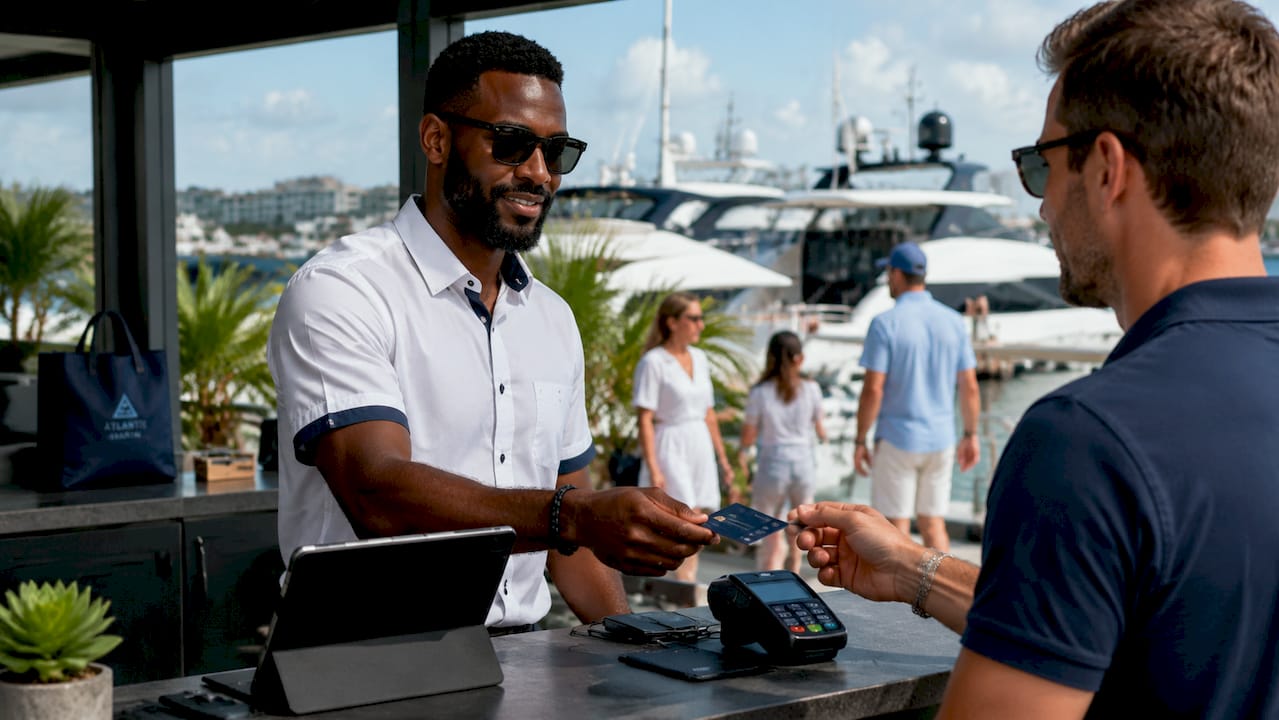
The mechanics work through attachable charges. When a fuel dock transaction is completed, the software automatically links it to the vessel's active billing record. Service tickets from the yard crew attach the same way. By the time the boater checks out, every charge is already waiting in a single invoice ready for review and payment.
Before and after unified checkout:
| Scenario | Fragmented system | Unified system |
|---|---|---|
| Fuel dock charge | Separate POS, manual entry | Auto-attached to vessel record |
| Slip rental billing | Standalone invoicing software | Included in combined checkout |
| Retail purchase | Independent store register | Linked to active billing account |
| End-of-day reconciliation | Manual cross-referencing | Automated, real-time |
| Error rate | High, due to manual steps | Low, due to system integration |
The staff workload reduction is significant. Automation removes the manual reconciliation step entirely, which also removes the human error that step introduces. Dockmasters can focus on operations rather than spreadsheets.
Pro Tip: Before committing to any unified checkout platform, verify that it integrates directly with your existing marina management software via a native connection or a documented API. A third-party integration that requires manual data exports defeats the purpose of unification.
For marinas managing ship store transactions alongside slip billing, the value of a single checkout screen becomes obvious within the first week of use.
What features do marina payment gateways need for high-value transactions?
Standard retail payment gateways are not built for the transaction sizes and complexity that marine operators routinely handle. A yacht charter deposit, a haul-out invoice, or a seasonal slip contract can each run into tens of thousands of dollars. Standard gateways cap transactions, reject cross-border payments, and lack the escrow workflows that high-value marine deals require.
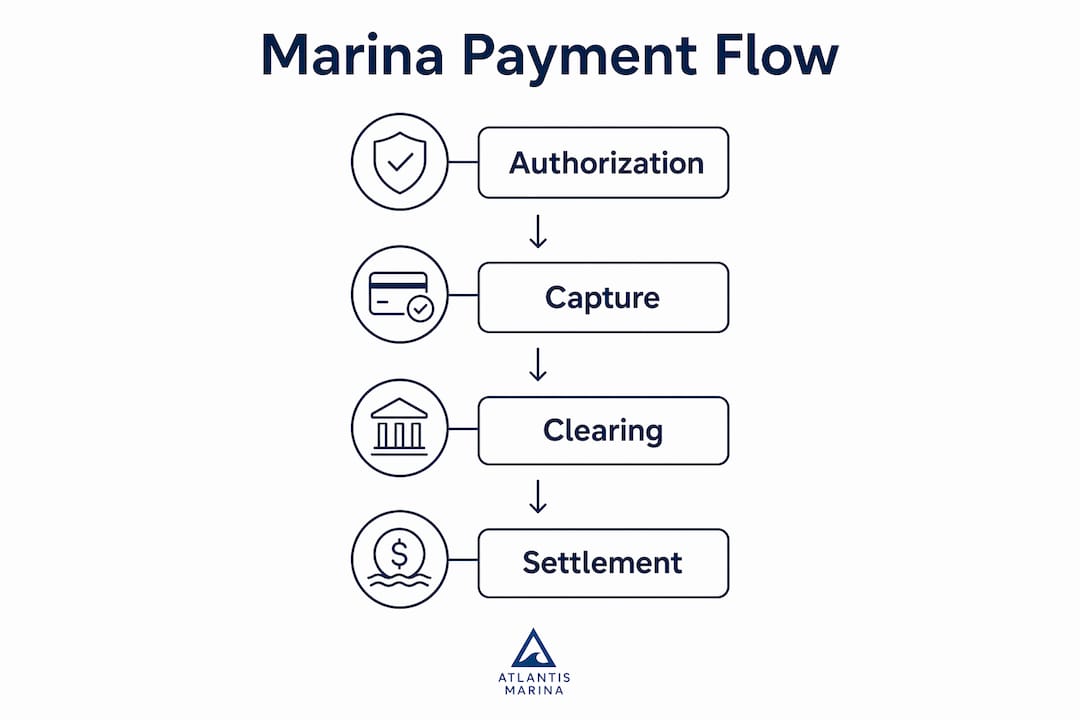
Marine merchant payment processing flows through four stages: authorization, capture, clearing, and settlement, with settlement completing in 1–3 days. Yacht-specific gateways add multi-currency support, escrow functionality, and high transaction limits designed for international deals. That distinction matters when a European buyer is booking a slip at a Florida marina and paying in euros.
Standard vs. yacht-specific gateway features:
| Feature | Standard gateway | Yacht-specific gateway |
|---|---|---|
| Transaction limit | Typically capped at retail levels | High-limit, supports large deposits |
| Multi-currency | Limited or unavailable | Full multi-currency settlement |
| Escrow support | Not available | Built-in escrow workflows |
| Identity verification | Basic card checks | KYC and compliance verification |
| Crypto compatibility | Rare | Available on advanced platforms |
| 3D Secure | Standard | Dynamic, surcharge-aware |
High-value international transactions require escrow workflows, multi-currency settlements, identity verification, and flexible payment rails including crypto compatibility. These are not optional features for luxury marinas. They are the baseline for operating safely at the high end of the market.
3D Secure protection and surcharge logic compliance in payment gateways mitigate fraud and reduce processing fees, which is critical for high-value marine transactions. A gateway without dynamic surcharge logic leaves money on the table every single month.
How to reduce marina transaction fees with surcharge optimization
Surcharging is the practice of passing credit card processing fees to the cardholder rather than absorbing them as a marina operating cost. When implemented correctly and in compliance with card network rules, it is one of the most direct ways to cut monthly payment costs. The key word is "correctly." Surcharging applied to debit cards is prohibited under card network rules, which means automated debit card detection is not optional. It is a compliance requirement.
Compliant surcharging and automated card-type detection can reduce monthly credit card processing costs by 20% to 90%. Operators processing $200,000 monthly can save approximately $6,000 per month by optimizing payment routing and fee recovery. That is $72,000 per year returned to the operation.
Common pitfalls in surcharge implementation include:
- Applying surcharges to debit card transactions, which violates card network rules
- Failing to disclose surcharges at the point of sale, which creates chargebacks
- Using a processor that does not automatically distinguish between credit and debit cards
- Setting surcharge rates above the card network maximum, currently capped at 3% in most U.S. states
- Ignoring state-level surcharge restrictions, which vary significantly
Pro Tip: Choose a payment processor that handles surcharge logic automatically and updates its debit card detection database regularly. Manual surcharge management creates compliance risk every time a new card product enters the market.
Marinas managing recurring billing for tenants benefit especially from automated surcharging, since monthly slip fees processed on credit cards generate predictable, recoverable fee volumes.
How the luxury marina payment experience is shifting toward cashless
The luxury marina segment is moving away from card-present transactions toward a model where payment is effectively invisible to the guest. The concept driving this shift is wallet provisioning: capturing and tokenizing a guest's payment method at the time of reservation or check-in, then processing all subsequent charges automatically without asking for the card again.
Wallet provisioning at booking enables automatic tokenized processing of subsequent charges without repeated card capture. That means a boater who checks in on monday morning does not need to present a card again for fuel, pump-out, or a dinner reservation at the marina restaurant. Every charge flows to the provisioned wallet and settles at departure.
Luxury yacht charter payment schedules already reflect this structured approach. Charter payment schedules typically require a 50% deposit at booking, with the final balance and an Advance Provisioning Allowance (APA) due 60–90 days before arrival. The APA ranges from 30% to 35% of the base charter fee and covers fuel, provisions, and port fees. That structure ensures funds are cleared and available before the vessel ever leaves the dock.
The operational shift required to support this model goes beyond installing new software. Key elements include:
- Training front desk and dockmaster staff to capture payment methods at check-in, not at checkout
- Configuring the billing system to attach charges in real time rather than batching them at departure
- Communicating the cashless process to guests before arrival so expectations are set correctly
- Auditing the provisioned wallet balance before departure to catch any missed charges
The industry shift toward cashless luxury depends more on operational culture change than on software upgrades alone. The technology exists. The harder work is changing the habits of staff who have processed payments the same way for years.
Key Takeaways
Effective marina payment processing requires unified billing, compliant surcharging, and a culture shift toward wallet provisioning at check-in.
| Point | Details |
|---|---|
| Unified checkout reduces errors | Consolidating fuel, slip, retail, and service charges into one record eliminates manual reconciliation. |
| Gateway features must match transaction scale | High-value and international marine deals require escrow, multi-currency, and 3D Secure compliance. |
| Surcharging cuts processing costs significantly | Compliant surcharging can reduce monthly fees by 20% to 90% when debit card detection is automated. |
| Wallet provisioning defines luxury billing | Capturing payment at check-in and tokenizing it removes card friction for every subsequent charge. |
| Culture change drives adoption | Software alone does not fix billing gaps. Staff training and process discipline complete the system. |
What I have learned from watching marinas adopt payment systems
The most common mistake I see marina operators make is treating payment system upgrades as a technology project. They install new software, connect the gateway, and expect the reconciliation problems to disappear. They rarely do. The software is only as good as the process running underneath it.
Wallet provisioning is the single feature that separates a genuinely modern marina billing experience from one that just looks modern on paper. When a marina captures payment at reservation and provisions that wallet for the entire stay, the guest experience changes completely. There are no awkward card requests at the fuel dock. There is no end-of-stay scramble to settle a long list of charges. The yacht club billing model has operated this way for decades. The rest of the marina industry is catching up.
The operators who struggle most are the ones running disconnected systems for fuel, retail, and slip billing. They know the numbers do not add up at the end of the month. They just do not realize the fix is a process change, not a spreadsheet upgrade. Choosing a platform with attachable charges and a unified billing record solves the technical side. Committing to capturing payment at check-in solves the operational side. Both are required.
— John
How Atlantis-marina handles integrated marina billing
Atlantis-marina brings together slip management, reservations, billing, and payment processing in one cloud-based platform built specifically for marina operators. The billing module supports recurring charges, utility billing, online payments, and invoice management from a single dashboard. Dockmasters can attach service charges in real time, and boaters receive clear, consolidated invoices through the customer portal.
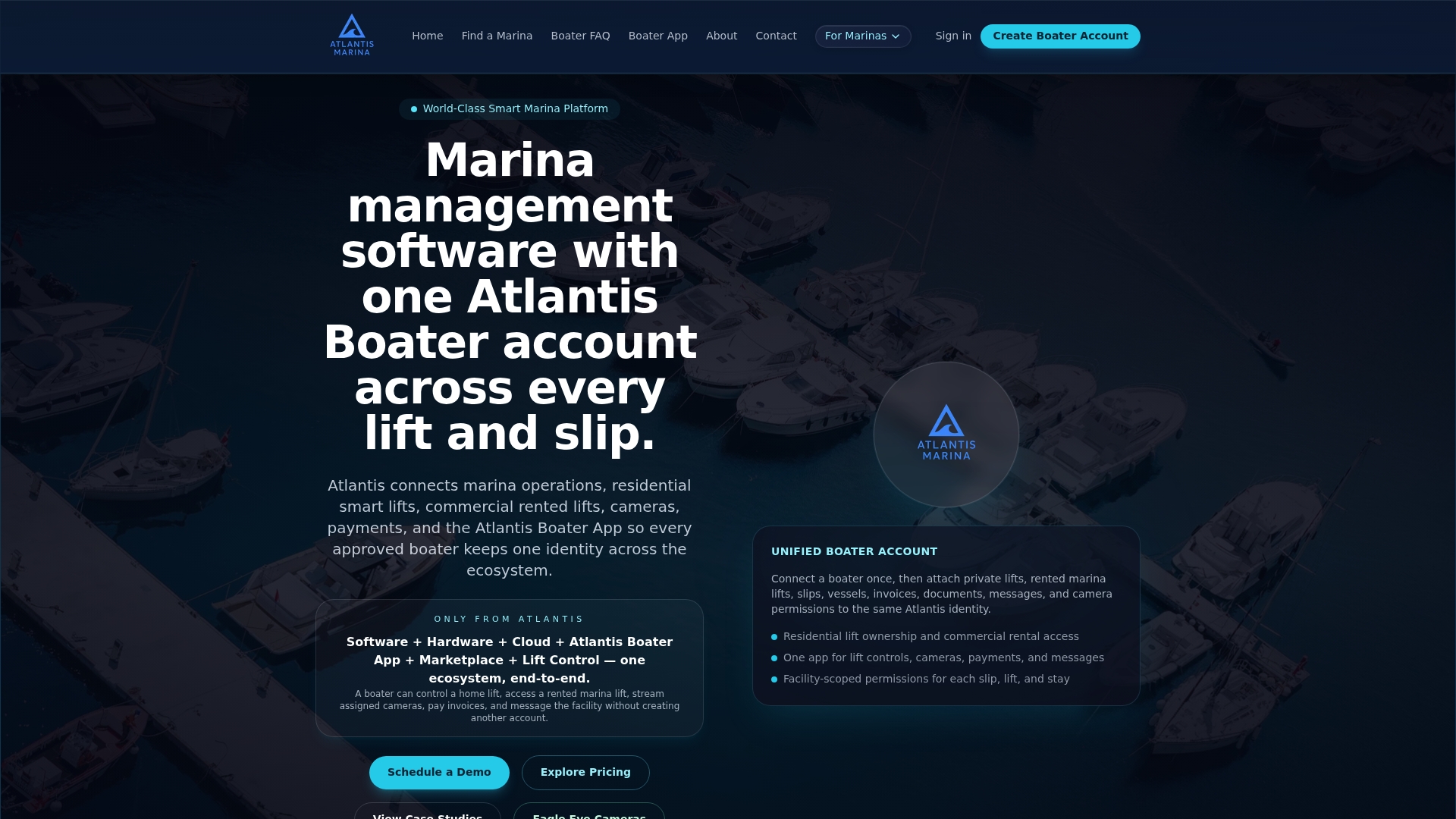
For marinas ready to move beyond fragmented systems, the marina management software from Atlantis-marina provides the unified billing foundation that makes accurate, efficient payment processing possible. The platform scales from independent marinas to multi-property operations, with mobile access for staff managing the dock from anywhere on the property. Explore the full marina billing software to see how the billing and payment features work in practice.
FAQ
What is marina payment processing?
Marina payment processing is an integrated billing system that consolidates slip rentals, fuel charges, retail sales, and service fees into one unified transaction workflow. It replaces disconnected point-of-sale terminals with a single record tied to each vessel and boater account.
How does a unified checkout flow work at a marina?
A unified checkout flow automatically attaches each charge, including fuel, labor, and retail purchases, to a vessel's active billing record as transactions occur. At checkout, the boater receives one combined invoice covering every service used during the stay.
What is wallet provisioning in a luxury marina context?
Wallet provisioning means capturing and tokenizing a guest's payment method at reservation or check-in, then processing all subsequent charges automatically without requesting the card again. It is the foundation of a frictionless, cashless marina stay.
How much can surcharge optimization save a marina?
Compliant surcharging with automated debit card detection can reduce monthly credit card processing costs by 20% to 90%. A marina processing $200,000 per month can recover approximately $6,000 monthly through optimized payment routing and fee recovery.
What features should a marina payment gateway include?
A marina payment gateway should support high transaction limits, multi-currency settlement, escrow workflows, 3D Secure fraud protection, and automated surcharge logic with debit card detection. Standard retail gateways lack most of these features and are not suited for high-value marine transactions.