
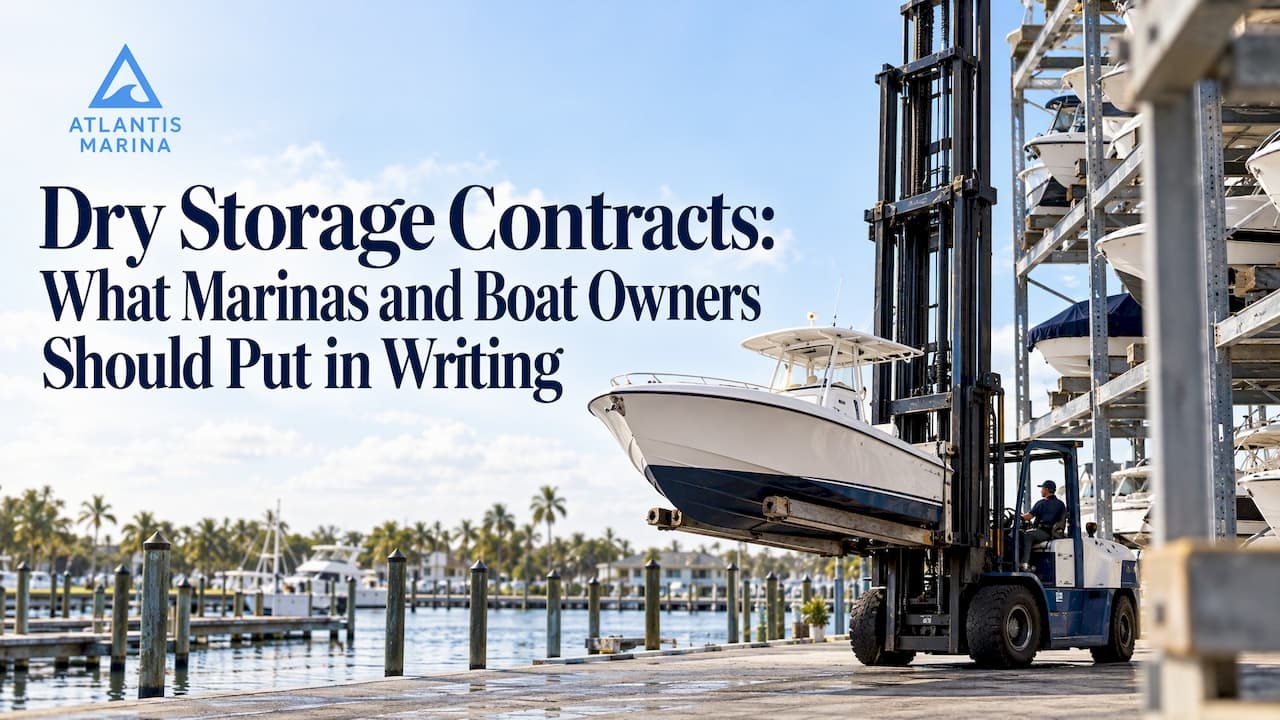
A dry storage contract is the written agreement between a marina and a boat owner for rack, yard or stack storage. It should name the vessel and owner, the space, the term and renewal, every fee, who handles launch and retrieval, what insurance is required, and what happens when rent goes unpaid. Courts look to the written contract first to decide who owes what, so the document does real work on the day something goes wrong.
This guide walks through each clause in the order a dockmaster or owner will meet it, then shows how to keep the paperwork consistent across a whole season of launches, renewals and invoices.
TL;DR
- A dry storage contract is not a self-storage lease. When the marina hauls, launches or moves the boat, it takes on a different liability profile than a facility that only rents space.
- Record the vessel, owner, rack or yard location, term, renewal method and every recurring or conditional charge.
- Spell out launch and retrieval procedures, notice times, contractor access and insurance proof before the first haul.
- Write the late-payment, lien, termination and notice terms to match the law of your state, and have a maritime attorney review them.
- Electronic signing, autopay and a single customer record keep the signed terms and the billing aligned.
Table of Contents
- How a dry storage contract differs from self-storage and wet-slip agreements
- The core terms every contract should record
- Launch, retrieval and access
- Insurance, damage and indemnity
- Late payments, liens, termination and notice
- Where dry storage contracts go wrong
- How to keep contracts consistent across a season
- Add dry stack operations to your marina's workflow
- FAQ
- Sources
How a dry storage contract differs from self-storage and wet-slip agreements
A self-storage operator typically rents a box and the tenant controls the contents. A dry stack or rack marina is different in practice. Staff lift the boat with a forklift or travel lift, place it on a rack, store it, and launch it on request. Inside Self-Storage Magazine notes that when a facility takes control of the property, as is common in full-service marina storage, it faces different liability risks than an operator who only rents space.
That is why a generic storage lease template, which is what many search results for this topic offer, leaves gaps. A marina contract also needs service terms (haul, launch, wash, blocking), movement risk (who is responsible when the boat is on the lift), and vessel-specific rules.
Compared with a wet-slip agreement, a dry storage contract shifts the focus from dockage, shore power and weather exposure to handling and scheduling. Marina insurer guidance stresses that these are not casual arrangements and should establish clear rights and responsibilities for both sides.

The core terms every contract should record
Parties and vessel details
A sample marina slip rental agreement drafted for an insurer presentation lists owner contact details alongside the vessel's name, manufacturer, type, year, registration number, length, beam, draft, color, insurance company and insured value. A dry storage contract needs the same fields, and a few more:
- Trailer or cradle information, if the boat arrives on one
- Engine configuration and weight, because rack capacity and lift ratings depend on them
- Beam and height with any tower, bimini or radar arch, since these decide which rack or yard row the boat fits
- Emergency contacts and who is authorized to request a launch
Collecting these at signing, rather than by email later, prevents the common problem of a boat that turns out to be too heavy or too tall for the space it was sold.
Space, term and renewal
Contracts typically specify the storage location, such as a dry rack or slip number, the duration of use and specific rules or restrictions, such as limits on live-aboards. The same sample agreement records start and end dates and a month-to-month renewal after the initial term.
Decide up front which model you run and say so plainly:
| Term model | Best for | What the contract must say |
|---|---|---|
| Seasonal | Northern marinas with winter layup | Season start and end, haul-out and launch windows, what happens to unused days |
| Annual | Year-round boating areas | Renewal date, rate change notice, early termination |
| Month-to-month | Flexible or overflow rack space | Notice period for either side, how rate changes are communicated |
If the space can be reassigned (for example, moving a boat to a different rack for forklift efficiency), reserve that right in writing and say how much notice the owner gets.
Fees and charges
A complete fee schedule goes beyond the monthly rate. The sample agreement itemizes rent, electrical service, late, returned-check and past-due charges. For dry storage, add the items that actually generate disputes:
- Launch and retrieval charges, and whether they are included, capped or per-lift
- Fees for a boat moved outside normal hours or on short notice
- Washdown, battery charging, blocking and shrink-wrap services
- Fuel dock or pump-out charges, if bundled with a storage account
- Payment method and the date a payment is considered received
- Any fee for credit card or ACH payments, stated as an exact amount or percentage
The rule is simple: if you will charge for it, the contract or an attached rate sheet names it. A fee that appears for the first time on an invoice is the one that gets disputed.
Launch, retrieval and access
This is the part generic templates skip. Your contract should answer these questions before a Saturday morning in July answers them for you:
- How does the owner request a launch? Phone, app, web portal or form, and how many hours or days ahead.
- What is the service window? Launch order, weather holds, and whether same-day requests are best-effort or guaranteed.
- What condition must the boat be in? Drain plug, fuel, loose gear, canvas, and who is responsible for removing items before a lift.
- Where does the owner's responsibility start and end? Typically at the lift or the dock; say which, and say what happens in between.
- Who else may touch the boat? Mechanics, detailers and delivery captains.
On that last point, insurer guidance advises that third-party contractors should provide documentation of current and adequate insurance before entering or working on marina premises. Put that requirement in the contract and give owners a way to submit their vendor's certificate.
Restrictions belong here too: no living aboard, no work on hazardous systems in the yard, speed and traffic rules for forklifts, and the marina's right to deny access during operations.
Insurance, damage and indemnity
Owners should be required to provide insurance information and adequate property-damage and liability coverage. The same guidance notes that marina and staff indemnification clauses are common, and that demanding additional-insured status may run afoul of state insurance laws. That is a drafting point to settle with counsel who knows your state, not one to copy from another marina.
A practical insurance section does these things:
- States the minimum coverages and requires a current certificate at signing and at each renewal
- Requires the owner to notify the marina of a lapse or change of insurer
- Defines what the marina is and is not responsible for during haul, storage and launch
- Sets a reporting window for damage, so a scrape found weeks later is not a mystery
- Says what happens in a named storm or other force majeure event, including evacuation or tie-down rules
For a deeper look at what to require and how to track it, see our guide to boat insurance requirements every marina should enforce.
Late payments, liens, termination and notice
This is the section owners read least and operators rely on most.
Late fees and default
Define the due date, grace period (if any), late fee and the point at which the account is in default. Define how you will send notices (email, SMS, mail, portal) and treat the contact details on the contract as valid for notice. Our piece on marina late fee policy and 90-day lien pitfalls goes through how operators set these terms without creating lien problems later.
Liens
Federal maritime law recognizes liens for necessaries. In a 2024 decision, a Wisconsin federal court recognized that maritime liens for necessaries such as dry storage and associated services are enforceable under the Commercial Instruments and Maritime Liens Act, 46 U.S.C. § 31342(a)(1), while also requiring more facts to establish admiralty jurisdiction in that case. The takeaway for contract drafting: your records of what was stored, what services were provided and what remains unpaid need to be specific and complete.
State law adds its own rules. Florida, for example, gives a marina a possessory lien for storage, dockage, repairs and related expenses that attaches when a vessel arrives or occupies rental space, under Florida Statutes § 328.17 (2025). A Florida marina-law paper also says that wet-slip, mooring and dry-rack agreements are governed by maritime law to the exclusion of contradictory state law. Because the interplay of federal and state rules is a legal question, have a maritime attorney in your state review your lien language. For the operational side, read our guide to the three essentials of the U.S. boat storage lien process.

Termination and notice
State separately:
- How the owner ends the contract (written notice, how many days, effective date)
- How the marina ends it, for cause and without cause
- What happens to prepaid rent
- How long the owner has to remove the boat after termination, and the storage rate during that period
- The consequences of abandonment, in language your attorney approves
Where dry storage contracts go wrong
Most disputes trace back to a short list of causes:
- The signed contract and the billing do not match. The agreement says one rate, the invoice shows another, because rates were updated in a spreadsheet and not on the contract.
- Vessel details are stale. The owner added a tower or changed engines, and nobody updated the record.
- Insurance expired quietly. The certificate on file is from two seasons ago.
- Launch requests live in text messages. When a boat is launched late or the wrong boat is moved, there is no record.
- Notice goes to an old email address. A lien or termination notice sent to a dead contact is a weak notice.
Every item on the list is a records problem, not a legal one. That is where software earns its place.
Our perspective on dry storage paperwork
A dry storage contract is only as good as the system that carries it out. We built Atlantis Marina so that the contract, the vessel record, the rack assignment, the launch queue and the invoice all live in one account, instead of in a PDF folder, a spreadsheet and a texting thread.
In practice that means a boater submits vessel details and uploads insurance and registration documents through the Atlantis Boater App or web portal, signs with Atlantis E-Sign, and requests launches from the same account. Staff see the same record when they assign space, manage the dry stack and launch queue, and bill. Billing is automated through autopay, Instant Pay, and Stripe and ACH processing, with QuickBooks Online sync keeping revenue booked without re-entry.
We think this is the right way to run dry storage, because most contract disputes start when the paperwork and the operation drift apart. When they share one record, the terms you signed are the terms you bill and the terms your staff see on the lift.
John R
How to keep contracts consistent across a season
Whether you use software or not, adopt a routine:
- Standardize. One contract template per storage type (rack, yard, covered), reviewed by a maritime attorney in your state, with a fee schedule attached by reference.
- Collect at signing. Vessel specs, insurance, registration and emergency contacts, all before the boat is lifted.
- Check at renewal. Reconfirm insurance and vessel details, and notify owners of rate changes in the manner your contract requires.
- Log every launch and move. Time, staff member, requested by whom.
- Escalate early. Send reminders before the due date and follow your written default steps the same way for every account.
Operators running dry stack at scale can handle these steps with the marina management solution, which covers reservations, waitlists, vessel records, documents and billing in one system.
Add dry stack operations to your marina's workflow
Atlantis Marina is a cloud-based platform for marinas, yacht clubs, dockmasters and dry stack operators. For dry storage, it supports contracts signed with Atlantis E-Sign, document uploads, launch queues, customer accounts and automated billing. Published plans run from Micro at $150 per month to Large at $900 per month, and the dry-stack operations add-on is $79 to $299 per month, with Enterprise pricing available on request. Setup is a one-off fee of $100 to $1,000. See the details on the pricing page, or talk with our team about your rack, yard or stack layout.

If you want to see the workflow first, the platform overview video is a 7-minute narrated tour.
FAQ
Do I need a different contract for dry storage than for a wet slip?
Yes, in most cases. Dry storage adds haul, launch, handling and rack or yard rules that a slip agreement does not address. A boat the marina physically moves creates different liability exposure than a boat that stays in the owner's control, so the contract should describe each service and who is responsible at each step.
What should a boat owner check before signing?
Check the total cost, including launch and retrieval charges, the renewal terms, the notice period for launches, and the insurance you must carry. Confirm that the vessel details, especially height and weight, are correct. Ask what happens if rent is late and how you will be notified.
Can a marina place a lien on a stored boat for unpaid fees?
Often yes, but the process depends on the facts and the law that applies. Federal law recognizes maritime liens for necessaries such as dry storage, and states such as Florida have their own possessory lien statute. Marinas should follow their attorney's guidance and keep clear records.
Can the marina require to be named as an additional insured?
That depends on your state. Insurer guidance cautions that additional-insured demands may conflict with state insurance laws. Ask your attorney or insurance advisor what your state allows before adding the clause.
Can dry storage contracts be signed electronically?
Marinas commonly collect signatures online, and Atlantis Marina includes Atlantis E-Sign so that the signed contract is stored on the boater's account next to their vessel and insurance documents. Confirm with your attorney that your template and process meet your state's requirements.
Sources
- Inside Self-Storage Magazine: Marina vs. Boat Storage
- What to Know When Preparing Marina Storage Agreements (Chubb)
- Florida Marina Storage Agreements at a Glance
- Sample Slip Rental Agreement
- Reducing Liability Exposures: Important Things to Know When Creating a Marina Contract
- Skipper Marine of Madison, Inc. v. 2019 VR5 Bayliner (W.D. Wis. 2024)
- Florida Statutes § 328.17 (2025)