
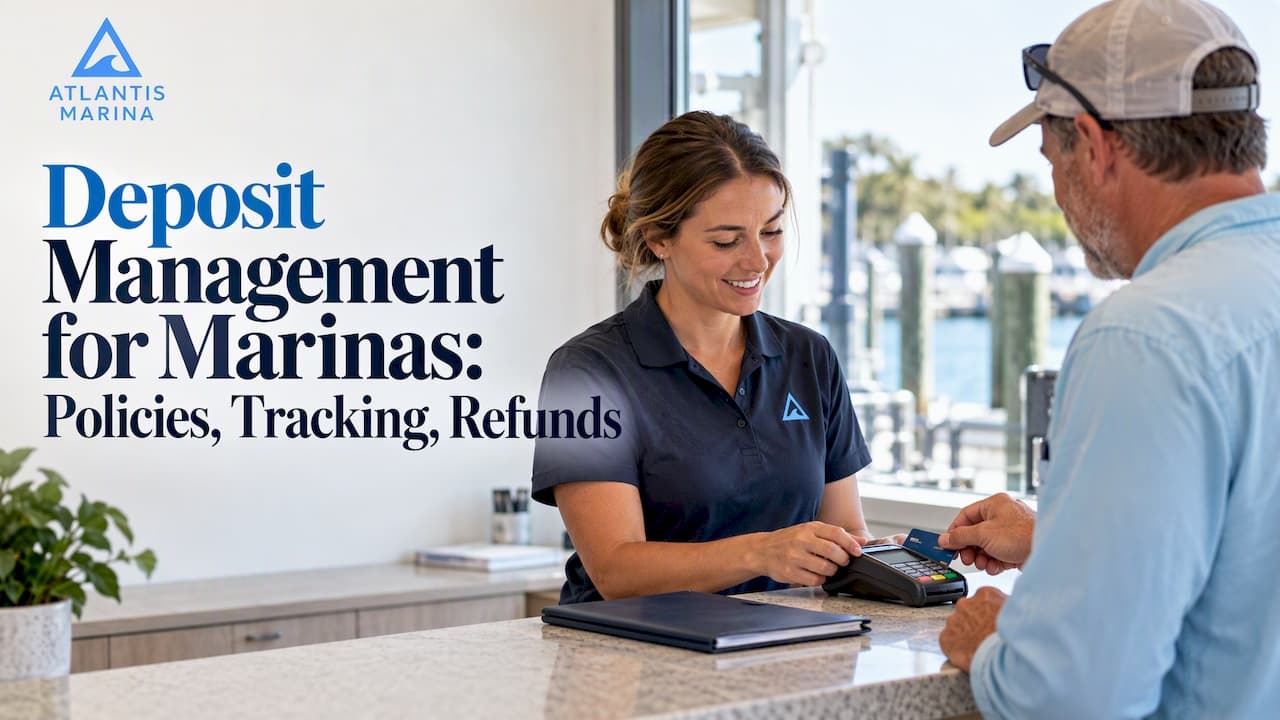
Marina deposit management is the work of collecting a security deposit at lease signing, recording what it covers, holding it under clear terms, and returning it (minus documented deductions) on a schedule you can defend. Done well, it protects the dock and keeps move-outs from turning into disputes. Done by spreadsheet and memory, it produces missed refunds, mismatched ledgers and angry boaters.
This guide covers what marinas typically charge, what the lease should say, how a deposit lifecycle works, where it goes wrong, and how to run it inside one system.
TL;DR
- Slip deposits commonly equal one or two months of slip fees, with separate small deposits sometimes taken for keys or parking permits.
- Put the deposit's purpose, refund conditions, notice period and refund deadline in the lease, not in a side email.
- Treat every deposit as a ledger item tied to a vessel, a contract and a slip, with a status: collected, held, applied, refunded.
- Log every deduction with a reason, a photo or invoice, and a timestamped message to the boater. That record is what wins disputes.
- Automating collection, refunds and accounting sync removes most of the manual entry where errors start.
Table of Contents
- What a marina deposit is for
- How much marinas typically collect
- What the lease should say
- The deposit lifecycle, step by step
- Where deposit management breaks down
- Perspective: what we see at Atlantis Marina
- A worked example
- Setting up deposits in software: a checklist
- What it costs to run this in Atlantis
- Policy tips that prevent disputes
- FAQ
- Sources
What a marina deposit is for
A deposit is not rent and not a fee. It is money you hold to secure the boater's performance of the agreement. A sample slip lease published by a residential marina community states the idea plainly: the boat owner deposits a sum to secure the faithful performance of the owner's promises under the lease. Other marina agreements use the same logic, for example a moorage agreement that describes the deposit as security for all of the owner's obligations and notes it does not cap the marina's other remedies.
In practice a deposit covers:
- Unpaid slip rent, utilities or late fees at move-out.
- Damage to docks, pilings, cleats, pedestals or shore power equipment.
- Cleaning or removal costs if a vessel or its gear is left behind.
- Unreturned keys, gate cards or parking permits.
Keep that list short and specific in your lease. Vague "any and all costs" language is hard to defend when a boater contests a deduction.
How much marinas typically collect
There is no national standard, and amounts vary by marina, season and slip size. A reasonable starting point comes from published guidance: security deposits are often one or two months of slip fees, usually alongside the first month's rent and sometimes the last. The same source notes some facilities add per-item deposits, such as $50 per key or parking permit.
Public listings show how wide the range runs in practice. One municipal-style boat lift lease asks for a $250 refundable deposit at signing, against a $100 monthly rental rate, but that is one facility's choice, not a benchmark. Use these factors to set your own number:
| Factor | Why it moves the deposit |
|---|---|
| Slip size and monthly rate | Larger slips mean larger exposure for unpaid rent |
| Lease length | Seasonal and annual leases carry more risk than transient stays |
| Services attached | Shore power, pump-out, lifts and dry stack add chargeable items |
| Boater history | Returning boaters with clean records may qualify for a lower deposit |
| Access items | Keys, gate cards and passes each need a recorded value |
Whatever you choose, apply it consistently by slip class. Inconsistent deposits are the easiest thing for a boater to point at in a dispute.
What the lease should say
Read several published slip agreements side by side and the same clauses recur. Build yours around them.
- Amount and due date. State the sum and that it is due at execution of the lease.
- Purpose. List what the deposit secures.
- Refundability and conditions. Whether the deposit is refundable and under what conditions should be spelled out, not implied.
- Notice to terminate. Many marinas require written notice, often 30 days, before the deposit can be returned.
- Refund deadline. After deductions for unpaid rent, damage or cleaning, the sample lease commonly returns the balance within a set period, often 30 days, provided access items are back.
- Interest. Say whether the deposit earns interest. A marina management license agreement, for instance, makes its deposit refundable without interest.
- Itemized deductions. Commit to sending a written list of any amounts withheld.
State and local rules on security deposits and lien processes differ, so have your attorney review the final language for your state. If you also charge late fees or pursue liens on abandoned vessels, keep those policies aligned with the deposit terms. Our guide to a marina late fee policy and 90-day lien pitfalls covers how they interact.
The deposit lifecycle, step by step
Think of each deposit as a record that moves through states. Every state change should leave a trail.
1. Collect at contract signing
Tie payment to the signed lease. When a boater cannot start the agreement without paying the deposit, you avoid the common situation where a boat arrives on the dock with a contract signed and the deposit "coming later." Collect by card or ACH, and record the payment method so a refund can go back the same way. If you are weighing options, marina payment processing explained walks through card and bank payments for operators.
2. Attach it to the right records
Link the deposit to the boater account, the vessel, the slip and the contract. If a boater changes slips mid-season, the deposit follows the account, not the slip number. If the boater owns two boats, decide in the lease whether one deposit covers both.
3. Verify the paperwork that protects you
The deposit covers damage, but insurance covers the large losses. Check proof of insurance and registration before the boat arrives, and set reminders for expiry. See boat insurance requirements every marina should enforce for what to ask for.
4. Hold and monitor
During the lease, deposits should sit untouched unless the lease allows applying them to a delinquent balance. If your policy allows that, require written notice to the boater before you apply it, and require the boater to top the deposit back up.
5. Inspect at move-out
Schedule the walk-through when notice is given. Photograph the slip, the pedestal and any lift. Collect keys and gate cards the same day and mark them returned in the record.
6. Decide, document and refund
Calculate deductions against the lease, attach the evidence, and send the itemized statement. Then refund the balance inside your stated deadline. A clean process for this step is laid out in the six-step marina refunds workflow for dockmasters and billing teams.
Where deposit management breaks down
Deposits live in three places
A payment is in the processor, the receipt is in an email and the balance is in a spreadsheet. A payments review aimed at boat and marine businesses describes the risk well: a marine business may collect a deposit in one place, a service payment at the dock and recurring fees months later, and those records cannot become three separate versions of the customer. For a marina, that means one account per boater with deposits, rent, fuel and ship store charges visible together.
Refunds slip past the deadline
If your lease promises a refund within a set number of days and nobody owns the clock, you will miss it. Late refunds are the fastest route to complaints and, in some places, statutory penalties. Assign the task automatically when a lease ends.
Deductions without evidence
"Dock damage, $400" with no photo and no invoice invites a dispute. Attach proof to every deduction.
Chargebacks on deposits
A boater who disagrees with a deduction may go to their card issuer instead of to you. Industry guidance suggests routing disputes through in-platform messaging and centralized logging so there is a timestamped record of what was agreed and what was done. That record is the evidence you submit if a chargeback is filed. For a practical playbook, read five operational steps to stop marina chargebacks.
Refund method mismatch
Refunding a card deposit by check, or an ACH deposit to a different account, creates reconciliation work and fraud risk. Refund to the original method unless the lease says otherwise.
Perspective: what we see at Atlantis Marina
Most deposit problems we see are not policy problems. They are record problems. The lease says 30 days, but the signed PDF is in one folder, the payment is in a processor dashboard, the key log is on a clipboard and the ledger is in accounting software that someone updates on Fridays.
Our view is that a deposit should be a first-class object in the same system that holds the contract, the vessel, the slip and the boater's messages. When staff open an account they should see the deposit amount, the contract that created it, the documents on file, the payment method and every message about it. Atlantis Marina is built around that unified account context: contracts signed with Atlantis E-Sign, payments through Stripe and ACH, refunds and adjustments handled in the platform, and QuickBooks Online sync so revenue and liabilities are booked without re-keying.

We also think boaters should be able to see the same thing. In the Atlantis Boater App and web portal, a boater can review reservations, make payments, upload insurance and registration documents and message staff from one account. Fewer surprises at move-out means fewer disputes.
The last point is about restraint: automation should handle the repetitive work, and staff should confirm the judgment calls. Atlantis Bot can answer deposit and billing questions from boaters on your website and help staff with daily tasks, with actions that staff confirm before they happen.
— John R
A worked example
Say your policy is a deposit equal to one month of slip fees, and a boater signs an annual lease for a slip at $600 per month. The figures here are illustrative, not a recommendation.
- At signing the boater pays the first month ($600) and a deposit ($600). The system records two separate items: revenue and a refundable liability.
- The boater also receives a gate card with a $50 deposit, recorded against the card.
- At move-out the boater gives 30 days' written notice. The walk-through finds a cracked cleat and a final utility charge.
- You deduct the documented repair and the utility bill, each with an invoice or photo, and return the card, which releases the $50.
- You send an itemized statement and refund the balance to the original card or bank account inside the window your lease states.
Every step is traceable, and no one had to remember anything. That is the standard to design toward whatever your amounts are.
Setting up deposits in software: a checklist
Whether you use Atlantis or another system, check that it can do the following.
- Require deposit payment as part of contract execution.
- Keep deposits as liabilities separate from earned revenue.
- Attach deposits to boater, vessel, slip and contract.
- Support partial refunds and adjustments with a reason code.
- Refund to the original payment method.
- Log messages and documents on the same account.
- Sync to your accounting system without manual entry.
- Alert staff when a lease end date starts the refund clock.
- Handle groups of properties with consistent policies and local overrides.
On that list, see how Atlantis marina management handles slips, reservations, documents, billing and boater accounts in one place. If you also run a store or fuel dock, the ship store POS shares the same customer account. Dry stack, lift and camera add-ons can bring their own deposit and access items into the same record.
What it costs to run this in Atlantis
Atlantis Marina uses tiered monthly plans based on marina size: Micro at $150 per month, Small at $300, Medium at $500 and Large at $900, with Enterprise pricing not published. A one-off Atlantis setup fee ranges from $100 to $1,000, and a platform fee of 3% per transaction applies to digital payments. Add-ons such as the dry-stack operations module ($79 to $299 per month), automated fuel operations ($50 per month) and Eagle Eye smart cameras ($30 to $150 per month) are priced separately on the same page.

Want to see deposits, contracts and refunds working together? Explore the Atlantis Marina platform or review the pricing page to match a plan to your marina's size. You can also see how marinas such as Keyhole Marina in Moorcroft, WY and Parks Marina in Okoboji, IA appear on the Atlantis network.
Policy tips that prevent disputes
- Publish the policy. Put deposit terms on your website and in the booking flow, not only in the lease.
- Use plain language. Say how long refunds take and what can be deducted.
- Separate access deposits. Keys, cards and passes should be tracked on their own lines. Digital credentials reduce the loss problem altogether; see marina digital passes.
- Review discounts and concessions. If some boaters get reduced rates, decide whether the deposit follows the discounted or standard rate, and automate it. Our post on concessions, autopay and QuickBooks sync shows how.
- Audit quarterly. Reconcile held deposits against active leases. Any deposit with no active lease needs an explanation.
FAQ
How much should a marina charge as a slip deposit?
Many facilities set it at one or two months of slip fees, though some use a flat amount. Pick a structure by slip class, apply it consistently and write it into the lease. Your attorney can confirm it fits your state's rules.
How long does a marina have to return a deposit?
It depends on your lease and your state. Sample agreements commonly use a window of around 30 days after the lease ends and access items are returned. Put your deadline in writing and have counsel check it against local law.
Can a marina keep a deposit for unpaid rent?
Usually only if the lease says so. Most agreements allow deductions for unpaid rent, damage or cleaning, with the remainder refunded. Send an itemized statement with evidence so the deduction is easy to justify.
Should deposits be separate from revenue in accounting?
Yes, in most cases a refundable deposit is a liability until you apply it. Confirm treatment with your accountant, and use a system that syncs to your books so the entries are created automatically.
Sources
- Marina Slip Agreements: Leases and Wet Slip Rentals, LegalClarity
- Sample slip lease agreement, Seascape at Holden Plantation
- Marina Moorage Agreement, Port Ludlow
- Marina Management License Agreement, Leschi and Lakewood
- Booking, Payment and Cancellation Terms, Docking
- Boat Dealer and Marina Payment Workflow Review, DATA ONE