
Yes, modern marina platforms can deliver near-instant payouts so operators get usable cash in hours instead of days. Card and ACH settlement, payment-facilitator advances, and pay-on-arrival QR workflows each move money at different speeds and different costs. The rest of this guide walks through the rails, the integration points, the real fees, and a checklist you can run before your next billing cycle closes.
TL;DR:
- Instant-card settlement offers funds within minutes to hours, but incurs higher fees compared to same-day ACH, which may be limited by cutoff times.
- Merchant cash advances fund within 24 to 48 hours and are repaid as a percentage of future sales, making them a financing option rather than a payout method.
- Proper integration involves configuring payment processors, bank verification, and accounting syncs to ensure refunds and chargebacks are reversible without disrupting cash flow.
- Most marinas benefit from a hybrid approach, using instant payouts for transient and retail transactions while applying standard settlement methods for predictable recurring billing.
- A full rollout typically takes three to four weeks, and running QR pay-on-arrival alongside manual payments for two weeks improves capture rates before full transition.
Table of Contents
- Overview: Instant Payout Models and Payout Rails
- How Instant Payouts Are Executed Inside Marina Management Systems
- Benefits Operators Actually See From Instant Payouts
- Implementation Checklist: Prepare Accounts, Hardware, and Staff
- Expert View and Case Example From Atlantis Marina
- When Instant Payouts Are the Right Choice and When a Hybrid Approach Is Better
- Atlantis Marina: How We Enable Integrated Instant Payouts
- Sources
- FAQ
Overview: Instant Payout Models and Payout Rails
Not every "instant" payout works the same way, and marina operators who don't know the difference tend to overpay for speed they don't need.
Instant-card settlement pushes card transaction funds to your bank within minutes to a few hours, usually for a flat fee on top of standard processing. Same-day ACH settles bank transfers same-business-day rather than the traditional one to two days, with lower fees but a hard cutoff time. Payment-facilitator advances let your front you the cash immediately and reconcile with the card networks behind the scenes. Merchant cash advances are a different animal entirely: they fund a lump sum within 24 to 48 hours of approval and repay through a cut of future sales, which makes them a financing product, not a payout feature.
- Instant-card settlement: minutes to hours, per-transaction fee
- Same-day ACH: same business day if submitted before cutoff, lower fee
- Platform advances: near-instant, built into your monthly subscription or a small per-advance fee
- Merchant cash advances: 24 to 48 hours, repaid as a percentage of daily sales
Short-stay and retail transactions favor instant-card rails because volume is unpredictable and guests expect to pay and leave. Recurring berth billing does fine on same-day or standard ACH since it's scheduled and forecastable anyway.
How Instant Payouts Are Executed Inside Marina Management Systems
The mechanics matter more than the marketing term. Here's the actual sequence when a guest pays and your marina sees cash:
- The guest pays through a QR code, the boater app, the web portal, or a POS terminal at the ship store.
- The payment processor authorizes the card or ACH transaction in real time.
- The marina platform posts the invoice, marks it paid, and triggers either standard settlement or an instant-payout advance.
- Funds route to your connected bank account or a platform holding account, depending on the rail selected.
- The system syncs the transaction to your accounting software so books stay current without manual entry.
Getting this flow right depends on a handful of integration points: a configured payment processor, verified bank connectivity, card-on-file and ACH routing rules, split tender support for guests paying with more than one method, and a live QuickBooks Online connection.
Refunds and chargebacks complicate instant payouts because a fast-out advance still needs to be reversible. Most platforms apply a short holdback or rolling reserve on new merchant accounts specifically to cover disputed transactions, which is a normal part of onboarding, not a red flag.
Benefits Operators Actually See From Instant Payouts
The upside isn't abstract. It shows up in the bank balance and in the office workload.
Cash-flow relief. A lift repair, an unexpected fuel delivery, or a payroll run no longer waits on a settlement cycle. Funds that used to sit for a day or two become available same-day or within hours.
Recaptured short-stay revenue. QR-based pay-on-arrival systems let visiting boaters pay in under 60 seconds, and operators using them report sharply higher capture rates on transient dockage that used to go uncollected. A large share of those payments happen outside staffed office hours, which means revenue that used to walk away now gets captured automatically.
Lighter reconciliation load. Fewer manual invoices, fewer end-of-month spreadsheet reconciliations, and a faster close.
- Fund repairs or fuel purchases without a bridge loan
- Reduce staff time spent chasing payments
- Close the books days faster each month
Pro Tip: Run pay-on-arrival QR codes alongside your existing manual payment process for two weeks before fully switching over. Watch the dashboard to confirm capture rates before you retire the old method.
Implementation Checklist: Prepare Accounts, Hardware, and Staff
Rolling out instant payouts works best as a sequence, not a single flip of a switch.
- Compliance and banking (week 1). Complete KYC verification, sign your merchant or payment-facilitator agreement, and connect your bank account for payout routing.
- Processor and rail setup (week 1 to 2). Enable instant-card settlement or same-day ACH inside your platform, and decide which rail applies to which revenue type.
- QR and pay-on-arrival configuration (week 2). Print and post QR codes at slips, fuel docks, and the ship store; test the flow end to end with a real transaction.
- Card-on-file and autopay (week 2 to 3). Turn on autopay for recurring berth tenants and confirm invoices trigger correctly.
- Split tender and accounting sync (week 3). Test split-tender payments and confirm QuickBooks Online sync posts transactions without duplication.
- Policy and staff training (week 3 to 4). Set hold and refund policies, train dock staff on the new workflow, and post signage explaining pay-on-arrival to guests.
- Go-live and monitoring (week 4). Run parallel manual and automated payments briefly, then cut over fully.
| Step | Typical time | Typical cost |
|---|---|---|
| Merchant/KYC setup | 3 to 7 days | Often no setup fee |
| Processor and rail configuration | 1 to 3 days | Included in platform subscription |
| QR/pay-on-arrival rollout | 3 to 5 days | Signage and printing costs only |
| Staff training and go-live | 1 week | Staff time, no direct cost |
Most marinas complete the full rollout within three to four weeks, with instant-card and QR payments live well before recurring billing automation is fully tuned.
Expert View and Case Example From Atlantis Marina
John R, editorial contributor covering marina operations for Atlantis Marina, has tracked how integrated billing and payout automation change the daily rhythm of a dockmaster's office.
Marina Jack, a working example of a marina moving toward integrated payments, needed a way to stop losing transient dockage revenue during unstaffed evening hours. After rolling out QR-based pay-on-arrival alongside card-on-file autopay for recurring tenants, the office saw fewer end-of-day reconciliation gaps and faster access to funds from short-stay guests who previously paid days later, if at all.
Operators who want a guided version of this rollout can review the Atlantis Marina pilot program, which walks through the same sequence: processor setup, QR deployment, and staff training, with support at each stage.
When Instant Payouts Are the Right Choice and When a Hybrid Approach Is Better
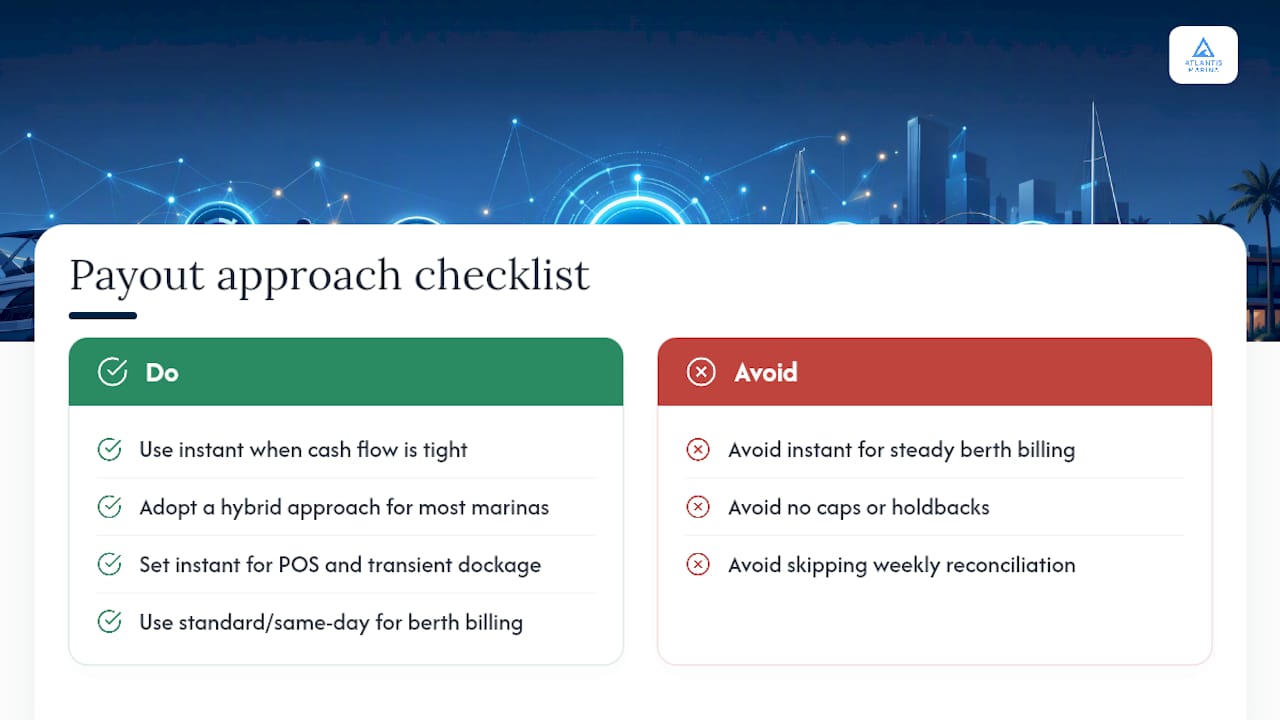
Instant payouts earn their fee when cash-flow timing is tight or transient volume is high enough that delayed settlement creates real friction. They matter less for a marina with steady, predictable berth billing and healthy reserves.
The stronger pattern for most marinas is hybrid: instant settlement for POS, ship store, and transient dockage, standard or same-day settlement for recurring berth billing. Pair either approach with sensible payout caps, a short holdback for new accounts, and reconciliation checks at least weekly. That combination keeps fee exposure low without sacrificing the speed that actually matters, which is getting paid for the guest who showed up last night and left this morning.
— John R
Atlantis Marina: How We Enable Integrated Instant Payouts
Atlantis Marina is the practical alternative to stitching together a separate processor, a separate advance product, and a separate accounting sync. The platform runs billing automation, Instant Pay, Stripe and ACH processing, split tender payments, and QuickBooks Online sync from one dashboard, so your dock staff and your bookkeeper can work from consistent numbers in real time.
Boaters pay through the Atlantis Boater App with QR check-in, card, or ACH, and your team sees the invoice update instantly without chasing a paper trail. If you're ready to see how instant payouts fit your specific billing mix, whether that's mostly transient dockage or a heavier recurring-tenant base, schedule a look at the Marina Management Software platform and bring your current fee schedule and a sample month of transactions so the demo can show real numbers, not hypotheticals.
Sources
- How Smart Business Funding Helps Marinas Get Back in Business Fast - Smart Business Funding
- Avalon Pay – Smartphone Mooring Payments – Avalon Pay
- Pay-on-Arrival Payments: Marina Management Software | Moored Solutions | Moored Solutions
FAQ
How Fast Are Instant Payouts for Marinas?
Instant-card settlement and platform advances typically move funds within minutes to a few hours, while same-day ACH settles within the same business day if submitted before the cutoff.
What Fees Come With Instant Payouts?
Instant-card settlement usually carries a small flat fee on top of standard processing, while merchant cash advances repay through a percentage of future daily sales rather than a flat charge.
Do Instant Payouts Work for Recurring Berth Billing?
They can, but most operators keep recurring berth billing on standard or same-day ACH since it's predictable, and reserve instant rails for transient dockage and retail where timing is less certain.
Can QR Pay-on-Arrival Replace Staffed Payment Collection?
QR and pay-on-arrival systems complement staffed collection rather than replace it, giving staff a live dashboard to monitor payments while capturing revenue during off-hours.
Does Atlantis Marina Support Instant Payouts?
Yes, Atlantis Marina supports Instant Pay, Stripe and ACH processing, split tender payments, and QuickBooks Online sync as part of its integrated billing automation.