

Marina invoice management is the centralized process of consolidating, tracking, and automating all billing activities across slips, utilities, fuel, services, and retail into a single, accurate payment workflow. For marina operators running multiple revenue streams, fragmented billing is not just an inconvenience. It is a direct threat to cash flow, customer satisfaction, and financial reporting accuracy. This guide breaks down the core components of a marina billing system, including unified checkout workflows, accounts receivable aging, bill lifecycle stages, and practical collection strategies that reduce Days Sales Outstanding and keep your operation financially healthy.
How does a unified marina billing system work?
Marina invoice management explained at its most practical level is the replacement of disconnected charge sources with a single customer account that captures every transaction in real time. Slip rentals, fuel dock charges, pump-out services, shore power, service labor, and ship store purchases all generate revenue. When those charges live in separate systems, billing errors and delays are inevitable.
Unified checkout consolidates multiple departmental charges into one customer invoice and one payment flow, reducing errors and billing delays. That matters because a boater who receives three separate invoices from the same marina is far more likely to dispute charges, delay payment, or simply lose confidence in the operation. One invoice, one payment, one clear record is the standard customers now expect.

The operational mechanics work like this: when a technician closes a repair ticket, the labor and parts costs attach automatically to the customer's account. When a boater fuels up at the dock, that charge posts to the same account. POS charges from the ship store and utility usage settle against the correct member or berth account without manual reconciliation. The invoice that reaches the customer is complete, accurate, and ready for payment.
The table below shows how manual and unified billing workflows compare across key operational dimensions.
| Dimension | Manual billing workflow | Unified billing workflow |
|---|---|---|
| Charge capture | Staff manually enters charges from each department | Charges post automatically from POS, utilities, and service tickets |
| Invoice accuracy | High error risk from data re-entry | Validated at source before invoice generation |
| Reconciliation time | Hours per billing cycle | Minutes, automated matching |
| Customer experience | Multiple invoices, potential confusion | Single invoice, single payment |
| Cash flow visibility | Delayed, incomplete picture | Real-time account balances |
Pro Tip: Test your current system by tracing one customer's charges from fuel dock to final invoice. If you cannot follow that path in under five minutes without opening multiple software tabs, your billing workflow has a fragmentation problem.
What is AR aging and why does it matter for marina billing?
Accounts receivable aging is the practice of categorizing outstanding invoices by how long they have been unpaid, measured from the payment due date. It is the single most useful tool for understanding your marina's cash flow risk at any given moment. AR aging reports bucket invoices by time past due: Current, 1 to 30 days, 31 to 60 days, 61 to 90 days, and 90 days or more. Each bucket signals a different collection priority and a different level of financial risk.
The critical detail most operators miss is that aging should be calculated from the payment due date, not the invoice date. An invoice issued on the first of the month with net-30 terms is not overdue until day 31. Building your AR aging logic on invoice dates instead of due dates produces inaccurate reports and triggers collection actions too early or too late. Both outcomes damage customer relationships and distort your cash flow picture.
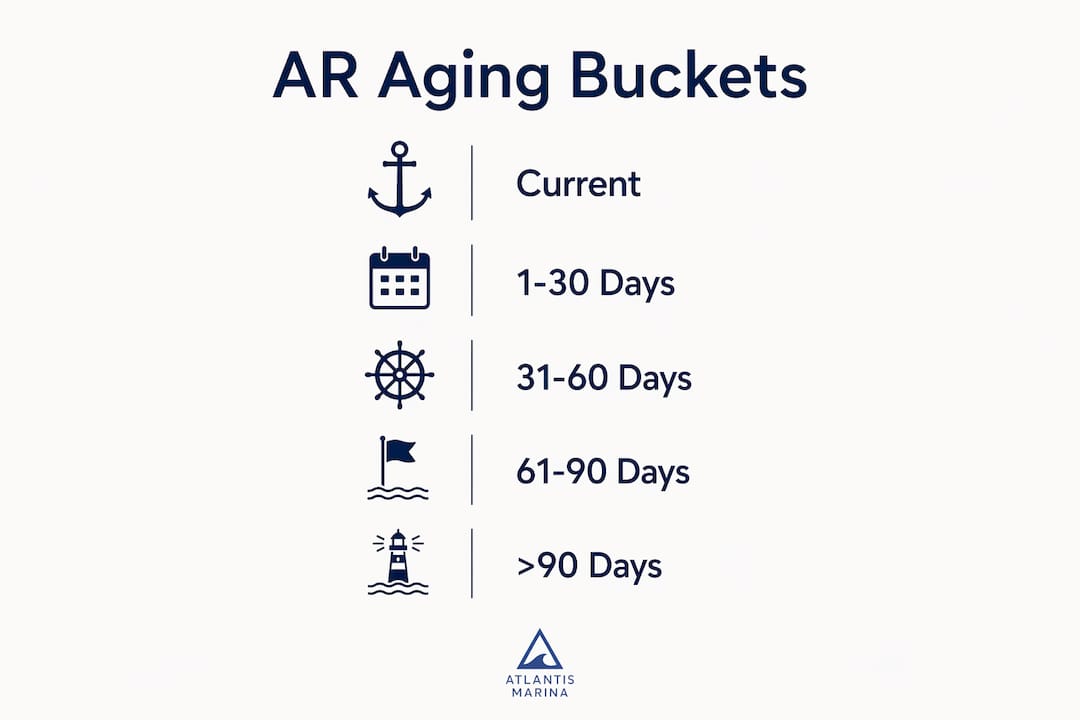
The table below illustrates standard aging buckets with recommended collection actions at each stage.
| Aging bucket | Balance status | Recommended action |
|---|---|---|
| Current | Not yet due | Confirmation email, payment link |
| 1 to 30 days | Recently overdue | Automated reminder, courtesy call |
| 31 to 60 days | Moderately overdue | Second notice, account review |
| 61 to 90 days | Seriously overdue | Direct outreach, payment plan discussion |
| 90+ days | High risk | Escalation, potential service restriction |
For high-volume marinas, a weekly review cadence is the recommended standard to catch overdue invoices early and prevent accounts from aging into the 61-to-90-day bucket unnoticed. Monthly reviews leave too much time for small balances to compound into collection problems. Weekly reviews also give your team the data needed to prioritize outreach before a boater's account becomes a dispute.
Pro Tip: Align your AR aging report schedule with your marina's peak billing dates. If slip fees post on the first of each month, run your aging report on the seventh. That gives payments time to clear while flagging any accounts that missed the window before the 30-day clock advances.
How does the bill lifecycle affect invoice accuracy?
The bill lifecycle defines the states an invoice moves through from creation to payment, and understanding those states is the difference between sending accurate invoices and sending ones that generate disputes. The three primary states are Pending, Complete, and Reopened. Each state has specific operational implications for your billing staff and finance team.
A bill in Pending status is not ready to send. It may be missing charge line items, awaiting utility meter reads, or flagged for a validation error. Invoices should only be sent after billing reaches the Complete state, which confirms that all validations have passed and the invoice accurately reflects the customer's charges. Sending a Pending invoice is one of the most common sources of billing disputes in marina operations. The customer receives an incomplete or incorrect charge, disputes it, and your team spends time correcting what should have been caught before transmission.
The Reopened state exists for legitimate post-completion adjustments. A fuel charge posted to the wrong account, a utility read that was estimated rather than actual, or a service credit that needs to be applied. Reopening a completed bill is a controlled workflow, not a casual edit. It affects downstream payment records, reconciliation reports, and in some systems, tax calculations. Marinas should treat bill reopening as an exception process with a documented approval step, not a routine correction method.
Common errors that keep bills in Pending status include:
- Missing vessel or slip assignment on the account record
- Utility meter reads not yet imported from the metering system
- Service tickets left open by technicians who have not closed their work orders
- Tax configuration errors on new charge categories
- Duplicate charge line items from manual data entry
Pro Tip: Design a daily billing review task for your dockmaster or billing coordinator. A five-minute check of all Pending bills each morning catches errors before they age into the billing cycle and prevents the last-minute scramble that produces inaccurate invoices.
What strategies improve invoice tracking and collections for marinas?
Effective invoice tracking for marinas is not about chasing payments after they are late. It is about building a workflow that makes late payments less likely in the first place. The most impactful shift any marina can make is moving from reactive to proactive collections. Preventive reminders sent five days before due dates are three times more effective than follow-ups sent after the due date. That single change, applied consistently, reduces DSO without a single confrontational collection call.
Issuing invoices immediately at service completion or billing milestone is equally important. A marina that batches invoices weekly gives customers less time to pay and gives its own team less visibility into outstanding balances. Same-day invoice issuance, combined with automated payment reminders, creates a billing rhythm that customers learn to expect and respond to.
Automated AR infrastructure manages reminder sequences, escalates intelligently by aging bucket, and reconciles payments to reduce manual workload. That means your billing coordinator spends time on exceptions, disputes, and relationship management rather than manually sending the same reminder email to 40 accounts every week.
The following steps outline an effective invoice follow-up sequence for marina operators:
- Issue the invoice on the same day as service completion or billing cycle close.
- Send a payment confirmation email immediately after invoice delivery, including a direct payment link.
- Send a pre-due reminder five days before the payment due date with the outstanding balance and payment options.
- Run an AR aging report on the day after the due date to identify any accounts that did not pay.
- Send a first overdue notice within 48 hours of the missed due date, keeping the tone professional and solution-focused.
- Escalate to direct outreach for accounts in the 31-to-60-day bucket, offering a payment plan if appropriate.
- Apply service restrictions for accounts exceeding 90 days, per your marina's credit policy, and document all actions taken.
Monitoring DSO monthly gives you a quantitative measure of whether your collection workflow is improving. A rising DSO signals that invoices are taking longer to collect, which directly reduces available working capital. A declining DSO confirms that your billing and collection practices are working.
Key takeaways
Effective marina invoice management requires unified billing, disciplined AR aging practices, and proactive collection workflows to protect cash flow and reduce billing errors.
| Point | Details |
|---|---|
| Unified billing reduces errors | Consolidating all charges into one invoice eliminates manual re-entry and reconciliation delays. |
| AR aging drives collections | Bucket invoices by due date, not invoice date, and review weekly to catch overdue accounts early. |
| Bill lifecycle controls accuracy | Only send invoices in Complete status; treat Reopened bills as an exception with documented approval. |
| Proactive reminders cut DSO | Sending reminders five days before due dates outperforms post-due follow-ups by a factor of three. |
| Automation frees your team | Automated reminder sequences and payment reconciliation reduce manual workload and improve consistency. |
Why most marinas are still solving the wrong billing problem
From working closely with marina operators across different facility sizes, the pattern I see most often is this: a marina invests in fixing its collection process when the real problem is upstream in how charges are captured and invoiced in the first place. Teams spend hours chasing payments on invoices that were inaccurate, incomplete, or sent late. The collection problem is real, but it is a symptom.
The operators who see the most improvement are the ones who fix the invoice generation side first. When fragmented systems cause billing gaps, the downstream effect is not just delayed payment. It is customer distrust. A boater who receives a corrected invoice after already paying the original one does not forget that experience. They remember it at renewal time.
The industry is moving toward real-time, unified billing because the financial case is clear. Integrated platforms that connect POS, utilities, slip management, and service ticketing into a single customer account eliminate the "split-brain billing" problem where charges fail to align with the correct berth account. That alignment is not a luxury feature. It is the foundation of accurate financial reporting and reliable cash flow. Marinas that evaluate software on integration depth rather than feature count tend to make better long-term decisions.
My honest advice: before evaluating any new billing platform, map every charge category your marina generates in a single week. Then ask each software vendor to show you exactly how each of those charge types flows to a customer invoice. If they cannot demonstrate that workflow live, the integration is probably not as complete as the sales deck suggests.
— John
See how Atlantis-marina handles billing from dock to payment
Atlantis-marina, built by Atlantis Control Systems, brings every revenue stream in your marina into a single billing platform. Slip fees, utility charges, service labor, and ship store purchases all post to the correct customer account automatically, producing complete invoices without manual reconciliation.
The marina billing software includes AR aging tools, automated payment reminders, and a customer portal where boaters can view invoices and pay online. For operators ready to move beyond spreadsheets and disconnected systems, Atlantis-marina offers a purpose-built solution designed for the way marinas actually operate. Visit the Atlantis-marina platform to see a live demo and explore pricing options that fit your facility size.
FAQ
What is marina invoice management?
Marina invoice management is the process of capturing, consolidating, and tracking all charges across a marina's revenue streams, including slips, utilities, services, and retail, into a single billing workflow. The goal is accurate invoicing, faster payment collection, and reliable cash flow reporting.
How does a marina billing system reduce errors?
A unified marina billing system eliminates manual data re-entry by automatically posting charges from POS terminals, utility meters, and service tickets directly to the customer's account. This removes the reconciliation step where most billing errors occur.
What are AR aging buckets in marina billing?
AR aging buckets categorize outstanding invoices by how long they have been unpaid past the due date: Current, 1 to 30 days, 31 to 60 days, 61 to 90 days, and 90 days or more. Each bucket guides a different collection action and signals a different level of cash flow risk.
When should a marina send an invoice?
Marinas should issue invoices on the same day as service completion or billing cycle close, then send a payment reminder five days before the due date. Same-day issuance combined with pre-due reminders is the most effective approach for reducing DSO.
What does "bill lifecycle" mean in marina payment processing?
The bill lifecycle refers to the status stages an invoice moves through: Pending, Complete, and Reopened. Invoices should only be transmitted to customers after reaching Complete status, which confirms all charges have been validated and the bill is accurate.