

A yacht club member portal is a secure, web-based platform that centralizes member profiles, document access, billing, and club communications in one place. For yacht club administrators managing dues cycles, race schedules, and member directories across fragmented spreadsheets and email threads, a well-configured portal replaces that overhead with self-service tools members actually use. The member portal setup process at a yacht club requires deliberate planning before any software is touched. Get the requirements right first, and the technical configuration becomes straightforward.
What you need before starting your member portal setup
Defining requirements upfront is the single most important step before any portal configuration begins. Clubs that skip this phase routinely encounter scope creep, misaligned features, and costly rebuilds. The planning phase should answer four questions: How many members does the club have now, and what growth is expected over three years? Which features are non-negotiable versus nice to have? What is the realistic budget for software, setup, and ongoing maintenance? Which external systems, such as payment processors, email platforms, or CRM tools, must the portal connect with?
The table below maps typical yacht club portal requirements to their priority level:
| Requirement | Priority | Notes |
|---|---|---|
| Member profile and account management | Must-have | Self-service updates reduce admin workload |
| Online dues payment and renewal | Must-have | Stripe or PayPal integration required |
| Document library with search | Must-have | Bylaws, race instructions, forms |
| Member directory with privacy controls | Must-have | Opt-in with visibility toggle |
| Event registration and calendar | High priority | Reduces manual RSVPs |
| Email/notification automation | High priority | Renewal reminders, announcements |
| SSO or passwordless login | Nice to have | Reduces support requests |
| Mobile app access | Nice to have | Increases adoption |
Before selecting any software, clubs should also audit their current workflows. Identify where staff time is lost, whether that is answering password reset emails, manually processing renewals, or hunting for the latest version of the race instructions document. Those pain points define your must-have feature list.
Pro Tip: Separate your must-have list from your wish list before speaking to any vendor. Vendors will always say their platform does everything. Your requirements document keeps the conversation grounded.
How to choose the best platform for a yacht club member portal
The core choice in platform selection is between purpose-built membership software and a DIY approach using a CMS like WordPress with plugins. Each path has real trade-offs that matter for yacht clubs specifically.

Purpose-built platforms such as AppDeck and MemberClicks are designed around membership workflows. They include tiered membership structures, automated renewal billing, member directories with privacy controls, and event management out of the box. Setup time is shorter, and the vendor handles hosting and security updates. The trade-off is less design flexibility and a recurring subscription cost that scales with member count.
WordPress with plugins like MemberPress or Paid Memberships Pro gives clubs full design control and lower entry costs. However, clubs take on responsibility for plugin compatibility, security patching, and payment integration testing. For clubs without dedicated technical staff, this path often costs more in time than the subscription savings justify.
The comparison below covers the features most relevant to yacht club operations:
| Platform | Tiered memberships | Payment automation | Member directory | Event management | Hosting included |
|---|---|---|---|---|---|
| AppDeck | Yes | Yes | Yes | Yes | Yes |
| MemberClicks | Yes | Yes | Yes | Yes | Yes |
| WordPress + MemberPress | Yes | Yes (with add-ons) | Limited | Limited | No |
| Wild Apricot | Yes | Yes | Yes | Yes | Yes |
Key features to prioritize when evaluating any platform:
- Tiered membership pricing with configurable upgrade and downgrade paths
- Automated billing with renewal reminders at defined intervals before expiration
- An opt-in member directory with individual privacy controls
- A document library with folder structure and keyword search
- A separate admin panel that is not visible to regular members
- Mobile-friendly member login experience
The right platform is the one that covers your must-have list without requiring custom development to get there.
Step-by-step configuration of essential portal features
Once a platform is selected, configuration follows a defined sequence. Configure tiers, payments, and directories first before expanding into document libraries and event tools. This approach gives members a usable portal quickly and generates real usage data to guide further development.
Step 1: Configure membership tiers
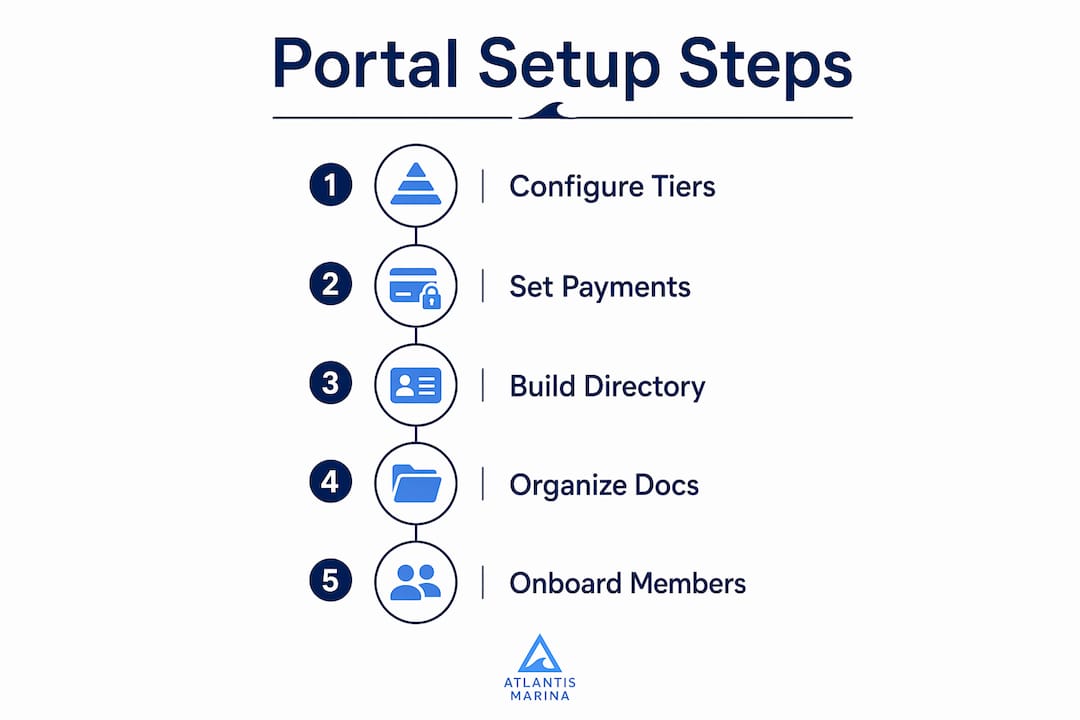
Define each tier by name, annual price, and included benefits. Set upgrade and downgrade rules so members can self-manage tier changes without contacting staff. Common yacht club tiers include Full Member, Associate Member, Junior Member, and Honorary Member. Each tier should map to a specific set of portal permissions.
Step 2: Set up payment processing
Connect Stripe or PayPal as your payment processor. Configure recurring billing for annual dues. Schedule renewal reminders at 30, 15, 7, and 3 days before expiration. Set a grace period of 7 to 14 days after expiration before access is restricted. Test the full payment flow end-to-end before launch, including failed payment scenarios.
Step 3: Build the member directory
The member directory must be opt-in with a privacy toggle that each member controls. Fields typically include name, vessel name, slip number, contact email, and phone. Restrict directory access to logged-in members only. Never expose the directory to the public web.
Step 4: Organize the document library
Structure the library with clearly labeled folders: Bylaws and Governance, Race Instructions, Club Forms, and Member Handbooks. Every document should be downloadable with a clear file name and upload date. Include a keyword search function so members can find what they need without browsing every folder. For a deeper look at how document libraries fit into a broader marina customer portal, the feature requirements are largely consistent across marine operations.
Step 5: Build the onboarding flow
New members should receive a welcome email within minutes of joining that includes their login link, a brief portal orientation, and links to the three documents they will need first: the member handbook, the current race schedule, and the dues payment confirmation. Automated onboarding reduces the volume of "how do I find X" support emails in the first 30 days.
The table below summarizes common setup pitfalls and how to avoid them:
| Pitfall | Impact | Fix |
|---|---|---|
| No privacy toggle on directory | Member complaints, potential liability | Add opt-in control before launch |
| Documents uploaded without search | Members revert to emailing staff | Implement keyword search on day one |
| No renewal reminder sequence | High lapse rate, revenue loss | Configure 30/15/7/3-day reminders |
| Admin features visible to members | Confusion and security risk | Use separate admin and member interfaces |
| No mobile optimization | Low adoption among younger members | Test on iOS and Android before launch |
Pro Tip: Launch with the minimum viable portal first. A working payment system, a clean directory, and a searchable document library will serve 80% of member needs. Add event management and advanced reporting in the second phase.
How to manage user roles, security, and authentication
Role-based access control (RBAC) is the security foundation of any yacht club portal. RBAC assigns permissions to roles rather than individuals, which makes access management scalable as the club grows. A well-structured RBAC model for a yacht club typically includes three roles: Member, Officer, and Administrator.
Here is how permissions should be distributed across those roles:
- Member: View and edit own profile, access document library, view opt-in directory, pay dues, register for events
- Officer: All member permissions plus access to event management, member communications, and committee documents
- Administrator: Full access including billing reports, member account management, role assignments, and portal configuration
Separating the admin panel from the member portal prevents sensitive billing and configuration tools from being exposed to regular members. Blurring this boundary creates both security risks and operational confusion. Officers should never need to navigate through admin settings to complete routine club tasks.
For authentication, passwordless magic-link login is the most practical choice for yacht club members. Members receive a one-time login link by email rather than managing a password. This approach cuts password reset support requests significantly and removes the most common barrier to portal adoption among less tech-savvy members.
For clubs with existing identity infrastructure, integrating a single sign-on (SSO) provider such as Google Workspace or Microsoft Entra ID gives administrators centralized control over access. When a member's account is deactivated in the identity provider, portal access is revoked automatically.
Pro Tip: Enable two-factor authentication for Administrator and Officer roles even if you use magic-link login for regular members. Admin accounts are the highest-value targets for unauthorized access.
How to troubleshoot common challenges and drive member adoption
The most common setup mistakes are poor navigation structure and inadequate document organization. Treating the portal as a core product with dedicated navigation and clear document affordances is what separates portals members use daily from portals members ignore. When the portal is buried as a secondary link on the club website, members default to emailing staff or posting in group chats instead.
Tactics that consistently improve adoption after launch:
- Send a portal introduction email to all existing members with a direct login link, not just a link to the homepage
- Record a two-minute screen-share video showing how to pay dues, find documents, and update profile settings
- Post the video in the welcome email and pin it in the portal's announcement section
- Set up automated reminders for any time-sensitive action, including dues renewal, event registration deadlines, and document acknowledgment requests
- Collect member feedback at 30 and 90 days post-launch using a short survey embedded in the portal
Members value self-service capabilities including profile updates, directory visibility controls, saved payment methods, and renewal history. Clubs that configure these features before launch see higher engagement and fewer inbound support requests from day one. The goal is a portal where members can answer their own questions without contacting the office.
Key takeaways
A successful yacht club member portal requires defined requirements, a platform matched to those requirements, and a phased configuration that prioritizes payments, directory, and document access before adding advanced features.
| Point | Details |
|---|---|
| Define requirements first | Lock down member count, must-have features, budget, and integrations before selecting any platform. |
| Separate admin and member interfaces | RBAC and distinct panels prevent security risks and reduce staff confusion. |
| Configure payments before launch | Set up Stripe or PayPal with a 30/15/7/3-day renewal reminder sequence to minimize lapse rates. |
| Launch minimum viable portal | Core features first, then iterate based on actual member usage and feedback. |
| Treat the portal as a core product | Dedicated navigation and searchable documents drive adoption and reduce support volume. |
Why most yacht club portals underperform in the first year
Most clubs I have worked with make the same mistake: they treat the member portal as a technology project rather than a member experience product. The technical setup gets done, the platform goes live, and then nothing happens. Members do not log in. Staff still answer the same emails. The portal sits unused while the club continues operating on spreadsheets and group chats.
The clubs that get this right do one thing differently. They define what success looks like before they configure a single feature. Not "we want a portal" but "we want 80% of members paying dues online within 60 days of launch" or "we want zero staff hours spent on document requests by end of Q2." Specific outcomes drive specific configuration decisions.
The other lesson I keep coming back to is the value of separating the admin panel from the member-facing portal. This sounds obvious, but most out-of-the-box setups blur the line. When officers can see billing configuration screens, or when members accidentally land on admin pages, the whole system loses credibility. Clean separation is not a luxury. It is a prerequisite for a portal that staff and members both trust.
For clubs considering a yacht club billing system as part of their portal build, the billing configuration is where most clubs lose the most time. Get the renewal reminder sequence and grace period logic right before launch. Fixing billing logic after members have already lapsed is far harder than getting it right the first time.
— John
How Atlantis-marina supports yacht club portal operations
Yacht clubs that need more than a basic membership portal, specifically clubs managing slip assignments, boat lift operations, reservations, and billing from a single platform, will find that Atlantis-marina covers the full operational picture.
Atlantis-marina, developed by Atlantis Control Systems, gives yacht club administrators a cloud-based platform that handles member communications, online reservations, recurring billing, and payment processing alongside slip and vessel management. The platform is built for clubs that are moving away from fragmented manual workflows and need a single system that connects marina infrastructure with member-facing tools. Explore the full range of marina management solutions to see how Atlantis-marina fits your club's operational needs.
FAQ
What does a yacht club member portal include?
A yacht club member portal includes account and profile management, a document library with bylaws and race instructions, and an opt-in member directory with privacy controls. Payment processing and renewal automation are also standard components.
How long does member portal setup take for a yacht club?
Setup time ranges from two to six weeks depending on platform choice, the number of membership tiers, and the volume of documents to organize. Purpose-built platforms like AppDeck or Wild Apricot reduce configuration time compared to WordPress-based builds.
What is the best login method for yacht club members?
Magic-link passwordless login is the most practical option for yacht club members. It eliminates password management, reduces support requests, and removes the most common barrier to portal adoption.
How do you protect sensitive data in a yacht club portal?
Role-based access control separates member, officer, and administrator permissions. Keeping the admin panel and member portal as distinct interfaces prevents sensitive billing and configuration data from being exposed to regular members.
When should a yacht club add event management to the portal?
Configure membership tiers, payment processing, and the member directory first. Add event management and advanced reporting in a second phase once the core portal is stable and member adoption is established.