
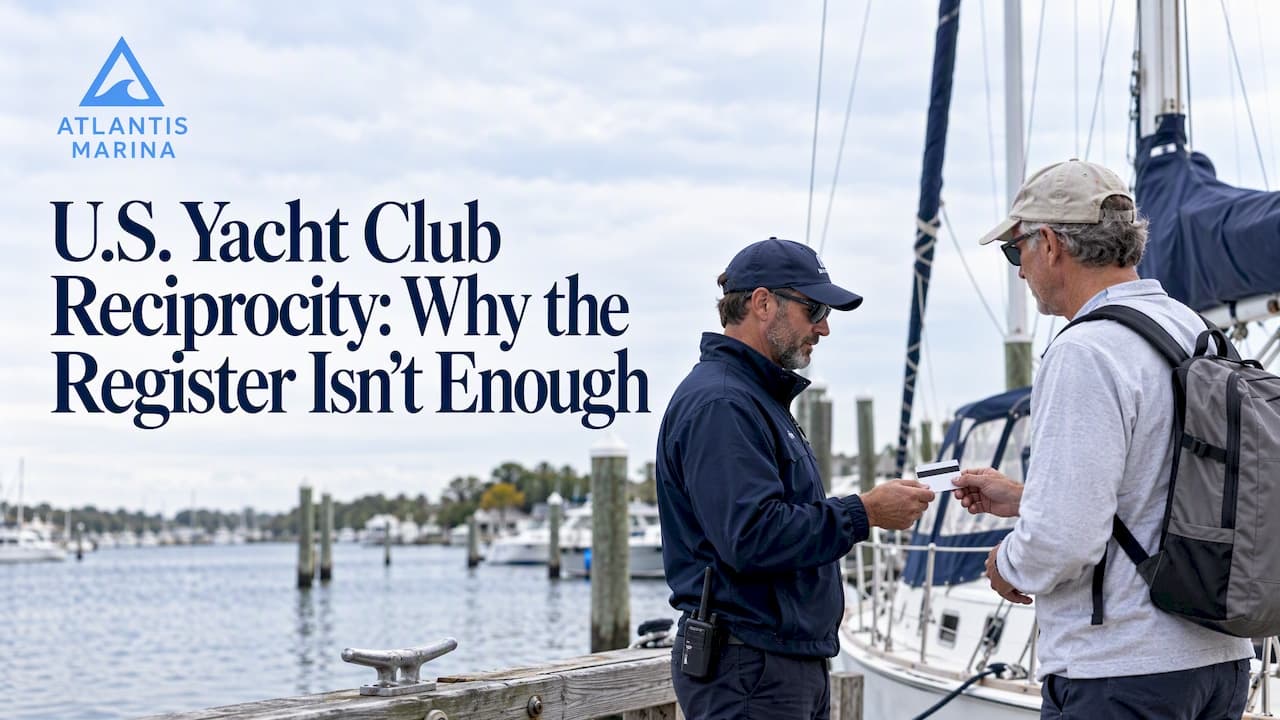
Reciprocity agreements between yacht clubs are a club-to-club courtesy that usually lets visiting members use a host club's facilities and, when space allows, short-term guest moorage. Many U.S. clubs identify one another through the Yachting Club of America and its Register. The host club sets the rules, limits and fees, so always call ahead and bring your membership card or a Letter of Introduction.
TL;DR:
- Contact the host club at least 48 hours ahead, confirm clubhouse access and moorage separately, and ask about blackout dates, fees, reservations, and payment methods.
- Ask your home club for a Letter of Introduction early; processing may take two weeks, and hosts often request it 48 hours before arrival.
- Seattle Yacht Club offers two free moorage days per calendar year; California Yacht Club allows one free night, then charges $2.50 per foot in 2026.
- Treat the YCA Register as a directory rather than a reservation guarantee; confirm current rules and space with the dockmaster, and arrange backup moorage.
Table of Contents
- How reciprocity agreements between yacht clubs actually work
- Typical privileges, limits, and fees you should expect
- Step-by-step: requesting reciprocity and preparing your visit
- Etiquette and expectations for reciprocal guests
- Where to find participating clubs and verify their policies
- Practical booking tips and pitfalls to avoid when cruising
- Why clear reciprocity processes help clubs and cruisers alike
- How club software can simplify reciprocity
- FAQ
- Sources
How reciprocity agreements between yacht clubs actually work
Most reciprocity runs through the Yachting Club of America (YCA), which maintains a Register of American Yacht Clubs. Clubs registered with YCA often extend privileges to members of other registered clubs, yet each host club keeps control of its own restrictions and fees. The Register itself is a directory: it lists member clubs, contact details, courtesy dockage and reciprocity status, and it does not impose one policy on anyone.
Clubs also recognize each other through bilateral agreements and regional associations. The Chesapeake Bay Yacht Clubs Association, for example, notes that its member clubs generally welcome visitors from other members, but that CBYCA does not require reciprocity and each club sets its own terms. Visitors there are asked to contact the host club's fleet captain in advance.
The takeaway: the host club's published policy is the controlling document. As one regional handout puts it, reciprocity is a privilege, not a right, and clubs may restrict access in peak season or limit which amenities visitors can use. A guest card from your home club opens a conversation, not a guaranteed slip.

Typical privileges, limits, and fees you should expect
Visiting members commonly find a familiar set of benefits, though no club offers all of them to every guest:
- Dining room and bar access, often with reservations required
- Showers and locker rooms
- Ship store purchases
- Launch service where the club runs one
- Short-term guest moorage when space is available
Larchmont Yacht Club's visitor sheet, for instance, shows reciprocal dining privileges, reservation procedures and dress codes, plus small fees on meals.
Limits matter just as much. Meydenbauer Bay Yacht Club publishes limited reciprocal moorage locations and detailed blackout dates when privileges are restricted, and some clubs spell out allowances such as one free night per year or monthly free nights for specific affiliated clubs. Policies vary widely, so a rule you learned at one club tells you little about the next.
Seattle Yacht Club offers two complimentary days of guest moorage per calendar year, then posted rates apply. California Yacht Club caps reciprocal moorage at one free night, with later nights charged at $2.50 per foot as of 2026.
On a larger boat, those later nights add up quickly, so budget for dockage even when the dining room and showers cost you nothing. Expect surcharges and service fees for non-member guests, and expect a card on file: Seattle's guidelines note that reciprocal guests often have a credit card added to a guest account at check-in.
Step-by-step: requesting reciprocity and preparing your visit
Good preparation is the difference between a warm welcome and a turned-away boat. Work through it in this order:
- Contact the host club's dock office or front desk at least 48 hours before arrival and ask exactly what they require for clubhouse admission and for moorage.
- Request a Letter of Introduction from your home club's Secretary or Commodore if the host club asks for one. Do not write it yourself, because most hosts want it to come directly from your home club.
- Allow lead time. Tower Harbour Yacht Club suggests at least two weeks for LOI processing in some cases.
- Email the LOI to the club manager early. Plymouth Yacht Club recommends sending it at least 48 hours before you arrive.
- Pack a current membership card, a credit card for incidental charges, and your home burgee if the club asks for it.
- On arrival, check in with the dock office, confirm your slip or mooring, and sign the guest register.
Pro Tip: Ask about shore power connections and adapters when you confirm your slip, and pick an anchorage or a nearby transient marina as a fallback before you leave the dock.
Etiquette and expectations for reciprocal guests
You are an ambassador for your home club. The PICYA handout is blunt that reciprocity relies on good relationships and professional courtesy, so a careless guest can cost every member of their club future access. Read the host club's dress code and rules of conduct on its website before you walk in.
Expect some facilities to be off limits. Fleet activities, pools and overnight rooms are often reserved for members, and certain privileges are tied to paying for dockage. Nargusta's guide describes reciprocal privileges as a courtesy, with short-term berthing and meal or bar service offered if available, which is a useful way to set your own expectations.
A few habits keep everyone happy:
- Sign the guest register every time
- Patronize the dining room or bar rather than only using the docks
- Follow the dress code, including phone etiquette where posted
- Never board another vessel without the owner's permission
- Respect blackout dates and posted visitor limits
- Settle your account before you leave
Where to find participating clubs and verify their policies
Start with the YCA Register, which lists club contacts, courtesy dockage and reciprocity status. Treat it as a map to the right club, then verify the details at the source. Rules change, and a printed or third-party list may lag behind a club's current policy.
- Club visitor pages: Most clubs publish guest procedures online. Milford Yacht Club states that guest dockage is not guaranteed and that failing to follow its steps can lead to denial of privileges.
- Dock office or dockmaster: Call or email for the latest rules, slip availability and any event closures.
- Your own cruising folder: Save or print each club's visitor page, along with contact emails and phone numbers, so you have them when cell service is poor.
Our own Newburyport Yacht Club visitor guide shows the kind of detail worth looking for on any club's page. We also publish marina guides and facility knowledge that help you build a booking folder before you go.
Practical booking tips and pitfalls to avoid when cruising
The most common mistake is assuming reciprocity guarantees a slip. It does not, and many clubs prioritize their own members for dockage. Confirming that the club accepts your reciprocity and confirming that it has space for your boat are two separate steps.
- Ask the dockmaster whether the club has designated visitor slips or only space-available moorage
- Line up a backup: an anchorage, a nearby public marina or a paid transient marina
- Ask which payment methods are accepted and whether card or service fees apply
- Check blackout dates for regattas and major events before you set your route
- Ask whether dining reservations are required in peak season
Dock key deposits and guest cards also catch visitors off guard. California Yacht Club describes guest cards, dock key deposits and limits on privileges tied to paid dockage.
Pro Tip: Confirm slip details in writing and save the reply. If the dock office changes hands or an event shifts the schedule, an emailed confirmation settles the question quickly.
Why clear reciprocity processes help clubs and cruisers alike

Reciprocity survives on goodwill, and goodwill survives on clear communication. When a club publishes its policy, answers inquiries quickly and confirms arrivals in advance, visitors behave better and dockmasters spend less time solving surprises at the fuel dock. When processes are vague, both sides lose patience, and the privilege gets narrower.
We see the same pattern in marina operations. Digital workflows let a dockmaster confirm a guest, collect documents and capture payment before the boat ties up, which protects the courtesy that makes reciprocity worth having.
— John R
How club software can simplify reciprocity
Clubs that handle visiting members by phone and spreadsheet tend to feel the friction first. We built Atlantis Marina to take that work off a manager's desk and put it in one cloud-based system, with the dockmaster still making every final call.
- Reservation requests arrive in one place instead of scattered inboxes
- Guests upload documents such as insurance and registration to their own account
- Dockmasters confirm arrivals and keep vessel records current
- Payments and billing run through the same account, with Stripe and ACH options

If you manage a club and want to see how visitor workflows could run, request a demo with our team or review our marina management solution and plans and pricing. Club officers who issue Letters of Introduction may also like our vessel records management guide.
FAQ
What is a yacht club reciprocal agreement?
It is a courtesy between clubs that lets visiting members use a host club's facilities and, when space allows, guest moorage. Each host club sets its own rules, restrictions and fees, so the privileges differ from club to club.
What do I need to bring to a reciprocal yacht club?
Bring a current membership card and, when the host club asks, a Letter of Introduction from your home club. Typical procedures also include contacting the dock office at least 48 hours ahead and signing a guest register on arrival.
Does reciprocity guarantee me a slip?
No. Guest dockage depends on availability and the host club's policy, and clubs often favor their own members. Confirm both your reciprocal status and your slip with the dockmaster before you leave.
How far ahead should I request a Letter of Introduction?
Allow as much time as your home club needs. Some clubs advise allowing at least two weeks for processing, and many hosts want the letter emailed at least 48 hours before you arrive.
Where can I find clubs that offer reciprocity?
Begin with the Yachting Club of America's reciprocity page and its Register of American Yacht Clubs. Then confirm current rules on each host club's own visitor page.