

Yacht club vessel records management is the process of organizing, tracking, and securing all essential vessel documentation and compliance data in a centralized system that supports daily operations and regulatory readiness. Platforms like SailHQ, YachtWyse, and RationalGo have each built purpose-specific modules around this need, recognizing that spreadsheets and paper files create compliance gaps that cost clubs time and credibility. The core industry term for this discipline is fleet documentation management, and it covers everything from registration certificates to safety equipment checklists. Clubs that treat it as a formal operational function, rather than an administrative afterthought, consistently outperform peers on audit readiness and member satisfaction.
What does yacht club vessel records management actually require?
Effective vessel records management for yacht clubs requires tracking two distinct categories of data: compliance documents and operational data. Confusing the two is the most common setup mistake dockmasters make.
Compliance documents include:
- Certificate of Documentation or state registration — US documented vessels require periodic renewal, and ownership or vessel detail changes must be updated promptly to maintain valid documentation.
- Insurance certificates — current coverage dates, insurer name, policy number, and coverage limits.
- Safety equipment certifications — life raft service records, flare expiry dates, fire extinguisher inspection tags.
- Compliance certificates — environmental compliance, radio licenses, and any flag-state certificates for offshore vessels.
Operational data includes:
- Bottom-paint schedules and haul-out appointment history.
- Engine service logs and maintenance intervals.
- Slip assignment history and mooring records.
- Fuel and utility consumption where tracked.
A practical vessel records system combines a vessel registry with a compliance tracker that manages all of the above with automated pre-expiry reminders. The registry holds the static vessel profile. The compliance tracker handles the living, expiring documents.
One distinction that matters for audit clarity: club-owned vessels and member-owned vessels require separate record domains. Club boats carry different liability, maintenance accountability, and insurance structures than member boats. Mixing them in a single flat list creates confusion during audits and complicates liability management. SailHQ explicitly recommends this separation to ease both audits and responsibility tracking.
How do you build a compliance renewal workflow that actually works?
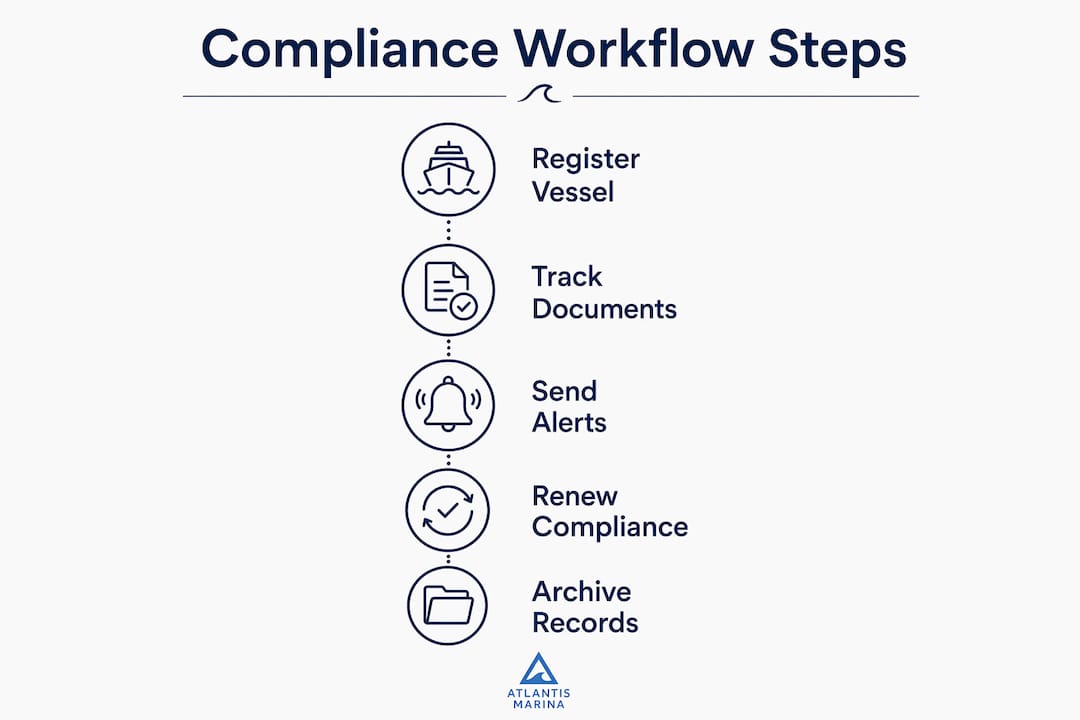
A compliance renewal workflow is a structured sequence of alerts, acknowledgments, and archival steps that keeps every vessel document current without relying on memory or manual calendar checks.
The standard workflow follows these steps:
- Set configurable expiry alerts. YachtWyse recommends alert intervals at 90, 60, 30, and 7 days before expiry. Each interval serves a different purpose: 90 days gives owners time to schedule renewals, 7 days triggers urgent action.
- Route alerts to the right people. Dockmasters need visibility on all vessels. Vessel owners need reminders for their own documents. Compliance officers need a consolidated dashboard. Role-based routing prevents alerts from landing in the wrong inbox and being ignored.
- Require logged acknowledgments. Every alert response must be recorded: who acknowledged it, when, and what action they took. Static calendar reminders with no acknowledgment trail are not a workflow. They are a notification with no accountability.
- Archive expired documents and reset the cycle. When a renewed document is uploaded, the system archives the expired version and generates a fresh alert cycle for the new expiry date. This creates a continuous, unbroken renewal loop.
- Prevent conflicting document versions. Naming conventions alone are insufficient. The system must enforce an immutable event history covering upload, acknowledgment, renewal, archival, and alert regeneration. Two versions of the same certificate in an active record is an audit failure waiting to happen.
Pro Tip: Configure your 90-day alert to trigger an automatic task assigned to the vessel owner through your member portal. This shifts the renewal burden to the right party and creates a documented paper trail without any manual follow-up from your dockmaster.
Common mistakes to avoid: leaving lapsed documents in the active record without archiving them, sending alerts with no acknowledgment requirement, and routing all alerts to a single staff email that changes with personnel turnover. Leadership turnover is one of the primary causes of recordkeeping failures in yacht clubs, and a workflow that depends on one person's inbox is a single point of failure.
What are the best practices for organizing and securing vessel records?
Secure, well-organized vessel records are the foundation of audit readiness. The goal is fast retrieval with controlled access, not just storage.

Separation of live and archived data is the first organizing principle. SailHQ recommends importing dormant or lapsed records as archived entries rather than active ones. This keeps your working record set clean and prevents expired data from cluttering compliance dashboards. Archived records remain searchable and retrievable for historical audits.
Role-based access control is non-negotiable for clubs handling sensitive member data. NexusTek's guidance on marina data security recommends mapping data flows, enforcing least-privilege access, conducting quarterly access reviews, and requiring multi-factor authentication for accounts with access to personal or payment information. Apply the same standard to your vessel records system. A dockmaster needs read access to all vessel compliance status. A member needs write access only to their own vessel documents. A board member may need read-only reporting access.
Tamper-evident audit trails separate credible records from ones that can be challenged. Marine Inspection's compliance framework specifies that credible audit trails require cryptographic hashing, timestamping, signature workflows, and edit detection. Every change to a vessel record should log who made it, when, and what changed. This is not optional for clubs subject to port state control or flag-state inspections.
"Electronic PSC audit records can be retrieved in 5–10 seconds versus 45–90 minutes for manual paper archives." — Marine Inspection
That gap is the operational case for going digital. When a port authority inspector arrives unannounced, your ability to produce a complete audit pack in seconds rather than hours reflects directly on your club's credibility and compliance standing.
Pro Tip: Build a standard "audit pack" template in your records system that pulls the five most commonly requested documents for any vessel: registration, insurance, safety equipment certification, last haul-out record, and the vessel's compliance alert history. Run a quarterly drill to confirm the pack generates correctly for every active vessel.
Additional security practices for vessel data management include:
- Encrypt stored documents, especially scanned certificates containing personal identification.
- Log all document downloads, not just edits.
- Review vessel data security protocols at least annually as your club's data footprint grows.
What software tools support yacht fleet documentation and compliance?
The right platform depends on your club's size, compliance complexity, and whether you need integration with billing and slip management. The table below compares the leading options by core capability.
| Platform | Vessel Registry | Compliance Alerts | Member Portal | Billing Integration | Best For |
|---|---|---|---|---|---|
| SailHQ | Yes | Yes | Yes | Limited | Small to mid-size sailing clubs |
| YachtWyse | Yes | Advanced (configurable intervals) | Yes | No | Compliance-focused clubs |
| RationalGo | Yes | Yes | Yes | Yes | Clubs needing custom app builds |
| Clubessential | Yes | Basic | Yes | Yes | Large private clubs with full CRM needs |
| Atlantis-marina | Yes | Yes | Yes | Full integration | Marinas and yacht clubs needing unified operations |
Criteria for selecting a platform:
Clubs with fewer than 100 vessels and straightforward state registration requirements can operate effectively on SailHQ or a similar purpose-built sailing club tool. Clubs managing offshore or documented vessels with ISM-style compliance requirements need configurable alert workflows and tamper-evident audit trails, which points toward YachtWyse or a platform with equivalent depth.
Clubs that also manage slip assignments, billing, and vessel registration tracking in a single system gain a significant operational advantage. When a vessel's insurance certificate lapses, the billing module can flag the account automatically. When a new member submits vessel information through the member portal, it flows directly into the compliance tracker without manual re-entry.
Integration with a member portal also shifts document submission responsibility to vessel owners, reducing staff workload and improving data accuracy. Owners upload their own renewal certificates, the system timestamps the upload, and the dockmaster receives a notification to review and approve.
ISM-style compliance requires controlled, versioned documents with complete audit trails tracing operational records back to procedures and certificates. Clubs operating larger vessels or running commercial sailing programs should confirm that any platform they select meets this standard before committing.
Key takeaways
Effective yacht club vessel records management requires a centralized digital system with separate live and archived records, configurable compliance workflows, role-based access controls, and tamper-evident audit trails that support fast, credible audit pack assembly.
| Point | Details |
|---|---|
| Separate record domains | Keep club-owned and member-owned vessel records in distinct categories to simplify audits and liability. |
| Use configurable alert workflows | Set expiry reminders at 90, 60, 30, and 7 days with logged acknowledgments, not static calendar alerts. |
| Archive, do not delete | Move expired documents to archive status to maintain audit history without cluttering active records. |
| Enforce role-based access | Apply least-privilege access with quarterly reviews and multi-factor authentication for all accounts. |
| Go digital for audit speed | Electronic records reduce audit pack assembly from over an hour to under 10 seconds. |
What i've learned after years of watching clubs get this wrong
The clubs that struggle most with vessel records are not the ones that lack good intentions. They are the ones that built their system around a single person's habits. One longtime dockmaster with a color-coded spreadsheet and a filing cabinet full of certificates looks like a functional system right up until that person retires or moves on. Then the new hire inherits a records environment that only made sense to one human brain, and the club spends the next two seasons reconstructing what they had.
The fix is not just software. It is process formalization before software selection. I have seen clubs migrate to a digital platform and simply recreate their spreadsheet chaos inside a database. The tool did not save them because they never defined what a complete vessel record actually looks like for their club.
The most underrated step in any records migration is cleaning existing data before go-live. SailHQ's migration guidance makes this point directly: archiving lapsed records before import reduces post-migration disputes and keeps the active system clean from day one. Clubs that skip this step spend months arguing about whether a 2019 insurance certificate should show as expired or just missing.
My honest recommendation: define your record schema first. Decide exactly which documents every vessel must have, what metadata each document requires, and who is responsible for each renewal. Write that down as a policy. Then select a platform that enforces it. The technology is the easy part. The discipline is what separates clubs that pass audits from clubs that scramble through them.
— John
How Atlantis-marina handles vessel records for yacht clubs
Atlantis-marina brings vessel registry, compliance tracking, billing, and slip management into a single cloud-based platform built for marinas and yacht clubs of all sizes.
The platform's vessel records module tracks registration documents, insurance certificates, and safety equipment data with configurable expiry alerts routed to dockmasters, owners, or compliance staff. When a document lapses, the billing module flags the account automatically, connecting compliance status directly to financial workflows. Owners submit and update their own vessel documents through the boater portal, reducing manual data entry for your team. Atlantis-marina's marina management software is designed for clubs ready to move beyond fragmented systems and manual workflows. Explore plans and request a demo to see how the platform fits your club's operational needs.
FAQ
What documents must a yacht club track for each vessel?
A complete vessel record includes the registration certificate or Certificate of Documentation, current insurance certificate, safety equipment certifications, and maintenance or haul-out history. Clubs managing offshore or commercially operated vessels should also track flag-state certificates and radio licenses.
How often should vessel compliance alerts be sent?
YachtWyse recommends configuring alerts at 90, 60, 30, and 7 days before document expiry. Each interval serves a distinct purpose, from scheduling renewals to triggering urgent action, and every alert should require a logged acknowledgment.
Should club-owned boats and member boats share the same records system?
They should use the same platform but separate record domains. Club-owned vessels carry different liability, insurance, and maintenance structures than member-owned boats. Mixing them in a flat list creates audit confusion and complicates responsibility tracking.
How do electronic vessel records improve audit readiness?
Electronic records allow audit packs to be assembled in seconds rather than hours. Marine Inspection reports that electronic PSC audit records are retrievable in 5–10 seconds compared to 45–90 minutes for paper-based archives.
What access controls should a yacht club apply to vessel records?
Apply role-based access with least-privilege permissions, conduct quarterly access reviews, and require multi-factor authentication for any account with access to personal or payment data. NexusTek's marina cybersecurity guidance recommends annual incident response testing as well.