
Aux device control in marina automation is the process of remotely managing vessel and facility auxiliary systems, including lighting, bilge pumps, HVAC, and utility metering, through centralized software and intelligent hardware. Marina operators who deploy this approach gain real-time visibility into every connected device across their facility. Digital switching systems replace mechanical switches with intelligent controllers that support CAN-bus and NMEA 2000 protocols, enabling unified control from a single interface. Platforms like Atlantis Marina unify this hardware layer with billing, occupancy tracking, and operations management in one cloud-based system. The result is a facility where automation handles routine tasks, staff focus on service, and revenue leakage from untracked utility consumption drops significantly.
What tools and infrastructure are needed for aux device control marina automation?
Effective auxiliary device management starts with the right physical infrastructure. Operators who skip this step find that software alone cannot compensate for hardware that was never designed to communicate.
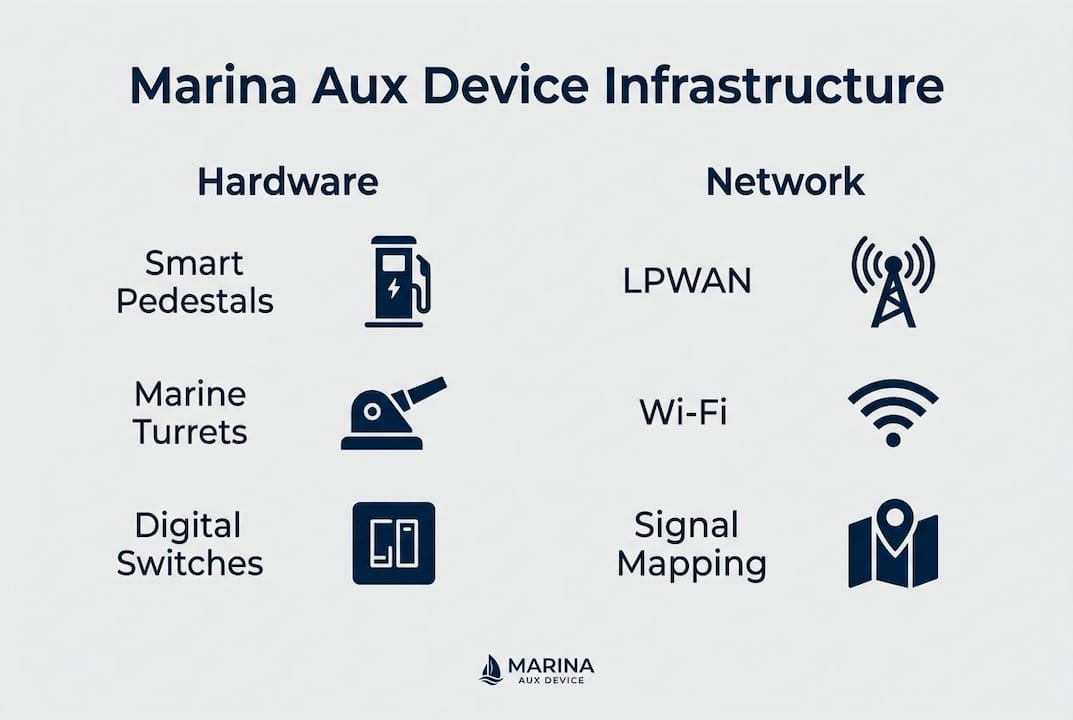
Smart utility pedestals are the foundation. Smart pedestals enable precise utility isolation and remote control, reducing revenue leakage by integrating with cloud billing platforms for real-time consumption tracking and automated invoicing. Every kilowatt-hour and gallon of water becomes a billable, auditable data point.
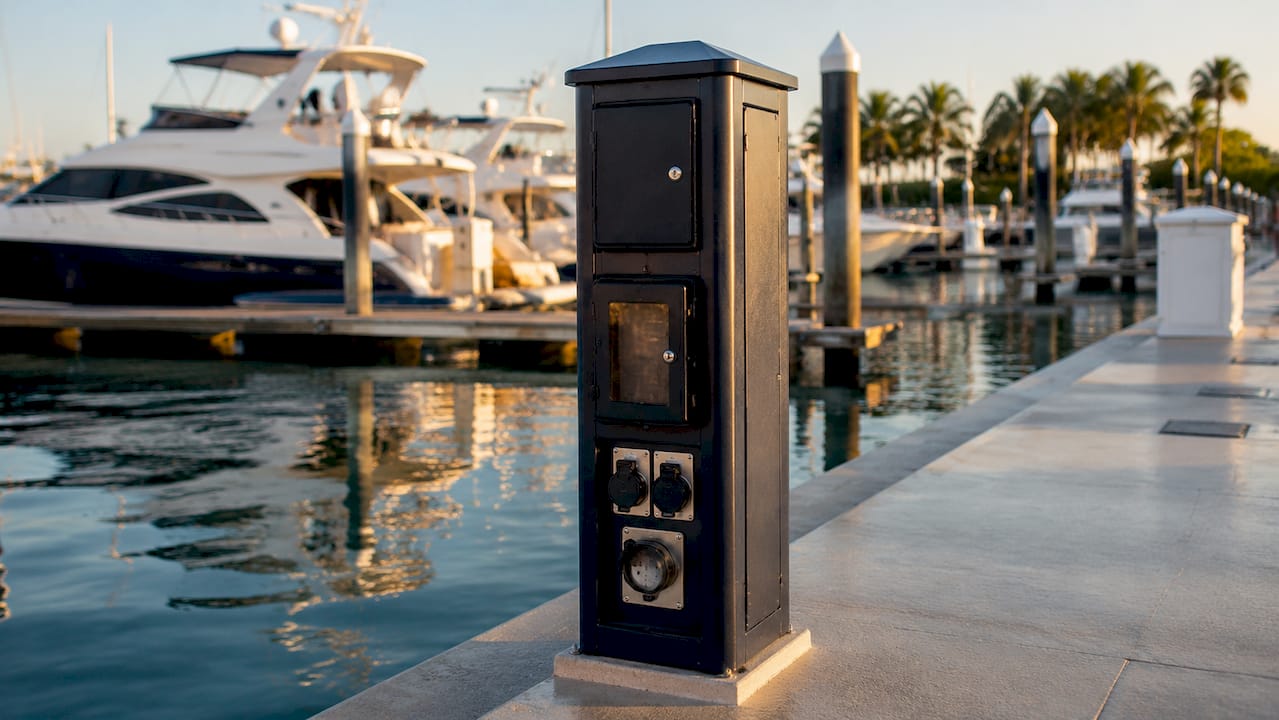
Marine distribution turrets come next. Corrosion-resistant, smart-ready turrets are critical for scalable marina automation. Specifying these systems during the design phase prevents scalability limits and asset devaluation later. Retrofitting a turret that was never built for digital integration costs far more than getting it right the first time.
Digital switching controllers complete the hardware layer. These devices replace traditional panel switches and connect to vessel and facility systems through CAN-bus or NMEA 2000 networks. They give operators centralized control over lighting scenes, bilge pump activation, HVAC zones, and power distribution from one human-machine interface (HMI) or software dashboard.
The networking layer is equally important. Key infrastructure requirements include:
- LPWAN/LoRaWAN gateways for long-range, low-power device communication across large marina footprints
- Wi-Fi access points for supplemental coverage in marina offices, ship stores, and high-density berth areas
- Intelligent gateways to bridge vessel-side CAN-bus systems with shore-side automation infrastructure
- Cloud-connected software to aggregate device data, trigger billing events, and surface alerts to staff
LPWAN networks like LoRaWAN are preferred over Wi-Fi for marina utility communication because of their range and resistance to interference. Wi-Fi alone is insufficient across large or complex marina layouts.
Pro Tip: Before purchasing any hardware, conduct a site-specific signal mapping survey. Dead zones in your marina's RF coverage will cause billing gaps and device dropouts that are far harder to fix after installation.
| Infrastructure component | Primary function | Integration requirement |
|---|---|---|
| Smart utility pedestal | Metering and remote isolation | Cloud billing platform, LoRaWAN gateway |
| Distribution turret | Power and water distribution | Smart-ready ports, CAN-bus compatibility |
| Digital switching controller | Device automation and HMI control | CAN-bus or NMEA 2000 network |
| LPWAN/LoRaWAN gateway | Long-range wireless communication | Cloud platform API |
| Intelligent gateway | Vessel-to-shore system bridge | CAN-bus, NMEA 2000, software API |
How do you integrate and configure auxiliary devices for centralized control?
Integration follows a defined sequence. Skipping steps creates gaps between what the system reports and what actually happens on the dock.
-
Audit existing devices and protocols. Catalog every auxiliary device on the facility: lighting circuits, bilge pumps, HVAC units, shore power outlets, and water meters. Note which devices already use CAN-bus or NMEA 2000 and which require a gateway adapter.
-
Install intelligent gateways at each integration point. Many retrofits fail by ignoring this step. Gateways translate vessel-side protocols into data the shore-side software platform can read and act on.
-
Connect digital switching controllers to the CAN-bus network. Map each controller to its physical device in the software. Assign device names, locations, and billing categories so the system knows which slip, berth, or facility zone each device serves.
-
Configure the centralized HMI or software control panel. Atlantis Marina's operations dashboard integrates occupancy data, utility consumption, and device status in one view. Staff can trigger manual overrides or review automated actions without switching between systems.
-
Set automation rules for routine tasks. Common automation schedules include:
- Lighting scenes that activate at sunset and deactivate at sunrise
- Bilge pump cycles triggered by float switch signals
- Shore power cutoffs when a vessel departs a slip
- HVAC zone activation tied to occupancy detection events
-
Integrate with occupancy detection. AI-powered occupancy detection using standard IP cameras achieves 99.7% accuracy. Data updates every 30 seconds, enabling real-time berth management and triggering utility activation or deactivation automatically when a vessel arrives or leaves. Atlantis Marina's camera integration connects this occupancy data directly to billing and slip management workflows.
-
Connect device events to the billing engine. Every utility consumption event should generate a billing record automatically. Atlantis Marina's marina billing software handles this connection, so operators never manually enter utility charges or reconcile meter readings at month-end.
Pro Tip: Configure your automation rules in "monitor-only" mode for the first two weeks after go-live. Watch the system log every action it would have taken, verify accuracy, then switch to live automation. This single step prevents costly errors during the learning period.
| Integration approach | Automation capability | Billing accuracy |
|---|---|---|
| Manual meter reading only | None | Low, subject to human error |
| Smart pedestals with cloud billing | Partial, utility isolation only | High for metered consumption |
| Full digital switching with CAN-bus | Full device automation | High, event-driven billing |
| Unified platform (Atlantis Marina) | Full automation plus AI occupancy | Highest, real-time and automated |
What challenges and troubleshooting practices apply to aux device control?
Marina environments are hard on electronics. Salt air, humidity, power surges, and vessel traffic create conditions that expose every weak point in an automation system.
The most common failure point is connectivity. Deterministic LPWAN networks are preferred for marina utility communication over Wi-Fi because of range and interference challenges. Site-specific signal mapping before installation is not optional. It is the difference between a system that bills accurately and one that drops readings during peak occupancy.
A second common mistake is confusing digital switching with simple remote power cycling. The distinction is critical: effective systems use CAN-bus or NMEA 2000 with intelligent gateways for vessel integration. A relay timer that cuts power to a slip is not auxiliary device control. It cannot report device state, trigger billing events, or integrate with occupancy data.
Staff resistance is a real operational risk. Operators who deploy full automation without a phased rollout often find that staff distrust the data and revert to manual processes. Phased automation deployment starting with real-time monitoring reduces operational risks and builds staff trust before full automation goes live.
Best practices for ongoing reliability include:
- Schedule monthly gateway firmware updates to maintain protocol compatibility
- Log all device state changes and review anomalies weekly
- Test bilge pump automation triggers quarterly using simulated float switch signals
- Maintain a spare intelligent gateway on-site for rapid swap-out during failures
- Train all dockmaster staff on manual override procedures before enabling automation
The biggest automation failures at marinas come not from bad hardware but from operators who skip the monitoring phase and go straight to full automation. Staff who never learned to trust the data will override the system at the worst possible moment. Build confidence before you build dependency.
What operational benefits can operators expect from full aux device control?
Fully implemented auxiliary device management delivers measurable gains across safety, revenue, and daily operations. The benefits compound over time as automation handles more routine decisions.
Real-time utility consumption tracking eliminates the revenue leakage that plagues marinas relying on manual meter reads. IoT platforms aggregating utility, security, and asset data improve safety, automate billing, and optimize resource usage across the facility. Operators who previously estimated utility charges now bill exactly what each vessel consumed.
Berth occupancy management improves dramatically with AI and camera integration. Occupancy data updated every 30 seconds means slip assignments, billing start times, and utility activation all reflect actual vessel presence rather than scheduled arrival times. Atlantis Marina's AI operations guide details how this data feeds directly into daily operations decisions.
The safety benefits are equally significant. Automated monitoring catches bilge pump failures, shore power faults, and unauthorized access events before they escalate. Alerts reach staff on mobile devices immediately, reducing response times from hours to minutes.
Key operational gains from full implementation:
- Reduced revenue leakage through automated, event-driven utility billing
- Lower labor costs as routine device management tasks run without staff intervention
- Faster incident response through real-time alerts on device failures or safety events
- Improved berth utilization through accurate, real-time occupancy data
- Simplified compliance with automated logs of all device states and utility consumption
Atlantis Marina's boat lift and aux device control capabilities extend these benefits to dry stack and lift operations, where device automation directly affects throughput and customer wait times.
Key Takeaways
Aux device control in marina automation delivers its full value only when smart hardware, reliable networking, and a unified software platform work together from the start.
| Point | Details |
|---|---|
| Infrastructure comes first | Smart pedestals, marine-grade turrets, and digital switching controllers must be in place before software automation can function. |
| CAN-bus and NMEA 2000 are the standard | Digital switching systems using these protocols enable true device automation, not just remote power cycling. |
| LPWAN outperforms Wi-Fi at scale | LoRaWAN networks provide the range and reliability that marina utility communication requires across large footprints. |
| Phased rollout builds staff trust | Starting with monitoring before full automation reduces errors and prevents staff from overriding the system. |
| Unified platforms close the billing gap | Connecting device events directly to billing software eliminates manual meter reads and revenue leakage. |
Why I think most marinas are automating in the wrong order
Marina operators tend to get excited about the end state: lights that turn on automatically, bilge pumps that self-activate, utility bills that generate themselves. That excitement leads them to buy automation hardware before they have reliable data on what their facility actually does.
I have seen this pattern repeatedly. A marina installs digital switching controllers and automation rules, then discovers six months later that their occupancy data was wrong, their gateway had a dead zone covering three slips, and their billing records do not match their meter readings. The automation was running. It was just running on bad inputs.
The operators who get this right start with monitoring. They install smart pedestals and occupancy sensors, watch the data for 60 to 90 days, and fix every anomaly before they write a single automation rule. By the time they enable automated billing and device control, they trust the numbers completely.
The other thing most guides miss is infrastructure specification. Modern distribution turrets are foundational infrastructure that must be specified with automation scalability in mind. A marina that installs standard turrets today will spend twice as much replacing them in five years when they want to add smart metering. Specify smart-ready hardware on day one, even if you do not activate every feature immediately.
The future of marina operations is full autonomy: AI-managed berth assignments, self-billing utility systems, and predictive maintenance alerts that fire before a device fails. That future is closer than most operators realize. The marinas that will get there fastest are the ones building the right foundation right now.
— John R
How Atlantis Marina supports aux device control and marina automation
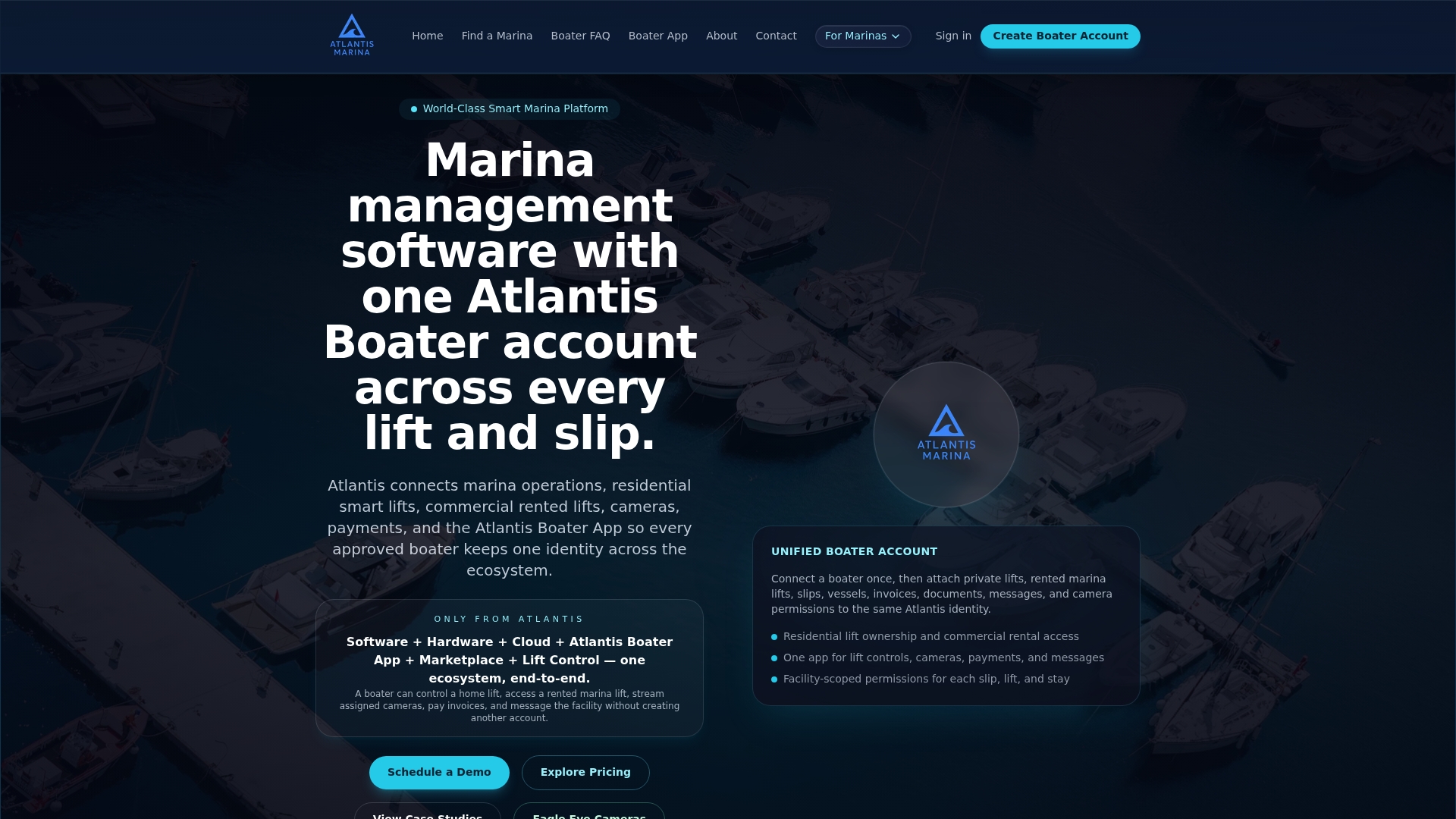
Atlantis Marina connects smart marine hardware directly to marina operations management in one cloud-based platform. The system supports AUX device control, smart boat lift controllers, remote monitoring, sensor and camera integrations, and mobile alerts alongside slip management, reservations, and fully automated billing. Operators manage utility consumption, occupancy data, and device status from a single operations dashboard without switching between disconnected tools. Billing events triggered by device activity flow automatically through Stripe, ACH, and QuickBooks Online sync, so revenue is captured the moment it is earned. Marina operators ready to connect their facility's hardware to a complete management platform can explore Atlantis Marina to see how the system fits their operation.
FAQ
What is aux device control in marina automation?
Aux device control in marina automation is the centralized management of auxiliary facility and vessel systems, including lighting, bilge pumps, HVAC, and utility metering, through digital switching controllers and software platforms. It replaces manual switch operation with automated, protocol-driven control using CAN-bus or NMEA 2000 standards.
What communication protocol works best for marina aux device networks?
CAN-bus and NMEA 2000 are the standard protocols for digital switching in marine environments. For wireless communication between shore-side devices and cloud platforms, LoRaWAN networks outperform Wi-Fi in range and reliability across large marina footprints.
How does aux device control improve marina billing accuracy?
Smart utility pedestals and digital switching controllers generate consumption and device-state events in real time. When connected to a billing platform like Atlantis Marina's marina billing software, these events trigger automated invoices that eliminate manual meter reads and reduce revenue leakage.
What is the best way to start deploying marina automation?
Phased deployment starting with real-time monitoring reduces operational risk and builds staff confidence before full automation goes live. Install occupancy sensors and smart metering first, validate the data for 60 to 90 days, then layer in automated device control and billing rules.
Can AI cameras integrate with aux device control systems?
AI-powered occupancy detection using standard IP cameras achieves 99.7% accuracy with data updated every 30 seconds. This occupancy data can trigger utility activation, billing start events, and device automation rules directly, making camera integration a high-value component of any marina automation system.