

Yes, dynamic pricing works for marinas, but only when it is run as a revenue-management program rather than a simple rate hike during busy weekends. Properly governed, it raises Revenue per Available Berth (RevPAB) instead of just chasing full docks. The way to know it is working is to compare RevPAB before and after a controlled pilot, not to watch occupancy alone. The rest of this guide shows how to build that pilot and scale it.
TL;DR:
- Properly governed dynamic pricing focuses on increasing revenue per available berth rather than simply maximizing occupancy.
- Key metrics such as RevPAB, booking lead time, and cancellation rates are critical for effective revenue management and should be monitored daily.
- Starting with transparent, rule-based pricing thresholds and layer rules by slip class and booking channel minimizes operational disruption.
- Collecting at least one year of booking and rate history is essential before advancing to demand forecasting or machine learning models.
- Automating billing, reservations, and rate adjustments through integrated systems ensures the success of a scalable dynamic pricing program.
Table of Contents
- Why Occupancy Alone Is a Poor Performance Metric
- Which Metrics and Analytics Do You Actually Need?
- What Pricing Rules and Triggers Should You Set First?
- What Data Do You Need Before You Model Anything?
- How Do You Roll Out Dynamic Pricing Without Disrupting Operations?
- What Trade-Offs Should Marina Operators Watch For?
- Turn These Rules Into a Working Pricing Program
- Sources
- FAQ
Why Occupancy Alone Is a Poor Performance Metric
Occupancy tells you how many slips are filled. It says nothing about whether you left money on the table getting there. That is the gap RevPAB closes.
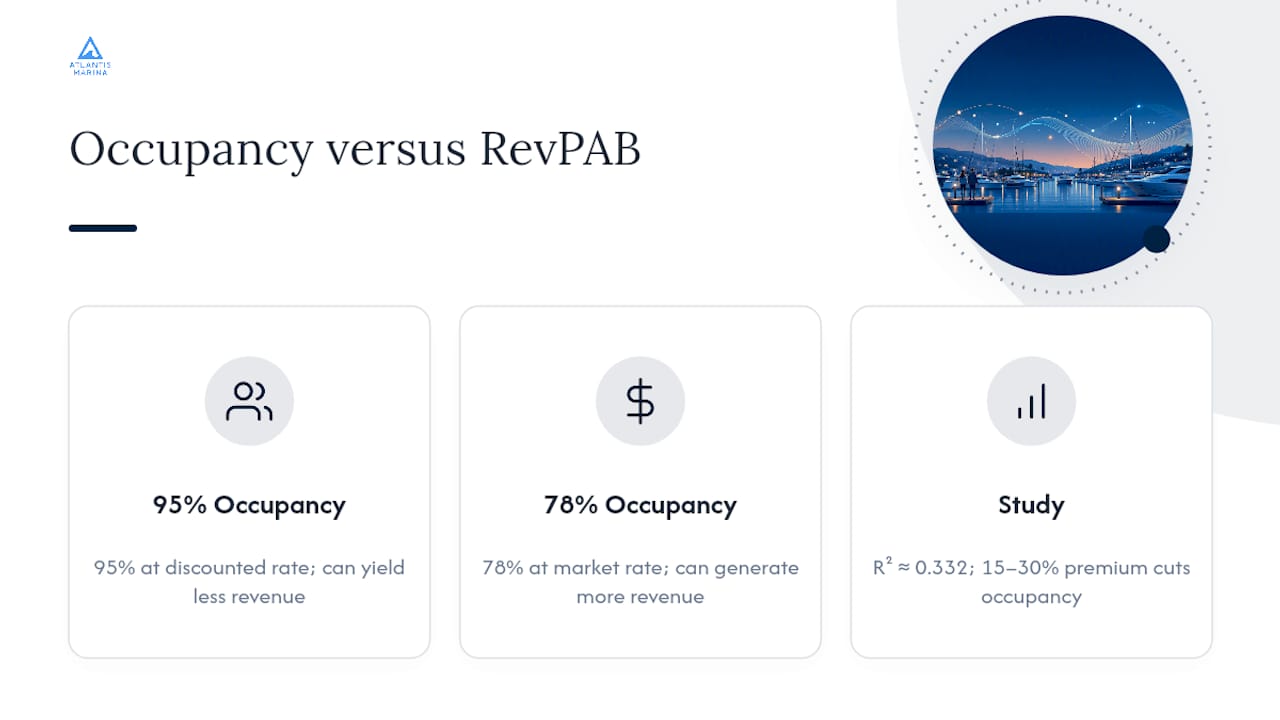
RevPAB (Revenue per Available Berth) is calculated as total slip revenue divided by the number of available berths, divided by the period measured. A marina running at 95% occupancy at a discounted rate can generate less revenue than one running at 78% occupancy at market rate.
An academic analysis of competitive pricing in the marina business found that marinas pricing above their local competitors tend to see lower occupancy, but often achieve higher RevPAB. Marinas pricing below competitors capture more occupancy but leave RevPAB lower. Price position and occupancy together explained roughly a third of RevPAB variance in the study's model (R² ≈ 0.332), and pushing premiums to 15-30% above competitors produced sharply lower occupancy for only a marginal RevPAB gain. That is the ceiling on how far a marina can push rate before occupancy losses erase the benefit.
The practical takeaway: don't optimize for full docks. Optimize for the revenue those docks produce.
Which Metrics and Analytics Do You Actually Need?
A marina running dynamic pricing needs a small, disciplined dashboard, not a sprawling reporting suite. Track these core numbers:
- RevPAB — total slip revenue ÷ available berths ÷ period (the north star metric)
- Occupancy rate — percentage of berths filled, still useful as a secondary signal
- ADR (average daily rate), tracked per foot or per berth to compare across slip sizes
- Booking lead time — how far in advance transient and seasonal customers reserve
- Cancellation and no-show rates — both erode realized RevPAB even when booked occupancy looks strong
Report bookings and cancellations daily, check competitor and channel rates weekly, and run a full strategic review monthly. A pricing action should trigger automatically: lead time shortening while occupancy climbs signals room to raise transient rates; rising cancellations after a rate increase signals a guardrail was breached. A marina operations dashboard that surfaces these numbers in one view is what turns this from a monthly spreadsheet exercise into a daily habit.
What Pricing Rules and Triggers Should You Set First?
Start with rules, not algorithms. Rule-based pricing is transparent, easy to explain to staff, and easy to roll back if it misfires.
- Occupancy threshold rule: raise transient rates 10-15% once same-week occupancy crosses 85%, and pull them back once it drops under 60%.
- Event premium rule: apply a fixed premium (commonly 20-30% in comparable hospitality markets) around regattas, boat shows, or holiday weekends with confirmed demand history.
- Early-booking discount: offer 5-10% off for seasonal or annual slip renewals confirmed 60+ days before contract expiration, protecting occupancy before it becomes a scramble.
- Last-minute surge rule: apply a modest surcharge for transient bookings inside a 48-hour window during peak season, when demand is provable and inventory is scarce.
Layer these by berth class. End-tie and premium deep-water slips can absorb higher event premiums than narrow finger slips with tighter maneuvering. Separate rules by channel too: a direct-booking discount can reward customers who reserve through your own portal instead of a third-party aggregator.
Pro Tip: Cap any single rate change at a maximum daily percentage move, and carve out annual slip holders from short-notice surge pricing entirely. A one-page notice explaining the new transient rate structure prevents most complaint calls before they start.
What Data Do You Need Before You Model Anything?
Rules alone will get a marina most of the way there. Forecasting comes later, and it depends on data you should start collecting now, before you need it.
The minimum useful dataset includes:
- Historical bookings by date, slip ID, and slip type
- Full price history for each rate change made
- A local events and holiday calendar, ideally tied to boat show and regatta schedules
- Weather proxies for peak-season demand swings
- Booking lead time and cancellation records
Practitioners generally recommend at least a full year of booking and price history before attempting anything more sophisticated than rules, since a single season rarely captures true seasonality. Progress in stages: start rule-based, move to seasonal regression once you have enough history to see repeatable patterns, and only add machine-learning demand forecasting if booking volume is high enough to make the model worth the effort. Validate every change with a holdout, either a control group of untouched slips or an A/B test between comparable berth types, before rolling a new rule fleet-wide.
How Do You Roll Out Dynamic Pricing Without Disrupting Operations?
A phased rollout protects revenue while you learn what actually moves RevPAB at your marina.
- Audit current pricing across every slip type and booking channel to find where rates have gone stale.
- Define your RevPAB objective for the pilot period, stated as a specific target, not a vague "increase revenue."
- Select pilot slips — a manageable subset, often one berth class or one dock, not the entire marina.
- Configure rules using the templates above, scoped tightly to the pilot group.
- Run the pilot for four to eight weeks, long enough to capture at least one demand cycle.
- Measure RevPAB uplift against the same period the prior year, adjusted for any major schedule differences.
- Scale gradually to additional berth classes once the pilot proves out.
Assign a single pricing owner who approves every rate change, rather than leaving it to whoever is on shift. Build a simple approval workflow for anything beyond the guardrails, and prepare customer communications for annual berth holders before the pilot goes live, not after complaints arrive.
Pro Tip: The systems checklist matters as much as the rules. You need an events feed, reservation integration, automated billing, and a reporting dashboard connected to each other. Manually re-entering rate changes across four disconnected systems is where dynamic pricing programs quietly die.

What Trade-Offs Should Marina Operators Watch For?
Chasing ADR at the expense of long-term relationships is the most common failure mode. Slip desirability and location matter more than most rate sheets admit. A premium price on a poorly protected slip will not hold occupancy the way the same premium does on a sheltered end-tie.
Staff workload is the quiet cost. Rate changes multiply the questions front-desk staff field, so build transparency and loyalty terms into annual contracts before you touch transient rates. If data is thin, staffing is stretched, or complaints repeat, pause the pilot rather than pushing forward on instinct.
— John R
Turn These Rules Into a Working Pricing Program
Every rule template above assumes your reservation system, billing, and rate changes talk to each other, and that is where most manual dynamic-pricing attempts break down. Atlantis Marina is built to close that loop: automated billing through autopay, Instant Pay, Stripe, and ACH, synced to QuickBooks Online, so a rate change doesn't mean a week of manual invoice edits.
The marina management solution ties reservations, waitlists, and occupancy analytics into one dashboard, so the RevPAB, lead time, and cancellation numbers you need for daily pricing decisions are already sitting in front of you. Event and calendar feeds feed directly into your rate rules instead of living in a separate spreadsheet, and Atlantis Bot handles the routine billing and reservation questions that pricing changes tend to generate, freeing your team to manage the pilot instead of fielding phone calls. If you're weighing a seasonal calendar coordination with local partners, resources like a marina-side campground's event schedule can help you spot demand overlaps worth pricing around. For slip-specific rate guidance, our pricing best practices guide breaks down more examples by berth class. Ready to see the platform running against your own occupancy data? Request a demo through Atlantis Marina's sales team and bring your current rate sheet.
Sources
The RevPAB and price-position findings referenced throughout this guide come from the competitive pricing analysis in the marina business, with supplemental beta coefficients available in the companion study record. For implementation details on billing automation, see the Atlantis Marina billing solution overview.
- The Competitive pricing in marina business: Exploring relative price position and price fluctuation
FAQ
Why Isn't Dynamic Pricing Illegal?
Dynamic pricing adjusts published rates based on demand, availability, or timing, which is standard revenue management practiced across hotels, airlines, and marinas. It becomes a legal problem only when it involves price collusion with competitors, discrimination based on protected characteristics, or deceptive practices that hide the actual price at booking.
How Profitable Is Owning a Marina?
Profitability varies widely by location, slip count, and how well rates are managed, but RevPAB is the clearest indicator of whether a marina is capturing the revenue its berths are actually worth. Marinas that price reactively, rather than by demand and season, consistently leave revenue unclaimed during peak weeks.
How Can Boaters Outsmart Dynamic Pricing?
Boaters can reduce costs by booking further ahead of peak events, since early-booking discounts are one of the most common rules marinas apply, and by avoiding last-minute reservations during high-demand weekends when surge pricing typically applies.
Is Dynamic Pricing Worth It for a Small Marina?
It's worth it when paired with clear guardrails and a measured pilot. Vendor case reports across the hospitality sector describe revenue gains from automated demand-based pricing, but results vary by market, and a small marina should validate uplift with its own before-and-after RevPAB comparison rather than assuming industry ranges apply directly.