

A high-end marina billing experience is defined as an integrated, automated payment process that treats every invoice as a hospitality touchpoint rather than a transactional obligation. For marina operators managing luxury boating clients, the premium marina billing process combines transparent charges, flexible payment options, and real-time account access into a single, frictionless system. Platforms like Atlantis Marina bring together billing automation, customer self-service portals, and data analytics to help marinas meet the expectations of high-net-worth guests. The result is fewer disputes, higher on-time payments, and a billing experience that reinforces the quality of every other service your marina delivers.
What is high-end marina billing experience, and why does it matter?
High-end marina billing experience refers to the full cycle of charging, communicating, and collecting payments in a way that reflects premium service standards. It is not simply about accepting credit cards. The experience covers how charges are presented, how easily clients can review and pay invoices, and how quickly staff can resolve questions.
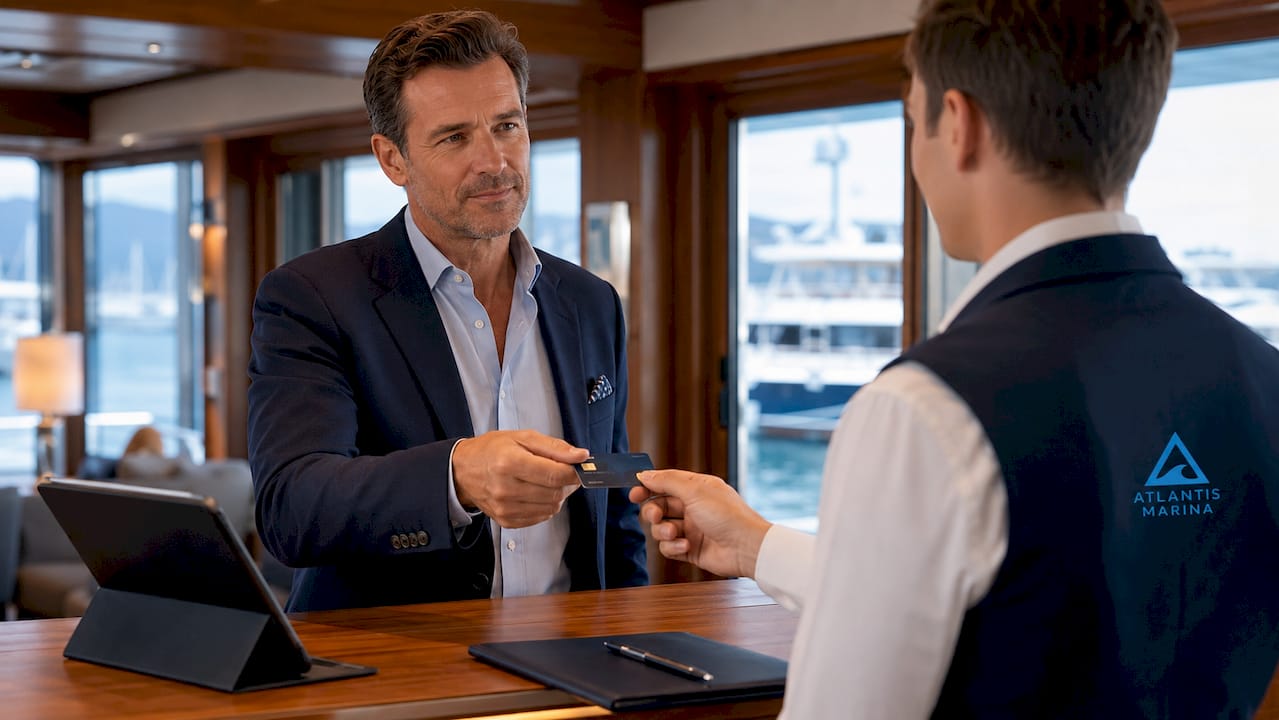
Luxury boating clients hold billing to the same standard as dockside service. A confusing invoice or a delayed statement creates friction that undermines an otherwise excellent stay. Operators who treat billing as a guest experience element, rather than a back-office task, consistently earn stronger client loyalty and better reviews.
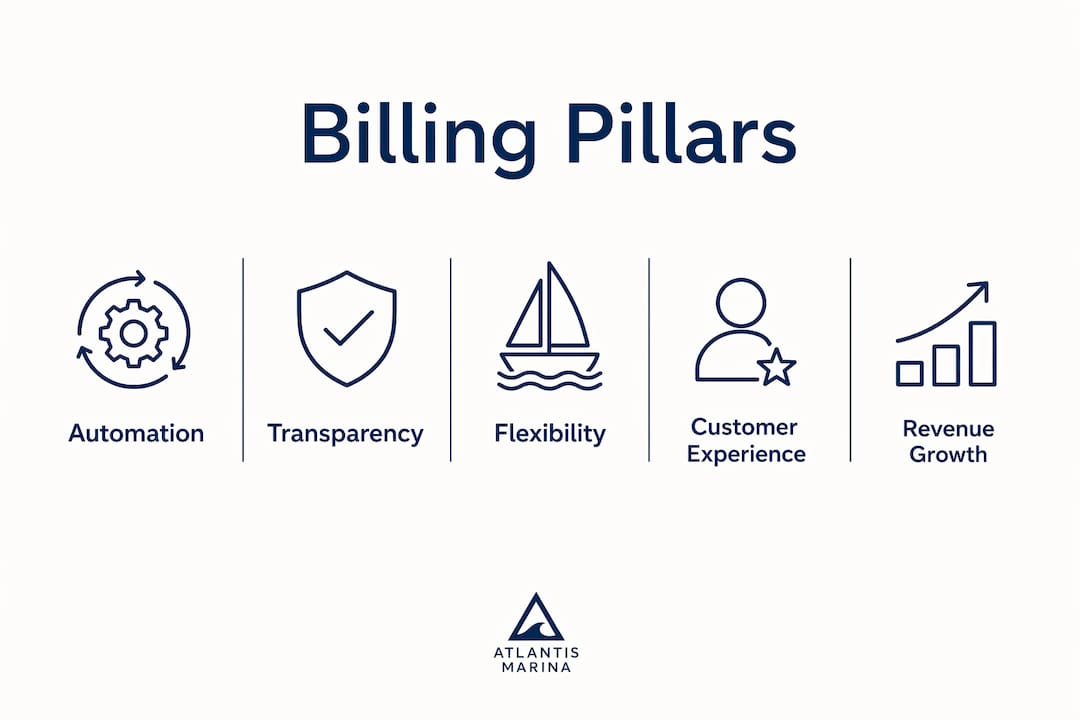
The three pillars of a premium billing process are automation, transparency, and flexibility. Automation removes human error from recurring charges. Transparency gives clients a clear view of every line item. Flexibility lets clients pay in the way that suits their financial preferences. All three work together to create what upscale marinas define as a truly high-quality billing workflow.
How does billing automation reduce errors and staff workload?
Automated billing is the single most effective upgrade a marina can make to its payment process. Marinas with automated billing and self-service portals reduced billing-related support calls by 40% and pushed on-time payments to 98%, while invoice errors dropped below 1%. That combination of accuracy and punctuality is nearly impossible to achieve with manual invoicing.
Automation handles the tasks that consume the most staff time:
- Recurring invoices for monthly slip fees, liveaboard charges, and seasonal storage generate automatically on schedule.
- Late fees and tax calculations apply without manual intervention, reducing the risk of inconsistent charges.
- Self-service portals let clients view statements, download invoices, and pay balances at any hour without calling the dock office.
- Automated reminders send payment notices by email or SMS before due dates, cutting the number of overdue accounts.
Automated recurring billing also lifts cash flow by cutting days sales outstanding and reducing the seasonal workload that spikes at the start and end of each boating season. Staff redirect that saved time toward guest services rather than chasing payments.
Pro Tip: Choose a platform that centralizes reservations, billing, and customer records in one system. When billing connects directly to slip assignments and service orders, charges post accurately without manual data entry.
Atlantis Marina delivers exactly this kind of connected workflow. Its marina billing software automates invoicing, applies fees, and gives clients 24/7 account access through a mobile-friendly portal.
What luxury marina payment options do high-end clients expect?
Flexible payment options are a defining feature of what to expect at upscale marinas. High-net-worth clients do not want to be limited to a single payment method, and they expect the same financial flexibility from their marina that they receive from other luxury service providers.
Modern luxury marina payment options include:
- ACH bank transfers for large recurring charges like annual slip fees or liveaboard agreements.
- Digital wallets such as Apple Pay and Google Pay for quick, contactless transactions at the ship store or fuel dock.
- Installment financing with terms ranging from 6 to 36 months, zero opening fees, and transparent repayment schedules.
- Concierge payment conveniences such as escrowed crew gratuities held securely until the client approves release.
Installment financing with transparent terms reduces client financial stress and protects the premium service reputation that high-end marinas depend on. Clients who can spread a large seasonal payment over several months are more likely to renew their slip lease and purchase additional services.
Luxury yacht service providers confirm that flexible installment payments are crucial for removing financial stress and preserving customer loyalty. That principle applies directly to exclusive marina membership fees and long-term slip agreements.
Pro Tip: Publish your accepted payment methods clearly in your client portal and welcome packet. Clients who know their preferred payment rail is supported are less likely to delay payment or contact staff for clarification.
How do dynamic pricing and personalized upsells increase marina revenue?
Dynamic pricing is the practice of adjusting slip rates and service fees based on demand, season, vessel size, and availability. When integrated directly into the billing system, dynamic pricing generates revenue that flat-rate pricing leaves uncaptured.
Dynamic pricing and automated cross-sell prompts contributed 12–18% additional slip revenue and 8–12% more in non-slip spending. Those figures represent a meaningful revenue lift without adding staff or expanding the facility.
Automated upsell prompts work by triggering offers at the right moment in the billing cycle. When a client receives their monthly statement, the system can include a personalized offer for:
- Premium power hookups or shore power upgrades
- Covered dry storage during off-season months
- Event passes for marina-hosted regattas or social events
- Detailing, maintenance, or concierge provisioning packages
The table below summarizes the revenue impact of key upsell categories based on integrated billing data:
| Upsell category | Revenue impact |
|---|---|
| Dynamic slip pricing | 12–18% increase in slip revenue |
| Non-slip service cross-sells | 8–12% increase in ancillary spend |
| Add-on power and utilities | Incremental per-stay revenue |
| Retail and provisioning | Captured through integrated POS billing |
Atlantis Marina's ship store POS integration connects retail purchases directly to the client's billing account, making it easy to bundle charges and present a single statement at checkout.
Why does billing transparency reduce guest friction and disputes?
Single-ledger billing reduces negative reviews and guest churn by eliminating hidden fees and disconnected invoices. A unified invoice that combines dockage, utilities, services, and retail purchases into one clear statement removes the confusion that drives billing disputes.
Premium marinas achieve a high-end feel by minimizing administrative friction through centralized billing and comprehensive concierge services. Clients should never need to reconcile charges from three separate systems or call the dock office to understand a line item.
The most common sources of billing friction at marinas include:
- Manual prorates that are calculated inconsistently between staff members
- Utility charges added as a separate invoice days after the primary statement
- Retail purchases that appear on a different account than the slip fee
- Fees that were not disclosed at check-in or in the slip agreement
Eliminating these friction points requires a system that consolidates every charge type into one ledger and presents it through a customer-facing portal that clients can access at any time.
Pro Tip: Train dock staff to walk new clients through their first invoice during check-in. A two-minute explanation of how charges appear on the statement prevents the majority of billing questions that arrive later by phone or email.
How can billing data intelligence improve operational decisions?
Billing data intelligence allows operators to make data-driven decisions to optimize pricing, occupancy, and guest spend. The analytics generated by an automated billing system are as valuable as the payments themselves.
Key metrics that operators should track include:
| Metric | What it reveals |
|---|---|
| Revenue per slip | Which slip types and locations generate the most income |
| Per-capita spend | How much each client spends beyond their base slip fee |
| AR aging report | Which accounts are overdue and by how long |
| Seasonal revenue trends | When to apply dynamic pricing or promotional rates |
Granular reporting on revenue per slip, AR aging, and per-capita spend gives operators a clear picture of where revenue is concentrated and where pricing adjustments will have the most impact. A marina that sees low per-capita spend from transient guests can target that segment with automated upsell offers tied to their next invoice.
Billing data intelligence from automated systems also empowers operators to execute personalized upsell offers that significantly increase revenue streams. When the system knows a client's vessel size, slip history, and purchase patterns, it can generate offers that feel relevant rather than generic. Atlantis Marina's analytics dashboard surfaces these insights directly within the operations view, connecting billing data to occupancy reporting and customer records without requiring a separate reporting tool.
Key Takeaways
A premium marina billing process succeeds when automation, transparency, and flexible payment options work together as a unified guest experience strategy.
| Point | Details |
|---|---|
| Automation drives accuracy | Automated billing cuts invoice errors below 1% and raises on-time payments to 98%. |
| Flexible payments build loyalty | Offering ACH, digital wallets, and installment plans keeps high-value clients engaged. |
| Dynamic pricing lifts revenue | Integrated upsell prompts add 12–18% to slip revenue and 8–12% to ancillary spend. |
| Unified invoices reduce disputes | A single ledger combining all charges eliminates the hidden fees that drive negative reviews. |
| Billing data guides decisions | Metrics like revenue per slip and AR aging allow operators to price and plan with precision. |
Billing as a brand statement: my perspective on where marinas get this wrong
Most marina operators I have worked with think of billing as the last step in the guest experience. They focus on the dock, the amenities, and the staff, and then treat the invoice as an afterthought. That is exactly backwards.
The invoice is often the last thing a client sees before they leave. It is the final impression. A confusing statement or an unexpected charge can undo everything that went right during the stay. I have seen marinas with beautiful facilities and excellent service lose long-term clients over a $40 utility charge that appeared without explanation.
The operators who get this right treat billing as a brand statement. They invest in systems that present charges clearly, accept payments flexibly, and give clients account access without requiring a phone call. They also use billing data to understand their clients better, not just to collect money faster.
The shift toward concierge-style billing, where a single point of contact handles charges, financing, and account questions, is the most significant change I have seen in premium marina operations over the past decade. It mirrors what five-star hotels have done for years. The marina that figures this out first in its market earns a loyalty advantage that is very hard for competitors to close.
Emerging payment technologies, including digital wallets and installment financing, are not optional extras for luxury clients. They are baseline expectations. Marinas that still rely on paper invoices and check payments are not just operationally behind. They are signaling to high-net-worth clients that the experience will not match the price.
— John R
How Atlantis Marina supports a premium billing experience
Atlantis Marina brings together every element of a high-end billing experience in one cloud-based platform. The system automates recurring invoices, applies fees and taxes without manual input, and gives clients 24/7 access to their account through a mobile-friendly portal. Marina operators can track revenue per slip, monitor AR aging, and trigger personalized upsell offers directly from the operations dashboard.
For managers ready to move beyond spreadsheets and disconnected billing tools, Atlantis Marina connects reservations, payments, customer records, and analytics into a single operating system. The platform supports ACH, digital wallets, and flexible payment workflows that match the expectations of luxury boating clients. Explore the full marina management platform to see how Atlantis Marina can raise your billing standard and your bottom line.
FAQ
What is a high-end marina billing experience?
A high-end marina billing experience is an automated, transparent payment process that consolidates all charges into a single client-facing invoice and supports flexible payment options. It treats billing as a hospitality touchpoint rather than a back-office task.
How does billing automation improve on-time payments?
Marinas with automated billing and self-service portals reach 98% on-time payments by sending automated reminders and giving clients 24/7 access to pay their accounts without staff assistance.
What payment methods should a luxury marina accept?
Luxury marinas should accept ACH bank transfers, digital wallets, credit cards, and installment financing with terms of 6–36 months. Offering multiple payment rails increases convenience and correlates with higher on-time payment rates.
How does dynamic pricing work in marina billing?
Dynamic pricing adjusts slip rates and service fees based on demand, season, and vessel size. When integrated into the billing system, it has contributed 12–18% additional slip revenue through automated rate adjustments and cross-sell prompts.
Why do billing disputes happen at marinas, and how can operators prevent them?
Billing disputes most often result from hidden fees, manual prorates, and disconnected invoices for utilities or retail purchases. A single-ledger billing system that consolidates all charges and presents them through a transparent client portal eliminates the majority of these disputes.