

Boat lift billing management is the systematic process of tracking, pricing, and invoicing all boat lift usage and related services to protect marina revenue and reduce operational errors. Marina operators who rely on manual spreadsheets or disconnected tools routinely lose income through undetected overstays, untracked add-on services, and mismatched charges. Structured billing management for boat lifts connects berth allocation data, vessel profiles, dynamic pricing rules, and automated invoice generation into one governed workflow. Atlantis Marina's platform brings these elements together, giving marina teams the visibility and control they need to bill accurately and get paid faster.
How does boat lift billing management integrate with marina systems?
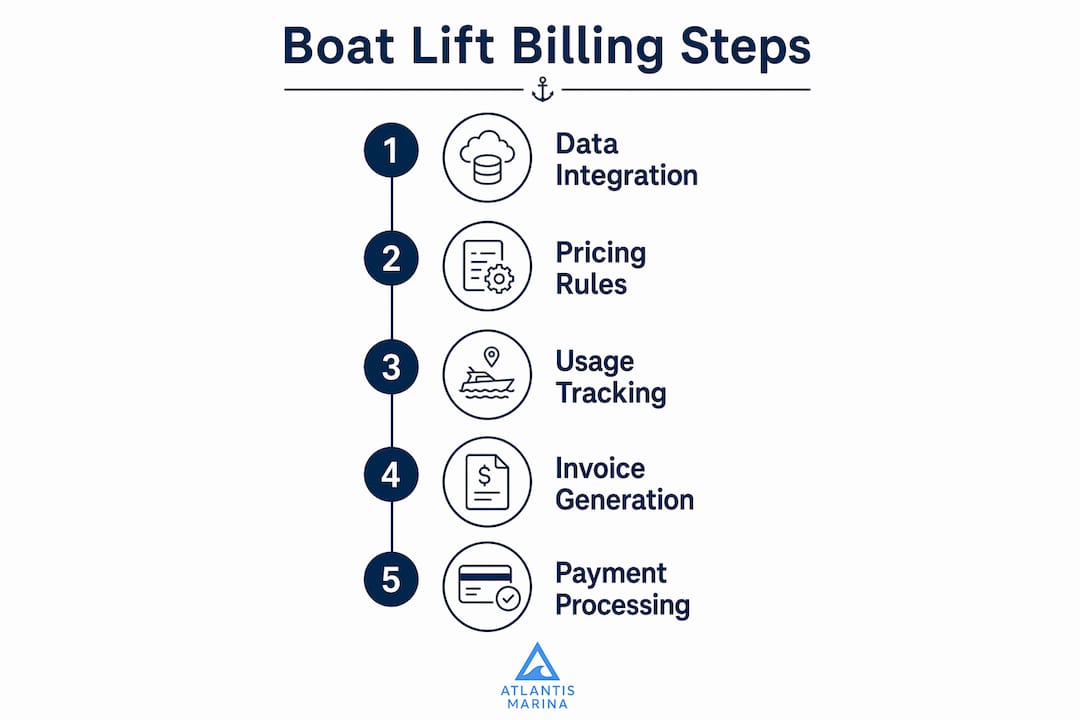
Effective boat lift billing starts with data integration, not invoicing. When a vessel's profile, berth assignment, and lift usage data all feed into a single system, billing becomes a byproduct of operations rather than a separate manual task. Automated invoice generation reduces the manual entry errors that have historically caused significant billing discrepancies.
Dynamic pricing rules are the engine behind accurate billing. A well-configured system applies different rates based on vessel size, length of stay, seasonal demand, and service add-ons such as power hookups or pump-out services. This means a 40-foot vessel staying through peak summer season generates a different invoice than a 22-foot boat on a weekend transient stay, with no manual calculation required.
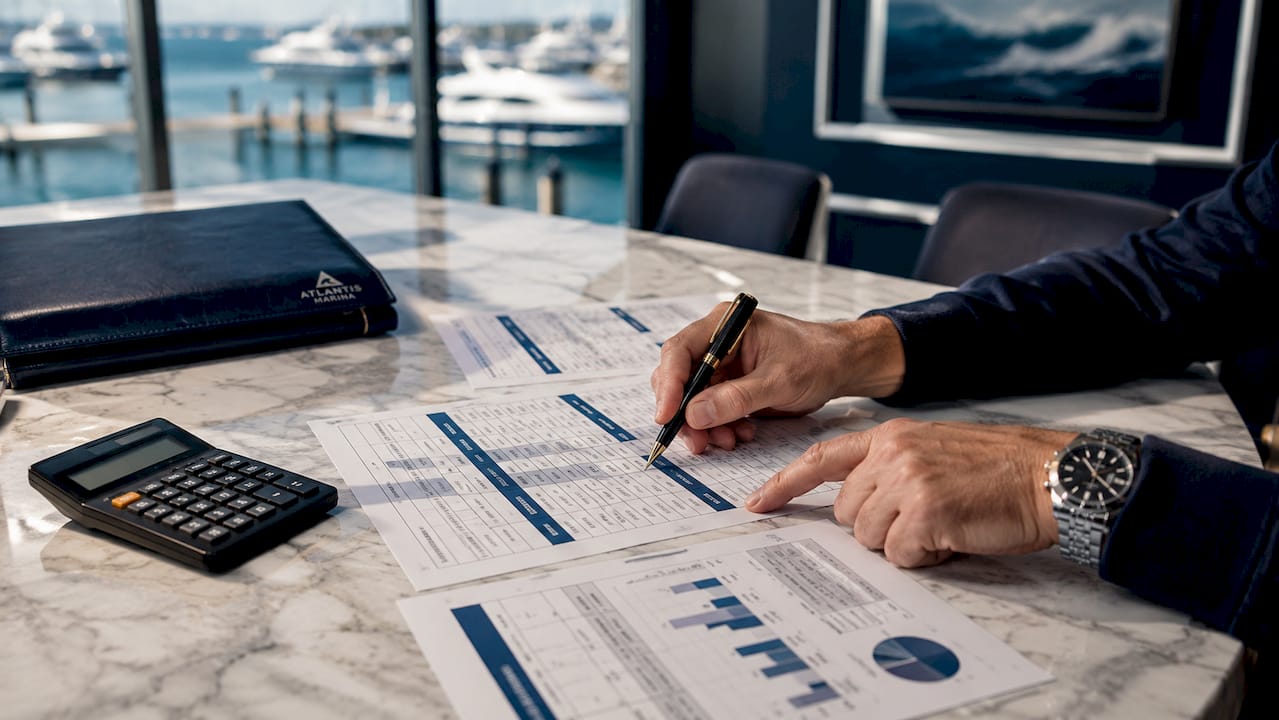
The billing cycle runs from reservation through checkout without staff intervention when the system is properly configured. Reservation data triggers a draft invoice, lift usage confirms the charges, and the system sends the final bill to the customer's account. This approach, moving from spreadsheet billing to platform-integrated invoicing, protects revenue and saves staff hours every billing cycle.
Key integration points that support accurate billing include:
- Vessel profile data: Length, beam, and weight determine applicable rate tiers automatically.
- Berth and lift assignment records: Confirm which asset was used, for how long, and by whom.
- Service add-on tracking: Captures fuel, power, pump-out, and other billable services tied to each visit.
- Reservation and contract linkage: Connects transient stays and seasonal contracts to the correct pricing schedule.
Pro Tip: Set up your pricing rules before entering any vessel data. Retroactive pricing corrections are time-consuming and create disputes. Getting the rate structure right at setup means every invoice that follows is accurate from day one.
What are the biggest revenue leakage pitfalls in boat lift billing?
Revenue leakage in boat lift billing follows predictable patterns. The most common cause is a disconnect between actual lift usage and what gets invoiced. Disconnects between booking, allocation, dock visibility, and billing remain the primary operational pitfall for marinas without integrated software.
Overstays are a particularly costly gap. A vessel that stays two extra days beyond its reservation generates real costs for the marina, including dock space, power, and staff attention. Manual systems rarely catch these situations in time to bill for them. Live occupancy mapping flags and bills extra usage automatically, closing this gap without requiring staff to monitor every slip.
Fragmented tools compound the problem. When reservations live in one spreadsheet, service charges in another, and invoices in a third, mismatches are inevitable. The following failures occur most often in fragmented billing environments:
- Double bookings: Two reservations assigned to the same lift, creating both a service failure and a billing dispute.
- Untracked service charges: Fuel, pump-out, or repair services completed but never added to the customer's invoice.
- Overstay revenue loss: Extended stays that go undetected and unbilled until the vessel has already departed.
- Contract pricing errors: Seasonal contract rates applied incorrectly to transient customers, or vice versa.
- Slow invoice delivery: Delays between service completion and invoice delivery reduce payment speed and increase dispute rates.
"Automating the capture of transient stays and ad hoc services can increase net operating income without adding physical capacity. The shift from manual tracking to platform-integrated billing is where most marinas recover their largest revenue gaps."
Maritime operators also need billing systems that separate multiple commercial relationships under a single customer profile. A boater may hold a seasonal lift contract, a storage agreement, and an active service order at the same time. Systems that link membership, berth contracts, and services distinctly but within one profile prevent billing confusion and improve financial reporting accuracy.
What advanced billing techniques reduce disputes and improve accuracy?
Multi-stage invoice approval is the most effective method for reducing billing disputes in complex marina environments. Rather than sending an invoice directly from the system to the customer, a multi-stage workflow routes the invoice through operations, finance, and management review before delivery. Stepwise reviews with line-item accept and reject options reduce disputes and improve client trust by catching errors before they reach the customer.
Multi-currency invoicing addresses a real operational need for marinas that serve international boaters or fleet operators. Billing in a customer's home currency, with cached daily exchange rates applied automatically, removes friction from the payment process. Each invoice can carry multiple currencies with converted amounts visible in accounts receivable reports, giving finance teams a clear picture of actual revenue.
Batch invoicing is the preferred method for monthly recurring charges or fleet accounts. Instead of generating individual invoices for every service event, batch invoicing groups charges by vessel, billing period, or project into one summary invoice. Batch invoicing grouped by vessel or period reduces administrative volume and makes reconciliation faster for both the marina and the customer.
The table below shows how billing method selection affects operational outcomes:
| Billing method | Best use case | Primary benefit |
|---|---|---|
| Automated single invoice | Transient stays and one-time services | Speed and accuracy with no manual input |
| Multi-stage approval | High-value contracts and fleet accounts | Dispute reduction through pre-delivery review |
| Multi-currency invoicing | International customers and foreign-flagged vessels | Payment friction reduction and clear FX reporting |
| Batch invoicing | Monthly recurring charges and fleet operators | Reduced admin volume and easier reconciliation |
Pro Tip: Apply disbursement accounting practices for any service where the marina pays a third-party vendor on the customer's behalf, such as haul-out contractors or fuel suppliers. Tracking these as pass-through charges rather than revenue keeps your financial reporting clean and defensible during audits.
How to implement boat lift billing management with Atlantis Marina
Implementation follows a clear sequence. Getting the foundation right before activating billing automation prevents the data quality problems that cause disputes later.
The setup process with Atlantis Marina covers these core steps:
- Vessel data entry: Record each vessel's length, beam, draft, weight, and owner profile. This data drives rate tier assignment automatically.
- Berth and lift mapping: Configure the facility map with each lift's location, capacity, and associated pricing schedule.
- Pricing rule setup: Define rates for transient, seasonal, and contract customers, including add-on service pricing and peak season adjustments.
- Contract and document linkage: Attach signed agreements, insurance certificates, and registration documents to each customer account.
- Payment method configuration: Set up online payment options so customers can pay directly from their self-service portal.
Once the foundation is in place, Atlantis Marina's live berth occupancy mapping identifies overstays in real time and triggers additional billing automatically. This closes the most common revenue leakage gap without requiring staff to monitor each slip manually.
Reporting tools give marina operators a clear view of revenue by lift, by customer, and by billing period. Operators can track which services generate the most revenue, which customers have outstanding balances, and where pricing adjustments could improve net operating income. Integrated payment processing connects directly with billing data, so customers receive invoices and pay through the same portal without staff involvement.
Atlantis Marina's platform also supports automated billing tied to usage, with online payments improving the customer experience and reducing the time between service delivery and payment receipt. Marinas that move from manual billing to this integrated approach consistently report fewer disputes, faster payment cycles, and better visibility into their actual revenue position.
Key Takeaways
Accurate boat lift billing management requires integrating vessel data, berth usage, and dynamic pricing rules into one automated system to prevent revenue loss and reduce disputes.
| Point | Details |
|---|---|
| Integration drives accuracy | Connecting vessel profiles, lift usage, and pricing rules eliminates manual entry errors and mismatched charges. |
| Overstays are the top revenue gap | Live occupancy mapping automatically detects and bills extended stays before vessels depart. |
| Multi-stage approvals cut disputes | Routing invoices through operations and finance review before delivery prevents errors from reaching customers. |
| Batch invoicing reduces admin load | Grouping recurring charges by vessel or period simplifies reconciliation for both marina staff and customers. |
| Automation protects net operating income | Capturing transient stays and ad hoc services automatically increases revenue without adding physical capacity. |
Why most marinas are still leaving money on the dock
After working with marina operations for years, the pattern I see most often is not a technology problem. It is a sequencing problem. Operators invest in billing software but skip the data foundation, entering vessels without complete profiles, mapping berths without pricing rules attached, and then wondering why invoices still require manual corrections.
The second mistake is treating billing as a back-office function rather than an operational one. Billing accuracy depends on what happens at the dock, not in the accounting department. When lift usage data, service completion records, and reservation confirmations all flow into the billing system in real time, invoicing becomes nearly automatic. When they do not, someone is always chasing records after the fact.
Customer expectations have also shifted. Boaters now expect to receive invoices digitally, review charges line by line, and pay from their phone before they leave the dock. Marinas that still mail paper invoices or require an office visit to settle a bill are creating friction that damages the customer relationship and slows cash flow.
The operators who get this right treat their marina billing software as the financial record of every operational decision, not just a tool for generating invoices. That mindset shift is what separates marinas with clean books and strong net operating income from those still reconciling spreadsheets at the end of every month.
— John R
Atlantis Marina's billing platform for boat lift operators
Atlantis Marina gives marina operators a single platform to manage every stage of the boat lift customer billing process, from reservation through payment.
The platform connects smart boat lift control with automated billing, so lift usage data flows directly into invoice generation without manual input. Operators get live occupancy maps, dynamic pricing rules, multi-stage invoice approval, and a customer self-service portal where boaters can review charges and pay online. The marina management platform supports transient, seasonal, and contract billing alongside fleet accounts and multi-currency invoicing for international customers. Marina teams replace clipboards and disconnected spreadsheets with one connected system that protects revenue and improves the customer experience from first reservation to final payment.
FAQ
What is boat lift billing management?
Boat lift billing management is the process of tracking lift usage, applying dynamic pricing rules, and generating accurate invoices for all boat lift services. It connects berth allocation data, vessel profiles, and service records to prevent revenue leakage and billing disputes.
How does automated billing reduce revenue leakage?
Automated billing captures overstays, ad hoc services, and transient charges in real time, so nothing goes uninvoiced. Live occupancy mapping flags extended stays and triggers additional charges before a vessel departs.
What is multi-stage invoice approval in marina billing?
Multi-stage invoice approval routes each invoice through operations, finance, and management review before it reaches the customer. Line-item accept and reject options with documented reasons reduce disputes and improve billing accuracy.
How does Atlantis Marina support boat lift billing?
Atlantis Marina connects smart lift controllers with automated billing, live occupancy maps, and a customer payment portal. The platform handles transient, seasonal, and contract billing from one cloud-based system.
Why is batch invoicing useful for marina operators?
Batch invoicing groups multiple services or recurring charges into one summary invoice by vessel, period, or project. This reduces administrative volume and makes monthly reconciliation faster for both marina staff and customers.