

For most U.S. marinas and yacht clubs, the right answer is a cloud-based, all-in-one platform that handles reservations, billing, boater self-service, and hardware integrations in one place. Atlantis Marina delivers exactly that: a single system covering slip management, automated billing with Stripe and ACH, a boater-facing app, POS, dry-stack workflows, smart lift controls, and QuickBooks Online sync. The result is fewer manual tasks, faster collections, and a boater experience that drives repeat bookings. See the full platform or book a demo to evaluate it against your current setup.
Key capabilities at a glance:
- Reservations and berth management with a visual dock map and waitlists
- Billing automation with autopay, e-sign contracts, Instant Pay, and QuickBooks sync
- Boater self-service via the Atlantis Boater App and web portal
- POS and fuel-dock operations with QR-code check-in
- Dry-stack, launch scheduling, and rack management
- Smart marine hardware integrations: lift controllers, sensors, cameras
- Reporting and occupancy analytics from a unified operations dashboard
Table of Contents
- What does marina management software actually cover?
- How does a boater-facing app change your marina's revenue?
- Running day-to-day operations: service, dry-stack, and work orders
- How billing automation stops revenue from slipping through the cracks
- What integrations and hardware should you expect from a marina platform?
- What does marina management software cost, and how long does rollout take?
- How to evaluate marina management vendors before you sign
- Why Atlantis Marina works for U.S. marinas
- Key Takeaways
- What the first 90 days actually look like
- Atlantis Marina is built for the modern waterfront
- Useful sources
- FAQ
What does marina management software actually cover?
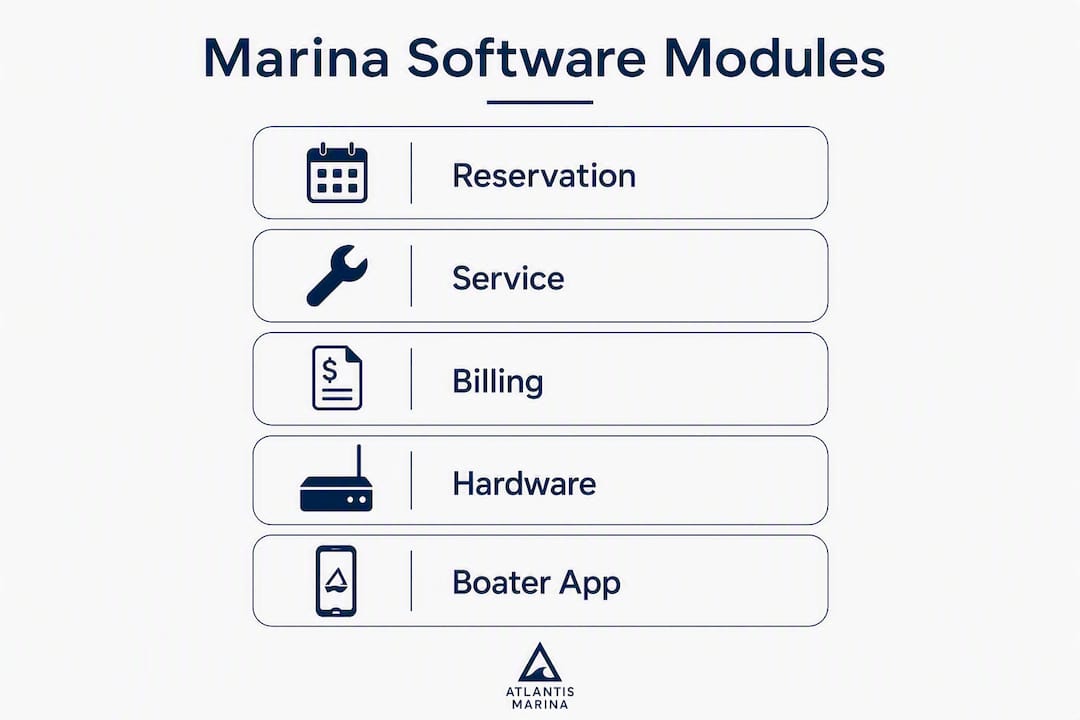
Modern marina platforms centralize reservations, berth tracking, billing, maintenance, and customer records in a single system, which cuts administrative overhead and improves booking accuracy. The table below maps each core module to the workflow it replaces and the operator benefit it delivers.
| Module | What it does | Operator benefit | When it's critical |
|---|---|---|---|
| Reservation & berth management | Visual dock map, slip assignments, waitlists, transient bookings | Eliminates double-bookings; maximizes occupancy | Year-round for transient traffic |
| Billing & autopay | Recurring invoices, contract templates, prorations, deposits, refunds | Reduces revenue leakage; speeds collections | Immediately at launch |
| Boater app & web portal | Online reservations, document uploads, e-sign, payments, messaging | Reduces front-desk calls; improves boater retention | High-volume seasons |
| POS & ship store | Inventory, sales, QR-code transactions, fuel-dock pay-at-pump | Faster checkout; ties sales to boater accounts | Daily operations |
| Service & work orders | Job creation, parts tracking, service history, scheduler integration | Prevents service bottlenecks; improves accountability | Boatyard and full-service marinas |
| Dry-stack & launch scheduling | Rack management, launch windows, vehicle/trailer logging | Reduces launch wait times; improves crew efficiency | Dry-stack and inland facilities |
| Reporting & analytics | Occupancy dashboards, revenue trends, customer behavior | Informs pricing and staffing decisions | Monthly and seasonal reviews |
The modules above are not equally urgent for every facility. A transient-heavy marina on the Gulf Coast will feel billing and reservation pain first. A dry-stack operation in Florida will prioritize launch scheduling before anything else. Start by mapping your top three operational pain points before you evaluate vendors.
Pro Tip: Identify the module causing the most revenue leakage or staff overtime first. Billing automation and reservation management consistently deliver the fastest return because they address immediate cash-flow and labor costs.
How does a boater-facing app change your marina's revenue?
Boater self-service is one of the clearest differentiators between modern platforms and legacy systems. The Atlantis Boater App and web portal let boaters reserve slips, upload insurance and registration documents, sign contracts electronically, pay online, message staff, and manage their full account from a single login that travels with them across the Atlantis Marina Network.
The user journey looks like this: a transient boater discovers your marina through Atlantis Marina Search, requests a slip online, submits vessel details and insurance documents, signs the contract via Atlantis E-Sign, pays the deposit, and receives SMS confirmation. On arrival, they scan their account QR code at the dock. Staff see the reservation, vessel, and billing status instantly, with no manual search required.
Boater self-service drives higher occupancy on off-peak days because transient boaters can book and pay without staff intervention. That matters most on weekday mornings and shoulder-season weekends when your front desk is understaffed but slips are available.
UX expectations operators should verify before signing with any vendor:
- Mobile-first design that works on iOS and Android without a native app install requirement
- Offline capability for dockmaster tablets and handheld devices in low-signal dock environments
- Two-way messaging with email and SMS notifications for reservation confirmations, payment receipts, and service updates
- Document management that stores insurance certificates, registration, and signed contracts in the boater's account
- Account portability so returning boaters don't re-enter vessel data at every marina in the network
Running day-to-day operations: service, dry-stack, and work orders
A marina platform earns its keep in daily operations, not just at check-in. Service and work-order management should let staff create jobs, assign technicians, track parts and inventory, log service history, and tie job status directly to reservation availability. When a vessel is in the yard for a bottom job, the slip should show as temporarily unavailable so reservations staff don't double-book it.
Dry-stack and launch scheduling adds another layer. Rack management tracks which vessel is in which rack position, launch windows are scheduled against tide tables and crew availability, and vehicle or trailer arrivals are logged so the yard team knows what's coming before the owner pulls in. A well-built platform connects the launch queue to the boater's account so owners can request a launch from the app and staff confirm it without a phone call.

Atlantis Marina supports smart boat lift controllers and remote monitoring, which means lift status, diagnostics, and AUX device control are visible from the operations dashboard. That level of hardware integration is rare in traditional marina management systems and it changes how a dry-stack facility manages surge demand during peak launch windows.
Pro Tip: During high-season surges, assign one staff member exclusively to the launch queue dashboard rather than splitting attention between the front desk and the yard. Platforms with real-time rack status and mobile alerts make this role practical with a single tablet.
How billing automation stops revenue from slipping through the cracks
Billing is where most marinas lose money quietly. Manual invoicing, missed autopay renewals, and unreconciled refunds add up fast across a 200-slip facility. Atlantis Marina automates the full billing cycle: contracts are signed with Atlantis E-Sign, recurring invoices run on schedule, autopay charges cards or ACH accounts without staff action, and Instant Pay handles one-time collections. Refunds and adjustments post back to the boater's account and sync to QuickBooks Online automatically.

The table below maps each billing capability to its operator impact and the compliance or integration requirement it carries.
| Billing capability | Operator impact | Compliance / integration requirement |
|---|---|---|
| E-sign contracts | Eliminates paper; creates audit trail | Electronic signature standards (ESIGN Act) |
| Autopay (card and ACH) | Reduces late payments; improves cash flow | PCI DSS for card data; NACHA rules for ACH |
| Instant Pay | Captures one-time payments without invoicing delay | Stripe or ACH processor integration |
| Prorations and deposits | Accurate mid-cycle billing; reduces disputes | Configurable contract templates |
| Refunds and adjustments | Faster resolution; reduces chargebacks | Linked to original transaction record |
| QuickBooks Online sync | Eliminates duplicate entry; speeds month-end close | QuickBooks integration via API |
Atlantis Marina applies a 1% platform fee on digital payments processed through the platform. That fee structure is transparent and consistent, but operators should present boaters with a clear statement showing gross payment, platform fee, and net remittance to prevent chargebacks and confusion at renewal time.
Pro Tip: Reconcile platform fees against gross payment totals weekly, not monthly. Catching a misconfigured autopay rule or a failed ACH return early prevents a compounding shortfall that's harder to explain to ownership at quarter-end.
What integrations and hardware should you expect from a marina platform?
Cloud-based marina platforms remove on-premises installation burdens and enable remote access, multi-site management, and regular feature updates. But the integration layer is where platforms diverge most sharply in real-world deployments.
Common integration classes and what they enable:
- QuickBooks Online — eliminates duplicate journal entries; syncs invoices, payments, and refunds automatically
- Stripe and ACH payment gateways — card and bank-transfer processing with tokenized storage for autopay
- POS hardware — barcode scanners, receipt printers, and card readers tied to the ship store and fuel dock
- Fuel-dock pay-at-pump — boaters pay at the pump; transaction posts to their account automatically
- IoT sensors and meter telemetry — automated meter readings for electricity, water, and fuel; eliminates manual reads and billing errors
- Camera systems and access control — security feeds and gate access tied to boater accounts and reservation status
- Smart boat lift controllers — remote diagnostics, AUX device control, and lift status monitoring from the dashboard
Hardware integrations require an initial commissioning phase with vendor technicians and a short pilot to verify telemetry accuracy before rolling out across the full facility. Budget two to four weeks for this phase on a typical mid-sized marina. Atlantis Marina's handheld Dealer Tool Kit supports lift setup and diagnostics in the field, which shortens commissioning time considerably.
Connectivity matters at the dock. Verify that the platform supports offline mode for dockmaster tablets and handheld devices, and confirm what data syncs when connectivity is restored. A platform that requires a live connection for every transaction will create friction at the fuel dock and in the yard.
What does marina management software cost, and how long does rollout take?
Pricing for marina management software in the U.S. follows a subscription model tiered by slip count or number of properties, with a transaction or platform fee on digital payments processed through the system. Atlantis Marina charges a monthly subscription plus a 1% platform fee on digital payments. Optional hardware, smart lift controllers, and installation services carry separate costs.
A realistic rollout breaks into six phases:
- Discovery — marina size, current systems, data export formats, and integration requirements
- Data migration — customer records, vessel data, meter mappings, and contract templates (this phase causes the most delays; clean your data before kickoff)
- Configuration — slip maps, billing rules, autopay schedules, document templates, and user permissions
- Staff training — dockmaster workflows, POS operations, billing review, and reporting
- Pilot — run one dock section or one billing cycle on the new system before full go-live
- Go-live and post-launch support — full cutover with vendor support on standby
Internal tasks operators frequently underestimate:
- Exporting and cleaning customer records from legacy spreadsheets or older platforms
- Mapping meter reads and utility accounts to the correct slip and boater record
- Building contract templates that match your current rate structures
- Training seasonal staff who join after go-live
- Communicating the transition to boaters (app download, new payment portal)
Small marinas under 100 slips typically go live in four to six weeks. Larger facilities or multi-property groups with complex billing structures and hardware integrations should budget eight to twelve weeks. Document management preparation — organizing insurance certificates, registration files, and signed contracts before migration — is the single task that most consistently shortens onboarding time.
How to evaluate marina management vendors before you sign
Use this checklist during demos and vendor conversations. It covers the questions that separate platforms that look good in a slide deck from ones that hold up in daily operations.
- Feature fit — Does the platform cover your top three operational pain points out of the box, or do they require custom development?
- Billing and payment completeness — Does it support autopay, ACH, card processing, prorations, refunds, and QuickBooks sync natively?
- Boater-facing experience — Is there a mobile app and web portal with e-sign, document upload, and two-way messaging?
- Data migration support — Will the vendor migrate your customer records, vessel data, and meter mappings, or do you do it yourself?
- Security and compliance — Is the platform PCI DSS compliant for card data? How is boater data stored and protected?
- Onboarding SLA — What is the committed go-live timeline, and what happens if it slips?
- Support hours and escalation — Is support available during peak marina hours (weekends, holidays)? What is the escalation path for billing failures?
- Mobile and offline capability — Does the dockmaster app work without a live internet connection?
- Customization and scalability — Can you add properties, adjust billing rules, and configure user permission levels without a developer?
- Pricing transparency — Are platform fees, transaction fees, and hardware costs documented before you sign?
Questions to ask in the demo: What is included in the base subscription versus add-ons? What is the migration process and who owns the data? How long does a typical go-live take for a marina our size? What does post-launch support look like in the first 90 days?
Red flags that should disqualify a vendor: No clear payment reconciliation workflow, no API or integration plan for QuickBooks, opaque or variable platform fees with no documentation, support that is email-only with no weekend coverage, and a migration process that puts all data cleanup on your team with no vendor assistance.
Why Atlantis Marina works for U.S. marinas
Three operational scenarios illustrate where the platform delivers the clearest impact.
Operations efficiency. A mid-sized marina running 150 slips with a manual reservation board and paper billing typically spends 15–20 staff hours per week on administrative tasks that a unified platform handles automatically. With Atlantis Marina's operations dashboard, reservations, billing, maintenance, messaging, and dry-stack workflows consolidate into one view, cutting cross-system context switching for dockmasters and front-desk staff.
Revenue recovery. Billing automation addresses the most common revenue leakage points: missed autopay renewals, unreconciled refunds, and manual invoicing errors. Operators that prioritize billing automation and accounting sync see the fastest return because revenue collection and reconciliation are immediate pain points. Atlantis Marina's billing platform handles the full cycle from e-sign contract to QuickBooks sync without manual entry.
Boater adoption. A yacht club that migrates its membership to the Atlantis Boater App gains a self-service layer that reduces front-desk calls and speeds document collection at the start of each season. Members reserve slips, upload insurance renewals, and pay dues from their phones. Staff confirm, not process.
Atlantis Marina replaces the clipboard, the spreadsheet, and the phone tag that define legacy marina operations. The platform's combination of billing automation, a boater-facing app, smart hardware integrations, and a unified dashboard gives U.S. marina operators a single system that covers the full operational surface — from the slip to the lift to the ship store.
The Atlantis Marina Network also creates a discovery channel: boaters searching for slips through Atlantis Marina Search find your facility and can book directly, which adds a lead-generation layer that most standalone platforms don't offer.
Key Takeaways
Atlantis Marina is the recommended cloud-based platform for U.S. marinas that need billing automation, boater self-service, smart hardware integrations, and a unified operations dashboard in one system.
| Point | Details |
|---|---|
| Prioritize billing and reservations first | These two modules deliver the fastest ROI by closing revenue leakage and reducing manual admin hours. |
| Require a boater-facing app with e-sign | Self-service reservations and document management reduce front-desk load and improve off-peak occupancy. |
| Budget 4–12 weeks for rollout | Small marinas go live in 4–6 weeks; larger or multi-property facilities with hardware integrations need 8–12 weeks. |
| Verify integrations before signing | QuickBooks Online sync, Stripe/ACH processing, and offline mobile capability are non-negotiable for most U.S. operators. |
| Atlantis Marina covers the full stack | From slip assignments and smart lift controls to autopay and analytics, Atlantis Marina handles daily operations in one platform. |
What the first 90 days actually look like
The feature list is the easy part. What most operators underestimate is the organizational change that comes with replacing a system people have used for years, even when that system is a spreadsheet and a phone.
The first two weeks after go-live are almost always the hardest. Staff revert to old habits under pressure. A boater calls to complain that the app isn't working, and the dockmaster reaches for the paper log out of reflex. This is normal, and it passes faster than most operators expect. The key is running a genuine pilot on one dock section or one billing cycle before full cutover, so staff build muscle memory in a lower-stakes environment.
What actually determines success in the first 90 days is data quality going in and support quality coming out. Customer records with mismatched vessel names, expired insurance dates, or unmapped meter reads will surface as billing errors in week three. Clean that data before migration, not after. On the support side, verify that your vendor has weekend coverage during your peak season. A billing failure on a Saturday morning in July needs a human response, not a Monday ticket.
The platforms that earn long-term loyalty are the ones that make the dockmaster's job easier by day 30, not the ones with the longest feature list on the demo slide.
Atlantis Marina is built for the modern waterfront
Most marina operators evaluating software today are choosing between a legacy desktop system that hasn't changed in a decade and a modern cloud platform that covers the full operational surface. Atlantis Marina is the latter: a cloud-based, all-in-one platform that unifies slip management, billing automation, boater self-service, POS, dry-stack workflows, smart hardware integrations, and analytics in one system built specifically for U.S. marinas, yacht clubs, and waterfront facilities.
The platform's 1% platform fee on digital payments is transparent and documented. Onboarding includes data migration support, staff training, and post-launch coverage. The Atlantis Boater App gives your customers a modern digital experience from first discovery to annual renewal. And smart hardware integrations, including lift controllers, sensors, and cameras, put Atlantis Marina in a category that traditional marina management systems simply don't reach.
To get started, request a demo and come prepared with your marina size, current systems, and your top three operational pain points. The team will map the platform to your specific workflow and walk you through a realistic go-live timeline. You can also explore the full marina management solution and billing features before the call.
Useful sources
- Marina Management Software: Features, Types & Benefits — Overview of core modules, platform types, and operator benefits; useful for evaluating feature coverage.
- Atlantis Marina Sales Page — Full platform overview with billing automation, payment integrations, and demo request.
- Atlantis Boater App — Boater-facing capabilities including reservations, e-sign, document management, and messaging.
- Marina Billing Software · Atlantis Marina — Detailed billing feature set: autopay, Instant Pay, refunds, and QuickBooks sync.
- Smart Marina IoT Integration Benefits for Operators — Practical guide to IoT sensors, smart lifts, and automated metering for marina operators.
- Marina Operations Dashboard Features — Dashboard and reporting capabilities for occupancy, revenue, and maintenance tracking.
- Marina Document Management Explained — Migration preparation and document organization guidance for operators switching platforms.
- Marina QuickBooks Integration Alternatives — Options and considerations for accounting sync in marina billing workflows.
FAQ
What is marina management software?
Marina management software is a platform that centralizes slip reservations, billing, boater records, POS, maintenance, and reporting in one system, replacing spreadsheets and fragmented tools for marina operators.
How long does it take to implement a marina management platform?
Most small marinas go live in 4–6 weeks. Larger facilities or multi-property groups with hardware integrations typically need 8–12 weeks, depending on data migration complexity and staff training requirements.
Does Atlantis Marina integrate with QuickBooks?
Yes. Atlantis Marina syncs invoices, payments, and refunds with QuickBooks Online automatically, eliminating duplicate entry and speeding month-end reconciliation.
What payment methods does marina management software support?
Modern platforms support credit and debit card processing, ACH bank transfers, and autopay. Atlantis Marina processes payments via Stripe and ACH, with a 1% platform fee applied to digital payments.
Can boaters manage their own reservations and documents online?
Yes. The Atlantis Boater App and web portal let boaters reserve slips, upload insurance and registration documents, sign contracts electronically, and pay online without staff assistance.