

Marina document management is the systematic process of organizing, securing, and controlling every document a marina facility generates or receives, from lease agreements to incident reports. Without a formal system, dockmasters rely on desktop folders, email chains, and paper files that create compliance gaps and operational errors. A proper document management system (DMS) centralizes files, automates version control, and maintains audit trails that manual methods simply cannot replicate. Marina operators who adopt structured document control gain faster retrieval, cleaner audits, and consistent policy enforcement across every shift.
What is marina document management explained as a system?
Marina document management is the systematic control of documents through their full lifecycle, covering creation, review, approval, distribution, and archival based on defined rules. That definition matters because it separates a true DMS from basic cloud storage like Google Drive or Dropbox. Storage holds files. Document management governs them.
The distinction shows up in daily operations. A dockmaster searching for a tenant's current insurance certificate needs to know that the file on screen is the approved, active version, not a draft from three months ago. A DMS enforces that certainty. Basic storage does not.
For marina operators, the lifecycle approach means every document has a defined owner, a clear status, and a traceable history. That structure is what makes audit preparation manageable rather than stressful.

What are the key features of a marina document management system?
A well-built DMS for marina operations delivers six core capabilities that go far beyond file storage.
- Centralized, searchable repository. All documents live in one location with metadata tags, so staff can retrieve a vessel registration or maintenance log in seconds rather than minutes.
- Version control. Document management systems distinguish between working drafts and official documents, preventing the distribution of outdated policies or contracts. Every revision is numbered and timestamped.
- Audit trails. A proper DMS logs every action: who opened a file, who modified it, and who approved it. That log is the foundation of audit readiness.
- Access controls. Role-based permissions determine who can view, edit, or approve each document type. A seasonal dock hand does not need access to financial contracts.
- Workflow automation. Documents route automatically for review and approval, eliminating the email chains that delay critical paperwork.
- Platform integration. The most effective systems connect with marina management platforms to link documents directly to reservations, billing records, and vessel profiles.
Pro Tip: When evaluating a DMS, test the audit trail feature first. If you cannot produce a complete action log for a single document in under two minutes, the system will not hold up during a regulatory inspection.
Cloud security versus local storage
Cloud-based document management solutions offer encryption, role-based access, and regular security audits. That combination makes them more secure than local shared drives for most marina operations. Local drives fail silently. Cloud systems alert administrators to unauthorized access attempts.
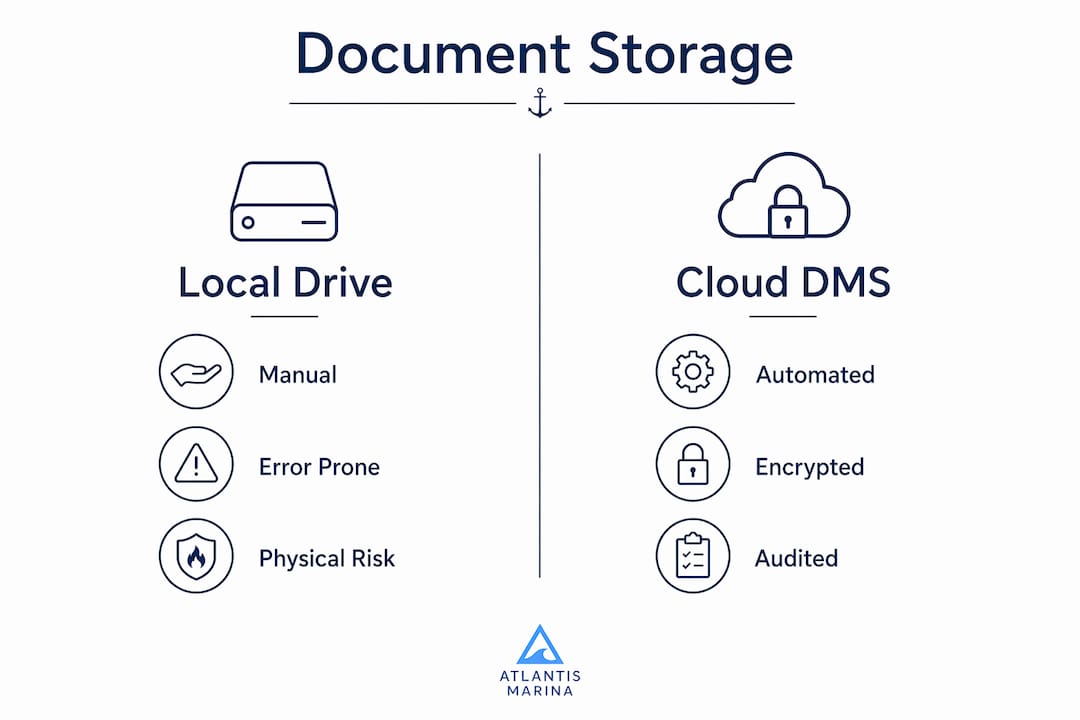
| Feature | Local shared drive | Cloud-based DMS |
|---|---|---|
| Version control | Manual, error-prone | Automated and timestamped |
| Audit trail | None | Full action log |
| Access control | Folder-level only | Role-based per document |
| Security | Network-dependent | Encrypted with audit alerts |
| Retrieval speed | Varies by folder structure | Metadata search, seconds |
How does marina document management ensure regulatory compliance?
Regulatory compliance in marina operations depends on governance, not just storage. Proper governance includes clear ownership per document and controlled publishing that distinguishes active documents from drafts. Without those controls, a marina cannot prove to an auditor that staff acted on current, approved information.
The governance framework for marina compliance covers five practical steps:
- Assign document ownership. Every document needs a named owner responsible for accuracy and timely updates. Lease agreements belong to the marina manager. Vessel registrations belong to the slip coordinator.
- Enforce controlled publishing. Only approved documents reach staff and tenants. Drafts stay in a restricted review stage until formally approved.
- Maintain full change histories. Version control with complete change histories enhances traceability and enables rollback when errors are discovered.
- Prepare for standards audits. Compliance with standards like ISO 9001, ISO 14001, and ISO 27001 includes strict document control requirements covering availability, protection against unintended changes, and suitability for use.
- Manage marina-specific document types. Common marina documents requiring active management include lease agreements, insurance certificates, vessel registrations, and incident reports. Each type carries its own update frequency and access requirements.
"Effective document management ensures only approved, current practices are accessible, reducing operational errors and ensuring consistent policy application across the facility."
Pro Tip: Build a document register that lists every document type, its owner, its review frequency, and its current version. Review that register quarterly. A register reviewed twice a year is the single fastest way to catch compliance gaps before an auditor does.
For marinas managing vessel records across multiple slips, a dedicated vessel registration tracking guide provides a practical framework for maintaining audit logs and meeting regulatory standards.
What are the practical benefits and risks of effective document control?
Document management transforms documentation from a passive archive into an active management asset. That shift produces measurable operational improvements for marina operators.
The benefits of well-managed marina documentation include:
- Reduced administrative burden. Staff spend less time searching for files and more time serving tenants. Automated workflows replace manual routing and follow-up emails.
- Faster document retrieval. A searchable DMS returns results in seconds. Manual filing systems require physical access and institutional memory.
- Policy consistency across shifts. Effective document management ensures only approved, current practices are accessible, so the morning dockmaster and the evening dockmaster follow identical procedures.
- Enhanced customer trust. Tenants who receive professional, accurate documentation, including current lease terms and up-to-date insurance requirements, perceive the marina as well-run and reliable.
- Audit-ready records. When a regulatory body requests documentation, a DMS produces a complete, organized record set without emergency file searches.
The risks of poor document control are equally concrete. Outdated insurance certificates create liability exposure. Unsigned lease amendments generate billing disputes. Incident reports filed inconsistently undermine legal defense. Each of these failures traces back to the absence of version control and access governance.
For yacht clubs managing vessel records across a membership base, the principles of yacht club records management apply directly to marina document governance.
How to integrate document management into your marina operations
Adopting a DMS works best as a phased process rather than a single-day switch. Marina operators who try to migrate everything at once typically stall midway and revert to old habits.
- Assess current documentation challenges. Identify which document types cause the most friction: expired certificates, version confusion, or slow approval cycles. That assessment defines your priorities.
- Choose the right platform. Select a DMS that integrates with your existing marina management software. Marina management platforms that integrate document management with booking, billing, communication, and service coordination reduce administrative burden and improve cash flow. A standalone DMS that does not connect to your reservation or billing system creates a new silo.
- Set up document ownership and access levels. Before migrating any files, define who owns each document category and what permissions each staff role requires. This step prevents the access control problems that plague rushed implementations.
- Train staff on workflows. A DMS is only as effective as the people using it. Train staff on the approval workflow, version naming conventions, and how to flag documents for review. Short, role-specific training sessions outperform long general orientations.
- Establish ongoing review practices. Schedule quarterly document audits to catch outdated files, reassign ownership after staff changes, and verify that all active documents reflect current policies.
Pro Tip: Start your DMS migration with one document category, such as tenant insurance certificates, and run it in parallel with your existing system for 30 days. That pilot reveals workflow gaps before they affect your full document library.
Marina management platforms that combine document management with e-signature capabilities remove the last paper-based step from the approval process. Atlantis-marina's e-signature functionality supports digital document workflows that connect directly to tenant records and compliance tracking.
Key takeaways
Effective marina document management requires governance across the full document lifecycle, not just centralized storage, to reduce compliance risk and operational errors.
| Point | Details |
|---|---|
| Define the system correctly | A DMS governs documents through creation, approval, and archival. Storage alone does not provide compliance protection. |
| Prioritize version control | Distinguishing drafts from approved documents prevents outdated policies from reaching staff or tenants. |
| Assign document ownership | Every document needs a named owner responsible for accuracy, updates, and timely review. |
| Integrate with marina platforms | Connecting a DMS to reservations, billing, and vessel records eliminates data silos and reduces administrative work. |
| Audit regularly | Quarterly document reviews catch compliance gaps before regulatory inspections reveal them. |
Why most marinas underestimate document governance
Marina operators tend to treat document management as an IT problem. It is not. It is an operations problem with legal and financial consequences.
I have seen marinas with perfectly organized shared drives that still failed compliance reviews because no one could prove which version of a safety procedure was active on the date of an incident. The files existed. The governance did not. That distinction cost one marina operator significant legal exposure during a slip accident investigation.
The shift I consistently recommend is to stop thinking about where documents live and start thinking about who owns them and when they expire. A lease agreement filed in the right folder is useless if no one flagged its renewal date. An insurance certificate uploaded to a tenant profile is a liability if the system does not alert staff when it lapses.
Marina management platforms are moving in the right direction. The integration of document workflows with reservations, billing, and vessel records is becoming standard infrastructure rather than a premium add-on. Operators who adopt integrated platforms now will spend far less time on manual compliance checks in the years ahead. Those who wait will face increasing regulatory pressure with increasingly fragile manual systems.
The practical advice I give every dockmaster is this: pick one document type that causes the most friction today and build a proper governance workflow around it. That single win builds the organizational habit that scales to your full document library.
— John
Atlantis-marina's approach to marina document operations
Atlantis-marina, developed by Atlantis Control Systems, brings document management into the same platform where marina operators already handle reservations, billing, and vessel records.
Boaters can upload insurance certificates and vessel registrations directly through the customer portal, and dockmasters receive those files linked to the correct slip and tenant profile. That connection removes the manual step of matching uploaded documents to the right account. Atlantis-marina's marina management solution supports access controls, document workflows, and integration with billing and reservation modules, giving operators a single place to manage both operations and compliance documentation. Marina operators ready to move beyond fragmented filing can review platform options and pricing to find the right fit for their facility size and workflow needs.
FAQ
What is marina document management?
Marina document management is the systematic control of all marina-related documents through their full lifecycle, including creation, approval, distribution, and archival. It replaces ad hoc filing with governed workflows that support compliance and operational consistency.
What documents does a marina need to manage?
Common marina documents requiring active management include lease agreements, insurance certificates, vessel registrations, and incident reports. Each type requires version control, access restrictions, and defined review schedules.
How does a DMS support marina compliance?
A DMS maintains a full audit trail of who accessed, modified, and approved each document, which is the core requirement for regulatory inspections under standards like ISO 9001. It also enforces controlled publishing so only approved documents reach staff and tenants.
What is the difference between document storage and document management?
Document storage holds files in a central location. Document management adds version control, audit trails, access permissions, and workflow automation to govern how those files are created, reviewed, and retired.
How should a marina start implementing document management?
Start by identifying the document type causing the most operational friction, assign an owner for that category, and run a DMS pilot for 30 days alongside your existing system. That approach surfaces workflow gaps before a full migration.