
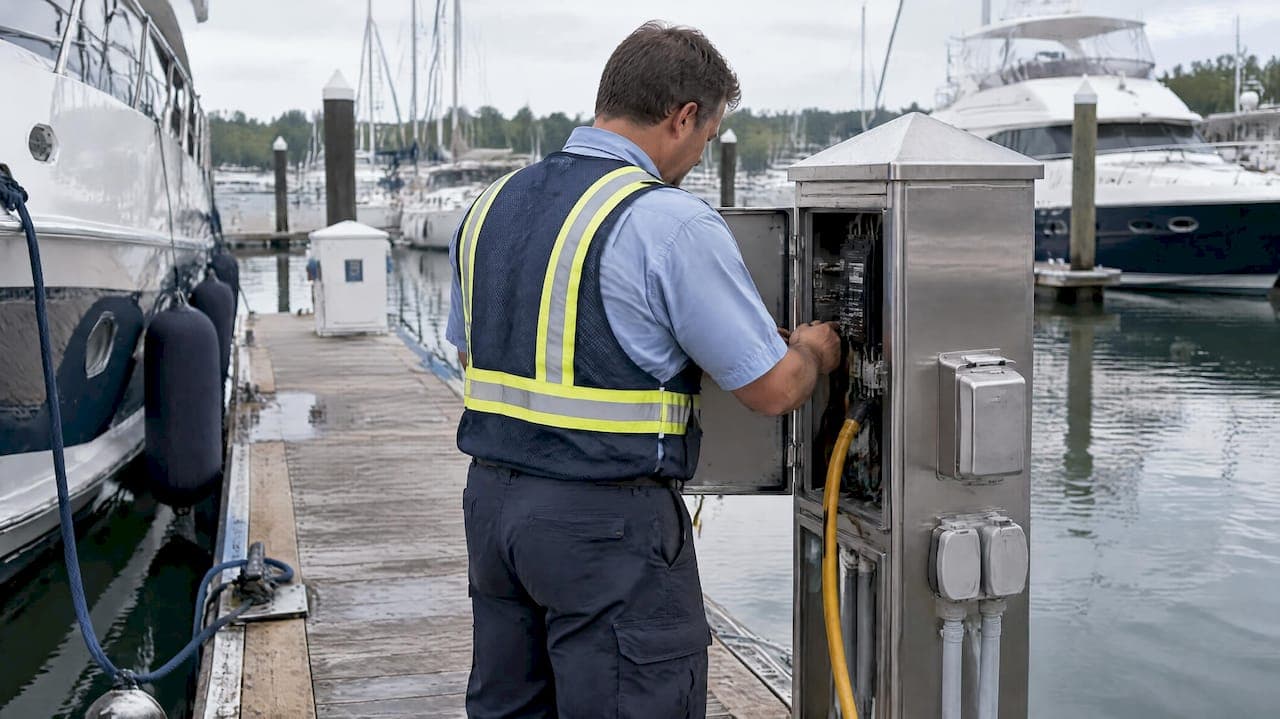
Remote pedestal control lets marina staff meter, switch, and safely manage shore power pedestals from a central platform instead of walking the docks for every reading or reset. We recommend it when faster fault response, automated billing, and remote disconnects matter to your operation, provided the system you choose prioritizes GFPE compatibility, reliable communications, and tight integration with your operations software.
TL;DR:
- Remote pedestal control systems support adjustable trip levels, self-test functions, and secure communications options like Ethernet or cellular gateways.
- Proper installation requires compliance with NEC ground-fault protection rules, including regular manual testing and on-site leakage measurement devices for vessels.
- Cost varies from $150 to $900 per month depending on system size and features, with additional setup fees and optional utility monitoring add-ons.
- Implementation involves a pre-install survey, network planning with backup power, precise wiring, and scheduled manual testing with comprehensive documentation.
- Integrating meter and fault data into marina management platforms enables automated billing, faster fault response, and streamlined maintenance workflows.
Table of Contents
- Core Features and Benefits of Remote Pedestal Control Systems
- Safety and NEC Requirements That Govern Pedestal Control
- How to Choose a Remote Pedestal Control Solution
- Implementation Checklist: From Procurement to Commissioning
- How Integrated Operations Software Amplifies Remote Pedestal Control
- Retrofit or Full Replacement: An Operator's Trade-Off
- Putting Remote Pedestal Control to Work on Atlantis Marina
- FAQ
- Sources
Core Features and Benefits of Remote Pedestal Control Systems
A remote pedestal control system gives marina staff three things a clipboard never could: per-pedestal metering, remote switching, and continuous fault monitoring. Each pedestal reports kilowatt-hours and instantaneous load back to a central dashboard, so billing reflects actual consumption instead of flat seasonal estimates. Staff can shut off power to a single slip for nonpayment or safety without walking the dock, and shunt-trip outputs let the system cut power automatically the instant a ground fault is detected.
The operational payoff shows up fast:
- Fewer dock visits for meter reads, disconnects, and routine checks.
- Automated billing tied directly to metered usage instead of manual entry.
- Faster troubleshooting because staff see which pedestal faulted and when, not just that "a breaker tripped somewhere."
- Continuous ground-fault monitoring that shortens the time between a leakage event and a response.
That last point matters more than it sounds. Electric shock drowning risk in marinas is almost always tied to leakage current from a vessel or a pedestal, and the sooner staff see an alarm, the sooner they can isolate the problem.
Pro Tip: Pull a year of manual meter-read data before you shop for a system. It tells you which pedestals carry the heaviest load and where remote metering pays for itself fastest.
Safety and NEC Requirements That Govern Pedestal Control
Any remote pedestal control project has to work inside the ground-fault protection rules in NEC Article 555, not around them. Reorganizations through 2017 to 2023 split protection into tiers: feeder-level ground-fault protection can be set as high as 100 mA, shore-power receptacles are generally protected at 30 mA, and personnel-level GFCI protection on 15 to 20 amp receptacles stays at 4 to 6 mA, according to the history of marina ground-fault protection documented by IAEI Magazine. Replacement and modification language added in 555.15 also affects what triggers a compliance upgrade when you touch existing pedestal wiring.

Continuous ground-fault monitoring catches leakage early, but it does not replace manual testing. The National Fire Protection Association notes that many GFPE trips originate with the vessel itself, not the pedestal, which is why marinas with more than three shore-power receptacles are expected to keep a leakage current measurement device on site and use it.
Hardware needs to support that reality:
- Adjustable trip coordination between feeder and receptacle-level protection.
- Self-test functions that confirm the monitor itself is working, not just the circuit.
- NEMA 4X enclosures with weep holes to survive salt air and splash without trapping moisture.
How to Choose a Remote Pedestal Control Solution
Vendor quotes for pedestal control systems can look similar on the surface and differ enormously in practice. Work through this checklist before you sign anything:
- Code and safety compliance. Confirm GFPE support with adjustable trip settings and UL listing; this is non-negotiable for inspection sign-off.
- Metering accuracy and billing support. Ask for kilowatt-hour accuracy specs and whether logs export in a format your billing system can ingest.
- Communications and security. Look for Ethernet or Modbus/TCP support, an optional cellular gateway for docks without wired runs, password protection, and over-the-air firmware updates.
- Control and resilience. Per-pedestal switching, shunt-trip outputs, scheduled control modes, and a manual override for when the network is down.
- Install and retrofit fit. Check CT sizing requirements, enclosure specs, corrosion-resistant materials, and whether a local technician can service the unit without shipping it back to the manufacturer.
A datasheet for a marina-grade ground-fault monitoring panel is a good reference point here: it shows the kind of adjustable trip levels, self-test functions, and communications gateway options that separate a purpose-built marina panel from a repurposed industrial one.
Pro Tip: Ask every vendor the same question: "What happens to pedestal control if the network connection drops?" The answer tells you more about resilience than any spec sheet.
Implementation Checklist: From Procurement to Commissioning
Getting a remote pedestal control system from purchase to operation takes more than bolting on a new panel. A structured rollout protects both the schedule and the inspection.
- Pre-install survey. Document feeder capacity, plan current transformer placement, and talk to your local code official about how GFPE coordination will be reviewed.
- Network planning. Decide between a wired Ethernet backbone and a cellular gateway for remote docks, secure the transport with VPN or TLS, and plan backup power for communications modules.
- Electrical wiring. Install CTs so all active conductors pass centrally through the opening, wire shunt-trip outputs to a properly rated breaker, and follow manufacturer torque and wire-size guidance exactly.
- Commissioning. Set trip thresholds, run the panel's self-test, perform a manual leakage measurement to confirm the reading matches, and record the result in a test log.
- Maintenance plan. Schedule monthly manual tests, periodic firmware checks, and keep a staff runbook for resets and fault response.
That monthly testing habit is not optional paperwork. Our guidance on monthly shore power testing and digital logs walks through what inspectors expect to see when they ask for your documentation, and a pilot monitoring approach on a handful of slips is a practical way to validate network and CT placement decisions before committing to a full-marina rollout.
Keep these on the wall by the panel:
- Trip threshold settings and the date they were last verified.
- Contact information for the installer and the local inspector.
- A log sheet for every manual test, signed and dated.
How Integrated Operations Software Amplifies Remote Pedestal Control
A pedestal panel that only talks to itself leaves value on the table. When metered data and fault events feed into a marina operations platform, billing and maintenance stop being separate jobs.
- Billing runs on real usage. Kilowatt-hour readings and event logs flow into contracts, autopay, and QuickBooks Online sync, so revenue gets billed and collected without manual entry.
- Alerts reach the right people fast. A ground-fault event can trigger a dockmaster alert and a boater notification at the same time, with remote reset or lockout available from the app rather than a drive to the dock.
- Field repairs move faster. A handheld Dealer Tool Kit for device diagnostics keeps audit-ready logs on hand for inspections and insurance reviews.
- QR-code account identification ties an on-dock fault directly to the correct boater account, so staff troubleshooting a pedestal are not guessing whose vessel caused the trip.
That kind of connected workflow is the difference between a smart panel and a smart marina, which our marina management solution is built around.
Retrofit or Full Replacement: An Operator's Trade-Off
Retrofitting existing pedestals makes sense on a limited budget or when you want to phase the rollout dock by dock. Full replacement pays off once infrastructure is aged, undersized, or you're planning an expansion anyway. The mistake we see most is treating automation as a staff reduction plan rather than a training investment. Remote switching and continuous monitoring cut routine walking and manual reads, but they raise the bar on documentation discipline: someone still has to run the manual tests, read the logs, and know what a false trip looks like versus a real one.
— John R
Putting Remote Pedestal Control to Work on Atlantis Marina
A modern marina operations platform can unify metered pedestal data, billing, and maintenance workflows. Once pedestal hardware reports kilowatt-hours and fault events, those readings can be turned into automated contracts, autopay charges, and accounting entries with minimal manual reconciliation.

Here's what that looks like day to day:
- Remote disconnect workflows that let a dockmaster lock out a nonpaying slip from the app.
- Dealer Tool Kit diagnostics that shorten field repair visits and keep audit-ready logs.
- Dockmaster and boater app alerts the moment a ground-fault event fires.
Our pricing page lists Micro at $150 per month, Small at $300, Medium at $500, and Large at $900, with Enterprise available on request; utility monitoring add-ons run $30 to $150 per month depending on scope. If you want to see how metered pedestal data fits your current setup, talk to our sales team about a demo.
FAQ
What does remote pedestal control actually do for a marina?
It lets staff meter, switch, and monitor dock power pedestals from a central dashboard instead of walking the docks for every reading or reset. The result is faster fault response, more accurate billing, and fewer routine dock visits.
What ground-fault protection level applies to shore power pedestals?
Under NEC Article 555, shore power receptacles are generally protected at 30 mA, feeder-level protection can be set up to 100 mA, and personnel-level GFCI protection on 15 to 20 amp receptacles remains 4 to 6 mA, as detailed in the history of marina ground-fault protection. The exact setting depends on where the protection sits in your system.
Does continuous monitoring replace manual ground-fault testing?
No. The NFPA notes that continuous monitoring should be paired with regular manual testing and documented logs, since many faults trace back to the vessel rather than the pedestal. Marinas with more than three shore-power receptacles are expected to keep a leakage measurement device on site.
How much does remote pedestal integration cost through a marina platform?
Pricing depends on your plan and add-ons: our subscription tiers start at $150 per month for Micro and scale to $900 per month for Large, with utility monitoring add-ons priced from $30 to $150 per month. A one-time setup fee ranging from $100 to several hundred dollars applies depending on the scope of your install.
How long does a typical pedestal control installation take?
Timelines vary by marina size and whether you're retrofitting existing pedestals or installing new ones, since both depend on a pre-install electrical survey and local inspection scheduling. Commissioning itself, once hardware is wired, generally involves setting trip thresholds, running self-tests, and logging manual verification before go-live.
Sources
- History of Marina Ground-Fault Protection – IAEI Magazine
- Navigating electrical safety through marina waters | NFPA
- MarinaGuard ® MG-1 datasheet (Bender)