

A vendor revenue share is an arrangement in which an outside business (a restaurant, a boat-rental operator, a mobile mechanic, a kayak concession) sells on your property and you take an agreed percentage of what it earns. It works when three things are written down: which sales count, what percentage applies to each, and how the numbers get reported and paid. It breaks down when those numbers live in spreadsheets and someone has to reconcile them by hand every month. That is why the strongest setup puts vendor sales, splits and payouts in the same system that already bills your slips and runs your ship store.
TL;DR
- Vendor revenue share is income from other businesses' sales on your property. Your own slip, fuel and store revenue stays separate and should be reported separately.
- Public marina contracts use a few repeatable structures: flat percentages by category, graduated rates, fixed rent, and a percentage on top of a base.
- The contract must define gross receipts, exclusions, reporting deadlines, payment timing, late penalties and audit rights.
- Accuracy depends on categorizing every sale at the point of payment, not rebuilding it from a vendor's monthly statement.
- A unified billing, POS and payout platform removes the reconciliation work that makes percentage deals painful.
Table of Contents
- What vendor revenue sharing means for a marina
- The revenue-share models marinas actually use
- How the revenue share is calculated
- Contract terms to settle before the first sale
- Tracking vendor sales and reconciling payments
- How Atlantis keeps the split accurate
- Where vendor revenue fits in your revenue mix
- Our perspective
- Put your vendor payouts on one platform
- FAQ
- Sources
What vendor revenue sharing means for a marina
Your marina has two kinds of revenue. The first is what you sell yourself: slip and storage rent, fuel, ship store goods, service labor. The second is your share of what someone else sells on your property. The vendor owns the customer transaction, takes the sales risk and keeps most of the revenue. You get a percentage, a rent, or both.
That difference matters for your books. A vendor's gross sales are not your revenue, only your cut is. If you mix the two, your revenue mix looks inflated, your margins look thinner than they are, and the percentage you owe or are owed becomes hard to defend in a dispute.
Typical vendors on marina property include:
- Restaurants and snack bars
- Paddle-craft, boat and equipment rentals
- Mobile detailers, canvas and mechanical contractors serving boaters
- Fuel dock operators on leased docks
- Tour, charter and ride services that use your docks
The revenue-share models marinas actually use
The clearest way to see how deals are structured is to read public contracts. Municipal and state marinas publish theirs, and the terms are specific.
Percentage of gross receipts by category
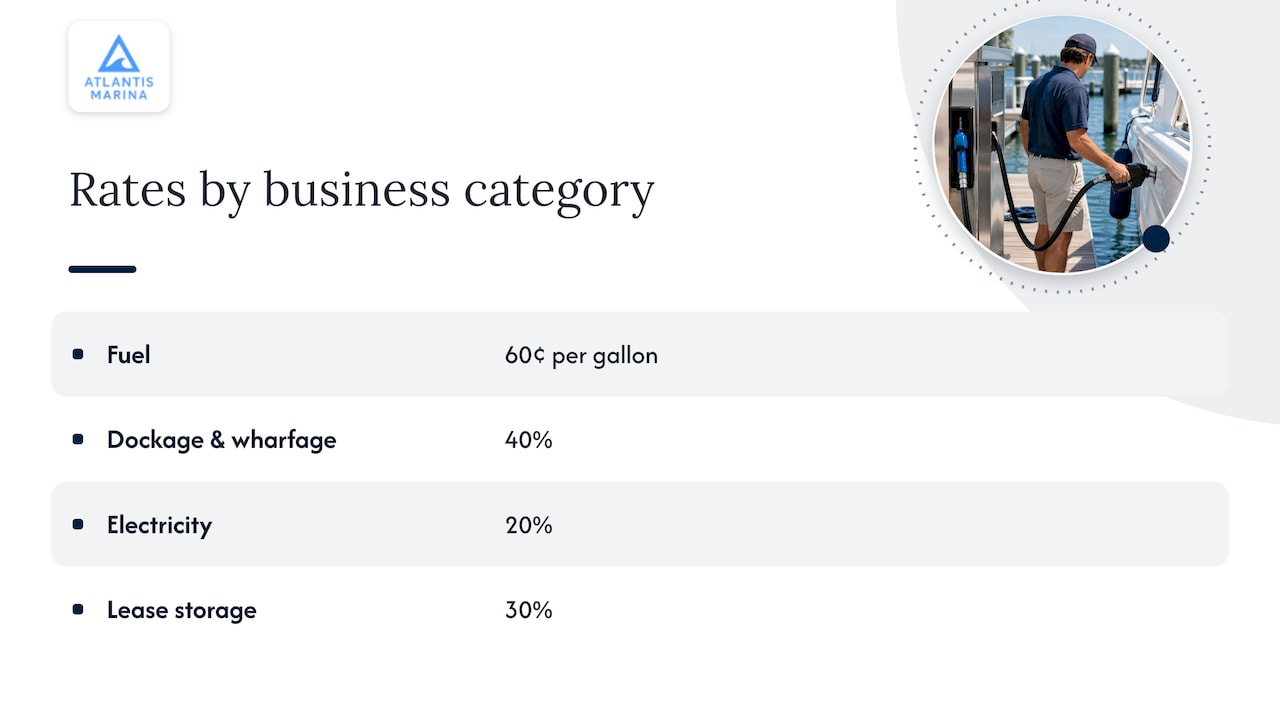
The town of Cape Charles, Virginia, pays its harbor operator a base fee set as a percentage of gross receipts, and the percentage differs by line of business: 60 cents per gallon on fuel, 40% of dockage and wharfage, 20% of electricity sales and 30% of lease storage. The same agreement adds an annual incremental fee on receipts above the prior year, and the staff report describes this as an incentive to grow the operation.
The lesson for a private marina: do not apply one flat percentage to everything. Fuel is a high-volume, low-margin line, while dockage carries far more margin. Splitting by category lets the percentage reflect the work and risk in each one.
A split agreed up front
The City of Saratoga Springs, Utah, put out a paddle-craft rental concession request for proposals that targets a 70/30 split, 70% to the vendor and 30% to the city. The split is negotiable for the vendor's inaugural year, and applicants propose their best offer for the startup period and the years after. A softer first year is a practical way to bring in a new vendor who has not yet built a customer base.
A minimum percentage bid
Kentucky's request for proposals for the Paintsville Lake marina sets a minimum acceptable bid of 5% of gross receipts, payable monthly. Setting a floor and letting vendors bid above it is a simple way to create competition without dictating the rate.
Graduated rent
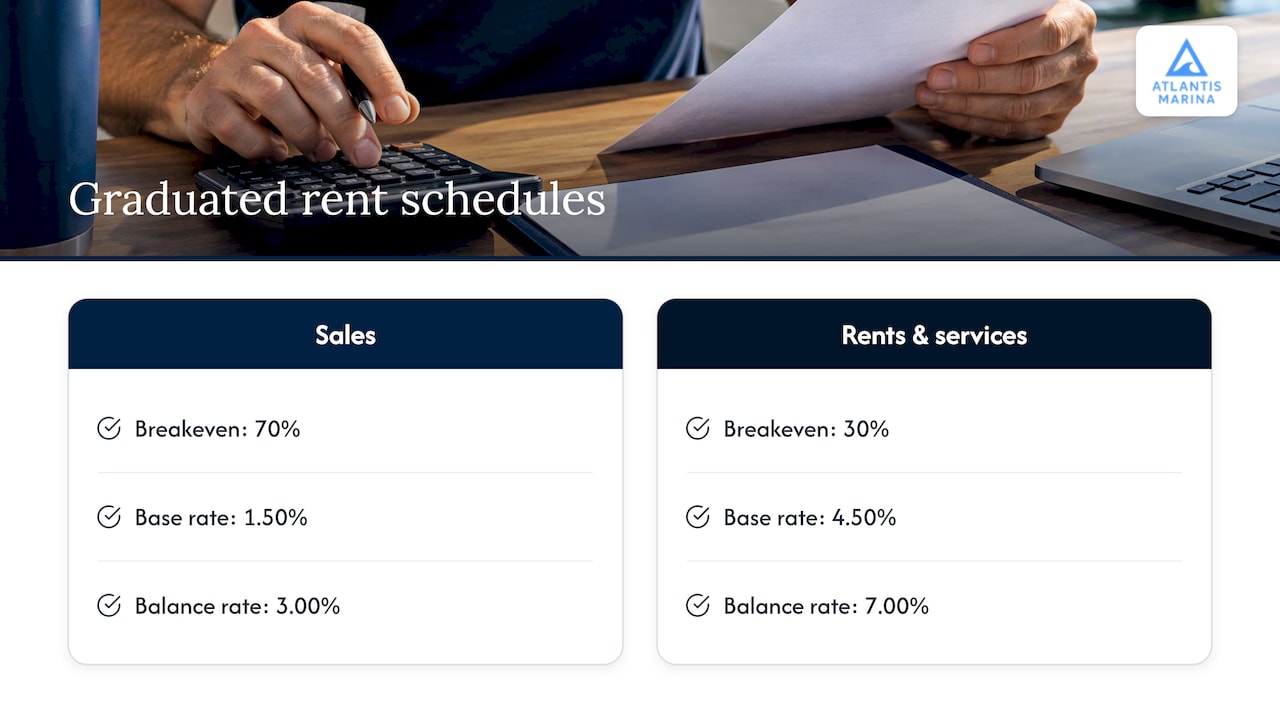
A U.S. Army lease exhibit shows a more elaborate design: a fixed rent combined with graduated percentages. For sales businesses it used a 70% breakeven point with a 1.50% base rate and a 3.00% rate on the balance. For rents and services the breakeven was 30%, with 4.50% and 7.00% rates. In short, the percentage rises as the vendor's sales rise. This is rare in small marinas, but it shows the principle: the better the vendor does, the larger your share.
Shared revenue on specific assets
Marina Jack Yacht Basin in Sarasota, Florida, runs as a public/private partnership. According to Marina Dock Age's 2021 profile, the city receives a percentage of gross profits, with a 50/50 split of expenses and revenues on the moorings. The operator also relies on about eleven vetted third-party contractors for services boaters need. The marina's approach to contractors is to try interested vendors, sign those that prove to be an asset and give customers their names.
Straight lease instead of a percentage
Some operators avoid percentages entirely. In a 2018 Marina Dock Age feature on marina restaurants, one operator said he prefers straight leases because getting into a tenant's business can cause stress. That is a legitimate choice when you cannot verify a tenant's sales. It is also the case for better tooling: when sales are captured automatically, a percentage deal no longer means getting into the vendor's books.
How the revenue share is calculated
The percentage is the easy part. The base it applies to causes the arguments. A well-drafted agreement answers each of these questions in writing.
1. What counts as gross receipts
The Kentucky request defines gross receipts as all cash or credits from food, gasoline, boat servicing, rentals and consigned items, counted at the total sale price rather than the operator's commission. It excludes state tax, license-writing fees, federal excise tax and utility fees. Consigned goods and pass-through charges are where most disputes start, so name them.
2. What is excluded
Taxes, tips, refunds, cancellation fees and metered utilities are the usual exclusions. A ride-service dock agreement published by Nava, for example, defines the fare as the rider's payment excluding taxes, tips and cancellation fees, and adjusts the next payment for refunds. Whatever you decide, write refunds in explicitly. A share calculated on a sale that was later refunded is a payment you will have to claw back.
3. Whether percentages differ by line
As the Cape Charles rates show, one percentage rarely fits every line. If a vendor sells both fuel and food, split the schedule.
4. When statements and payments are due
Public contracts are precise here. Kentucky requires monthly payment within 10 working days after month-end, with a late penalty of 1.5% per month. Cape Charles requires a gross-receipts statement within 20 business days after month-end, detailing daily receipts by income category, with payment due within 30 days of the required documentation.
A worked example
Say a paddle-craft vendor on your docks grosses $18,000 in July, including $600 in sales tax collected and $400 in refunded rentals. Under a 70/30 split with taxes and refunds excluded, the base is $17,000 and your share is 30%, or $5,100. If the agreement had been silent on tax and refunds, the base could be argued as $18,000, a $5,400 share, and you would be negotiating a $300 gap over a single month. Clear definitions are cheaper than good relationships.
Contract terms to settle before the first sale
Beyond the math, settle these items in the agreement:
- Term and renewal. Initial term, notice period and who can end the agreement without cause.
- Reporting. The format, frequency and deadline for sales statements.
- Audit rights. Cape Charles keeps records open to inspection on reasonable notice for the contract duration plus five years. The Kentucky request requires an annual audit by an independent CPA firm, submitted within three months of year-end. A small marina does not need that, but it needs the right to see records.
- Payment method. Who collects the money, and whether the vendor is paid net of your share or remits the share to you.
- Insurance and compliance. Certificates of insurance and licenses for each vendor.
- Sale of the facility. What happens to the agreement if you sell.
Tracking vendor sales and reconciling payments
The contract is only as good as the data behind it. Most marinas that run percentage deals end up asking vendors for a monthly statement, then comparing it to whatever they can see. That is exactly the setup that creates mistrust on both sides.
A better routine runs in four steps:
- Capture the sale where payment happens. If vendor sales run through your system, with each transaction tagged by vendor and category, the base is built as sales occur rather than reconstructed later.
- Apply the schedule automatically. The percentage by category should calculate from the transaction, not from a spreadsheet formula someone maintains.
- Reconcile against deposits. Card and ACH payouts should match the sales ledger. Processing fees, refunds and chargebacks are where the totals drift.
- Review on a rhythm. Look at each vendor monthly: sales trend, your share, refunds and boater feedback. A vendor who is growing is a reason to renegotiate the next term, and one who is flat is a reason to ask why.
If you are choosing how to collect on the water, a guide to boat rental payment processing explains how rental revenue is collected and paid out, which is the money flow your split sits on top of.
How Atlantis keeps the split accurate
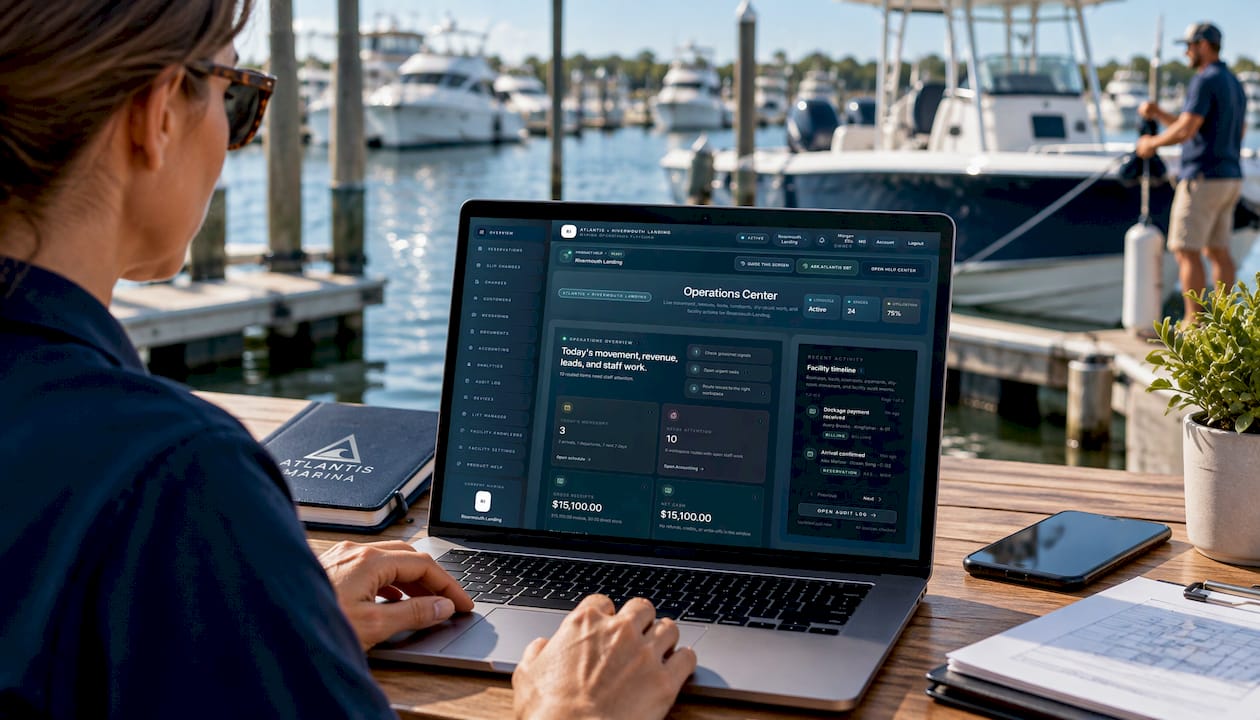
Our platform already handles the pieces a revenue share depends on. Staff run ship store point of sale and marina billing from the same account, with Stripe and ACH processing and QuickBooks Online sync keeping revenue booked without manual entry. Our guide to vendor marketplace payouts, commission and payouts covers how marketplace vendors fit into that flow. If you are working out how payments are routed, marina payment processing explained for operators and our walkthrough of concessions, autopay and QuickBooks sync show the setup, and split tender payments show how a single payment can be divided across destinations.
The practical benefit: a vendor's sales, your share and the accounting entry come from one record, so month-end becomes a review instead of a reconstruction.
Where vendor revenue fits in your revenue mix
Treat vendor revenue as a separate line in your reporting. Marina income is typically concentrated in a few lines. A Marina Dock Age report on a 2026 public workshop put dock charges at 54% of one marina's sales, with dockage and fuel together at 86%, so vendor shares are usually a supplement rather than the foundation. Their value is often broader than the percentage: a restaurant draws visitors, a rental operator fills daytime slips, and a vetted contractor keeps boaters on site for service.
That is why the best vendor agreements are built around fit, not the highest percentage. Choose vendors your boaters will use, set a rate that leaves them profitable, and keep the reporting simple enough that both sides trust it.
Our perspective
Most vendor revenue share problems we see described by operators are not disagreements about the percentage. They are disagreements about the numbers: which sales counted, whether a refund was netted out, when the payout landed.
Our view is that the fix is structural. When vendor sales, boater accounts, payments and accounting live in one cloud platform, the base is not something anyone has to argue about. Atlantis Marina is built to unify slip management, billing, ship store POS, marketplace vendors and QuickBooks sync, so each transaction is recorded once and carries its context with it.
That lets an operator choose the model that fits the vendor, whether a flat percentage, a category split or a growth incentive, without worrying that the reporting will not support it. A percentage deal becomes as easy to run as a fixed lease, and you keep the upside.
John R
Put your vendor payouts on one platform
If you run vendors, a ship store, slips and service from different tools, the first step is bringing them into one record. Atlantis Marina combines billing, ship store POS, marketplace vendors and QuickBooks sync for marinas, yacht clubs and dry stack operators. See the marina software and the plans and pricing, which start at $150 per month for the Micro plan.
FAQ
What percentage should a marina take from a vendor?
Public contracts show a wide range because the right figure depends on the line of business. Kentucky's marina request set a minimum bid of 5% of gross receipts, a Utah paddle-craft concession targeted a 30% share to the city, and Cape Charles uses different rates for fuel, dockage, electricity and storage. Set the rate by category and leave the vendor enough margin to stay in business.
Should I use a percentage or a fixed lease?
A fixed lease gives predictable income and little administration. A percentage shares the upside and suits vendors whose sales grow with your traffic. Some operators prefer straight leases for restaurants because of the friction of monitoring tenant sales. If your system captures vendor sales automatically, a percentage deal carries far less of that friction.
What should the agreement say about refunds and taxes?
State whether the base is gross sales or net of taxes, tips, refunds and cancellation fees, and write the choice into the definition of gross receipts. Kentucky's request excludes state tax and federal excise tax, and the Nava dock agreement excludes taxes, tips and cancellation fees from the fare, adjusting later payments for refunds.
How often should vendors report and pay?
Monthly is the norm in the public contracts above. Cape Charles asks for a statement within 20 business days after month-end, and Kentucky requires payment within 10 working days. Choose a deadline, attach a late penalty, and reserve the right to inspect records.
Sources
- Cape Charles harbor management agreement staff report
- Saratoga Springs, Utah, recreational rentals and concessions RFP
- Kentucky Paintsville Lake Marina RFP (2021)
- U.S. Army lease exhibit with graduated rent
- Marina Jack Yacht Basin public/private partnership, Marina Dock Age
- Marina restaurants feature, Marina Dock Age
- Dock partner agreement, Nava
- Boat rental payment processing guide