

A cloud-based yacht club platform is an integrated online software suite that centralizes member management, slip reservations, billing, and communications into a single system accessible via web and mobile. The industry commonly refers to these as yacht club management systems or marina management software. Platforms like Clubessential, ClubSoft, and Northstar represent the established category, each consolidating front-office member experiences with back-office operations. For marina owners and yacht club administrators, the core promise is simple: replace fragmented spreadsheets, paper logs, and disconnected tools with one platform that keeps every department synchronized.
What features do cloud-based yacht club platforms typically include?
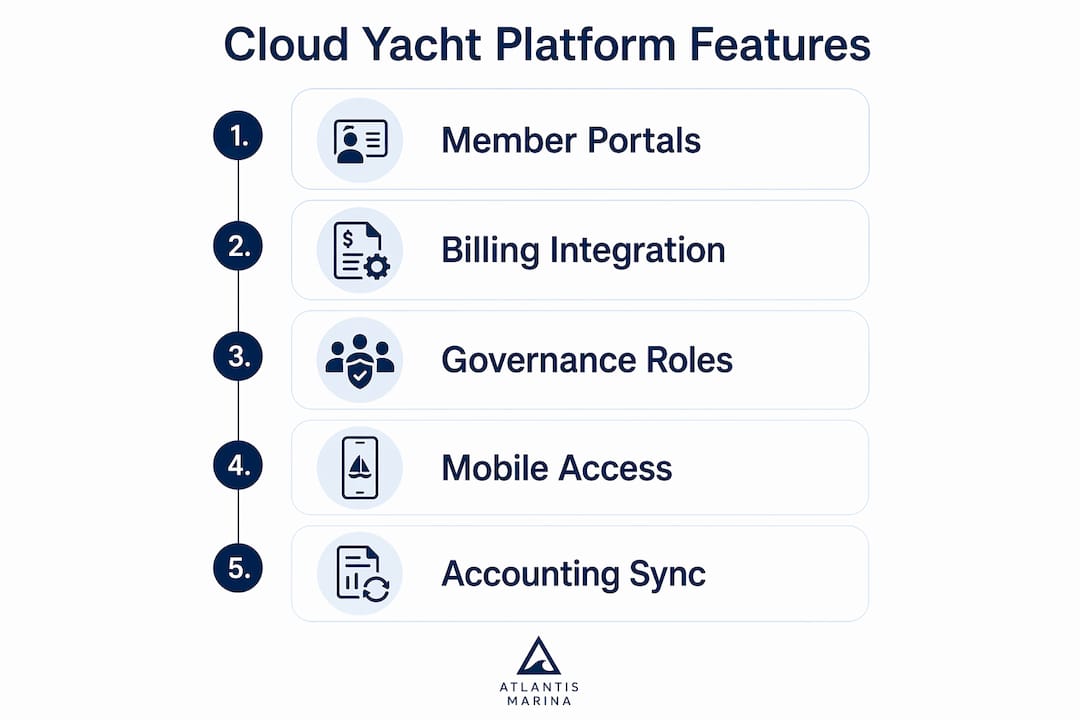
A yacht club management system covers five primary functional areas, and understanding each one helps administrators assess whether a platform fits their operational reality.
Slip and moorage reservations form the operational backbone of any marina-facing platform. This includes:
- Drag-and-drop marina maps for visual slip assignment (ClubSoft)
- Waiting list management with automated promotion workflows
- Real-time occupancy tracking across wet slips and dry storage
- Reservation state handling for check-ins, no-shows, and early departures
- Security deposit collection tied to individual bookings
Member self-service portals give boaters direct access to their accounts without staff involvement. Members can submit vessel information, upload insurance and registration documents, make payments, and communicate with marina staff. Northstar extends this further with integrated boat directories that link vessel records directly to member profiles.
Billing and payments in a cloud yacht club software environment go well beyond simple invoicing. ClubSoft uses Stripe for card processing and syncs with QuickBooks for accounting. Anny supports SEPA direct debit alongside card payments. Clubessential deploys a cloud-based mobile POS that handles point-of-sale transactions at the dock, bar, or pro shop. Recurring charges for seasonal slips, membership dues, and utility billing run automatically without manual intervention.

Governance and role-based permissions separate professional platforms from basic booking tools. SailHQ, for example, enables custom roles like Sailing Committee and House Committee with granular access control and audit logs. This means a race committee member can access event registrations without touching billing records.
Mobile apps and accounting integrations round out the feature set. Staff manage operations from tablets on the dock. Administrators reconcile accounts directly through QuickBooks or Xero connections. The result is a connected workflow from reservation request to payment receipt.
Pro Tip: When evaluating platforms, request a live demonstration of the waiting list workflow specifically. This single feature consumes more admin hours than any other function, and the quality of its implementation varies significantly between vendors.
How do cloud-based platforms improve yacht club operations?
The operational improvements from adopting a yacht club management system follow a predictable sequence. Here is how the transition typically unfolds:
-
Elimination of manual tracking. Paper dock logs and Excel reservation sheets create reconciliation errors every time data moves between systems. Cloud-based systems consolidate operations into one platform, removing the double-entry problem entirely.
-
Real-time data access for staff and members. A dockmaster checking slip availability on a tablet sees the same data a member sees when booking online. This shared data layer prevents overbooking and eliminates the "I'll call you back" response to availability inquiries.
-
Automated billing tied to membership status. When a member's status changes, such as a pause or lapse, billing automation updates recurring charges without manual adjustment. Clubs that run these functions separately routinely lose dues revenue through timing gaps.
-
Scoped committee access. Governance-aware platforms allow multiple committee members to work simultaneously without stepping on each other's data. A race officer can post results while the treasurer processes invoices, each within their defined permission scope.
-
Improved member engagement. Mobile and web portals shift routine requests, such as document uploads, payment submissions, and service inquiries, away from staff and toward self-service. This frees administrators to focus on higher-value interactions.
Pro Tip: Plan your staff training before go-live, not after. The biggest implementation failures come from clubs that deploy the software before their team understands the billing and reservation workflows. Two days of structured training prevents months of workarounds.
How to evaluate and choose the right cloud-based yacht club platform
Choosing the right platform requires evaluating specific capabilities against your club's operational complexity. Generic feature lists are not enough. The table below outlines the critical evaluation criteria and what to look for in each area.
| Evaluation Criterion | What to Assess |
|---|---|
| Waiting list and reservation edge cases | Can the system handle no-shows, deposits, and partial-day bookings without manual workarounds? |
| Governance and role permissions | Does it support multiple committees with distinct access scopes and audit trails? |
| Billing and membership integration | Are membership status changes automatically reflected in recurring charge schedules? |
| Cloud deployment and data hosting | Where is data hosted? Is there an option for on-premises deployment if connectivity is a concern? |
| Scalability and administrative complexity | Can the platform grow from 50 slips to 500 without requiring a platform migration? |
Waiting list management and reservation state handling consume the most admin time of any platform function. Evaluating these features carefully is not optional. Ask vendors specifically how their system handles a no-show when a deposit has been collected and a waitlisted member is next in line. The answer reveals the platform's actual operational depth.
Governance support is equally critical for committee-heavy clubs. Systems limited to a single admin user create workaround burdens that grow as the club grows. Verify that the platform supports multiple simultaneous users with role-based permissions before committing.
Billing integration with membership status is where many clubs lose revenue quietly. A member who pauses their membership should trigger an automatic hold on their slip charges. If your billing and membership modules are separate products stitched together, that automation likely does not exist. Tight integration between member status and billing prevents revenue loss and reduces administrative errors.
Cloud deployment is now the standard across all major vendors, including ClubSoft and SailHQ. Most platforms offer web portals with mobile access. Some support on-premises options for clubs with privacy requirements or unreliable marina connectivity. Confirm the hosting location and data residency terms before signing a contract.
Comparing prominent cloud-based yacht club platforms
The market includes several well-established options, each with distinct strengths. The comparison below focuses on the differentiators that matter most to marina administrators.
| Platform | Standout Feature | Billing Support | Governance Tools |
|---|---|---|---|
| ClubSoft | Drag-and-drop marina maps, QuickBooks sync | Stripe payments, recurring charges | Standard role permissions |
| Clubessential | Mobile POS, member app | Integrated cloud POS billing | Committee-level access controls |
| Anny | 3D occupancy plan, transparent waiting lists | SEPA direct debit, card payments | Booking rule configuration |
| SailHQ | Custom committee roles, audit logs, GDPR compliance | Membership-linked billing automation | Granular role-based permissions |
| Northstar | Integrated slip and member boat directories | Comprehensive reservation billing | Member directory management |
ClubSoft suits marinas that prioritize visual dock management and need a direct accounting connection through QuickBooks. Clubessential targets larger clubs that need a mobile POS alongside member-facing apps. Anny's 3D occupancy plan is particularly useful for marinas with complex layouts where visual clarity reduces booking errors. SailHQ stands out for governance-heavy clubs where committee structure drives daily operations. Northstar fits clubs that manage large vessel inventories alongside traditional slip reservations.
No single platform wins across every criterion. The right choice depends on whether your primary pain point is visual slip management, billing automation, governance complexity, or member self-service.
Key takeaways
A cloud-based yacht club platform reduces administrative workload and improves member experience only when billing, reservations, and governance tools operate from a unified data layer.
| Point | Details |
|---|---|
| Unified data layer is the core value | Platforms that connect reservations, billing, and member status eliminate manual reconciliation errors. |
| Governance tools determine scalability | Role-based permissions and audit logs are required for clubs managed by multiple committees. |
| Waiting list handling reveals platform depth | How a system manages no-shows and deposits is the clearest indicator of operational maturity. |
| Billing and membership must be integrated | Separate billing and membership modules create revenue gaps when member status changes occur. |
| Cloud deployment is now standard | Most leading platforms host on cloud infrastructure with web and mobile access as the default. |
Why governance is the feature most administrators underestimate
Most administrators shopping for cloud yacht club software focus on the reservation interface and billing reports. Those are visible, daily-use features. What they consistently underestimate is governance, and that oversight costs them later.
I have seen clubs deploy platforms that look excellent in a demo, only to discover six months in that their race committee, house committee, and fleet captain all share a single admin login. That is not a minor inconvenience. It is a data integrity problem and a liability. When something goes wrong, such as a billing error or a reservation dispute, there is no audit trail to identify who made the change.
Yacht club software is more than a website. It connects front-office member experiences directly to back-office data. That connection only works reliably when each person accessing the system has a defined, scoped role. Clubs that skip this requirement during evaluation almost always regret it once they scale past a handful of staff users.
The other underestimated factor is implementation sequencing. Clubs that configure billing rules before they configure membership categories create a tangled setup that requires a full rebuild. The correct sequence is: membership structure first, billing rules second, reservation workflows third. Any vendor that does not walk you through this sequence during onboarding is leaving you to figure it out yourself.
My honest recommendation is to weight governance and billing integration at least as heavily as the reservation interface during your evaluation. The reservation UI is easy to learn. A broken billing-to-membership connection is hard to fix after launch.
— John
How Atlantis-marina supports modern yacht club management
Atlantis-marina, developed by Atlantis Control Systems, brings slip management, reservations, billing, and member communication into a single cloud-hosted platform built specifically for marinas and yacht clubs.
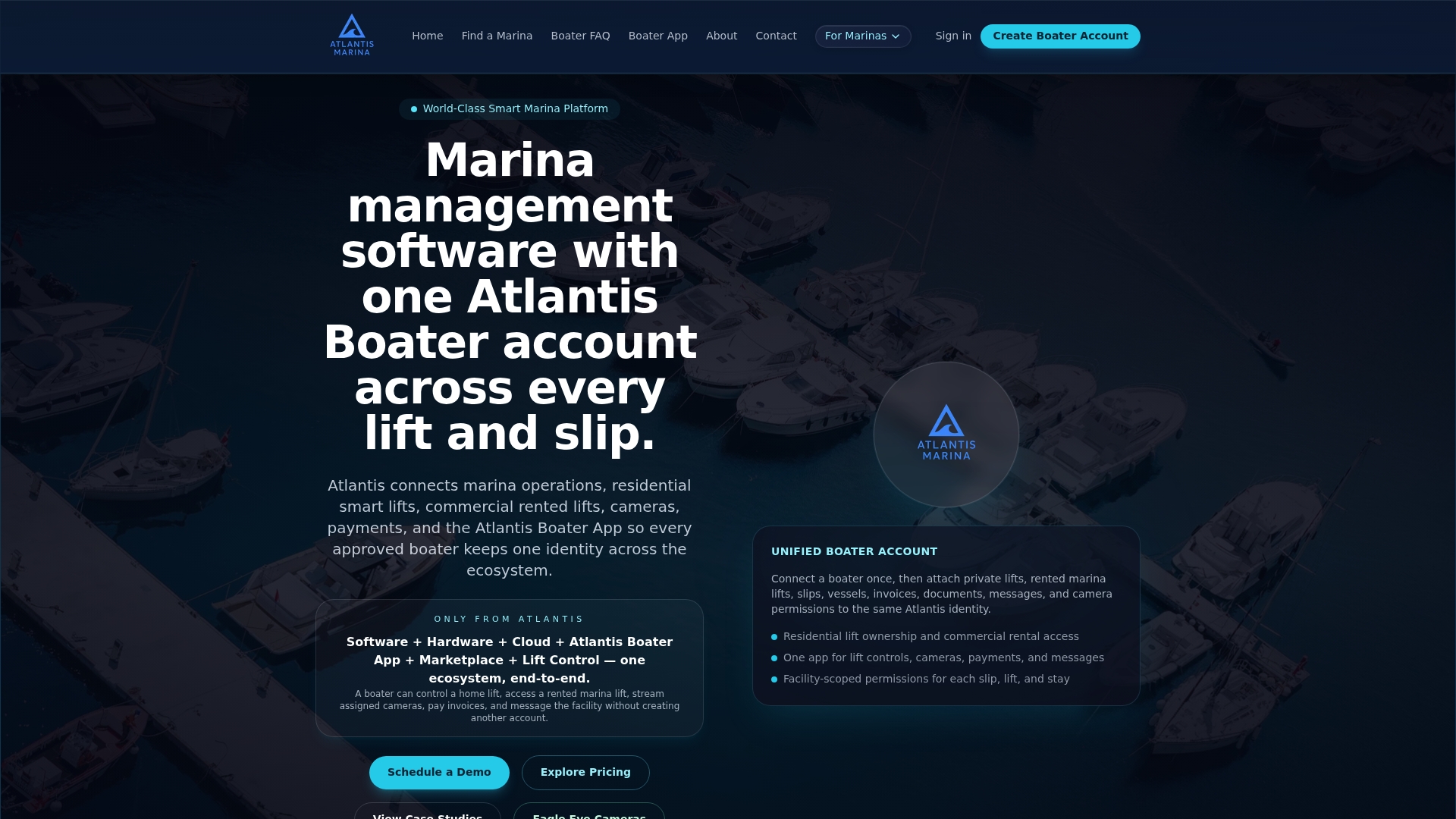
The platform covers the full operational cycle: online slip reservations that embed directly into your existing website, recurring billing and payment processing for dues and utility charges, and a member-facing portal for document uploads and service requests. Atlantis-marina also integrates smart marina hardware, including boat lift controllers and camera monitoring, into the same operational dashboard. For marina owners ready to move beyond fragmented workflows, the marina management software overview covers features, deployment options, and pricing in detail.
FAQ
What is a cloud-based yacht club platform?
A cloud-based yacht club platform is an online software system that centralizes member management, slip reservations, billing, and communications into one web-accessible tool. Platforms like Clubessential, ClubSoft, and SailHQ are established examples of this category.
How does cloud yacht club software handle billing?
Most platforms support recurring charges, invoicing, card payments, and direct debit, often integrated with payment gateways like Stripe or accounting tools like QuickBooks. The most effective systems link membership status changes directly to billing updates to prevent revenue gaps.
What governance features should a yacht club platform include?
A platform should support role-based permissions that restrict access by function, such as separate roles for sailing committees, house committees, and treasurers. Audit logs that record who made each change are equally important for accountability and dispute resolution.
Can small marinas use a cloud-based yacht club management system?
Yes. Most platforms, including Anny and ClubSoft, are designed to scale from small independent marinas to large multi-property operations. The key is selecting a platform whose administrative complexity matches your current size while allowing room to grow.
How long does it take to implement a yacht club management system?
Implementation timelines vary by platform and club complexity, but most clubs complete initial setup within two to six weeks. Clubs that configure membership categories and billing rules before going live consistently report faster adoption and fewer post-launch errors.