

What is a boater self-service portal?
A boater self-service portal is a web or mobile platform that lets boaters manage their marina relationship entirely online, without calling the dock office or waiting for staff to process paperwork. Boaters can reserve slips, upload insurance documents, sign contracts, make payments, and message staff from one account. On the marina side, that same account feeds directly into reservations, billing, and vessel records, so staff see everything in real time.
The core purpose is two-sided efficiency. Boaters get 24/7 access to their marina services. Staff stop fielding routine calls and chasing down signatures. Platforms like Atlantis Marina connect the boater-facing portal to billing automation, smart hardware, and an operations dashboard, making the portal a genuine operational hub rather than a simple contact form.
Key functions a boater self-service portal typically covers:
- Slip reservation requests and waitlist management
- Vessel record submission and updates
- Insurance and registration document uploads
- Electronic contract signing
- Online payment processing and billing history
- Direct messaging with marina staff
- Real-time reservation and account status
Key benefits of boater self-service portals for marina operators and staff
Portals do more than save time. They change the daily rhythm of marina operations in ways that compound over a season.
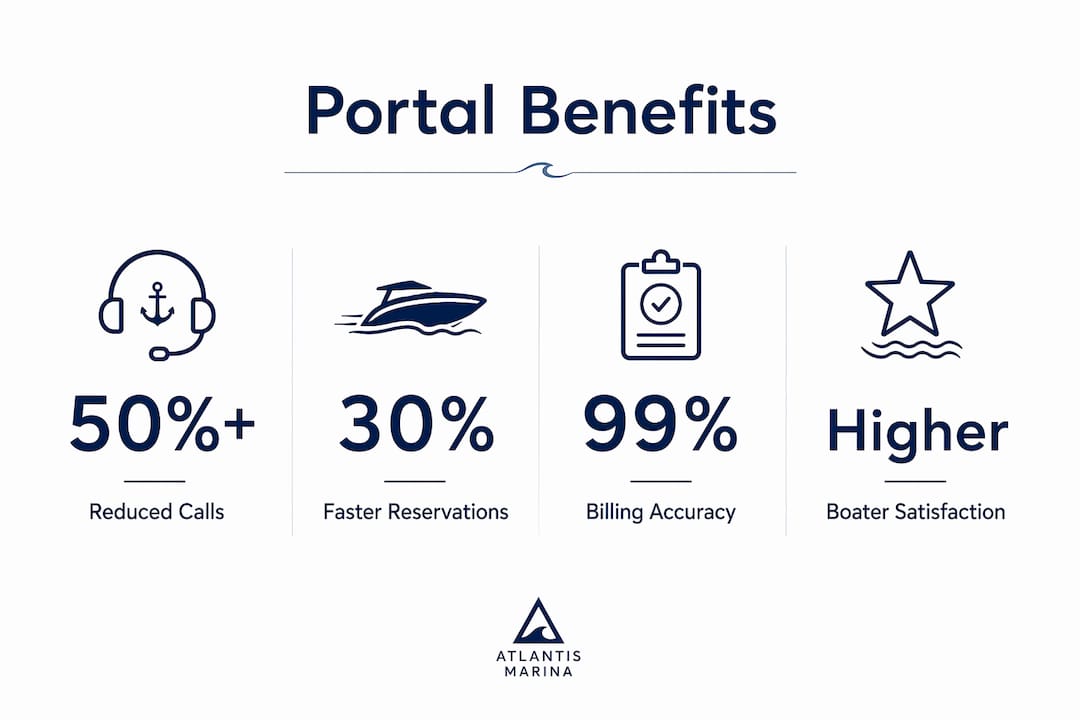
Reduced inbound volume. When boaters can check their reservation status, pay invoices, and upload documents themselves, call and email volume drops sharply for marine service teams. Staff reclaim hours that previously went to answering the same questions repeatedly.
Faster slip reservations. Online reservation requests move through a defined workflow instead of waiting for a dockmaster to be available by phone. That speed matters most during peak season when every slip counts.
Improved billing accuracy. Connecting the portal to payment processors like Stripe and ACH, with QuickBooks Online sync, reduces manual entry errors and keeps revenue collection on schedule. Atlantis Marina's billing automation handles autopay, Instant Pay, refunds, and adjustments without staff touching each transaction.
Better boater satisfaction. Boaters increasingly expect the same digital convenience from their marina that they get from airlines or hotels. A portal that works well at 10 PM on a Saturday keeps customers happy without requiring after-hours staff.

Operational transparency. Real-time updates flow both ways. Staff see document uploads and payment confirmations as they happen. Boaters see their reservation confirmed without waiting for a callback.
Core features of a boater self-service portal
The feature set separates a capable portal from a basic contact page. A well-built portal covers the full boater lifecycle from first inquiry through annual renewal.
- Slip reservation and waitlist management: Boaters submit requests online; staff approve or adjust from the dashboard.
- Digital contract signing: Atlantis E-Sign lets boaters execute agreements electronically, eliminating printed paperwork.
- Online payments: Stripe, ACH, autopay, and Instant Pay give boaters flexible options while keeping collections automated.
- Document uploads: Insurance certificates, vessel registration, and photos go directly into the boater's account record.
- Service request submissions: Boaters log maintenance needs or requests without calling the office.
- Two-way messaging: Direct communication between boaters and staff stays logged in the platform.
- AI assistant support: Atlantis Bot answers boater questions on marina websites and supports staff with reservation and billing inquiries, reducing the load on front-desk teams.
| Feature | Operational Benefit | Atlantis Marina Capability |
|---|---|---|
| Slip reservations online | Faster processing, fewer phone calls | Reservation and waitlist management |
| Electronic contract signing | No paper, instant execution | Atlantis E-Sign |
| Stripe and ACH payments | Reduced billing errors, faster collection | Autopay, Instant Pay, QuickBooks sync |
| Document uploads | Centralized records, audit-ready | Vessel and insurance document storage |
| AI assistant | 24/7 boater support, less staff interruption | Atlantis Bot |
| QR-code check-in | Instant account access, no manual search | Account QR codes and digital passes |
Security and privacy are built into the architecture. User authentication protects account access, and data handling follows standard cloud security practices for financial and personal information.
How implementing a boater portal reduces administrative workload for marina staff
The administrative reduction from a portal is most visible in three areas: billing, document handling, and status communication.
Manual invoice collection by phone disappears when autopay and online payment are active. Dockmasters stop tracking down boaters for signatures when contracts route through an electronic signing workflow. Status update calls drop when boaters can log in and see their reservation confirmed or their document approved.
Key workload reductions marina teams typically see after portal adoption:
- Elimination of paper intake forms and manual data re-entry
- Fewer inbound calls for payment status, reservation confirmation, and document questions
- Automated billing reminders replacing manual follow-up
- Digital maintenance request logs replacing verbal or handwritten notes
- Real-time messaging replacing back-and-forth phone tag
Atlantis Marina's operations dashboard consolidates reservations, billing, maintenance tracking, messaging, analytics, and daily tasks in one place, so dockmasters manage the full day from a single screen rather than switching between spreadsheets and phone logs.
Pro Tip: Run a two-week pilot with a subset of returning boaters before full rollout. Their feedback on the portal flow will surface friction points before the busy season, and their familiarity with the system makes them informal advocates with newer customers.
How boater portals connect with smart marina technology
A portal that only handles paperwork is useful. One that connects to physical marina infrastructure is a different category of tool entirely.
Atlantis Marina links the boater portal to smart boat lift controllers, sensor and camera security systems, mobile alerts, and access control workflows. Staff receive alerts on their phones when a lift is activated or a sensor triggers, and those events tie back to the relevant vessel and account record. QR-code workflows connect in-person interactions to digital accounts instantly, so a boater scanning their account code at the dock completes check-in, POS purchases, or service interactions without staff searching manually for the record.
Smart technology integration benefits for marina operations:
- Remote monitoring of boat lifts and AUX devices from mobile
- Camera and sensor alerts linked to specific vessel accounts
- QR-code check-in reducing front-desk congestion
- Access control workflows tied to reservation status
- Mobile alerts keeping staff informed without requiring them to be on-site
The result is a marina where the physical and digital layers talk to each other, and staff spend less time running between systems to piece together what is happening on the water.
What boater self-service portal platforms look like in practice
The boater self-service portal category has grown as marinas modernize. Platforms range from standalone customer portals focused on service requests and communication to fully integrated marina management systems where the boater portal is one layer of a broader operational platform.
Atlantis Marina sits in the integrated category. The Atlantis Boater App and web portal give boaters access to slip discovery through Atlantis Marina Search, online reservations, document management, payments, and staff messaging, all connected to the same platform staff use for daily operations. America's Boating Club runs a member portal at portal.americasboatingclub.org for member account management and course registration, showing how boating organizations use portals for member services beyond slip management.
The practical difference between portal types shows up in data flow. A standalone portal collects information but requires staff to transfer it into a separate management system. An integrated platform like Atlantis Marina writes boater submissions directly into the operational record, eliminating that manual transfer step.
How boater portal design affects the experience for boaters
A portal that works technically but frustrates boaters on mobile will see low adoption, which defeats the purpose for marina staff. Accessibility and ease of use determine whether boaters actually use the self-service tools or call the office anyway.
Atlantis Marina's Boater App is built for both web and mobile, so boaters manage their account from a phone at the dock or a laptop at home with equal ease. Email and SMS notifications keep boaters informed without requiring them to log in to check status. Account QR codes and digital passes give boaters a physical-world touchpoint that connects instantly to their digital record, which matters for boaters who are less comfortable navigating apps.
Language clarity, logical navigation, and fast load times on mobile are the practical factors that separate portals with strong adoption from those that get ignored after the first login.
Challenges and limitations marina operators should plan for
Adopting a boater portal solves real problems, but the transition requires planning. The most common friction points are not technical.
Boater adoption takes time. Some long-term customers prefer phone calls and will need encouragement to shift. Clear communication about what the portal does and why it is easier helps, but expect a ramp-up period rather than immediate full adoption.
Data migration from legacy systems can be labor-intensive. Vessel records, billing history, and contact information stored in spreadsheets or older software need to move into the new platform accurately before the portal goes live.
Staff training matters as much as boater onboarding. If staff are not confident using the operations side of the platform, they cannot support boaters who have questions. Allocating training time before launch prevents confusion during the busy season.
Connectivity at the dock can be a limitation for smart hardware integrations. Marinas with inconsistent Wi-Fi coverage may need infrastructure upgrades to get full value from sensor and camera integrations.
Atlantis Marina gives your marina a complete digital operations platform
Atlantis Marina is the direct path from manual marina operations to a fully connected digital waterfront. Where most portals handle one piece of the workflow, Atlantis Marina covers the entire operation: boater self-service, billing automation, smart hardware integration, AI-assisted support, and a staff operations dashboard in one cloud-based platform.
For marina operators who are tired of managing reservations in spreadsheets, chasing invoice payments by phone, and manually pulling up vessel records at check-in, Atlantis Marina replaces all of it. The Atlantis Boater App gives your customers a modern digital experience while your team runs the dock from a single connected dashboard. Pricing is available at atlantis-marina.com/pricing, and you can see the full platform at atlantis-marina.com/sales.
FAQ
What is a boater self-service portal?
A boater self-service portal is a web or mobile platform where boaters manage slip reservations, payments, documents, and marina communication online without contacting staff directly.
How does a boater portal reduce work for marina staff?
Portals cut administrative tasks by automating invoice collection, document intake, and status updates, reducing calls, emails, and paper forms for marine service teams.
What features should a boater portal include?
Core features include online slip reservations, electronic contract signing, payment processing, document uploads, service request submission, and two-way messaging with staff.
How does Atlantis Marina's portal connect to smart marina hardware?
Atlantis Marina links the boater portal to smart boat lift controllers, sensor and camera systems, QR-code check-in workflows, and mobile alerts, connecting digital accounts to physical marina infrastructure.
Can boaters use the portal on a mobile device?
Yes. Platforms like the Atlantis Boater App are built for both web and mobile, with email and SMS notifications keeping boaters informed whether they are at the dock or at home.
Key Takeaways
A boater self-service portal replaces manual marina workflows with a digital platform that connects boater accounts, billing, reservations, and smart hardware in one system.
| Point | Details |
|---|---|
| Definition and purpose | A boater portal lets boaters manage reservations, payments, and documents online, reducing staff workload. |
| Administrative reduction | Portals cut calls, emails, and paper forms by automating billing, document intake, and status updates. |
| Core feature set | Effective portals include e-signing, Stripe and ACH payments, document uploads, messaging, and AI support. |
| Smart technology connection | Linking portals to boat lifts, sensors, and QR-code workflows creates a fully connected marina operation. |
| Atlantis Marina | Atlantis Marina delivers an integrated boater portal, billing automation, AI assistant, and smart hardware in one cloud platform. |