
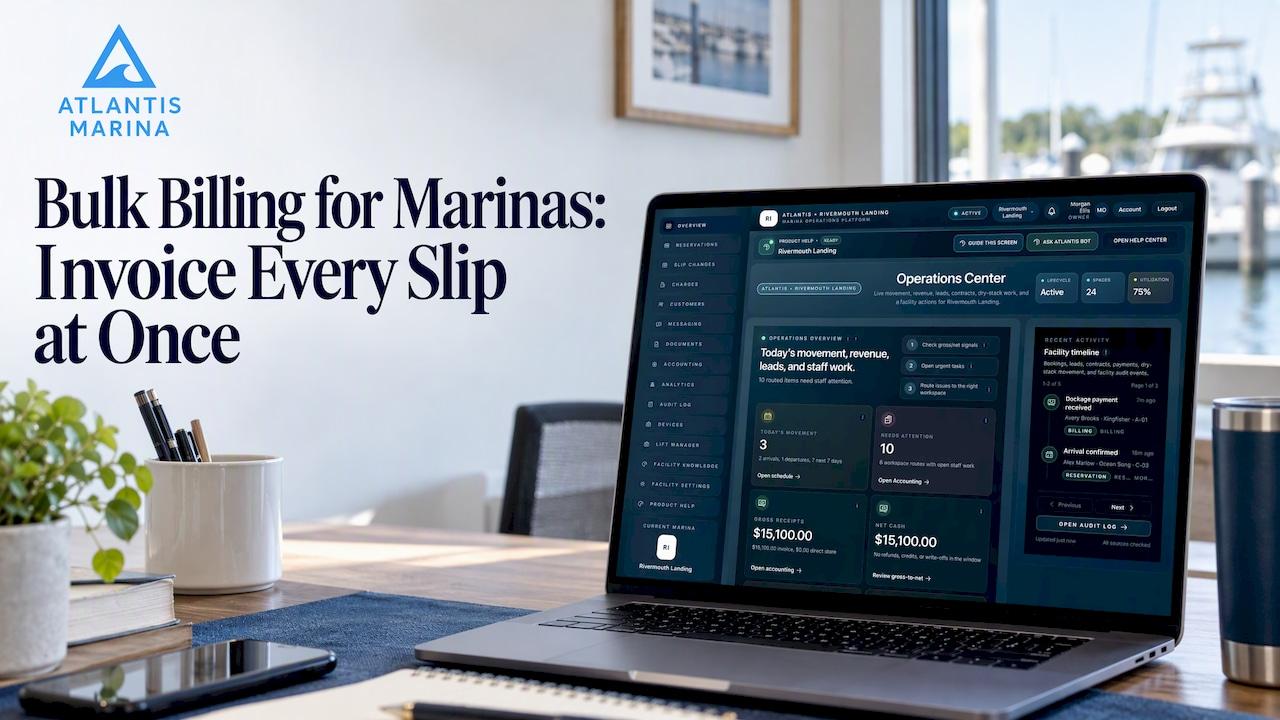
Bulk billing for a marina means billing every slip holder, dry stack customer and service account in one controlled run, not one invoice at a time. Done well, it combines recurring charges, automatic payment collection and accounting sync, so the office stops rekeying the same data each month. This guide covers how it works, where it breaks, and how to set it up.
A quick note on the term. Search results for "bulk billing" are dominated by medical clinics, where it means something unrelated. Here we mean marina operations: batch invoicing, recurring charges and automated collection.
TL;DR
- Bulk billing in a marina is a repeatable run: recurring slip and storage charges, plus variable items such as utilities, fuel and service, billed together and collected automatically.
- The biggest gains come from three habits: contracts that define the charges up front, autopay on file, and ACH for large recurring rent.
- Clean records matter more than software. Every vessel, contract and account needs to be accurate before a run goes out.
- Atlantis Marina automates billing end to end: e-signed contracts, autopay, Instant Pay, Stripe and ACH processing, refunds and adjustments, and QuickBooks Online sync.
- Plans start at $150 per month, with a 3% platform fee per transaction on digital payments.
Table of Contents
- What bulk billing means on a marina
- Why manual billing costs a marina more than time
- The anatomy of a clean billing run
- ACH, cards and what each costs you
- Variable charges: utilities, fuel and service
- Common bulk billing mistakes
- How Atlantis Marina handles billing
- What it costs
- Our perspective: billing is a records problem first
- A practical rollout plan
- Frequently asked questions
- Sources
What bulk billing means on a marina
A marina does not sell one product. A single customer can owe seasonal slip rent, a metered electric charge, a pump-out, a lift launch, a ship store purchase and a service ticket, all in the same month. Bulk billing is the discipline of generating all of those charges for all customers on a schedule, reviewing them once, and sending them out together.
In practice that covers four kinds of charges:
| Charge type | Pattern | Billing approach |
|---|---|---|
| Seasonal or annual slip rent | Fixed, recurring | Contract-driven schedule, autopay or ACH |
| Dry stack or storage | Fixed or tiered, recurring | Recurring plan tied to the vessel record |
| Utilities and fuel | Variable, monthly | Usage posted, then added to the next run |
| Service, ship store, launches | One-off, event-driven | Billed at the point of sale or added to the account |
The fixed items are the easy win. The variable items are where errors come from, because someone has to capture the usage and attach it to the right account.
Why manual billing costs a marina more than time
Manual monthly billing has a visible cost, the staff hours, and a hidden one: late and disputed payments. When invoices go out on different days, in different formats, to customers who have no easy way to pay, collections stretch out.
The revenue at stake is not small. In a fall 2025 conference presentation to harbormasters, the average yearly slip price was reported at $3,908, and the average service bill at $838.09. Multiply either figure by a few hundred customers and a missed or late cycle becomes a cash-flow problem, not an admin annoyance.
The same presentation noted that 19.09% of service bills include additional fees. Add-on fees are exactly the kind of charge that gets forgotten in a hand-built invoice run.
The anatomy of a clean billing run
A reliable run has five parts. Skip one and the rest get harder.

1. Accurate vessel and customer records
Every charge needs an owner and a vessel. If a boat changed hands in June and the record still shows the old owner, the invoice goes to the wrong person. Before automating anything, audit your vessel records, contact details and slip assignments.
2. A contract that defines the charges
Recurring billing works when the contract states the rent, the schedule, the late-fee rule and what gets billed on top. Contracts signed electronically are stored against the customer account, so staff can see what was agreed when a question comes up. In Atlantis Marina, contracts are signed with Atlantis E-Sign and live with the customer's documents.
3. A payment method on file
An invoice that nobody has to act on gets paid on time. Autopay removes the monthly decision. For customers who prefer to pay manually, a portal with a clear balance and a pay button comes next best.
4. A review step before release
Bulk does not mean blind. A short review of the run, covering new accounts, changed rates and unusual usage, catches the mistakes that cost the most to fix after the fact.
5. Reconciliation into your books
If the billing run still ends with someone keying totals into accounting software, you have automated only half the job. Sync is what closes the loop.
ACH, cards and what each costs you
Slip rent is large, predictable and repeating, so the payment method you steer customers toward matters. Card payments are convenient, but on a large seasonal charge the processing cost adds up. ACH bank transfers are typically cheaper on big recurring amounts, which is why many operators offer ACH as the default for annual and seasonal contracts and keep cards for smaller or one-off charges.
Platforms differ in how they pass fees along, so read the fee schedule before you commit. With Atlantis Marina, digital payments carry a 3% platform fee per transaction, and payments run through Stripe and ACH processing. Check your own mix of card and ACH volume against that figure when you model costs, and decide whether your terms pass any fee to the customer. Confirm the rules for surcharging in your state and with your card network before you add one.
Variable charges: utilities, fuel and service
Fixed rent is simple. The harder question is how to bring variable charges into the same run.
- Utilities: Decide whether electric and water are included in the slip rate or billed on usage. If billed on usage, you need reliable readings each cycle. Manual readings are slow and prone to error, which is why many marinas move to connected monitoring.
- Fuel: Fuel dock sales are best billed at the point of sale for transient customers, and added to the account for members on a house account.
- Service and lifts: Tie each work order to the vessel and the account so the charge lands in the next run without retyping.
Atlantis Marina offers utility monitoring and automated fuel operations as add-ons, so these charges can feed the same system that bills the slip. Pricing is listed on the pricing page: utility monitoring at $30 to $150 per month, and automated fuel operations at $50 per month.
Common bulk billing mistakes
- Billing from stale records. A wrong owner or slip assignment creates disputes that take longer to resolve than the billing run saved.
- No documented late-fee rule. If it is not in the contract, enforcing it becomes a negotiation.
- Running monthly cycles without a review. One wrong rate can repeat across dozens of accounts.
- Keeping accounting separate. Double entry invites reconciliation errors at month end.
- Ignoring refunds and adjustments. Credits for a canceled stay or a billing error need a clean trail, not a spreadsheet.
How Atlantis Marina handles billing
Billing in Atlantis Marina is part of the same marina management platform that holds your slip assignments, reservations, waitlists, vessel records and customer accounts. That matters because the billing run draws on the same records staff already maintain, so there is less to reconcile.
The billing side includes:
- Contracts signed with Atlantis E-Sign
- Autopay for recurring charges
- Instant Pay for fast, direct payment
- Stripe and ACH payment processing
- Refunds and adjustments
- QuickBooks Online sync, so revenue is billed, collected and booked without manual entry
Boaters see their balance and pay through the Atlantis Boater App and web portal. They can also upload insurance and registration documents, review reservations, message staff and receive email and SMS updates from one account. For a dockmaster, that means fewer calls asking what is owed and where to send a check.
For marinas that run dry stack, the platform handles storage and launch queues, and a dry-stack operations add-on is listed at $79 to $299 per month. Marinas with powered lifts can also connect smart boat lift control to the same system, with premium smart lift automation listed at $1 per month per lift.
What it costs
Atlantis Marina plans are tiered by marina size, as published on the pricing page:
| Plan | Price |
|---|---|
| Micro | $150 per month |
| Small | $300 per month |
| Medium | $500 per month |
| Large | $900 per month |
| Enterprise | No published price |
Setup is a one-off fee between $100 and $1,000. Digital payments carry a 3% platform fee per transaction. Optional add-ons include Eagle Eye smart cameras and utility monitoring (each $30 to $150 per month), the dry-stack operations add-on ($79 to $299 per month) and automated fuel operations ($50 per month).
To judge the real cost, add up your monthly plan price and the platform fee on your expected digital volume, then compare that to the staff hours and late payments your current process consumes.

Our perspective: billing is a records problem first
We see marinas arrive with the same assumption: that billing is a payments problem. Usually it is a records problem. When a vessel, a contract, a slip and a payment method all live in different places, even a good payment processor cannot save the month-end close.
That is why we built billing inside the same system as slips, reservations, documents and customer accounts, not beside it. A reservation creates the charge. The signed contract defines it. The customer's stored payment method collects it. QuickBooks Online receives it. Each step reads from the step before, so nobody retypes anything.
Our advice for any marina, with us or not: start by cleaning your vessel and customer records, write your late-fee and refund rules into the contract, and move large recurring rent to ACH. Then automate. The order matters.
— John R
A practical rollout plan
- Audit records. Match every active slip and storage space to a current owner, vessel and contact.
- Standardize rate cards. List every recurring and variable charge, with its schedule.
- Update contracts. Include payment terms, late fees, refund rules and which charges are billed on top of rent.
- Collect payment methods. Ask customers to enroll in autopay or ACH at contract signing, not later.
- Run one cycle in parallel. Compare the automated run to your manual one and fix the differences.
- Connect accounting. Turn on sync so totals reach the books without keying.
- Review monthly. Check exceptions, failed payments and adjustments before each release.
If you want to see the workflow in practice, explore the platform overview or look at our full pricing and plan details to match a plan to your marina size.
Frequently asked questions
What does bulk billing mean for a marina?
It means generating and sending charges for many customers in a single scheduled run, instead of invoicing each account individually. It typically covers recurring slip and storage rent, plus variable charges such as utilities, fuel and service. The goal is consistent timing, fewer errors and faster collection.
Is bulk billing the same as autopay?
No. Bulk billing is how charges are created and sent. Autopay is how they are collected, using a payment method the customer has stored. The two work best together, because a billing run with autopay needs far less follow-up.
Can I bill utilities and fuel in the same run as slip rent?
Yes, if usage is captured in the same system that holds the account. The weak point is data capture, not billing. Connected utility monitoring and fuel operations reduce manual readings and keep the charges attached to the right vessel.
Does Atlantis Marina sync with QuickBooks?
Yes. Atlantis Marina syncs with QuickBooks Online, so billed and collected revenue is booked without manual entry. Refunds and adjustments are handled in the platform as well.
How much does Atlantis Marina cost?
Plans run from $150 per month for Micro to $900 per month for Large, with Enterprise priced on request. Setup is a one-off $100 to $1,000, and digital payments carry a 3% platform fee per transaction. Details are on the pricing page.