
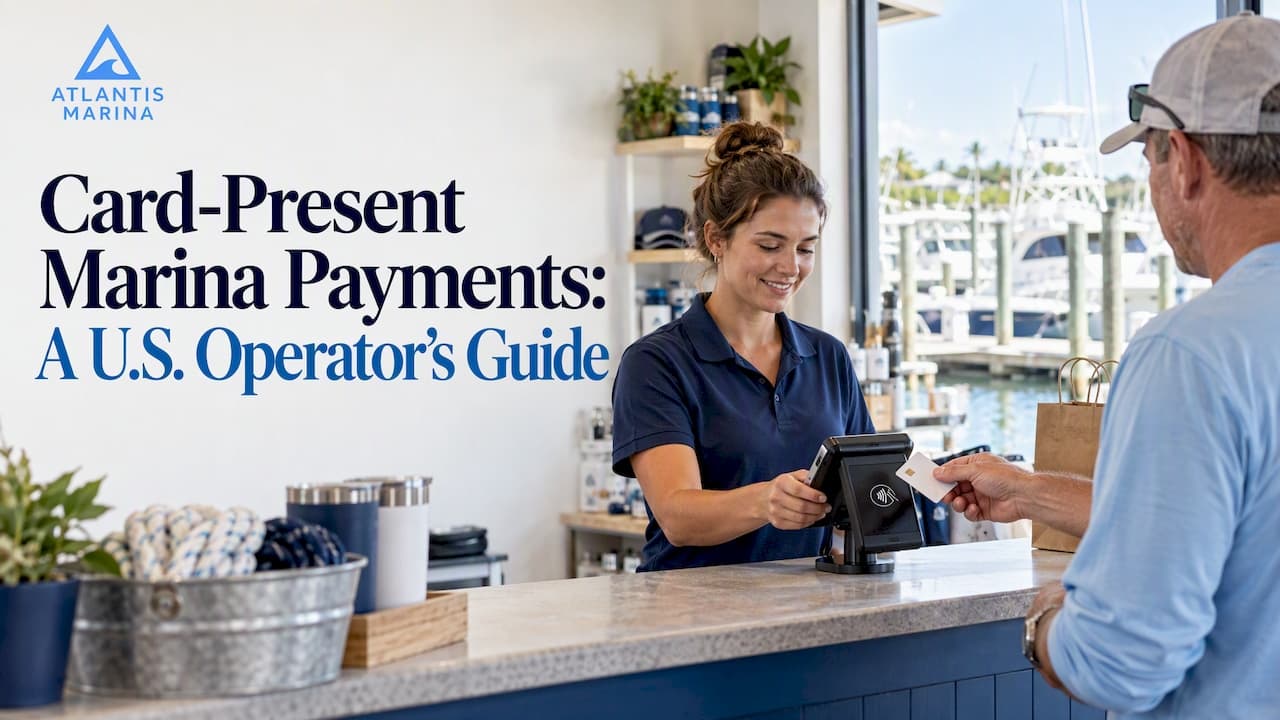
A card-present marina payment is one where the boater and the physical card, or a phone or watch holding a digital version of it, are at your terminal and the card's chip or contactless data is read electronically. Everything else, such as a reservation deposit paid online, a card read over the phone or a card on file charged in November, is card-not-present. The distinction matters because it sets your fraud exposure, your chargeback liability and usually your processing cost. This guide shows where each marina transaction falls and how to set up your fuel dock, ship store, office and dock walks.
TL;DR
- Card-present means the cardholder and card are at the point of sale and the card data is read by chip, tap or mobile wallet. A card keyed in by hand does not qualify, even with the card in your hand.
- Card-present payments generally cost less and carry less fraud and dispute risk than card-not-present payments. Merchants carry the liability for card-not-present losses.
- At a marina, the same boater can be card-present at the ship store at noon and card-not-present when autopay charges a slip invoice that night. Each channel needs its own setup.
- EMV-capable terminals, including the fuel dock, are how you avoid taking on counterfeit-card liability.
- One platform that ties the ship store, billing, card on file and QR workflows to a single customer account keeps both kinds of payment organized.
Table of Contents
- What card-present means at a marina
- Where each marina transaction falls
- How card-present and card-not-present differ on cost, fraud and liability
- Setting up card-present acceptance at each point of sale
- Handling the card-not-present side well
- Our perspective: one customer, one account, many payment types
- See how Atlantis handles dock, store and online payments
- FAQ
- Sources
What card-present means at a marina
The card networks and processors use a simple definition: a card-present transaction happens when the cardholder and the payment card are physically present at the point of sale. A card-not-present transaction happens when the cardholder does not present the card at the time of payment, as in online, phone or mail orders.
Two details trip up operators.
Keyed entry is not card-present. If your dockhand types a card number into a terminal while the boater stands there holding the card, it does not qualify as a card-present transaction, because the electronic data stored on the card was never captured. Processors treat it as a higher-risk, higher-cost transaction.
The channel matters, not the customer. Visa treats an in-store Apple Pay payment as card-present and an in-app Apple Pay payment as card-not-present. The same logic applies to a boater who opens your web portal to pay a bill from the boat: the wallet is the same, but the transaction is not card-present.

Which in-person methods count
Chip cards (dips), contactless cards (taps) and mobile wallets such as Apple Pay and Google Pay all count as card-present when presented at a physical terminal. Swiping a magnetic stripe also reads the card in person, but it leaves you exposed on liability, as covered below.
Where each marina transaction falls
Marinas have an unusually mixed revenue picture. A single customer may generate every type of payment in one season. This table maps the common ones.
| Marina transaction | Typical channel | Card-present? | What to watch |
|---|---|---|---|
| Ship store sale at the counter | Chip, tap or wallet at a terminal | Yes | Keep the terminal EMV and contactless enabled |
| Fuel dock sale, attended | Terminal at the dock | Yes | Dock weather and glare; keep the reader protected |
| Fuel dock sale, unattended pump | Automated fuel dispenser | Yes, if chip or tap is read | Fuel dispensers had later EMV deadlines than other terminals |
| Transient slip paid on arrival at the office | Terminal | Yes | Do not key in the card if the chip reader fails without a fallback plan |
| Transient slip reserved online | Web portal or app | No | Collect AVS and security code, confirm identity at check-in |
| Seasonal slip invoice charged by autopay | Card on file | No | Written authorization and clear descriptor |
| Phone payment to the office | Staff keys card | No | Highest-risk, highest-cost route; steer boaters to the portal |
| Haul-out or service balance paid at pickup | Terminal | Yes | Match the payment to the work order |
| Rent routed to ACH | Bank transfer | Not a card payment | Avoids card cost altogether |
The last row matters. Not every payment should be a card payment. Large seasonal contracts are often cheaper to collect by bank transfer, and we cover that approach in our guide to routing rent to ACH with split tender payments.
How card-present and card-not-present differ on cost, fraud and liability
Fees
Card-present transactions typically have lower processing fees and lower fraud risk, while card-not-present transactions carry higher fees and are more prone to disputes and chargebacks. The exact gap depends on your processor, your pricing model and the card type, so check your merchant statement for the qualification categories your processor assigns. If a large share of your in-person volume shows up as keyed or non-qualified, that is money you can recover by fixing your terminals and habits.
Fraud and chargebacks
With a card-present payment, you can see the card, read the chip and, where required, verify the cardholder. That is the security advantage of being there in person. Remote payments lack it. Card-not-present transactions, including mail order, telephone order and e-commerce, are considered high risk, and merchants are liable for chargebacks and losses related to them.
For remote payments, processor guidance recommends using Address Verification Service (AVS) and the card security code (CVV2) to reduce risk. For a marina, that means every online reservation form and every card-on-file enrollment should capture both.
The EMV liability shift
Since October 1, 2015, the party in a counterfeit-card transaction that does not support EMV chip technology generally takes on the liability. For you, that means that if a counterfeit chip card is used at a terminal that cannot read chips, you may be liable for the chargeback. Chip technology also reduces the data fraudsters can steal to counterfeit cards.
Fuel was treated separately. Visa delayed the U.S. liability shift date for automated fuel dispensers because the fuel-industry solutions were not ready. If your marina runs unattended pumps, ask your processor which terminals and chip-enabled readers your dispensers use and whether they are current.
Setting up card-present acceptance at each point of sale
The checklist below works for most U.S. marinas. Walk your property with it once a year.
- Confirm every terminal is EMV-capable and enabled. Your processor can help you upgrade older devices, as the card networks advise.
- Turn on contactless and mobile wallets. Boaters who arrive in wet weather with a phone in a pocket will tap before they dig out a wallet. Accepting a broad range of in-person payment methods shortens lines at the fuel dock.
- Ban keyed entry as a default. Allow it only as a documented fallback when a chip is damaged, and have a manager review those sales.
- Separate the fuel dock. Fuel has its own pre-authorization behavior and its own terminal requirements. Confirm settings with your processor.
- Protect the hardware. Sun, spray, and dropped devices cause most outages. Keep a spare reader and a cellular or backup connection on the dock.
- Tie each payment to the customer account. A payment made in person should land in the same customer record as the slip contract and the fuel tab, so staff never reconcile three systems.
Ship store and service counters
The store is where card-present volume is highest and where speed matters. A marina ship store POS that works from the same customer and vessel records as your billing lets staff charge a part to a slip account or take a card at the counter without re-entering anything. If you are weighing options, our write-up of ship store POS software alternatives covers what to compare by type of system.

Dock walks and mobile payments
Marinas that collect on the dock, at haul-out or at the launch ramp need a way to take a payment away from the office. QR-based flows let the boater pay from their own phone, which is a digital payment, so confirm with your processor how it is classified. Our support article explains how to use QR scan pass and QR payment workflows.
Handling the card-not-present side well
A marina cannot go fully card-present. Reservations happen online, seasonal contracts renew in the off-season and boaters pay from home. The goal is to make those payments safe and well documented.
- Do not charge before you deliver. Card-network guidance for processors says merchants should not submit a card-not-present transaction until the goods have shipped or the service has been provided, with exceptions for custom-made goods where billing was disclosed. For a marina, this is why deposit and cancellation terms must be spelled out at booking. Treat that as a reason to have your policy reviewed by your processor or counsel.
- Collect the right data. Billing address, security code and a clear signed agreement are your defense in a dispute.
- Use card on file correctly. Get clear consent, show the amount and schedule, and notify before each charge. Our seven-step guide to card on file for U.S. marinas walks through the workflow.
- Mind surcharging rules. Passing card costs on to boaters is regulated by card brands and by state. Read our overview of credit card surcharge rules before adding a line to a receipt.
- Layer your fraud controls. Our post on marina payment fraud prevention with EMV 3DS, tokenization and QR-linked receipts covers the online side in depth.
Card data security applies to both channels. Our guide to PCI compliance for marinas explains what operators need to do on the dock and in the office.
Our perspective: one customer, one account, many payment types
Most marina payment problems we hear about are not about the terminal. They are about fragmentation. The fuel dock runs on one system, the store on another, slip billing in a spreadsheet or a separate accounting tool, and the boater who paid a deposit online is a stranger at the counter. Each seam creates a manual entry, and each manual entry is a chance for a keyed card, a missed charge or a disputed bill.
Our view is that a marina should treat card-present and card-not-present as two doors into the same customer account. A tap at the store, a QR payment on the dock, an autopay charge on a seasonal invoice and an ACH payment for rent should all post to one record, then flow into your books. That is how Atlantis Marina is built: one cloud platform covering slips, reservations, ship store POS, billing, Stripe and ACH processing, and QuickBooks Online sync, with the same boater account visible to staff everywhere.
The practical rule we give operators: push as many payments as possible into the cheapest, lowest-risk route that suits the transaction. Counter and dock sales go card-present. Large recurring charges go to ACH. Everything remote carries full data capture and a clear authorization. Review your processor statement quarterly to see where the exceptions are creeping in.
— John R
See how Atlantis handles dock, store and online payments
Atlantis Marina brings marina billing, ship store POS, boater self-service and automated payments into one system, so in-person and remote payments land in the same customer record. Plans are priced by marina size, from Micro at $150 per month to Large at $900 per month, and Enterprise is available on request. See Atlantis pricing or explore marina billing software to see how it fits your operation.

Want to see it working? Watch the product films and walkthroughs, or look at how Diversified Yacht Services Marina in Fort Myers Beach, FL runs on Atlantis.
FAQ
Is a keyed-in card at the marina office card-present?
No. Even if the boater is standing in front of you with the card, a manually keyed transaction does not count as card-present, because the card's electronic data was not captured. Expect higher cost and more liability. Use the chip or tap whenever you can.
Does Apple Pay count as card-present?
It depends on where it is used. An in-store tap at your terminal is card-present, while the same wallet used inside an app or web portal is card-not-present under Visa's rules. The channel, not the payment brand, decides.
Who pays if a boater disputes a card-not-present charge?
Usually you do. Processor operating guides state that merchants are liable for chargebacks and losses on card-not-present transactions. Strong records, a signed contract and AVS and security-code checks give you the best chance in a dispute.
Do I need EMV terminals at my marina?
Yes, for practical purposes. Since the October 2015 liability shift, a merchant whose terminal cannot read chips can be liable for counterfeit-card chargebacks. Ask your processor about upgrading, and ask separately about your fuel dispensers.
Should seasonal slip rent be paid by card?
Often a bank transfer makes more sense. Large recurring invoices carry the highest card costs, and ACH avoids them. Offer both, and let the boater choose with clear terms.
Sources
- Card-present vs. card-not-present transactions | Stripe
- Card Present vs. Card Not Present, ClubReady
- Card-present transactions and contactless payments, Authorize.net
- State of the Industry Report September 2024, CMSPI
- Operating Guide, Elavon
- Your Payments Acceptance Guide, Hancock Whitney
- Understanding Fraud Liability for EMV Contact and Contactless, U.S. Payments Forum
- EMV chip fact sheet, Mastercard
- U.S. Automated Fuel Dispenser EMV Liability Shift Delayed, Visa