
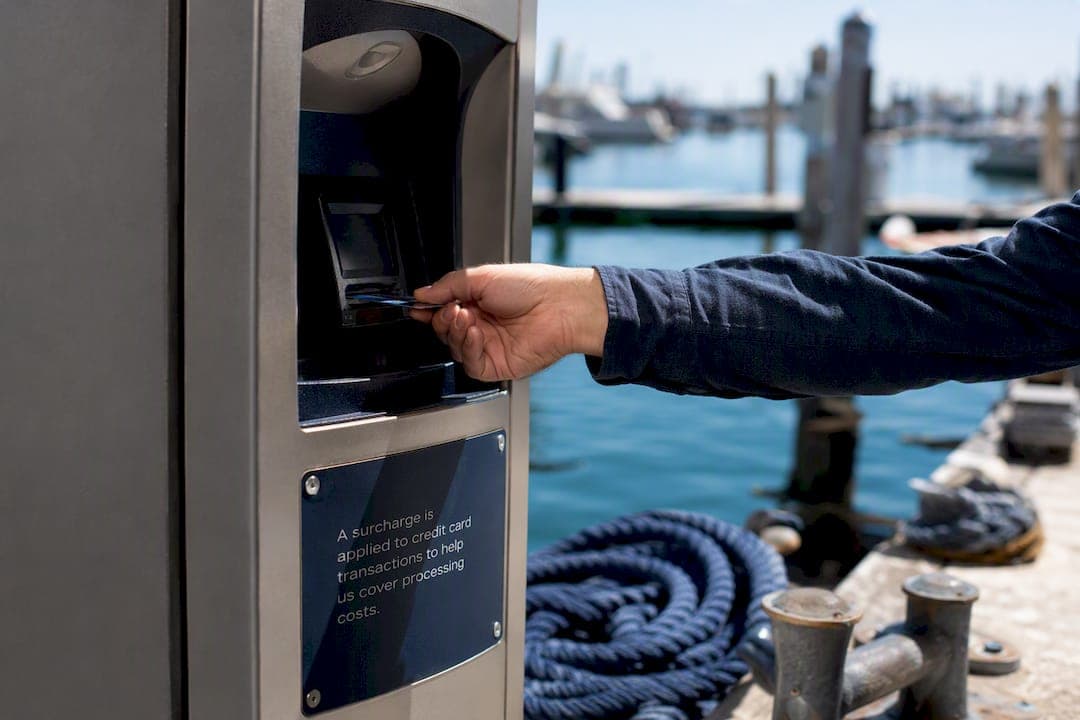
Surcharging credit-card payments is legal in most U.S. states, but not all of them, and the rule of thumb has three parts. You can never surcharge a debit or prepaid card transaction, your surcharge can never exceed the lower of your actual processing cost or the card network's cap, and you must verify your state's specific statute and notify your acquirer at least 30 days before you start. Get any one of those three wrong and you're looking at acquirer fines, network penalties, or a deceptive-practices complaint.
TL;DR:
- Merchants must ensure their surcharge does not exceed their actual processing rate or the card network's cap, which is 3% for Visa and 4% for Mastercard, whichever is lower.
- State laws vary: some prohibit surcharging outright, others require specific caps or notification steps, and some defer to federal rules, so checking current statutes is essential.
- Proper compliance involves notifying your acquirer 30 days in advance, posting clear signage, itemizing surcharges on receipts, and ensuring you do not surcharge debit or prepaid cards.
- Surcharging is limited to credit cards only; using it on debit or prepaid cards violates card-network rules regardless of state law.
- Alternatives like cash discounts and ACH payments often provide simpler, more flexible options, especially in states with strict surcharging restrictions.
Table of Contents
- What Are Credit Card Surcharge Rules, Exactly?
- Card-Network Rules Every Merchant Must Follow (Visa, Mastercard, AmEx, Discover)
- State Rules at a Glance: A Scannable Reference
- Step-by-Step: Set Up a Compliant Surcharge Program
- How to Calculate a Lawful Surcharge Without Overcharging
- Alternatives to Surcharging: Cash Discounts and Pricing Strategies
- Penalties, Enforcement, and Common Violations to Avoid
- Federal Context: CFPB, TILA, and Statutes That Matter
- Atlantis Marina's View: Marina Payment Best Practices and When to Surcharge
- How Atlantis Marina Handles Payment Fees and Compliance
- Sources
- FAQ
What Are Credit Card Surcharge Rules, Exactly?
Before diving into state-by-state specifics, it helps to separate three terms merchants routinely conflate: surcharges, convenience fees, and cash discounts. Each one carries different legal exposure, different math, and different rules about which card types you can touch.
A surcharge is a fee added specifically to credit-card transactions to offset processing costs. It cannot touch debit or prepaid cards under any circumstance, in any state, for any reason. A convenience fee is a flat or percentage charge for accepting payment through an alternative channel, phone, online portal, or similar, that you wouldn't otherwise offer, and it generally must apply uniformly across all payment types you accept through that channel, not just credit cards. A cash discount works in reverse: you set a higher "regular" price and discount it for cash, check, or ACH payment. Because the discount applies to the payment method rather than adding a penalty to card use, cash discount programs face far less state-level restriction than surcharges do.
The distinction matters operationally, not just semantically:
- Surcharges require card-network notification, disclosure signage, and a strict percentage cap.
- Convenience fees must be tied to a genuine alternative payment channel, not tacked onto your standard checkout.
- Cash discounts can be structured almost anywhere in the country, including states that ban surcharging outright, because the "list price" is the discounted one and the card price is simply the undiscounted price.
Get the labeling wrong on a receipt or in advertised pricing and you risk more than a compliance letter. Several state deceptive-practices statutes treat a mislabeled surcharge as consumer fraud, independent of whether the underlying fee amount was reasonable. That's why the terminology isn't cosmetic. It determines which statute applies to you.
Card-Network Rules Every Merchant Must Follow (Visa, Mastercard, AmEx, Discover)
Card-network rules apply everywhere in the country, regardless of what your state allows, and they're often stricter than people expect. Visa permits surcharging on credit transactions as long as merchants disclose the fee, notify their acquirer, and cap the surcharge at the lower of their actual processing cost or 3%. Mastercard's rules allow surcharging too, subject to a Maximum Surcharge Cap of 4% and a mandatory 30-day notification window before you start charging.
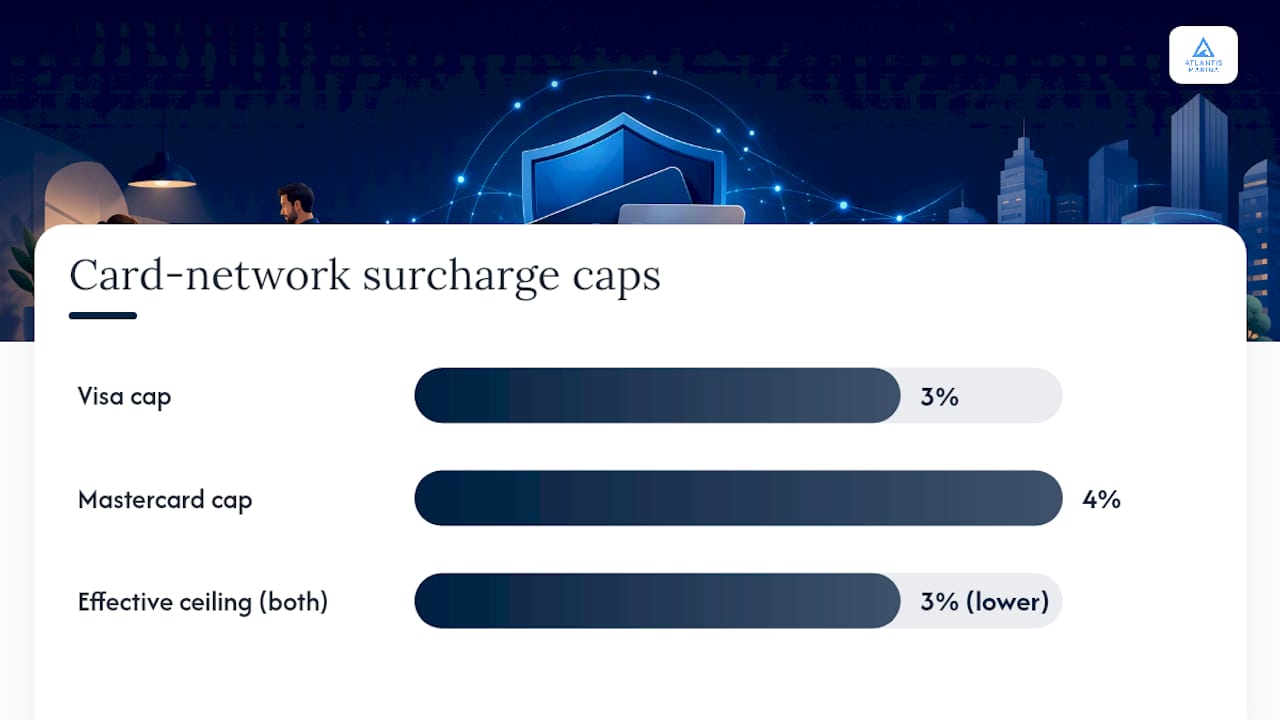
Pro Tip: If you accept both Visa and Mastercard, and most merchants do, your effective ceiling is the lower of the two applicable caps for that transaction, not the higher one. Charging 4% across the board because Mastercard allows it will put you out of compliance on every Visa transaction that runs through your terminal.
Here's what compliance actually requires, step by step:
- Choose brand-level or product-level surcharging. Brand-level means the same percentage across all a network's credit products; product-level lets you vary the rate by card type, but requires more granular disclosure.
- Notify your acquirer at least 30 days before launch. Most processors will handle the network-side notification for you once you confirm intent in writing.
- Enable Field 28 transaction messaging. This is the data field that reports the surcharge amount separately to the network so the transaction reconciles correctly on the back end.
- Post signage at the point of entry and point of sale. Both physical locations and online checkout pages need clear notice before the customer taps or enters a card.
- Itemize the surcharge on the receipt. A bundled total that doesn't break out the surcharge line is one of the most common violations acquirers flag.
Acquirers audit this. Mystery shopping and transaction sampling are standard tools processors use to catch merchants who surcharge without proper notification or who exceed the cap, and the resulting fines land on the merchant, not just a warning letter.
State Rules at a Glance: A Scannable Reference
Card-network rules set your ceiling, but state law decides whether you're allowed to surcharge at all. This is the layer most merchants get wrong, because network compliance can lull you into thinking you're covered when your state statute says otherwise.
States generally fall into three buckets: those that prohibit surcharging outright, those that permit it with a specific cap or disclosure requirement, and those that defer to the federal/network framework with minimal additional restriction. NFIB's state-by-state surcharging guide is the most current practical reference for tracking which category your state falls into, because these statutes get amended more often than most merchants realize.
| State posture | What it means for you | Examples |
|---|---|---|
| Surcharge ban | You cannot add a card surcharge line item at all; cash discounts remain an option | Connecticut, Massachusetts |
| Cap or disclosure requirement | Surcharging is allowed but subject to a percentage ceiling or specific signage rules | Colorado, New York, California |
| Notification/registration nuance | Surcharging is allowed but the state requires specific advance notice or registration steps beyond the card network's own rules | Texas, Oklahoma |
A few things to keep in mind when you read a table like this:
- Statutes change. A state that permitted surcharging last year can amend its consumer-protection code without much notice, so treat any published list, including this one, as a starting point rather than a final answer.
- "Cap" states sometimes set their own percentage ceiling below the card network maximum, in which case the state limit controls, not the network's 3% or 4%.
- Some states regulate surcharge disclosure at the point of entry separately from the point of sale, meaning a sign at the door isn't enough if your checkout screen doesn't repeat the disclosure.
- Territories and municipalities occasionally layer additional restrictions on top of state law, particularly in tourist-heavy commercial districts.
The safest operational habit is treating your state's statute as the first filter and the card network cap as the second. If your state bans surcharging, the network's 3% or 4% ceiling is irrelevant, because you're not allowed to charge anything. If your state permits surcharging but caps it lower than the network maximum, the state number wins. Before flipping the switch on a surcharge program, check your state attorney general's consumer protection page or a current legal reference, not a blog post from a few years ago, because several states have adjusted their rules recently enough that outdated guides are actively misleading.
Step-by-Step: Set Up a Compliant Surcharge Program
Rolling out surcharging correctly is a sequencing problem as much as a legal one. Do these out of order and you risk a program that's technically legal but operationally sloppy enough to trigger a chargeback wave or an acquirer review.
- Confirm your state permits surcharging. Check current statute language or a state-specific legal summary before building anything else. If your state bans it, skip to cash discount programs instead.
- Calculate your actual merchant discount rate (MDR). Pull your last three processing statements and find your blended effective rate across interchange, assessment, and processor markup. This number, not a round percentage, is your true ceiling.
- Pick the lower of your MDR or the applicable network cap. Whichever number is smaller is the maximum you may legally charge.
- Notify your acquirer in writing at least 30 days before launch. Ask your processor directly whether they'll handle Visa and Mastercard notification on your behalf, most do as part of standard onboarding.
- Configure your POS to itemize the surcharge as its own receipt line. A combined total that hides the fee inside the subtotal is a common compliance failure.
- Post signage at your entrance and at checkout, both in-person and online. The disclosure needs to appear before the card is presented, not after.
- Reconcile monthly. Compare surcharge revenue collected against actual processing costs to confirm you haven't drifted above your cap as your blended rate shifts.
Pro Tip: Recurring billing and online checkout carry an extra wrinkle: if a customer's card details are stored for automatic renewal, your checkout flow needs to disclose the surcharge again at each authorization point, not just at initial signup. A one-time disclosure buried in a terms-of-service page won't satisfy network requirements for recurring transactions. A platform built for recurring billing workflows can automate that repeated disclosure so it isn't a manual step someone forgets during a busy season.
How to Calculate a Lawful Surcharge Without Overcharging
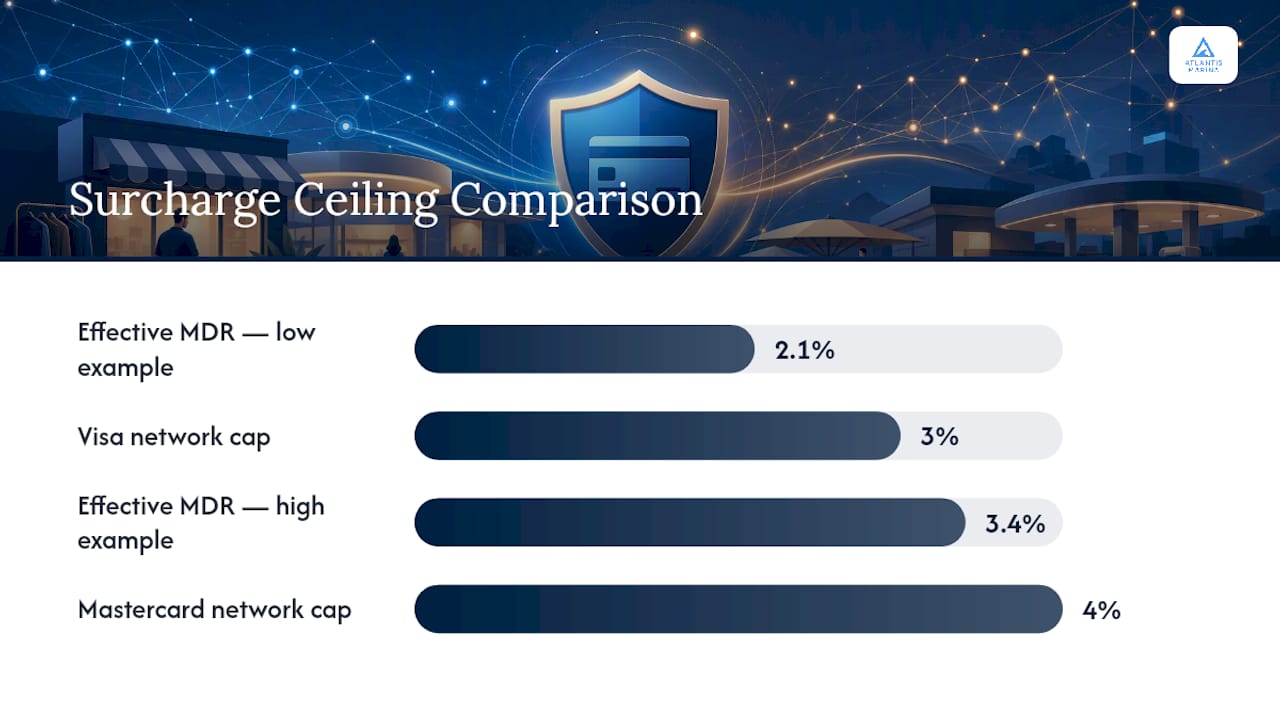
The math is simpler than most guides make it sound, but the mistake merchants make constantly is charging the network's advertised cap instead of their own actual cost. Your legal ceiling is always the lower of your effective MDR or the applicable network cap, whichever number is smaller for that specific card brand.
Start by pulling your effective processing rate. Add your interchange percentage, assessment fees, and any processor markup, then divide by total card volume over a representative period, typically the last full month or quarter. That blended number is your real MDR, and it's often lower than merchants assume once markup fees are averaged across volume.
- If your effective MDR comes out to 2.1%, you cannot charge 3% just because Visa's network cap allows it. Your legal ceiling is 2.1%.
- If your MDR is 3.4%, you're still capped at 3% for Visa transactions and 4% for Mastercard, because the network ceiling is lower than your actual cost in that case.
- A $500 slip rental charge with a 2.5% surcharge adds $12.50, itemized separately on the receipt, not folded into a round $512.50 total.
Mixed-cart transactions, where a customer buys retail items and pays a service invoice in one swipe, get trickier because you can't surcharge the portion of a purchase made with a debit card even if it's bundled with a credit transaction. Recurring charges need the same cap discipline applied every billing cycle, not just at signup, since your blended MDR can shift as your card mix changes month to month.
Alternatives to Surcharging: Cash Discounts and Pricing Strategies
Cash discount programs sidestep most of the surcharge restrictions entirely, which makes them the more flexible option in states that ban or tightly cap surcharging. The mechanic is straightforward: you post a slightly higher "list" price and discount it at the point of sale for cash, check, or ACH payment, rather than adding a penalty for card use.
- Two-tier pricing displays both the card price and the cash price side by side, which most states treat as fully compliant since no punitive fee is technically added to the card transaction.
- Receipt disclosure still matters. Show both prices clearly rather than presenting the card price as the "real" number with a mysterious discount subtracted.
- ACH routing is often the better fix entirely for high-dollar recurring charges. A marina payment processing analysis from Brookside Payments notes that businesses with large recurring bills, seasonal slip rent being a textbook example, typically save more by moving those charges to ACH than by surcharging card payments at all.
For a marina billing $4,000 in seasonal dockage, a 3% card surcharge adds $120 per tenant, but ACH processing fees run a fraction of that, often a flat few dollars regardless of the transaction size. When the dollar amount is large and the payment is recurring, ACH usually beats surcharging on both cost and compliance simplicity.
Penalties, Enforcement, and Common Violations to Avoid
Enforcement comes from two directions: card networks policing their own rules through acquirers, and state attorneys general policing consumer protection law. Both carry real financial consequences, and neither cares whether the violation was intentional.
Acquirers levy fines directly against merchants who surcharge without proper notification, exceed the network cap, or fail to itemize the fee on receipts. These aren't warning-letter offenses. Repeated violations can trigger account review or termination of your merchant processing agreement entirely. State enforcement adds a second layer: several states treat improperly disclosed surcharges as a deceptive trade practice, which opens the door to consumer complaints and attorney general action independent of any card-network penalty.
The most common failure point isn't whether surcharging is legal for a given merchant. It's getting the mechanics wrong: surcharging a debit card by mistake, skipping the 30-day acquirer notice, or charging above the lower of your actual cost and the network cap.
Common violations worth building checklists around:
- Surcharging a debit or prepaid card, even accidentally, when a customer's card type isn't clearly flagged at the terminal.
- Skipping or delaying acquirer notification before turning surcharging on.
- Charging the full network cap instead of your actual, lower MDR.
- Failing to itemize the surcharge as a distinct receipt line.
- Missing signage at either the point of entry or the point of sale, not just one or the other.
Federal Context: CFPB, TILA, and Statutes That Matter
Surcharging is governed primarily by card-network rules and state law, but federal fee regulation shapes the broader enforcement climate merchants operate in. The CFPB's final rule on credit-card penalty fees under Regulation Z isn't a surcharge-specific rule, but it signals how federal regulators think about fee reasonableness generally, which matters when state regulators borrow that framework to evaluate merchant fee practices.
- 15 U.S.C. § 1693o-2 establishes reasonable-fee principles for payment transactions that intersect with how state surcharge statutes get interpreted.
- CFPB guidance doesn't override card-network rules or state surcharge statutes directly, but it informs the enforcement posture regulators bring to fee disputes.
- Federal sources matter as background even though your actual compliance obligation runs through your state statute and your card network agreement first.
Atlantis Marina's View: Marina Payment Best Practices and When to Surcharge
Marina operators tend to overthink surcharging and underthink ACH. Seasonal slip rent is a large, predictable, recurring charge, exactly the profile where card surcharges make the least sense and ACH routing makes the most. A 3% surcharge on a $6,000 season contract is a real number your tenants will notice and question, while ACH processing costs a fraction of that with far less compliance overhead.
Surcharging still has a place for one-off transactions: incidental ship store purchases, service appointments, transient dockage where a card is the only payment method offered. That's where a compliant surcharge program, properly disclosed and capped, earns its keep.
Atlantis Marina's billing tools were built around that split. Contracts route recurring charges to ACH automatically, with card-on-file as backup for incidentals, and receipt templates apply the correct disclosure format depending on your state's rules. Compliance shouldn't be a separate project layered onto your existing marina payment processing setup.
— John R
How Atlantis Marina Handles Payment Fees and Compliance
Atlantis Marina is built for marinas that want their billing to run correctly without a staff member manually checking every receipt against state statute language. The platform routes recurring slip rent to ACH by default, applies compliant surcharge disclosures and receipt line-items for the transactions where surcharging makes sense, and reconciles what you've actually charged against your real processing costs so you never drift above your cap without noticing.

Billing runs through Stripe and ACH with automated contracts through Atlantis E-Sign, autopay enrollment, and direct QuickBooks Online sync, so revenue gets billed, collected, and booked without someone re-entering numbers by hand. Reporting flags when your effective processing cost creeps above your surcharge cap, catching the kind of drift that turns into an acquirer fine months later. If you're setting up a compliant payment program for the first time or auditing an existing one, request a demo of Atlantis Marina's payments and billing platform and see how the receipt templates and ACH routing handle it for your specific state.
Sources
Verify your specific situation against primary sources before flipping the switch on any surcharge program. Visa's merchant surcharging Q&A covers disclosure and cap requirements directly from the network. Mastercard's merchant surcharge rules page does the same for its 4% cap and notification process. For the federal fee-reasonableness backdrop, the CFPB's Regulation Z final rule is worth a read. For state-specific status, NFIB's state-by-state surcharging guide is a practical starting reference, and Atlantis Marina's marina management solution page walks through how compliant billing gets configured inside the platform.
This article is general information, not a substitute for advice from a qualified financial advisor. Consult a qualified financial professional about your own circumstances before acting on anything here.
- U.S. merchant surcharging Q&A — Visa
- Mastercard US — merchant surcharge rules
- CFPB final rule: Credit card penalty fees (Regulation Z) — January 2024
- NFIB: Credit card surcharging guide (state-by-state)
FAQ
Is it legal to charge 3% for a credit card?
Yes, in most states, as long as 3% doesn't exceed your actual processing cost and stays under your card network's cap; Visa's ceiling is the lower of your cost or 3%, while Mastercard allows up to 4%.
What states ban credit card surcharges?
Several states restrict or ban surcharging outright, including Connecticut and Massachusetts, though statutes change, so check a current source like NFIB's state-by-state guide before assuming your state's status.
Is it legal to charge 4% on a debit card?
No. Debit and prepaid cards can never be surcharged under card-network rules, regardless of the percentage or your state's surcharge laws for credit cards.