
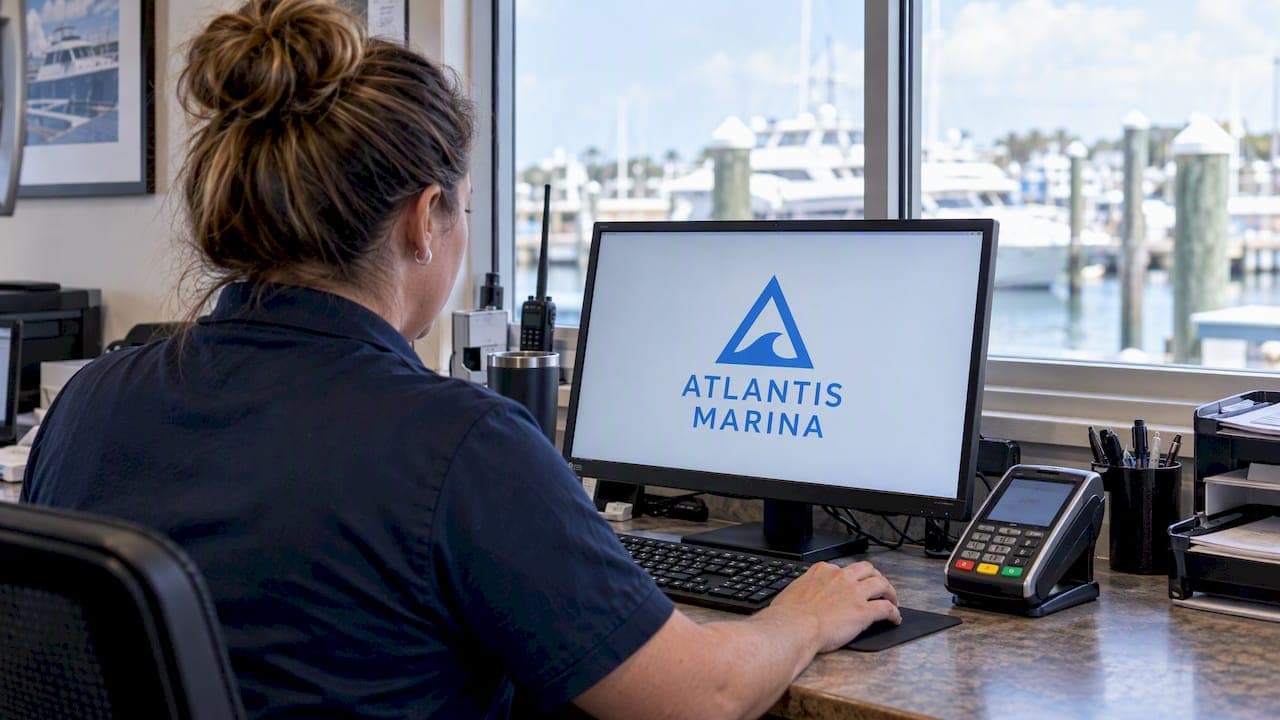
Most marina payment fraud is stopped by enabling card-not-present authentication, monitoring return and chargeback signals, enforcing staff approval workflows, and preserving clean evidence for disputes. The FTC and PCI Security Standards Council both point to the same layered approach. Together, these controls address online reservation fraud, ACH abuse, chargebacks, and social-engineering scams that target marina billing desks.
TL;DR:
- EMV 3-D Secure, AVS, and CVV checks are essential but must be combined with staff training and manual reviews for maximum fraud prevention.
- High ACH return rates, especially unauthorized or suspicious micro-charges, indicate potential fraud and require close monitoring to avoid account restrictions.
- Consistent staff verification, two-person approval processes, and thorough documentation are critical to preventing social engineering scams and chargebacks.
- Outsourced payment processing still requires ongoing PCI compliance, including monitoring integration and retaining signed self-assessment questionnaires.
- An integrated marina platform streamlines controls, automates billing, links physical and digital records, and reduces manual errors that lead to fraud vulnerabilities.
Table of Contents
- A quick checklist you can act on today
- How to harden online reservations and remote payments
- Recognize ACH red flags and build chargeback-proof billing
- Procedures and staff training that stop social engineering
- Lock down your APIs, webhooks, and device logs
- A step-by-step incident response and reconciliation playbook
- How an integrated marina platform puts these controls to work
- What marina operators consistently get wrong
- Reduce fraud exposure without adding headcount
- FAQ
- Sources
A quick checklist you can act on today
Before diving into the mechanics, here is the short list that closes most gaps fast:
- Require CVV and AVS checks on every online booking or card-on-file transaction.
- Enable EMV 3-D Secure wherever your payment processor supports it.
- Tokenize stored cards and route payments through a PCI-scoped processor instead of storing raw card data.
- Set alerts for ACH return-rate spikes and flag anomalies for manual review.
- Require two-person approval for refunds, account edits, and bank-detail changes.
- Train staff to refuse wire transfers, gift cards, or crypto requests tied to slip fees or deposits.
- Whitelist IP addresses for API traffic and validate webhook signatures.
Pro Tip: Run this checklist as a quarterly audit, not a one-time setup. Fraud tactics shift with the season, and so should your review cadence.
How to harden online reservations and remote payments
Card-not-present transactions, the kind that dominate slip reservations and transient dockage, carry the highest fraud exposure in marina billing. EMV 3-D Secure (3DS) adds an authentication step between the cardholder and the issuing bank before a reservation payment clears, which PCI guidance notes reduces exposure to card-not-present fraud when implemented on online payment pages. Require it for any booking above a threshold you set, and for first-time guests paying by card.

AVS and CVV checks catch mismatched billing information and card-present verification failures, but marinas should apply them carefully: a boat owner's billing address rarely matches the marina's physical location, so AVS mismatches on marina transactions need a human look before automatic decline rather than an automatic one.
Tokenizing card-on-file data removes raw card numbers from your systems entirely, which shrinks your PCI scope and limits what a breach could expose. Our card-on-file workflow outlines how to rotate tokens and schedule periodic re-authentication so stored credentials do not go stale.
- Set velocity limits and amount caps on reservation payments to catch rapid repeat attempts.
- Use automated fraud scoring from your processor and route flagged transactions to manual review.
- Keep signed PCI self-assessment questionnaires on file even when a third party processes your payments.
Even outsourced payment processing leaves merchants with ongoing PCI responsibilities, including monitoring integration integrity and retaining signed compliance agreements.
Recognize ACH red flags and build chargeback-proof billing
ACH payments carry their own fraud signature, and it shows up in return rates. FTC staff commentary on NACHA's return-rate framework notes that unusually high unauthorized or account-data return rates reliably indicate fraud or problematic origination practices. A marina that lets return rates climb unchecked risks landing in a processor's monitoring program, which can restrict processing ability altogether.
Watch for a sudden rise in unauthorized returns, repeated account-data errors on the same payer, or odd micro-charge batching that looks like testing stolen account numbers before a larger draw. Recent FTC enforcement against a payment processor underscores that processors ignoring high return and chargeback patterns face real regulatory consequences, and merchants share the burden of monitoring those signals.
- Require signed authorization records before enrolling any tenant in autopay or recurring ACH billing.
- Issue detailed, line-item receipts with date, time, and contract references for every charge.
- Keep CCTV footage tied to account activity through QR check-in logs, so a disputed slip charge has a physical record behind it.
When a chargeback lands, card networks and processors want a signed contract, an automated receipt trail, and supporting logs before they will side with the merchant. Our guide to stopping marina chargebacks walks through what to prepare before you ever contact your acquirer.
Procedures and staff training that stop social engineering
Payment controls catch bad cards. Staff training catches bad actors who skip the card entirely and go straight for a human. The FTC's small business scam guidance notes that scammers rely on urgency, impersonation, and unusual payment channels, and that training staff to verify and refuse nonstandard requests reduces how often those scams succeed.
- Require two-person approval for refunds, price overrides, and any bank-account change on file.
- Train front-desk and billing staff to recognize urgency and impersonation tactics, especially requests for wire transfers, gift cards, or cryptocurrency tied to slip fees.
- Verify any invoice or bank-change request with a callback to a known phone number, never the number listed in the request itself.
- Require digital signatures on contract amendments and confirm changes through the customer's existing account portal rather than email alone.
Pro Tip: Build attestation fields into every contract and billing change form. A simple checkbox confirming "I verified this request through an independent channel" creates an evidence trail that pays off months later in a dispute.
Our reservations playbook covers verification steps specific to transient and seasonal bookings, where social engineering attempts cluster most heavily.
Lock down your APIs, webhooks, and device logs
Payment fraud does not always start at the card. Intercepted API calls and forged webhook events can move money just as effectively.
- Require IP whitelisting for server-to-server API calls and issue limited-use tokens for any third-party integration.
- Validate and sign every webhook payload, and rotate webhook secrets on a regular schedule rather than leaving them static for years.
- Monitor source IPs on payment traffic, block anomalies automatically, and keep TLS and a web application firewall active on every payment page.
- Tie CCTV and dock-access logs to account activity through QR codes, so a physical check-in record backs up the digital transaction tied to that same account.
This layered approach mirrors what our PCI compliance guidance recommends for marinas running their own payment integrations alongside dockside hardware.
A step-by-step incident response and reconciliation playbook
When fraud is suspected, speed and documentation both matter.
- Pause autopay on the affected account and preserve all logs, tokens, and system snapshots immediately.
- Notify your processor or acquirer the same day you detect the issue.
- Collect every piece of supporting evidence: signed contracts, automated receipts, IP and webhook logs, CCTV footage, and staff approval records.
- Submit required documents to the card network or ACH originator within the dispute window, and prepare a written rebuttal referencing your evidence trail.
- Run a post-mortem: reconcile the account, trace the root cause, and adjust thresholds or staff training based on what you find.
- Keep a standing template for dispute rebuttals so you are not drafting one from scratch under deadline pressure.
- Review your recurring billing policies after every incident; our recurring billing guide covers how autopay terms should evolve as you tighten controls.
How an integrated marina platform puts these controls to work
Running these controls by hand across spreadsheets and separate tools is where most marinas lose consistency. An integrated platform closes that gap by linking billing, contracts, and physical records into one account history.
- E-sign contracts and tokenized card-on-file through Atlantis E-Sign and autopay remove manual data entry and reduce stored card exposure.
- Instant Pay, Stripe, and ACH processing run through a PCI-aware billing layer rather than scattered manual terminals.
- Automated receipts and QuickBooks Online sync keep audit trails current without extra staff time.
- QR-linked check-ins connect dockside activity and camera footage to the correct account, so a disputed charge has both a digital and physical record.
- Our marina payment processing overview walks through how these pieces fit together for operators building a fraud-resistant billing workflow.
What marina operators consistently get wrong
The biggest mistake I see is treating payment fraud as a technology problem to solve once, rather than an operational habit to maintain. A marina that enabled 3DS two years ago and never revisited its approval workflow is just as exposed as one that never enabled it at all. The marinas that actually stop fraud attempts are the ones where a front-desk employee flags an odd bank-change request, calls the number on file instead of the one in the email, and the attempt dies right there, documented and closed within the hour. That habit matters more than any single tool.
— John R
Reduce fraud exposure without adding headcount
Reducing marina payment fraud comes down to the same three jobs covered throughout this guide: tightening transaction controls, automating billing so nothing slips through manual gaps, and keeping evidence ready for disputes before you need it.

We built our platform around exactly that sequence. Card-on-file tokenization, automated receipts, QuickBooks sync, and QR-linked dockside records work together so a disputed charge comes with its evidence already attached, rather than assembled under deadline pressure.
- Billing automation through Stripe and ACH, with autopay and Instant Pay built in.
- Contracts signed and stored through Atlantis E-Sign, with attestation fields built into the workflow.
- Plans start at $150 per month for the Micro tier, scaling through Small, Medium, and Large based on your marina's size, detailed on our pricing page.
If you want to see how this fits your operation, request a demo and we will walk through your current billing setup together.
FAQ
What is the single most effective control against marina payment fraud?
No single control covers every risk, but EMV 3-D Secure combined with AVS and CVV checks stops the majority of card-not-present fraud attempts on online reservations. Pairing it with staff training on social engineering closes the gap that payment controls alone cannot.
How do ACH return rates signal fraud at a marina?
A sudden rise in unauthorized or account-data returns on recurring ACH billing often points to stolen account information or problematic origination, according to FTC staff commentary on NACHA monitoring. Monitoring those spikes lets you catch abuse before your processor flags your account.
What evidence do I need to win a marina chargeback dispute?
Processors and card networks generally expect a signed contract, an itemized automated receipt, and supporting logs such as IP records or CCTV tied to the account. Our chargeback mitigation steps outline how to assemble this evidence before a dispute ever reaches your acquirer.
Do I still have PCI responsibilities if I outsource payment processing?
Yes. Merchants retain PCI obligations even when a third party handles card processing, including monitoring integration integrity and keeping signed self-assessment questionnaires on file, per PCI Council guidance. Outsourcing reduces scope, but it does not eliminate accountability.
How much does marina management software with built-in payment automation cost?
Pricing depends on marina size and features; plans start at a lower entry-level tier and scale up through several sizes, with Enterprise pricing available on request, as listed on our pricing page.
Sources
- Scams and Your Small Business: A Guide for Business (FTC)
- Securing eCommerce: Anti‑Fraud Considerations (PCI SSC)