
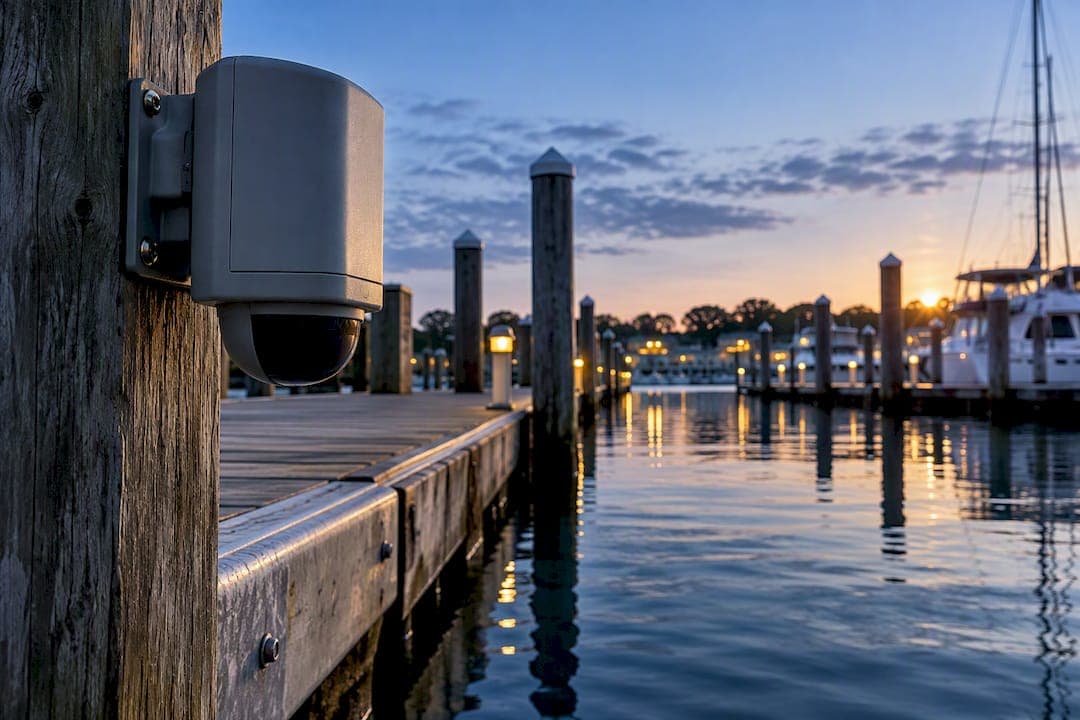
Dock security sensors are devices installed on piers, slips, and pedestals that detect unauthorized access, unexpected vessel movement, and infrastructure faults like water intrusion or shore-power leakage. The most effective approach layers multiple sensor types (contact, motion, occupancy, and water/electrical) and feeds every trigger into a marina operations platform. That integration turns raw alerts into faster triage, stronger incident documentation, and better support for regulatory compliance.
TL;DR:
- Layering multiple sensor types, such as contact, motion, and water leakage detectors, improves detection accuracy and reduces false alarms in marinas.
- Integration with a marina operations platform allows alerts to be matched to vessel records, enabling faster response and detailed incident documentation.
- Proper placement, marine-grade enclosures, and routine testing are essential to ensure sensor durability against saltwater, storms, debris, and extreme weather conditions.
- Electrical safety regulations require leakage detection devices near shore-power, and all sensor work near electrical sources must involve licensed marine electricians.
- Using identity linkage via QR codes and reservation data transforms raw sensor alerts into actionable insights, cutting manual checks and speeding up incident resolution.
Table of Contents
- Types of dock security sensors and what each detects
- Integrating sensors into a marina operations platform
- Installation and placement best practices for docks and slips
- Safety, electrical code, and regulatory considerations
- Operations: alerting, triage, and staff workflows
- Maintenance, testing, and false-alarm mitigation
- Case studies and examples of dock security sensor implementations
- Data privacy and cybersecurity when connecting sensors to marina IT systems
- How saltwater, storms, and debris affect sensor durability
- Lessons from an integrated marina platform operator
- How Atlantis Marina turns sensor events into daily operations
- Primary sources and standards
- Sources
- FAQ
Types of dock security sensors and what each detects
Choosing sensors starts with matching the device to the specific risk you are trying to catch. Marinas rarely need one sensor type; they need a mix that covers access, movement, and infrastructure health.
- Contact, reed, and magnetic sensors monitor gates and pedestal doors, triggering when a circuit breaks on opening.
- Motion and vibration sensors adapted for marine environments detect movement near slips, though wind, waves, and wildlife can trigger false positives if sensitivity is not tuned.
- Load, tilt, and mooring-line tension sensors flag unusual vessel movement or theft attempts by detecting shifts in line tension or hull angle.
- Slip-occupancy sensors, including pressure pads, proximity detectors, and BLE or LoRa beacons, report real-time slip status for dockmasters and reservation systems.
- Water-leak, water-level, and shore-power leakage detectors catch flooding, rising water, and electrical faults before they become safety hazards.
Each category has tradeoffs. Contact sensors are reliable but limited to a single access point. Motion sensors offer wider coverage but demand careful placement to avoid nuisance alerts. Occupancy sensors add operational value beyond security, since they also inform billing and reservation accuracy. Water and electrical sensors are less about intrusion and more about preventing the kind of infrastructure failure that turns into a liability claim.
Integrating sensors into a marina operations platform
A sensor that only sounds a local alarm solves half the problem. The value comes from routing that trigger into a system that knows which slip, vessel, and reservation it belongs to.
Connection choices affect reliability and cost. Power over Ethernet works well for pedestals near existing network runs, cellular suits remote piers without cabling,, Wi-Fi fits shorter distances with reliable signal, and LoRaWAN extends battery-powered sensors across large marina footprints without heavy infrastructure.
- A sensor triggers on a gate, pressure pad, or leak detector.
- The event reaches the platform, which matches it to a slip, vessel record, or reservation instead of arriving as an anonymous alert.
- The dashboard logs the event and pushes a mobile alert to the dockmaster on duty, with a camera snapshot attached when available.
- Automation rules decide whether the event needs immediate escalation or can wait for a routine check.
- An incident record is created automatically, useful later for billing disputes or insurance claims.
QR codes and vessel profiles are what make step two work. Instead of a generic "motion detected at Slip 14" message, staff see the vessel name, owner contact, and reservation status tied to that slip, which is a workflow the operations dashboard is built to support.
Pro Tip: Set automation rules to suppress low-risk daytime triggers on high-traffic gates, then re-enable full sensitivity after hours.
Installation and placement best practices for docks and slips
Placement determines whether a sensor earns its cost or generates weekly nuisance calls. A few fundamentals apply across most marina layouts.
- Mount motion and vibration sensors at heights that avoid water reflections and low-flying birds, which are common false-trigger sources.
- Plan power early: PoE and solar-plus-battery setups avoid the risk of tying sensors directly into shore-power circuits without a licensed electrician's review.
- Use marine-grade enclosures and surge protection on all cable runs exposed to salt spray and lightning.
- Place contact sensors on gate posts and pedestal doors, load sensors near cleats and piling bases, and vibration sensors under decking where hull contact is most likely.
- Test every installation across day and night conditions, including a rain or spray simulation, before confirming it reports correctly to the operations platform.
Skipping the verification step is the most common reason sensors underperform. A device that reports fine on a dry afternoon can behave differently once spray, tide changes, or overnight temperature drops enter the picture.
Safety, electrical code, and regulatory considerations
Sensor systems near shore power intersect directly with electrical code and federal security rules, and neither can be treated as optional.
- NEC Article 555.35 sets ground-fault protection limits: marina feeders are capped at 100 mA and shore-power receptacles at 30 mA, with leakage measurement devices expected on-site where a marina has more than three shore-power receptacles, according to NFPA's commentary on marina electrical safety.
- 33 CFR § 105.275 requires facility operators to continuously monitor shore and waterside access, with automatic intrusion-detection devices activating an audible or visual alarm at a continuously attended location.
- 33 CFR § 104.285 places similar monitoring obligations on vessel owners and operators, reinforcing that alarms must reach a staffed point, not just a log file.
- Electric shock drowning risk is why leakage detection matters as much as intrusion detection: undetected shore-power faults can energize the water around a dock.
- Sensors support but do not replace lighting, patrols, and trained watchkeepers, which the Coast Guard's layered security guidance still expects.
**Marinas with more than three shore-power receptacles are expected to keep leakage measurement devices on-site, per NFPA's coverage of the NEC's marina ground-fault provisions, which shows how closely electrical safety and security monitoring now overlap. Any sensor work near shore-power pedestals should involve a licensed marine electrician, not just a security installer.
Operations: alerting, triage, and staff workflows
Sensors generate noise unless staff have a clear policy for what each alert priority means and how fast it needs a response.
- Rank alerts by severity: an intrusion at a locked gate outranks a routine occupancy change, and a shore-power fault outranks both.
- Route high-priority alerts to mobile devices immediately, with dashboard context showing vessel, slip, and reservation history.
- Apply escalation rules so unattended alarms reach a continuously monitored point, aligning with the attended-alarm expectations in 33 CFR § 105.275.
- Adjust workflows for night shifts, where automated snapshot capture reduces the need for a physical walk to the slip.
- Train staff to document incidents consistently and to recognize surveillance-style behavior that sensors alone will not catch.
Pro Tip: Review your alert priority list every quarter. Slip layouts, tenant turnover, and seasonal traffic change what counts as a genuine anomaly.
Maintenance, testing, and false-alarm mitigation
A sensor network is only as good as its last inspection. Weekly visual checks, monthly functional tests, and a full seasonal verification catch most issues before they become blind spots.
- Check firmware versions, battery levels, and connector corrosion on a fixed schedule, and keep spare parts on hand.
- Adjust sensitivity settings after seasonal changes in tide, wind, or wildlife activity.
- Use camera snapshot verification on trigger events to confirm whether an alert was a real intrusion or a false read.
- Common false-alarm sources include wildlife, wave spray, loose mounting hardware, and electrical noise near shore-power lines.
- Log every test and incident. Records support insurance claims and demonstrate compliance during inspections.
Alarm fatigue is a real operational cost. Reviewing tuning practices used in alarm-heavy fields like SCADA operations can help marina staff design filters that cut noise without missing genuine threats.
Case studies and examples of dock security sensor implementations
Marinas that layer sensors with identity linkage tend to report the same pattern: fewer false escalations and faster resolution once a trigger fires. A mid-sized marina running gate contact sensors alongside occupancy beacons, for instance, can cut the number of manual slip-walks a dockmaster performs overnight, because occupancy data already confirms whether a slip should be active.
Facilities that add water-leak and shore-power leakage sensors near older pedestals often catch faults during routine testing rather than after a boater complaint, which matters given the electric shock drowning risks tied to marina electrical systems. The pattern across these examples is not the sensor hardware itself. It is the linkage between the sensor event and a vessel or slip record, which turns "something triggered at Slip 22" into "Slip 22, vessel Sea Breeze, reservation active through Friday." That context is what separates a useful alert from a distraction.
Marinas piloting a small set of slips before a full rollout tend to catch placement and sensitivity issues early, avoiding a costly reinstallation across an entire dock system. Starting with the highest-risk slips, typically transient or high-value vessel berths, gives operators a faster read on whether sensor placement and platform integration are actually reducing manual checks before committing budget to full-property coverage.
Data privacy and cybersecurity when connecting sensors to marina IT systems
Every sensor added to a marina network is another device that touches vessel records, reservation data, and sometimes payment systems, so cybersecurity planning has to move alongside the hardware rollout.
Segmenting sensor traffic from billing and payment networks limits the damage a compromised device could cause. Sensors and cameras should sit on their own network segment, with access to core operational data restricted to what the integration actually requires. Firmware updates matter here too: outdated sensor firmware is a common entry point for unauthorized network access, so a maintenance schedule that includes firmware checks is a security control, not just a reliability one.

Data retention policies also deserve attention. Camera snapshots and occupancy logs tied to specific vessels and slips are personal data in a practical sense, even if they are not classified that way by regulation. Marinas should define how long incident records and snapshots are kept, who can access them, and how boater information stays protected when it flows between sensors, the operations platform, and any third-party hardware vendor. A platform that keeps sensor data, vessel records, and billing information in one governed system is generally easier to secure than a patchwork of standalone devices each reporting to a different app.
How saltwater, storms, and debris affect sensor durability
Marine environments are harder on electronics than almost any other commercial setting, and sensor selection has to account for that from day one.
Saltwater corrosion attacks connectors, housings, and exposed circuit boards faster than fresh water ever would, which is why marine-grade enclosures and corrosion-resistant connectors are worth the higher upfront cost. A sensor rated for general outdoor use will often fail within a season near open water, while one built for marine exposure can run for years with routine maintenance.

Storms introduce a different set of risks. Wind-driven debris can damage exposed motion and vibration sensors, and storm surge can submerge low-mounted occupancy pads or leak detectors that were never designed for full immersion. Mounting height and enclosure rating both matter more in storm-prone marinas than in sheltered inland facilities.
Debris buildup, whether from seaweed, sediment, or dock traffic, can also block sensor line of sight or trigger false reads on proximity and motion devices. Routine cleaning as part of the maintenance schedule prevents this from turning into a reliability problem. Marinas in colder climates add one more variable: ice formation on pedestals and cabling, which can stress connectors and housings during freeze-thaw cycles. Sensor selection should account for the specific environmental profile of the marina, not just a generic marine rating.
Lessons from an integrated marina platform operator
The biggest mistake we see is deploying sensors as isolated devices, each reporting to its own app with no connection to slip, vessel, or reservation data. A gate sensor that only says "triggered" forces staff to walk out and check, every time, regardless of whether the trigger was a real issue.
The bigger win comes from linking that same trigger to an account record. When a sensor event ties to a vessel profile through a QR code or reservation record, staff know instantly whether a boat owner is expected on-site, which cuts unnecessary phone calls and speeds resolution. That single change, identity linkage over raw alerting, tends to matter more than the sensor hardware itself.
— John R
How Atlantis Marina turns sensor events into daily operations
Running sensors without a system to interpret them just adds another screen for staff to watch. Atlantis Marina was built to close that gap by connecting sensor and camera integrations directly to the same platform that already manages slip assignments, reservations, and vessel records.

- Sensor triggers reach the operations dashboard with vessel and slip context attached, not as anonymous alerts.
- Mobile alerts notify the dockmaster on duty, with camera snapshots pulled in through camera security integrations.
- QR-code account workflows let staff confirm who a triggered slip belongs to in seconds, instead of guessing from a bare notification.
- Atlantis Bot helps staff sort routine questions from real incidents, keeping attention on events that actually need a response.
- Every event logs automatically, building the incident history operators need for insurance claims or MARSEC-related recordkeeping.
Marinas can start small: pilot sensor integration on a handful of high-value slips before expanding property-wide. Pricing runs from the Micro plan through Large plans, with add-ons like Eagle Eye smart cameras and utility monitoring priced separately, all detailed on the pricing page. To see how sensor and camera data fits into daily operations, visit the Atlantis Marina sales page and request a walkthrough.
Primary sources and standards
- 33 CFR § 105.275 and 33 CFR § 104.285 cover MARSEC monitoring requirements.
- NFPA's marina electrical safety commentary explains NEC 555.35 ground-fault provisions.
- The DHS maritime surveillance market survey reviews sensor and system procurement considerations.
Sources
- 33 CFR § 105.275 - Security measures for monitoring.
- 33 CFR § 104.285 - Security measures for monitoring.
- Maritime surveillance technologies market survey (SAVER/DHS)
- Navigating Electrical Safety Through Marina Waters | NFPA
FAQ
What do dock security sensors actually monitor?
Dock security sensors monitor gate and pedestal access, vessel movement, slip occupancy, and infrastructure faults like water leaks or shore-power leakage. Most marinas layer several sensor types rather than relying on a single device to cover every risk.
How do dock sensors reduce false alarms?
False alarms usually come from wildlife, wave spray, loose mounts, or untuned sensitivity settings, and correcting those causes cuts most nuisance triggers. Attaching camera snapshots to each trigger, as supported by Atlantis Marina's camera integrations, also helps staff confirm real incidents faster.
What electrical code applies to marina shore power and sensors?
NEC Article 555.35 sets ground-fault protection limits for marina feeders and shore-power receptacles, capping feeders at 100 mA and shore-power receptacles at 30 mA, according to NFPA's coverage of the rule. Any sensor installation near shore power should involve a licensed marine electrician.
Are marinas required to monitor access points under federal rules?
Yes. 33 CFR § 105.275 requires facility operators to continuously monitor shore and waterside access points, with automatic intrusion-detection devices triggering alarms at a continuously attended location.
What does Atlantis Marina cost for a marina adding sensor integrations?
Atlantis Marina's plans range from Micro at $150 per month to Large at $900 per month, with Enterprise pricing available on request, all listed on the pricing page. Hardware add-ons like Eagle Eye smart cameras and utility monitoring are priced separately on the same page.