
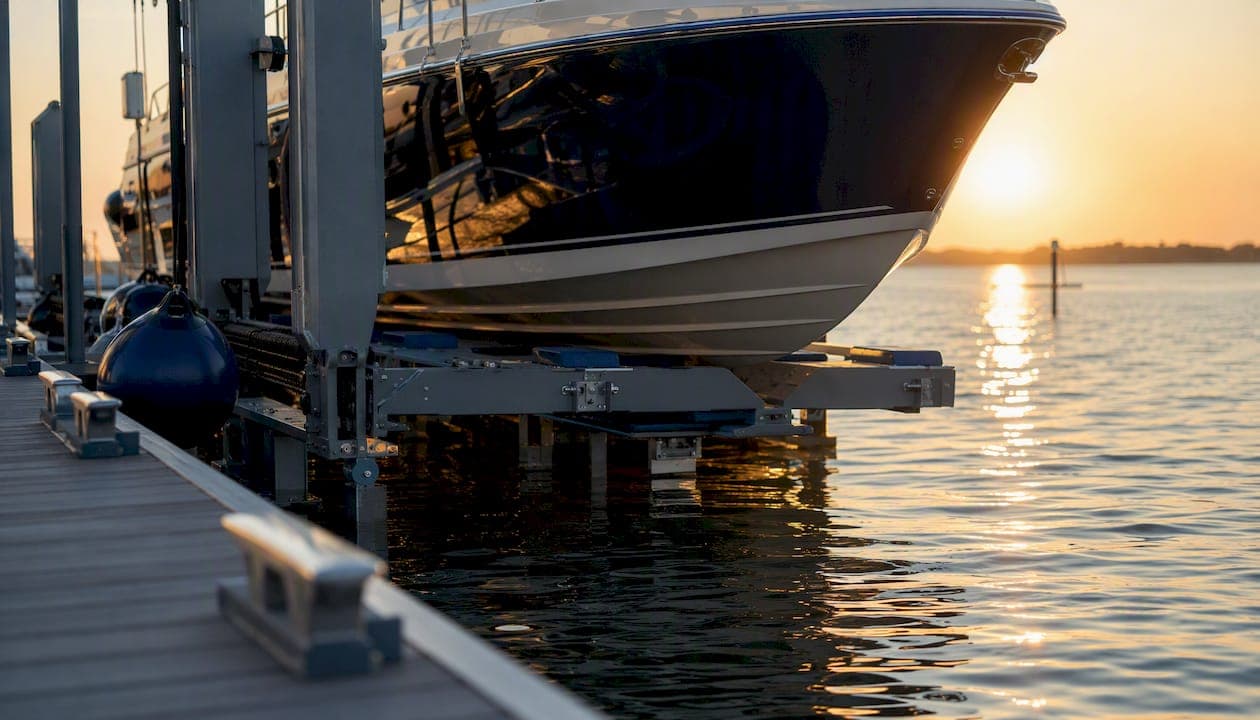
For most Homewood Marina operators ready to replace spreadsheets and fragmented tools, Atlantis Marina is the recommended platform. It unifies reservations, billing automation, smart boat lift control, and mobile dock operations in one cloud system. Request a demo now to see how it maps to your facility's specific workflow.
Key Takeaways
A unified smart-marina platform with automated billing, mobile dock tools, and hardware integrations delivers the fastest operational payback for U.S. marina operators.
| Point | Details |
|---|---|
| Autopay and self-service first | Configure autopay and the boater portal in week one to recover staff hours immediately. |
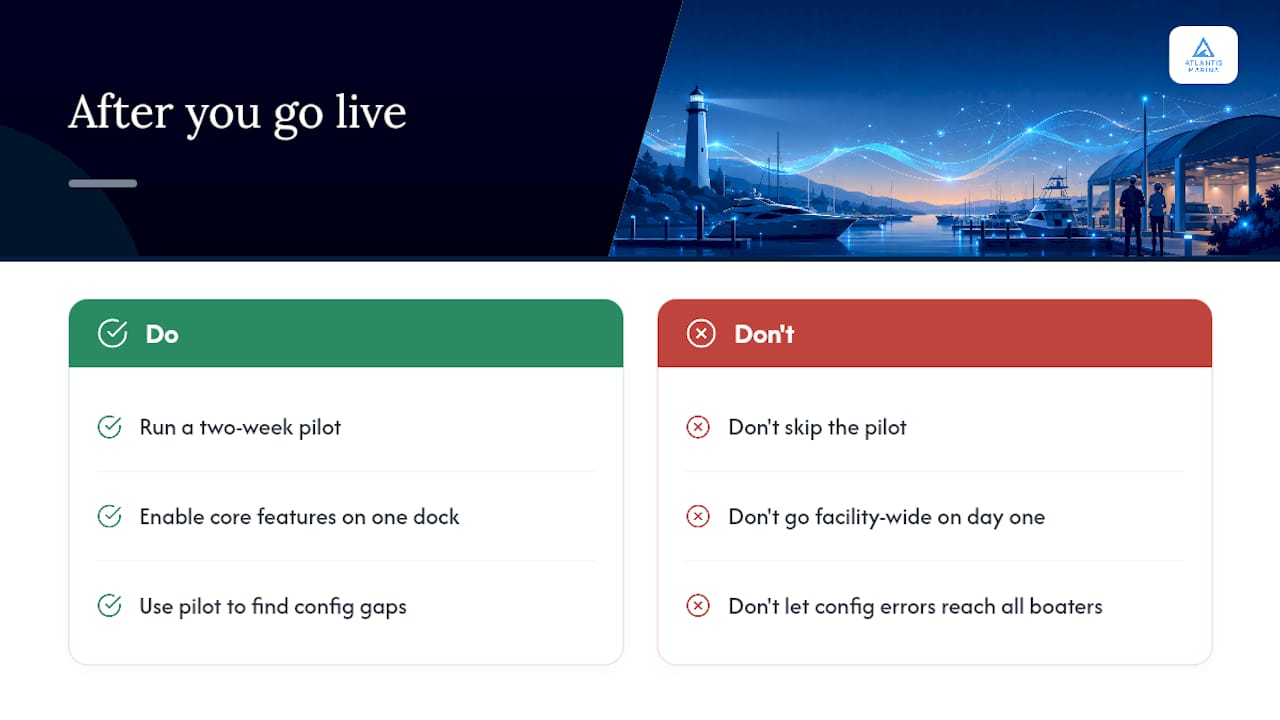
| Run a two-week pilot | Activate core features on one dock section before full rollout to catch configuration gaps early. |
| Request a full TCO worksheet | Ask every vendor for setup fees, a transaction-fee scenario, and a three-year cost projection. |
| Platform fee to budget | Atlantis Marina charges a 1% fee on digital payments; factor this into your payment volume projections. |
| Atlantis Marina recommended | Maps to every checklist item: reservations, smart lift control, QuickBooks sync, Stripe/ACH, and Atlantis Bot. |
Table of Contents
- What does a marina management platform do for a facility like Homewood Marina?
- Top features to require when you evaluate platforms
- Which smart-hardware integrations materially change your operations?
- How to evaluate vendors: checklist, what to ask, and red flags
- What to expect during implementation and onboarding
- What to budget for beyond the sticker price
- How Atlantis Marina maps to the evaluation checklist
- What actually changes after you go live
- Ready to see Atlantis Marina in action?
- Sources
- FAQ
What does a marina management platform do for a facility like Homewood Marina?
A marina management platform is a unified cloud system that replaces disconnected spreadsheets, paper contracts, and phone-based coordination with one operating environment. It handles slip and berth assignments, reservations, automated invoicing, customer relationship management, maintenance scheduling, and facility analytics from a single dashboard. According to Marina Management Software for Marinas and Yacht Clubs, centralized booking, mobile staff tools, and integrated billing reduce paperwork and measurably improve the boater experience across facilities of all sizes.
Core functions operators rely on daily include:
- Reservations and berth assignments with real-time availability
- Visual dock maps showing slip status at a glance
- Automated invoicing and autopay via Stripe and ACH payment processing
- Boater self-service portal for contracts, payments, and vessel records
- Maintenance and work-order tracking tied to specific slips or vessels
- QuickBooks Online sync for clean accounting without manual entry
The Association of Marina Industries (AMI) consistently points to industry-specific feature depth as the primary differentiator when selecting a system.
Top features to require when you evaluate platforms
Not every feature delivers equal payback. Prioritize in this order during any demo or RFP process:
- Reservations and berth management — real-time slip availability, online booking, and waitlist management are non-negotiable for any marina with transient traffic.
- Visual dock maps — interactive facility maps that show occupancy, vessel details, and slip status reduce double bookings and cut phone-based coordination.
- Automated invoicing and autopay — automated billing with Stripe, ACH, and QuickBooks Online sync captures contract revenue without manual follow-up.
- Boater self-service portal and mobile app — online contract signing, document uploads, and payment access reduce front-desk workload significantly.
- CRM and boater profiles — vessel records, insurance documents, and communication history in one place speed up every guest interaction.
- Maintenance and work-order system — tied to slips and vessels so nothing falls through the cracks between seasons.
- POS and ship store integration — fuel, retail, and service transactions linked to boater accounts for consolidated billing.
- Reporting and analytics — occupancy rates, revenue trends, and utilization data for smarter pricing decisions.
- Multi-property support — critical for marina groups managing more than one location.
- API and customization options — open integrations protect your investment as your tech stack grows.
Pro Tip: Set up autopay and the boater self-service portal in the first two weeks of go-live. Those two features alone recover more staff hours than any other configuration step.
Atlantis Bot, the platform's built-in AI assistant, handles boater questions on your marina website and supports staff with reservation lookups, billing queries, and ship store restocking tasks. It is one of the few AI tools in the category that operates with staff-confirmed actions rather than autonomous changes.
Which smart-hardware integrations materially change your operations?
Hardware integrations separate a modern smart-marina platform from a basic booking tool. The right integrations change daily workflows in concrete ways:
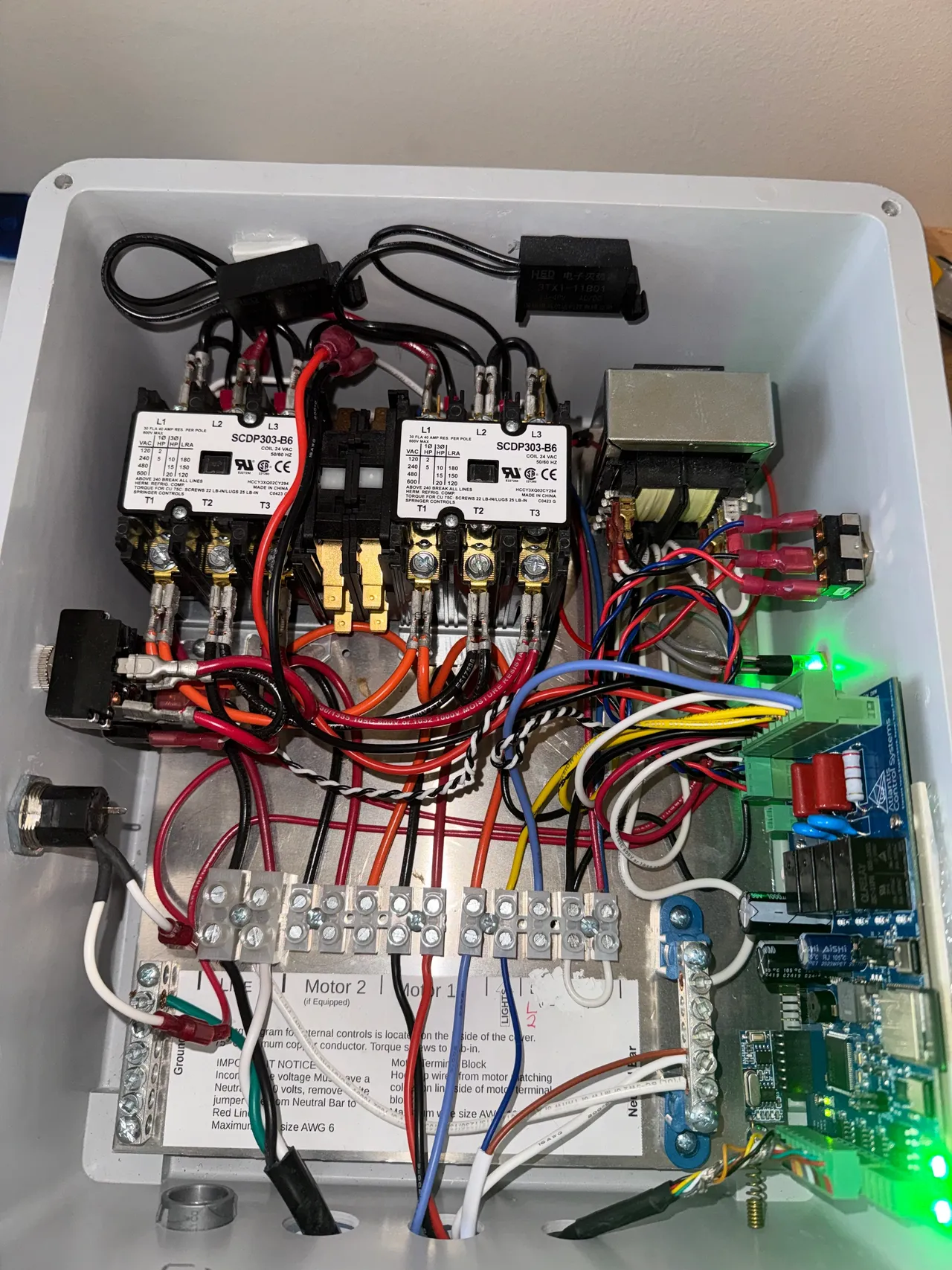
- Smart boat lift controllers automate lift operations and tie lift events directly into scheduling and safety workflows. Atlantis Marina's smart lift control connects lift activity to the platform so every haul and launch is logged, scheduled, and visible to dock staff in real time.
- Dry-stack launch and haul scheduling lets boaters request launches through the app, and staff fulfill them from a queue without phone calls or paper logs.
- Dock sensors for occupancy and utility metering provide accurate data for utility billing and reduce disputes over power and water consumption.
- Camera integrations create a security and incident-review record tied to the facility map, which supports liability documentation.
- Access-control integrations manage gate and fob workflows so only authorized boaters and staff enter restricted areas.
When evaluating hardware compatibility, confirm that the platform supports open APIs, standard protocols such as MQTT or HTTP, and vendor-provided hardware modules. Proprietary-only integrations create long-term lock-in and limit your ability to add equipment from other manufacturers.
How to evaluate vendors: checklist, what to ask, and red flags
Demo checklist
- Confirm industry-specific features: slip management, dry storage, reservations, POS, CRM, maintenance, and reporting.
- Verify mobile app availability for both dockmasters and boaters.
- Ask for a live API documentation walkthrough.
- Confirm accounting integrations, specifically QuickBooks Online sync.
- Clarify payment processor flexibility: Stripe, ACH, and any processor lock-in terms.
- Request a written data export and data ownership policy.
- Ask about security certifications and uptime SLAs.
- Test multi-property support if you manage more than one facility.
Questions to ask the sales and product team
- What is the realistic implementation timeline for a marina our size?
- Who owns data migration, and what format do you accept?
- Is a dedicated customer success manager included, or is that an add-on?
- What is the escalation path if a critical issue arises during peak season?
- Can you provide two or three customer references in our marina size category?
Red flags to walk away from
- Opaque or bundled pricing with no itemized breakdown
- No sandbox or trial environment before contract signing
- Undocumented API or no named integration partners
- Vague answers about data ownership or export rights
- Zero industry-specific references on request
Marina Dock Age recommends treating vendor support quality and clear total cost of ownership as equally important as feature depth when making a final selection.
What to expect during implementation and onboarding
A realistic implementation timeline varies by facility size:
- Discovery (1–2 weeks): document current workflows, slip inventory, pricing tables, and integration requirements.
- Configuration (1–3 weeks): build the facility map, set up slip categories, pricing rules, and payment settings.
- Data migration (1–2 weeks): import customer and vessel records, slip history, and tax settings.
- Pilot (2 weeks): run core features with a subset of slips or a single dock section before full rollout.
- Go-live (1 day to 1 week depending on complexity): full facility activation with staff on-site support.
- Post-launch support (30–90 days): dedicated check-ins, issue resolution, and feature expansion.
Data migration checklist items to prepare before kickoff:
- Customer and vessel records (name, contact, vessel specs, insurance)
- Slip history and current assignments
- Pricing tables and seasonal rate structures
- Vendor invoices and tax settings
- QuickBooks chart of accounts mapping
Training should cover admin configuration, dockstaff mobile management workflows, and recorded sessions for seasonal staff who join mid-season. Run the pilot with your highest-volume dock section first so staff build confidence before full rollout.
What to budget for beyond the sticker price
Total cost of ownership for a marina management platform typically includes more than the monthly subscription. Budget for:
- Subscription tier: monthly fee scaled to marina size and feature set
- Platform transaction fee: Atlantis Marina charges a 1% fee on digital payments processed through the platform
- Hardware: smart lift controllers, POS terminals, cameras, and sensors purchased and installed separately
- Payment processor fees: Stripe and ACH transaction fees in addition to the platform fee
- Professional services: setup, data migration, and custom configuration work
- Ongoing support: premium support tiers or dedicated CSM packages if not included in base subscription
Automated invoicing and autopay typically deliver the fastest payback by recovering revenue that previously slipped through manual billing gaps. Dynamic pricing and occupancy optimization add a second layer of return over the first full season.
Pro Tip: Request a comprehensive cost worksheet from every vendor that covers setup fees, a transaction-fee scenario at your average monthly payment volume, and a three-year TCO projection. Hidden fees surface fastest in that format.
How Atlantis Marina maps to the evaluation checklist
Atlantis Marina covers every item on the checklist above. Here is how the platform maps to each priority:
- Reservations and berth management: marina reservations software with online booking, waitlists, and transient intake forms
- Visual dock maps: interactive facility maps in the operations dashboard showing real-time slip status
- Smart Boat Lift Control: automated lift operations tied to scheduling and safety workflows
- QuickBooks Online sync: two-way accounting integration with no manual entry
- Stripe and ACH support: flexible payment processing with autopay and Instant Pay
- Atlantis Bot: built-in AI assistant for boater questions and staff workflows
- Boater app and web portal: self-service reservations, document uploads, contract signing, and payment management
For your demo, request this specific agenda: slip mapping walkthrough, a transient booking flow from the boater app to dockmaster confirmation, autopay setup, dry-stack haul and launch queue, and a live smart lift control demonstration. Those five sequences cover the highest-friction workflows at most U.S. facilities.
Pro Tip: Bring your current booking spreadsheet and one sample contract to the demo. Seeing your own data structure reflected in the platform's import flow is the fastest way to assess real fit.
What actually changes after you go live
The most underestimated shift after implementation is not the software itself. It is the staff behavior change. Dockmasters who spent mornings on the phone confirming arrivals and chasing payment now spend that time on the dock. Boaters who previously called to check slip availability now self-serve through the app, and the front desk handles exceptions rather than routine transactions.
One practical tip worth acting on immediately: run a two-week pilot with your core features active on one dock section before enabling the full facility. It surfaces configuration gaps before peak season, and it gives your team a low-stakes environment to build confidence with the new workflows.
The most common first-season pitfall is skipping the pilot and going live facility-wide on day one. Configuration errors that would have been minor in a pilot become visible to every boater at once. A phased rollout costs two extra weeks upfront and saves far more than that in recovery time.
Ready to see Atlantis Marina in action?
Atlantis Marina gives Homewood Marina operators a concrete alternative to patching together booking tools, billing software, and hardware systems that never fully talk to each other. The platform handles marina management from slip assignment through smart lift control in one connected system, with no manual accounting reconciliation and no separate boater communication tool to maintain.
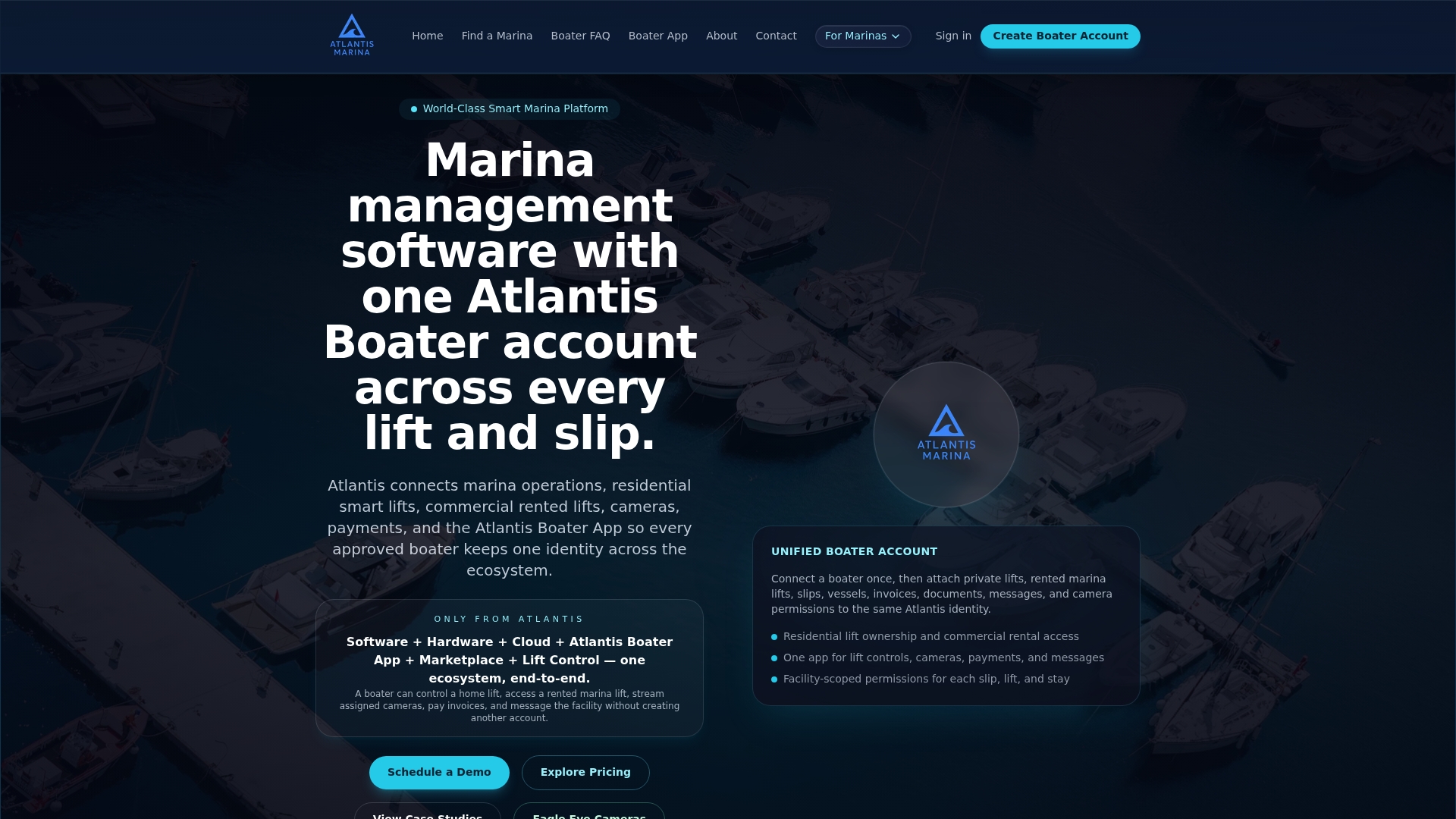
To schedule a demo, visit the Atlantis Marina sales page. Demos run 20–30 minutes and are tailored to your facility type and size. Bring your current booking spreadsheets, a sample contract, your required integration list, and hardware model numbers if you have existing lift or sensor equipment. You will leave with a sample data import assessment, a hardware integration discussion, and a pricing overview specific to your operation.
Sources
- How to Choose the Right Marina Management System | Marina Dock Age
FAQ
What is marina management software?
Marina management software is a cloud platform that centralizes slip assignments, reservations, billing, boater records, and maintenance in one system, replacing spreadsheets and disconnected tools.
Does Atlantis Marina support smart boat lift integration?
Yes. Atlantis Marina's smart lift control ties automated lift operations directly into the platform's scheduling and safety workflows, with events logged in real time.
What payment methods does Atlantis Marina support?
The platform processes payments via Stripe and ACH, supports autopay and Instant Pay, and syncs with QuickBooks Online for automated accounting reconciliation.
How long does implementation typically take?
For most small to mid-sized marinas, implementation runs four to eight weeks from discovery through go-live, with a recommended two-week pilot before full facility activation.