
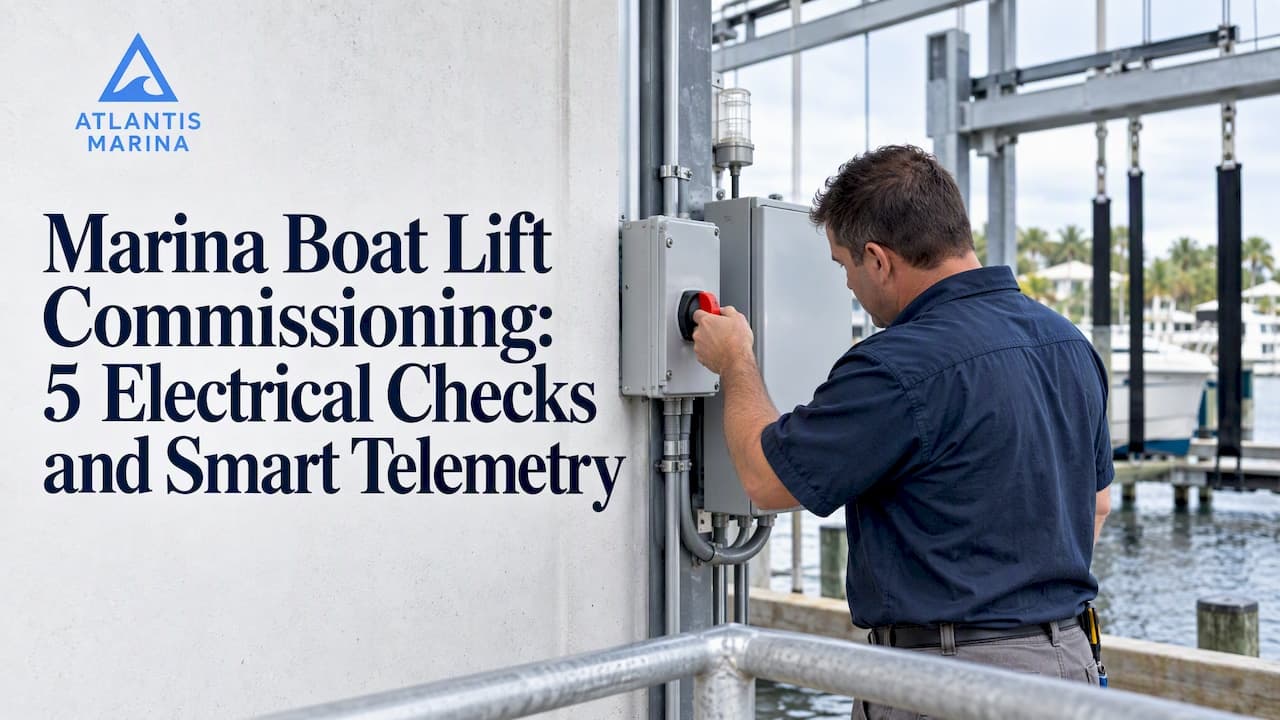
A boat lift commissioning checklist confirms that structure, electrical safety, mechanical operation, controls, and operator training are all sound before the lift carries a vessel. Follow a sequence: inspect, dry-test with no vessel, test with the boat, carry out any manufacturer-specified load testing, then document and train. Check GFCI protection, grounding and bonding, and the shore disconnect before anything else.
TL;DR:
- Have a licensed electrician verify the dedicated circuit, GFCI and feeder protection, grounding, bonding, and accessible shore disconnect; permits and code adoption vary locally.
- Run a full dry cycle before placing the boat, then test slowly with the vessel secured and complete capacity testing only as the manufacturer directs.
- After commissioning, test GFCI protection monthly, log each trip test, and refer devices that trip repeatedly to an electrician rather than returning them to service.
- Test every limit switch, interlock, and emergency stop with the platform empty, and trigger a sample fault to confirm mobile alerts reach staff.
- Record amp draw, fault codes, run times, photographs, and operator signatures, then keep manuals and the completed checklist both onsite and digitally.
Table of Contents
- What should you inspect on the structure and hardware first?
- Which electrical safety checks protect people and equipment?
- How do you check the mechanical, hydraulic, and power systems?
- How do you verify controls, limit switches, and telemetry?
- What is the testing sequence and what counts as a pass?
- What documentation, training, and inspection schedule finish commissioning?
- What do commissioning crews most often miss?
- How we help you commission and maintain smart lifts
- FAQ
- Sources
What should you inspect on the structure and hardware first?
Start before any power goes on. A lift that is mechanically wrong will fail electrically and hydraulically no matter how well you test it later, so this pass sets the baseline for everything that follows.
- Inspect frame members, welds, and structural hardware for cracks, bends, or corrosion.
- Confirm every bolt and fastener is present and torqued to the manufacturer's recommendation. A manufacturer manual example lists tight frame and platform fastenings as a pre-lift check.
- Verify leg pins are installed and adjustable legs are set correctly, with the frame square and level and the platform level at its lowest position.
- Check overhead and underwater travel clearances, and make sure no auxiliary equipment hangs on the lift.
- Photograph any pre-existing damage and record every finding for the commissioning file.
Acceptance is simple: no cracks, no missing hardware, no unexplained play, and a platform that sits level and square. Anything that fails goes on a punch list and gets fixed before power-on, not after.
Pro Tip: Check the manufacturer's guidance before applying anti-seize to stainless-steel mating surfaces. Suitable assembly practices can help avoid seized hardware.

Which electrical safety checks protect people and equipment?
Electrical faults around water can be lethal, so this section deserves the most care. Bring in a licensed electrician and confirm permits with your local authority, since code adoption and permitting vary by jurisdiction. NEC Article 555 governs marina and dock installations.
- Confirm a dedicated, permanently wired circuit sized for the motor, and check voltage drop on long runs. Consider 230V for long runs or heavy motors, as dock electrical guidance describes.
- Test the GFCI protecting the lift and any feeder-level GFPE: press TEST, confirm the device trips, then reset it. Flag repeat trips for electrician follow-up.
- Confirm that the disconnect is weatherproof, readily accessible, and labeled, and check with a licensed electrician that it is suitable for the installation.
- Verify continuous equipment grounding and bonding of metal dock parts and the lift frame.
- Check that no extension cords are in use, and that wiring methods and enclosures suit a wet, corrosive location.
Why this matters: electrical safety specialists at ESFI point out that current leaking into the water can cause electric shock drowning, which is why every GFCI and ELCI must be verified working.
Code references help you set acceptance criteria. EC&M's NEC notes state that boat hoists not exceeding 240V need GFCI protection under Article 555, and that disconnects must isolate each shore power connection.
How do you check the mechanical, hydraulic, and power systems?
Once structure and electrical protection pass, move to the parts that do the lifting. Leaks and weak batteries show up here long before they show up as a stuck boat.
- Inspect hydraulic hoses, fittings, and seals for leaks, and confirm connections and pressure against the manual.
- Check motor mounting, wiring insulation, and strain relireliefs, and confirm the motor turns freely where a manual override exists.
- On battery systems, check condition, fluid levels where applicable, terminal cleanliness, secure mounting, and charge level per manufacturer guidance.
- Confirm charger polarity and output voltage, whether the charger is solar or AC.
- Remove any dealer-installed safety locks before testing. The manufacturer example above lists removing locking devices as a pre-operation step.
- Confirm nothing else is attached to the lift.
A leak that weeps under no load will usually become a drip under load. Treat any seepage at commissioning as a failed check and not as something to watch.
How do you verify controls, limit switches, and telemetry?
Controls decide whether an operator can stop the lift when it matters. Test them empty, with no vessel on the platform.
- Trip each limit switch and safety interlock, and confirm the lift stops and the emergency stop behaves as designed.
- Check remote transmitter range and clear line-of-sight operation, then test operator station controls and local disconnects.
- Confirm control enclosures are weatherproof and labeled, with strain reliefs on all wiring.
- If a smart controller is installed, verify it reports motor runtime and fault alerts to your operations dashboard, and set thresholds for mobile alerts. Our guide to boat lift mobile alerts covers how those notifications reach your phone.
- Record who may operate each remote and where spare transmitters and lockout tags are stored.
Pro Tip: Trigger a fault on purpose during commissioning and confirm the alert actually lands on a staff phone. A silent alert path is a failed test.
What is the testing sequence and what counts as a pass?
Run the tests in order and never skip ahead. Each stage protects the next.
- Dry run, no vessel. Cycle the lift through full travel and watch for binding, unusual noise, or control faults.
- Vessel test. Position the boat correctly with drain plugs in and the hull secured. Operate at slow speed and check alignment and stability. The manual example runs the lift first without and then with the boat.
- Rated-capacity test. Follow the manufacturer's guidance. Watch motor amp draw, temperature, and control response, and stop immediately on any sign of slipping or overheating.
- Log the results. Record amp draw, fault codes, run times, and operator signatures in the commissioning report.
- Sign off. Require acceptance from the installing technician and the dockmaster or owner/operator.
A pass means smooth, quiet travel, stable holding at every height, controls that respond immediately, and readings that stay inside the manufacturer's stated limits. If any reading drifts, stop, fix the cause, and repeat the stage.
What documentation, training, and inspection schedule finish commissioning?
Commissioning is not done when the boat floats off. It is done when the record exists and the people running the lift understand it.
- Produce a commissioning report with photos, test results, who performed each step, dates, and open follow-up items.
- Train operators on manual controls, emergency stop procedures, proper boat placement, and the pre-use checklist, then collect their sign-off.
- Keep manufacturer manuals and the completed checklist on-site and in digital form, with copies in your facility management system.
- Schedule recurring checks, including GFCI tests and pre-use inspections, following the manufacturer's guidance and applicable local requirements, and log each one.
- Keep vendor contacts and warranty documents within reach.
What do commissioning crews most often miss?
The failures I see are rarely exotic. One is a single missed fastener that loosens over a season. Another is a GFCI that trips after the first big storm because nobody tested it under real moisture. Both are cheap to catch and expensive to ignore.
Keep the records, and cross-train staff so the checklist does not live in one person's head. Then connect lift telemetry to your operations dashboard, so a developing fault shows up as an alert and not as a stranded boat. Our look at remote boat lift monitoring shows how that works in practice.
— John R
How we help you commission and maintain smart lifts

Paper checklists get lost between seasons. We built our platform to bring marina operations and smart lift technology together in one place your whole team can reach.
- Smart-lift controller telemetry with mobile alerts
See how smart boat lift control fits your docks, review plans and pricing, or contact our sales team to request a demo.
FAQ
What is a boat lift commissioning checklist?
It is a written, step-by-step verification that a newly installed lift is structurally sound, electrically safe, mechanically reliable, and properly controlled. It ends with documented testing and operator training. Marinas keep it as the record that the lift was safe to put into service.
Who should perform the electrical checks?
A licensed electrician should handle the wiring, grounding, and ground-fault protection, and confirm local permits. Requirements follow NEC Article 555 and vary with the code edition your jurisdiction has adopted.
How often should GFCI protection be tested after commissioning?
Test it monthly by pressing TEST, confirming the trip, and resetting. Log each test, and send any device that trips repeatedly to an electrician for follow-up.
Should the lift be tested with a boat on it?
Yes, but only after a dry run with no vessel passes. Then test with the boat in place, and finish with a rated-capacity test following the manufacturer's guidance.
Sources
- Esfi
- Boat Lift Electrical: Dock Wiring, GFCI, and NEC 555 | Boat Lift Lab
- Boat Lift Electrical Installation | Dock Electrical Safety | Trophy Electric LLC
- Navigating NEC Requirements for Marinas and Boatyards | EC&M
- RGC HL9000 Instructions Manual (Page 4 of 33) | ManualsLib