

A marina chargeback happens when a cardholder disputes a charge through their bank rather than contacting you directly, reversing the payment before you've had a chance to respond. The moment you're notified, gather your evidence (signed contract, condition photos, communication records) and check your processor's response deadline immediately, since most windows close in days, not weeks.
TL;DR:
- Using pre-authorization holds for damage deposits and disclosing them clearly reduces dispute risks significantly.
- Timestamped condition reports with consistent photos and immediate charge notices within 48 hours strengthen your evidence during disputes.
- Automating notifications and clearly outlining damage calculation methods in contracts minimize confusion and potential chargebacks.
- Responding promptly within your processor’s deadline and providing comprehensive evidence, including signed agreements and proof of delivery, increases your chances of winning disputes.
- Implementing automated, integrated payment and documentation systems like Atlantis Marina's platform helps maintain operational consistency and reduces manual errors.
Table of Contents
- Understanding Marina Chargebacks and How the Dispute Process Works
- Common Marina-Specific Reasons Chargebacks Happen
- Preventing Chargebacks: Policies, Documentation, and Communication
- Responding to a Marina Chargeback: Evidence and Representment
- Payments Technology That Reduces Marina Chargebacks
- How Atlantis Marina Puts These Controls Into Practice
- What Most Operators Get Wrong About Chargebacks
- Let Atlantis Marina Handle the Paper Trail For You
- Sources
- FAQ
Understanding Marina Chargebacks and How the Dispute Process Works
A chargeback starts when a cardholder contacts their bank instead of you, claiming a charge is fraudulent, unauthorized, or unfair. The issuer reviews the claim, assigns it a reason code, and typically reverses the funds from your account immediately, before you've said a word in your defense. That's the provisional reversal, and it puts the burden on you to prove the charge was legitimate within a fixed response window.
Reason codes generally fall into four buckets: fraud (someone else's card was used), friendly fraud (the cardholder made the purchase but disputes it anyway), billing errors (duplicate or incorrect amounts), and service disputes (the customer says they didn't get what they paid for). Stripe's dispute category documentation breaks these down in detail, and mapping your response to the specific code matters more than most operators realize.
Marinas carry unique exposure here. You're processing holds and charges for damage deposits, billing transient boaters who may not recognize your business name on a statement, and running recurring tenancy billing for seasonal slips, all of which create distinct dispute patterns.
Common Marina-Specific Reasons Chargebacks Happen
Certain scenarios show up again and again in marina dispute logs, and most trace back to gaps in documentation or timing rather than actual fraud.
- Damage and deposit disputes. A boater disagrees with a damage charge, especially when there's no photo evidence or the charge notice arrived weeks after checkout.
- Unrecognized transaction claims. Visiting boaters, especially those using a shared or corporate card, often don't recognize your marina's billing descriptor and dispute the charge reflexively.
- Recurring billing pushback. Seasonal slip renewals and autopay charges get disputed when tenants forget they signed up, or feel they weren't warned before the renewal hit.
- Duplicate charges and post-cancellation billing. A slip canceled mid-season but still billed the following cycle is one of the most avoidable chargeback triggers in the industry.
- Service-performance disagreements. A boater claims a lift or service appointment wasn't delivered as promised, which lands as a straightforward service dispute.
Merchants classified under MCC 4468 (marinas and marine services) already face heightened scrutiny from card networks, including elevated processing rates and, in some cases, reserve requirements, according to payment industry classification data. That scrutiny only grows when dispute rates climb, which makes prevention worth far more than the cost of the paperwork.
Pro Tip: Tag every damage-related charge internally with the date the condition report was completed. If you can't produce that timestamp fast during a dispute, your evidence packet is already weaker than it should be.
Preventing Chargebacks: Policies, Documentation, and Communication
Most marina chargebacks are preventable with three changes: how you charge, how you document, and how you notify.
Charge structure. Use a pre-authorization hold for damage deposits instead of an immediate charge. A hold reduces refund friction and lowers dispute risk because you're not moving money until damage is confirmed. Disclose the hold amount clearly at booking and again on the rental agreement itself.
Documentation standards. Standardize a timestamped condition report at both dispatch and return, with side-by-side photos covering the same angles each time. A single blurry photo of a hull scratch, taken who-knows-when, rarely survives a dispute review. A consistent checklist does.
Notification timing. Card issuers and banks tend to view damage charges levied weeks after an incident as suspicious, while charges issued within 48 hours read as legitimate and well-documented. Automate your charge notification to go out within that window, and keep delivery or read receipts as proof the customer was informed.
Here's the operational sequence worth building into your workflow:
- Complete a photo-documented inspection at both check-in and check-out.
- Issue any damage charge notice within 48 hours, with photos attached.
- Retain proof of delivery (email open, SMS confirmation, or signed acknowledgment).
- Spell out your damage calculation method, waiver options, and appeal process in the rental contract itself.
- For recurring billing, send a pre-renewal notice at least several days ahead, with a clear, visible cancellation path.
Contracts should never leave the damage-calculation method to interpretation. State it plainly: hourly labor rate, parts cost, and a cap where applicable. Include a waiver option customers can purchase upfront, and list a real phone number or email for disputes before they escalate to the bank.
Pro Tip: If your recurring billing contract doesn't clearly state the renewal date and cancellation deadline in bold text, assume half your renewal disputes are actually confusion, not fraud.
Operators who consistently apply timestamped documentation, signed waivers, and prompt charge notices report noticeably stronger outcomes when disputes do arise, since the paper trail does the arguing for them.
Responding to a Marina Chargeback: Evidence and Representment
The moment a dispute notice arrives, read it fully, note the acquirer's deadline, and tag the case by reason code before doing anything else. Missing the response window is the single fastest way to lose a chargeback you could have won.
Your evidence packet should include:
- The signed rental or slip agreement
- Pre- and post-service condition photos, timestamped
- The completed inspection checklist
- Any repair invoice tied to the disputed charge
- A copy of the charge notification and its delivery confirmation
- A log of customer communications, including any resolution attempts
- The original booking or reservation reference
Structure your representment letter to walk the issuer through the timeline in plain language: what was agreed, what happened, what was charged, and when the customer was notified. Upload it through your processor's dispute portal, following the recommended evidence formats and timing your processor specifies, since a poorly formatted submission can undercut a strong case.
Not every dispute is worth fighting. Weigh the dispute fees your processor charges against the disputed amount and the strength of your documentation. A well-documented $400 damage charge is worth fighting. A $30 discrepancy with no photos probably isn't. Processors also allow you to withdraw a dispute if you find a resolution with the customer directly before the deadline, which is often faster than a full representment cycle.
Payments Technology That Reduces Marina Chargebacks
The right payment setup prevents disputes before they start. Step-up authentication (3DS) adds a verification layer for high-ticket transactions or unfamiliar cards, which is worth enabling for large deposit holds. Velocity checks flag rapid repeat charges on the same card, catching billing errors before a customer notices and disputes them.
Autopay needs its own safeguards: automated email receipts for every charge, a pre-renewal notice before seasonal billing hits, and a cancellation flow the customer can complete without calling anyone. Stripe's dispute best-practices guidance is worth reviewing directly if you manage your own gateway settings.
Integrations matter more than most operators expect. Syncing payments to QuickBooks Online means your evidence trail and your books never disagree, and a centralized dispute manager cuts the admin time spent hunting down a single receipt across three different systems. That speed translates directly into stronger representment outcomes, since disputes reviewed and submitted quickly tend to fare better than ones assembled under deadline pressure. For a deeper look at how these pieces fit together, see this overview of marina payment processing.
How Atlantis Marina Puts These Controls Into Practice
Atlantis Marina builds these safeguards directly into daily operations rather than leaving them to manual habit.
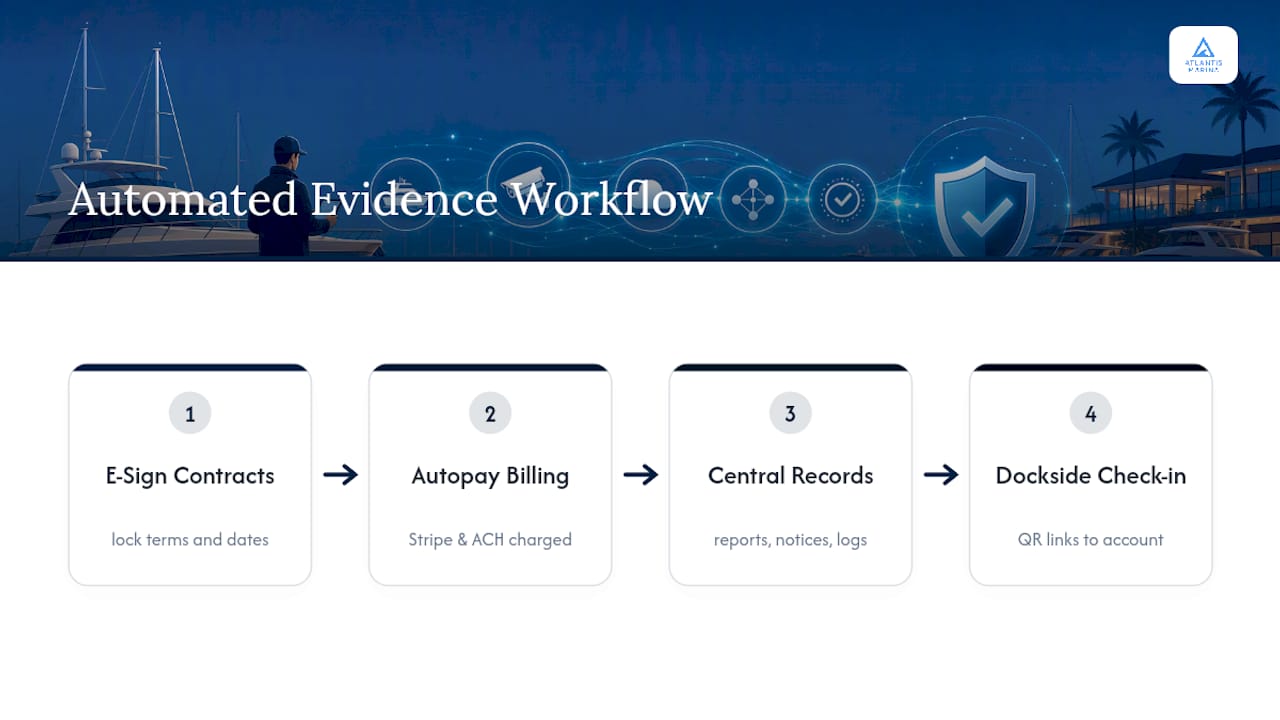
- Atlantis E-Sign contracts lock in damage terms and cancellation policies at signing, with a timestamped record.
- Autopay via Stripe and ACH, plus Instant Pay, keep billing predictable and receipts automatic.
- Timestamped condition reports attach directly to the vessel record, not a loose folder on someone's desktop.
- Automated charge notifications fire within your set window, with delivery confirmation logged.
- QuickBooks Online sync keeps your evidence and your books aligned automatically.
QR-code check-in ties a dockside interaction straight to the right customer account, so a dockhand snapping a damage photo attaches it to the correct reservation instantly. Staff can then pull the full history through Atlantis Bot and the operations dashboard when a dispute lands, turning what used to be a scavenger hunt into a five-minute export.
What Most Operators Get Wrong About Chargebacks
Automating documentation pays off the moment your dispute volume outpaces what one person can track by memory. Below that threshold, the cheapest fix is often just tightening your contract language and photo habits, not buying new software.
The three mistakes I see most: inconsistent photo angles between check-in and check-out, charge notices sent a week too late, and contracts that never spell out the damage calculation. Run a one-hour audit of your last ten disputes against those three points before you invest in anything else.
— John R
Let Atlantis Marina Handle the Paper Trail For You
Every prevention step described above, from pre-authorized holds to timestamped inspections to 48-hour charge notices, only works if it happens consistently, every single time, without relying on someone remembering to do it. Atlantis Marina is built to make that consistency automatic instead of aspirational.
The platform pairs Atlantis E-Sign contracts with automated Stripe and ACH billing, so damage terms and renewal dates are locked in from day one rather than argued over after the fact. Condition reports, charge notices, and communication logs live in one centralized record tied to each vessel, which means when a dispute notice arrives, your evidence folder is already built instead of scattered across email threads and a phone camera roll. Explore the marina billing platform to see how contracts, autopay, and documentation connect, or dig into recurring billing workflows built specifically for seasonal slip tenants. On the customer side, QR-code check-ins similar to the workflows detailed in RESTOBOT's payment guide connect a dockside interaction to the right account instantly, cutting down the "I don't recognize this charge" disputes that plague transient billing.
Ready to see it running against your own docks? Request a demo through Atlantis Marina's sales team and walk through your current chargeback exposure with someone who's built the fix.
Sources
For processor-level detail, review Stripe's guides on dispute categories and evidence best practices, plus Atlantis Marina's guide to invoice management.
FAQ
Can you go to jail for filing a chargeback?
No, filing a legitimate chargeback is a consumer right, not a crime. Repeatedly filing false or fraudulent chargeback claims, however, can constitute fraud and carries legal consequences for the cardholder.
What are valid reasons for a chargeback?
Valid reasons include unauthorized or fraudulent transactions, billing errors like duplicate charges, and cases where a service wasn't delivered as agreed, categories Stripe's dispute documentation outlines in detail.
Can you win a chargeback dispute as a marina operator?
Yes, with strong documentation. Signed contracts, timestamped condition photos, and prompt charge notices sent within 48 hours give you a real chance at winning representment, especially against friendly-fraud or service-dispute claims.
Can a customer get their money back after a chargeback is filed?
Yes, the cardholder receives a provisional credit as soon as the issuer accepts the dispute, before your response is even reviewed. If your representment succeeds, that reversal is undone and the funds return to you.
How long do I have to respond to a marina chargeback?
Response windows vary by processor but are typically measured in days, not weeks, so check your dispute notice immediately and follow your processor's response procedures closely.