

Optimize for revenue per available berth, not occupancy alone. RevPAB blends how full your marina runs with what you actually charge, and the fastest path to raising it is tiered pricing, seasonal rate bands, and billing automation working together. Chasing full docks with constant discounts erodes long-term revenue; a platform to run rate boards, contracts, and payments without manual overhead is what makes the strategy stick.
TL;DR:
- Optimizing dockage rates requires using data on occupancy, seasonality, and competitor pricing rather than relying on last year's rates or discounts.
- Maintaining accurate monthly metrics like RevPAB, average daily rate, and booking lead time helps detect pricing issues before revenue declines occur.
- Tiered pricing, contract incentives, demand-based transient rates, and bundled amenities maximize revenue without sacrificing long-term customer trust.
- Automating billing, rate enforcement, and reservation updates reduces operational leaks and ensures consistent rate discipline across the marina.
- Legal, contractual, and regulatory factors—such as lease restrictions, compliance laws, and utility disclosures—must be understood when implementing dynamic or seasonal pricing strategies.
Table of Contents
- What Is Marina Rate Optimization and Why Does RevPAB Matter?
- Which Metrics Should You Track Every Month?
- What Pricing Models Actually Work for Marina Slips?
- How Do You Set Up Seasonal and Dynamic Pricing Without Losing Trust?
- What Operational Systems Do You Need to Enforce Optimized Rates?
- Real-World Evidence From Marina Operations
- What Legal and Regulatory Factors Affect Marina Rate Setting?
- How Do Ancillary Fees Change Your Overall Rate Strategy?
- Author Perspective: Three Priorities Every Operator Should Act On This Season
- How Atlantis Marina Puts This Playbook Into Practice
- Sources
- FAQ
What Is Marina Rate Optimization and Why Does RevPAB Matter?
Marina rate optimization is the practice of setting dockage rates using data on occupancy, seasonality, and competitive position rather than gut instinct or last year's price sheet plus a flat percentage. The metric that separates a well-run marina from one that's merely full is RevPAB: revenue per available berth. It's calculated as total dockage revenue divided by the number of berths you have to sell, whether they're occupied or not.
Here's a simple example. A marina with 100 berths brings in $450,000 in dockage revenue over a quarter. RevPAB for that period is $4,500. If the premium marina's RevPAB comes out higher, it's outperforming on the metric that actually matters, even with empty slips.
Regression research on marina pricing backs this up. A study on competitive pricing in the marina business found that berth occupancy performance has a slightly stronger statistical pull on RevPAB than price position, but price position remains a major driver in its own right. Neither variable operates alone, which is why optimization has to work both levers instead of leaning on discounts to fill empty slips.
A related paper on marina price positioning found that marinas priced meaningfully below competitors did pull in higher occupancy, but their RevPAB came in only marginally lower than premium-priced marinas that ran emptier docks. Higher-priced marinas with lower occupancy actually posted slightly better RevPAB overall. That's the case against blanket discounting: undercutting the market fills your docks but rarely pays for itself, and it trains transient boaters and even annual tenants to expect a bargain.
| Positioning strategy | Typical occupancy | RevPAB outcome |
|---|---|---|
| Priced below market | Higher | Slightly lower |
| Priced at market | Moderate | Balanced |
| Priced above market | Lower | Slightly higher |
There's a brand cost to discounting that doesn't show up in a spreadsheet immediately. Once a marina develops a reputation as the cheap option, raising rates later invites pushback from tenants who feel entitled to last year's price. Consider what discount-driven pricing actually does over time:
- It trains repeat customers to wait for a deal instead of booking early.
- It signals lower quality to boaters comparing marinas on amenities, not just price.
- It makes future rate increases feel like a broken promise rather than a market adjustment.
- It compresses margin exactly when fuel, labor, and insurance costs are climbing.
Price position and occupancy are both levers you pull, not a choice between them.
Which Metrics Should You Track Every Month?
Six numbers tell you whether your pricing is working: occupancy by berth type, average daily rate (ADR), RevPAB, booking lead time, tenant churn, and no-show rate. Track these monthly, and you'll spot a pricing problem weeks before it shows up as a revenue shortfall on your P&L.
Occupancy needs to be segmented, not reported as one blended number. Segment by:
- Berth size or vessel length band
- Annual/seasonal contract vs. transient booking
- Amenity tier (power pedestal capacity, dry stack vs. wet slip, proximity to fuel dock)
ADR tells you what you're actually charging on average once every discount and surcharge nets out. RevPAB tells you whether that rate is working across your full inventory. Booking lead time, meanwhile, is an early warning system: when transient reservations start coming in closer to the arrival date than usual, demand is softening before occupancy numbers confirm it.
Pro Tip: Set an alert threshold, not just a report.
Churn and no-show rates round out the picture. A marina with strong bookings but rising annual-tenant churn is often quietly pricing itself out of retention even as new transient business masks the problem. No-show rates matter for a different reason: they tell you whether your deposit and cancellation policy is doing its job or whether you're holding berths open for reservations that never materialize, which is lost RevPAB you can't recover.
Run these six metrics side by side every month, segmented the same way each time, and pricing decisions stop being guesswork. You'll see a soft segment before it becomes a soft quarter.
What Pricing Models Actually Work for Marina Slips?
Four models cover most of what a marina needs: tiered pricing by vessel size and service level, contract-length discounting, transient rate bands, and bundled amenity pricing. Each one is a formula you can apply to your rate board this week.
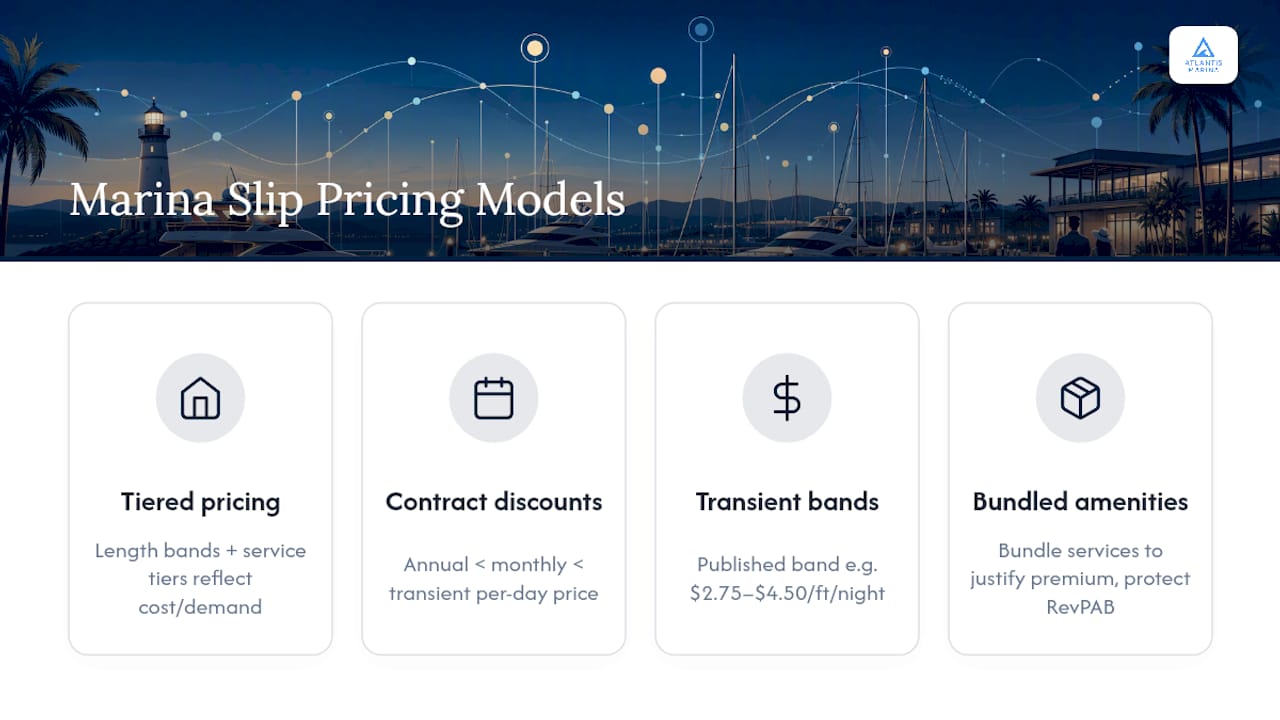
1. Tiered pricing by length and service level. Break berths into length bands, then layer a service tier on top for power, water depth, or proximity to amenities. The tiers should reflect real cost and demand differences, not arbitrary rounding.
2. Contract-length discounting. Annual tenants should pay less per day than monthly tenants, who pay less than transient boaters, in a clear stepped structure. Anything deeper than that starts eating into RevPAB without a corresponding retention benefit, based on the discounting research cited above.
3. Transient rate bands tied to demand. Transient slips should carry a base rate that flexes with a published band, not a single fixed number. A band of, say, $2.75 to $4.50 per foot per night gives your team room to move within pricing you've already approved, rather than negotiating from scratch on the dock.
4. Bundled amenity pricing. Instead of itemizing every fee, bundle security, reserved parking, and a discounted ramp fee into the annual contract rate. One piece of practical guidance on structuring annual contracts is to fold in a service bundle specifically to justify a premium and protect RevPAB when short-term demand spikes and transient rates climb past the annual tenant's locked-in rate.
Here's how the mix changes the math. The transient segment, priced correctly, is often the highest RevPAB contributor per berth even though it looks riskier on paper.
Bundling and tiering work together: a tenant who might balk at a $40 rate increase on a bare slip rental often accepts the same increase without complaint when it's presented as "includes reserved parking and priority fuel dock access." The slip rental pricing guidance Atlantis Marina has published covers additional worked examples for structuring these tiers by market size.
How Do You Set Up Seasonal and Dynamic Pricing Without Losing Trust?
Seasonal and dynamic pricing works when it's rule-based and transparent, not reactive and arbitrary. The goal is to raise rates when demand signals justify it and discount narrowly when it doesn't, without training tenants to distrust your rate board.
Five triggers should drive rate adjustments:
- Local events (regattas, fishing tournaments, boat shows) that spike short-term demand
- Holiday weekends and peak boating season windows
- Occupancy bands crossing a defined threshold (for example, above 85% or below 60%)
- Severe weather or storm season, which can either suppress or spike transient demand depending on your market
- Booking lead time trends, where shrinking lead times often signal firming demand before occupancy confirms it
Guardrails matter as much as the triggers themselves. Notify annual tenants and repeat transient customers of any rate change through a consistent channel, whether that's email, SMS, or an in-app message, so a price increase never feels like it happened without warning.
Pro Tip: Never discount below your published transient floor rate to fill a single slip on a slow Tuesday. One bad precedent on a review site or in a boater forum can undercut months of disciplined pricing.
The hotel and short-term rental industries have run demand-driven pricing for years, and the same logic transfers to marinas: use occupancy bands and lead time as your automated signal rather than manual daily rechecking of the rate board.
Testing a new pricing rule should happen in a controlled pilot, not a marina-wide rollout. Measure RevPAB change and booking lead time shift across the pilot period before expanding the rule marina-wide. If RevPAB improves without a spike in cancellations or complaints, you have evidence to scale it. If it doesn't, you've limited the downside to one segment instead of your whole property.
What Operational Systems Do You Need to Enforce Optimized Rates?
Pricing strategy only works if your operations can enforce it consistently, bill for it accurately, and report on it without a spreadsheet reconciliation every month. Four pillars make that possible.
- Contracts and disclosure. Every rate tier, deposit requirement, cancellation window, and ancillary fee needs to be spelled out in the signed contract before a tenant moves in. Vague fee structures are a leading driver of billing disputes and lost transient bookings, according to industry pricing guidance on marina rate clarity.
- Distribution and parity. Your published rate on your own website should match what you quote by phone and what appears on any third-party listing channel. Rate parity failures create the exact kind of confusion that erodes trust in your pricing.
- Billing and payment automation. Manual invoicing is where rate discipline quietly falls apart, since staff under pressure will informally round down a bill rather than chase a disputed few dollars. Automated billing through Stripe and ACH processing with QuickBooks sync removes that friction entirely, so the rate you set is the rate that gets billed and booked.
- Rate boards and reservation mapping. A digital rate board tied to your reservation system lets you update tiered and seasonal pricing in one place instead of updating a spreadsheet, your website, and your booking software separately.
Staffing needs a clear structure too:
- One person or role owns final approval on any rate rule change, including discount caps and seasonal triggers.
- Dockmasters and front-desk staff monitor daily occupancy and flag anomalies, but don't have authority to discount outside the approved band.
- A monthly review meeting checks the KPI set against the rate rules currently in effect and adjusts before the next season, not after it.
Waitlists deserve a specific mention here. Rather than discounting to fill a slip that just opened, a well-managed waitlist converts existing demand into a booking at full rate, since boaters on a waitlist have already signaled willingness to pay your published price.
Real-World Evidence From Marina Operations
Marinas that pair disciplined pricing with automated billing consistently outperform those relying on manual rate boards and paper contracts, and the gap shows up fastest in RevPAB, not gross occupancy. The pattern holds across markets: the marina that enforces its rate structure without exception collects more revenue per berth than the one that quietly discounts to avoid an awkward conversation on the dock.
Billing automation is where the discipline actually gets enforced. When deposits, autopay, and QuickBooks reconciliation run without manual entry, staff no longer have room to informally round down an invoice under pressure from a frustrated tenant. That single operational fix removes one of the most common ways rate discipline erodes in practice.
Waitlists shift the same dynamic from the demand side. A marina using a reservation map with an active waitlist converts a canceled or newly available berth into a full-rate booking instead of a rushed discount, because the next boater in line has already agreed to the published price.
The marinas seeing the clearest RevPAB gains aren't necessarily raising rates aggressively. They're closing the small leaks: the manually rounded-down invoice, the discounted slip that didn't need discounting, the transient booking lost to a competitor with a clearer online rate board. Automation closes those leaks without a single rate increase.
Atlantis Bot supports this from the operations side by fielding routine boater questions about reservations and billing status automatically, which frees dockmaster time for the judgment calls that actually require it, like approving an exception or handling a tenant escalation.
What Legal and Regulatory Factors Affect Marina Rate Setting?
Marina pricing sits inside a regulatory framework that varies by state and by whether the marina operates on public or leased waterfront land. Marinas built on land leased from a state, port authority, or Army Corps of Engineers easement often face rate caps, public-access requirements, or reporting obligations tied to the lease terms themselves, not general market pricing freedom. Check your lease or permit documentation before assuming full pricing flexibility on public waterway frontage.
Consumer protection law is the other major factor. Deposit handling, cancellation fee disclosure, and advance notice requirements for rate increases on existing tenants are governed by state contract law and, in some cases, marina-specific statutes. A rate increase mid-contract without the notice period specified in the signed agreement can expose a marina to a breach-of-contract claim, regardless of whether the increase itself was reasonable.
Fair housing and anti-discrimination principles that apply to residential landlords generally extend to marinas offering long-term liveaboard arrangements, which means rate and eligibility policies need to be applied consistently across tenants rather than negotiated ad hoc.
None of this replaces legal counsel familiar with your state's marina and waterfront leasing statutes. What it does mean operationally: every rate change, fee disclosure, and cancellation policy should be documented in a contract signed before the tenant moves a boat in, both to protect the marina and to make the pricing itself defensible if it's ever challenged.
How Do Ancillary Fees Change Your Overall Rate Strategy?
Utilities, maintenance access, and amenities aren't side income. They're a direct lever on RevPAB, because how you price and disclose them determines whether tenants feel they're getting fair value or being nickel-and-dimed.
Metered electricity and water are the clearest example. Marinas that pass through utility costs transparently, with a clear per-kilowatt or flat monthly utility fee stated in the contract, see far fewer billing disputes than those bundling an estimated utility charge into the base slip rate and adjusting quietly later. The transparent approach protects RevPAB because tenants aren't surprised by a bill and don't associate the surprise with a "hidden rate increase."
Maintenance and amenity access, meanwhile, are where bundling pays off. Pump-out service, ramp access, and dry storage transfers priced as part of an annual contract bundle justify a higher base rate than the same services offered a la carte, because the tenant perceives the bundle as convenience rather than upsell. This is the same bundling logic that applies to annual contract premiums generally: fold ancillary services into the rate, and the increase feels like added value instead of a fee.
Ship store and service marketplace revenue round out the ancillary picture. A marina running point-of-sale and service bookings through the same platform as its dockage billing captures ancillary revenue that a marina relying on a separate cash register or paper log typically loses to informal transactions never tied back to a tenant account.

Author Perspective: Three Priorities Every Operator Should Act On This Season
If you take one thing from this guide, measure RevPAB and ADR every month, not once a season. That single habit surfaces pricing problems before they become revenue problems. Second, build tiered pricing with real contract-length incentives; flat rates leave money on the table in both directions. Third, automate billing and rate updates so discipline doesn't depend on staff remembering to enforce it during a busy weekend. If you want to see how a platform handles all three, Atlantis Marina has demo materials worth a look.
— John R
How Atlantis Marina Puts This Playbook Into Practice
Atlantis Marina is the alternative to running your rate board on spreadsheets and paper contracts. It gives you one system where tiered pricing, seasonal rate rules, and billing enforcement actually connect, instead of living in three disconnected tools that drift out of sync by midseason.
Every tactic in this guide maps to a specific feature. Rate boards and reservation mapping let you update tiered and seasonal pricing in one place and have it reflect instantly across your booking channels. Billing automation through Stripe and ACH with QuickBooks sync enforces the rate you set, so no invoice gets quietly rounded down under pressure. Waitlists convert reopened berths into full-rate bookings instead of rushed discounts, and Atlantis Bot handles routine reservation and billing questions so your staff can focus on the pricing decisions that need a human judgment call. Ship-store POS and the operations dashboard tie ancillary revenue and occupancy reporting into the same view you use for RevPAB tracking.
If you're ready to see how these pieces fit your marina specifically, request a demo through Atlantis Marina's sales page and walk through your current rate structure with the team.
Sources
- The Competitive pricing in marina business: Exploring relative price position and price fluctuation
- The Competitive pricing in marina business (RePEc/HAL version)
FAQ
What Is RevPAB and Why Should I Track It Instead of Occupancy?
RevPAB, or revenue per available berth, divides total dockage revenue by total berths, occupied or not, giving you a truer measure of pricing health than occupancy alone. A marina can run high occupancy on discounted rates and still post a lower RevPAB than a marina charging market-rate prices with more empty slips.
What Are Typical Cap Rates for Marinas?
Marina cap rates vary widely by region, waterfront access, and lease structure, and no single figure applies universally across the industry. Consult a marina-focused commercial real estate appraiser or broker for a cap rate specific to your market and property type rather than relying on a generic industry average.
What Is the Best Marina Management Software?
The right platform depends on your marina's size and needs, but look for one that unifies rate boards, reservations, billing automation, and reporting in a single system rather than requiring separate tools. Atlantis Marina was built specifically to combine those functions, along with boater self-service and smart lift integrations, on one platform.
Why Do Marinas Charge So Much for Gas?
Marina fuel pricing reflects delivery logistics, storage and environmental compliance costs, low-volume purchasing compared to highway stations, and the convenience premium of dockside fueling. It's a separate cost structure from dockage pricing and isn't typically part of a berth rate optimization strategy.
Can I Sleep on My Boat in a Marina?
Liveaboard policies vary by marina and are often governed by local zoning, marina lease terms, and state regulations on residential use of waterfront facilities. Check your specific marina's contract and local ordinances, since liveaboard arrangements frequently carry different rate structures and utility terms than standard slip rentals.