

Effective marina waitlist management means organizing the queue of boaters seeking available slips with legal clarity, operational discipline, and technology that removes the guesswork. Done well, it protects your marina from disputes, fills slips faster, and gives every boater on the list a fair shot. Done poorly, it costs you revenue, trust, and tenants. This guide covers the full picture: legal frameworks, operational realities, software features, and a practical checklist you can put to work immediately.
Key components of a well-run waitlist system include:
- Legal and contractual clarity on slip rights, lease types, and cancellation terms
- Operational discipline around vessel sizing, real-time berth visibility, and demand tracking
- Software automation for priority scoring, notifications, and billing integration
- Transparent communication that keeps waitlisted boaters informed and engaged
Pro Tip: Treat your waitlist as a CRM extension, not just a queue. Tracking vessel specs, contact history, and lease preferences for every applicant lets you personalize boater communication well before a slip opens, which builds loyalty and reduces no-shows when you finally make an offer.
Table of Contents
- What are the legal and contractual realities of slip rights?
- Why manual waitlist management creates operational problems
- How does waitlist management software solve these challenges?
- How Atlantis Marina handles waitlist management end to end
- Best practices checklist for running a fair and accurate waitlist
- Atlantis Marina gives you one system for the full waitlist workflow
- Key Takeaways
- FAQ
What are the legal and contractual realities of slip rights?
Slip rights are legal interests, not informal courtesies. A boater on your waitlist who has paid a deposit or signed a reservation agreement may have enforceable rights depending on your state's contract law. That distinction shapes how you write your policies from day one.
Every waitlist program should rest on documented terms covering:
- Deposit and fee structure: what is collected, when it is refundable, and under what conditions it is forfeited
- Lease types offered: seasonal, annual, and month-to-month agreements each carry different renewal and cancellation rules
- Priority criteria: date added, vessel size flexibility, membership status, or lease term preference, stated explicitly so no applicant can claim the process was arbitrary
- No-show and cancellation policy: a clear deadline for accepting an offer and the consequence of missing it
- Service rules and utility access: which slips include shore power, water, and pump-out, and how those terms attach to the lease
Automated billing that ties directly to lease type, rate schedule, and deposit tracking keeps your financial records aligned with your legal commitments. Contracts signed electronically with a timestamped audit trail are far easier to defend than paper forms filed in a binder. Marinas that document every step of the assignment process reduce disputes and build the kind of institutional trust that keeps tenants renewing year after year.
Why manual waitlist management creates operational problems
The core problem with spreadsheet-based waitlist management is fragmentation. Reservations, vessel specs, berth assignments, and billing live in separate tools, and operational fragmentation causes double bookings, inefficient slip allocation, slow responses, and poor occupancy visibility. Each of those failures has a direct revenue cost.
Common operational challenges marina managers face include:
- Vessel-to-slip size mismatches: assigning a 45-foot vessel to a slip rated for 38 feet, or leaving a premium large slip vacant because no one checked the waitlist for compatible boats
- Seasonal demand spikes: spring and summer demand can overwhelm a manual process, creating backlogs that frustrate boaters and delay revenue
- Inconsistent communication: applicants who hear nothing for months disengage, accept slips elsewhere, or call repeatedly to check status
- No-show cascades: without a firm response deadline and automated follow-up, a single no-show can stall the entire assignment queue
- Lack of real-time berth visibility: a static spreadsheet cannot reflect arrivals, early departures, or slips under maintenance, so staff make decisions on stale data
Real-time berth visibility that shows current occupancy, expected arrivals, delayed departures, and dock conditions is the operational foundation that prevents these conflicts. Without it, even experienced dockmasters are reacting to problems rather than preventing them.

How does waitlist management software solve these challenges?
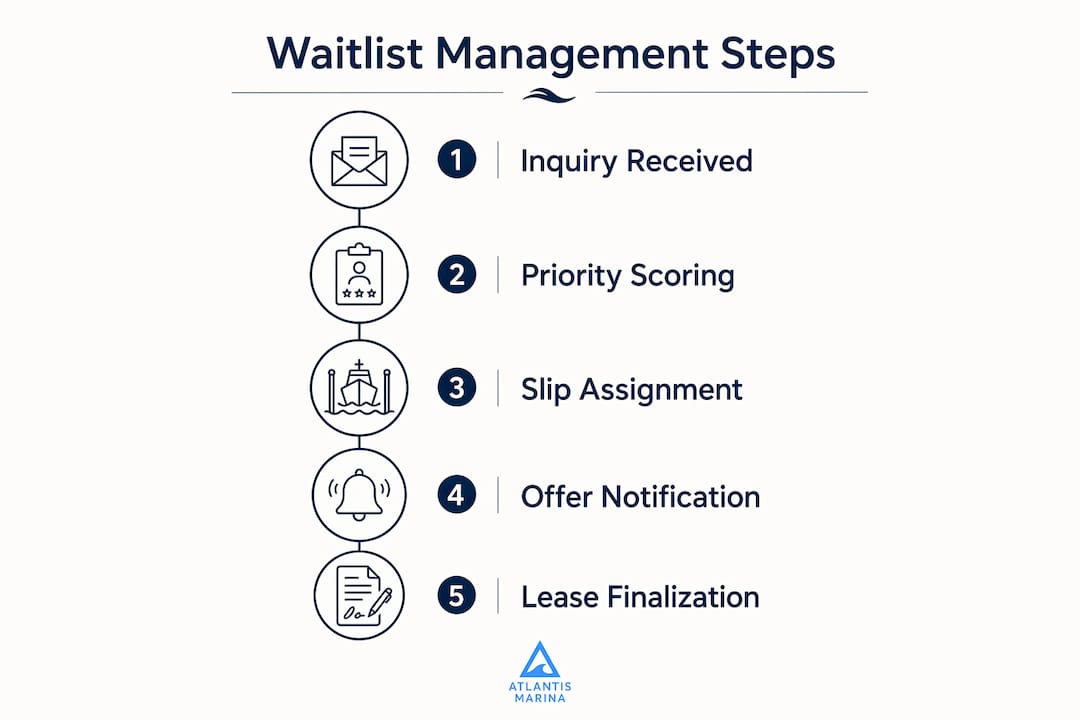
Purpose-built waitlist software replaces manual guesswork with automated logic. The most capable platforms handle priority scoring and automated notifications based on configurable criteria: date added, existing customer status, vessel size flexibility, and lease term preference. When a slip opens, the system identifies the highest-priority matching candidate and sends an offer with a response deadline automatically.
Key software features that directly improve waitlist operations:
- Vessel-to-slip matching engine: filters waitlist candidates by beam, draft, and length to prevent size mismatches and avoid wasting large slips on smaller vessels
- Interactive slip map: shows real-time assignment status, dimensions, utility connections, and water depth for every berth
- Automated offer notifications: email and SMS alerts with configurable response windows reduce no-shows and keep the queue moving
- Integrated lease management: generates seasonal and annual agreements, tracks renewal dates, and sends expiration alerts
- Document tracking: monitors insurance certificate and vessel registration expiration so you are never caught with an uninsured tenant
- Billing integration: connects slip assignments directly to rate schedules, deposits, and payment processing without manual entry
- Data privacy controls: protects customer information with access controls and compliance safeguards
The contrast between manual and software-driven management is significant across every operational dimension:
| Capability | Manual management | Software-driven management |
|---|---|---|
| Slip assignment | Staff judgment, prone to error | Automated matching by vessel dimensions |
| Waitlist priority | Informal or inconsistent | Configurable scoring criteria |
| Offer notifications | Phone calls or emails sent manually | Automated alerts with response deadlines |
| Lease generation | Paper forms or generic templates | Auto-generated, e-signed agreements |
| Billing accuracy | Manual entry, reconciliation errors | Tied directly to slip usage and lease terms |
| Berth visibility | Static spreadsheet | Real-time occupancy and dock status |
| Audit trail | Incomplete or missing | Full timestamped record of every action |
How Atlantis Marina handles waitlist management end to end
Atlantis Marina brings every layer of waitlist management into one cloud-based platform, from the first inquiry to a signed lease and automated billing. The operations dashboard gives dockmasters a live view of slip assignments, occupancy, reservations, and waitlist status without switching between tools. That single source of truth is what makes real-time decision-making possible.
The platform's capabilities that directly serve waitlist operations include:
- Slip assignment and waitlist management with vessel records, priority tracking, and offer workflows built into the same system as billing and contracts
- Atlantis E-Sign for electronic contract execution with a full audit trail, eliminating paper and manual filing
- Autopay and Instant Pay via Stripe and ACH, tied directly to lease type and rate schedule so billing runs without staff intervention
- Atlantis Boater App giving waitlisted boaters a self-service portal to submit vessel details, upload insurance and registration documents, sign contracts, and receive SMS and email updates from one account
- Atlantis Bot, the platform's built-in AI assistant, which answers boater questions on your marina website around the clock and handles routine reservation and billing inquiries without staff involvement
- QuickBooks Online sync keeping financial records current without duplicate entry
- AI-assisted occupancy forecasting that identifies demand trends, flags underutilized berths, and supports pricing decisions based on vessel category, season, and stay length
Atlantis Marina also supports marina facility operations beyond the waitlist itself, covering dry stack workflows, boat lift control, maintenance tracking, and ship store POS in the same connected system.
Pro Tip: Use Atlantis Marina's customer records to segment your waitlist by vessel type, preferred lease term, and tenure. Sending a targeted message to annual-lease prospects when a matching slip opens converts faster than a generic broadcast to the full list.

Best practices checklist for running a fair and accurate waitlist
Consistent process is what separates a waitlist that builds trust from one that generates complaints. The following checklist covers the operational and policy disciplines that hold up under scrutiny.
Legal and documentation standards:
- Write explicit priority criteria into your waitlist policy and publish them to applicants
- Document every fee, deposit, and refund condition in the signed agreement
- Use electronic contracts with timestamped signatures for every lease type
Operational disciplines:
- Audit your waitlist at least quarterly: verify vessel specs, contact information, and applicant status are current
- Set a firm offer response window (typically 48–72 hours) and enforce it consistently
- Track no-shows and cancellations in your system so patterns are visible and policy adjustments are data-driven
Communication standards:
- Send a confirmation when an applicant joins the waitlist, including their position and the criteria used for advancement
- Provide regular status updates, even when no slips are available, to maintain engagement
- Use automated notifications for offer delivery, document expiration, and lease renewal reminders
Software and integration practices:
- Connect your waitlist directly to your billing and contract system so assignment triggers the financial workflow automatically
- Use marina occupancy reporting to identify seasonal patterns and adjust transient slip availability accordingly
- Maintain data privacy controls and limit access to customer records to authorized staff only
Regular audit processes that review waitlist accuracy, policy consistency, and communication standards reduce disputes and strengthen boater trust over time.
Atlantis Marina gives you one system for the full waitlist workflow
Running a waitlist across disconnected tools costs you time, revenue, and tenant relationships. Atlantis Marina replaces that fragmented setup with a single platform covering slip assignments, automated billing, electronic contracts, real-time occupancy, and boater self-service in one place.
For marina managers who want to move from spreadsheets to a system that actually runs the workflow, Atlantis Marina handles the entire cycle: a boater submits their vessel details through the Atlantis Boater App, your team reviews the match against available slips, the offer goes out automatically, the contract is signed electronically, and billing starts without manual entry. No clipboards. No missed follow-ups. No billing reconciliation at month end.
The platform scales from a single-location marina modernizing its operations to a multi-property group managing hundreds of slips across sites. Whether you are handling a 60-person waitlist or a 600-person one, the logic stays consistent and the audit trail stays complete. Schedule a demo to see how Atlantis Marina fits your marina's specific slip inventory and waitlist volume.
Key Takeaways
Effective marina waitlist management requires legal documentation, real-time berth visibility, automated matching, and consistent communication working together as one connected system.
| Point | Details |
|---|---|
| Legal clarity is foundational | Document priority criteria, fees, and cancellation terms in every signed agreement to prevent disputes. |
| Fragmentation costs revenue | Disconnected reservations, billing, and vessel data cause double bookings and slow assignment cycles. |
| Matching engines prevent waste | Filtering waitlist candidates by vessel dimensions avoids size mismatches and fills high-value slips efficiently. |
| Audits protect fairness | Quarterly reviews of waitlist accuracy, policy consistency, and communication standards reduce boater complaints. |
| Atlantis Marina unifies the workflow | The platform connects slip assignments, automated billing, e-sign contracts, and boater self-service in one cloud-based system. |
FAQ
What is marina waitlist management?
Marina waitlist management is the process of organizing and advancing a queue of boaters seeking available slips, using documented priority criteria, vessel matching, and consistent communication to assign berths fairly and efficiently.
How does waitlist priority scoring work?
Priority scoring ranks applicants based on configurable factors such as date added, existing customer status, vessel size flexibility, and preferred lease term. When a slip opens, the system identifies the top-ranked compatible candidate and sends an automated offer notification.
What features should waitlist software for marinas include?
Core features include a vessel-to-slip matching engine, automated offer notifications with response deadlines, integrated lease and billing management, real-time occupancy visibility, document expiration tracking, and a full audit trail for every assignment decision.
How does Atlantis Marina support waitlist management?
Atlantis Marina manages the full cycle from initial inquiry through signed lease and automated billing, with the Atlantis Boater App giving applicants self-service access to submit documents, sign contracts, and receive updates without staff involvement.
How often should marina managers audit their waitlist?
A quarterly audit is the standard practice, covering vessel spec accuracy, applicant contact information, policy consistency, and communication records to maintain fairness and reduce the risk of disputes.