
Marina task management works when a cloud-based operations platform replaces clipboards and spreadsheets, and a Standard Operating Procedure sits behind every workflow the software runs. The combination matters more than either piece alone: software without documented process just digitizes confusion, and SOPs without software still require someone to remember everything by hand. A modern marina operations platform handles this by unifying reservations, automated billing, and staff task lists into one dashboard, so a slip request and a recurring invoice move through the same system instead of three disconnected tools.
TL;DR:
- Most marina operations are best improved by focusing on high-frequency tasks like reservations and billing before expanding to maintenance or inventory management.
- Software that unifies reservations, automated billing, vessel records, and staff task tracking minimizes manual work and reduces customer friction.
- Integrating hardware such as smart lift controls and security sensors can enhance safety, efficiency, and incident documentation during peak periods.
- Dashboards should automatically flag overdue tasks, unpaid invoices, and long launch queues, and route these issues to staff for quick resolution.
- Starting with limited pilot projects, documenting workflows, and staff training are essential to a successful transition to digital task management.
Table of Contents
- What Software Features Actually Handle Marina Daily Tasks?
- How Do Marinas Actually Use Task Management Software Day to Day?
- How Should a Marina Roll Out New Task Management Software?
- Which Integrations and Hardware Actually Pay Off?
- What KPIs Actually Tell You the System Is Working?
- How Does Atlantis Marina Put These Practices Into Practice?
- Emergency and Safety Task Management in the Marina
- Environmental Compliance and Sustainability Task Tracking
- Incident and Accident Reporting Workflows
- Inventory and Supplies Management for Marina Operations
- What I'd Tell Any Marina Manager Starting This Process
- Ready to See This Running at Your Marina?
- Sources
- FAQ
What Software Features Actually Handle Marina Daily Tasks?
The right feature set for marina task management isn't about having the most modules. It's about covering the five or six task categories that eat up staff time every single day and cause the most customer friction when they break down.
Slip reservations sit at the top of that list. A visual berth map with real-time availability, automated waitlists, and confirmation emails removes the back-and-phone-call cycle that still runs a surprising number of marinas. When a boater can see open slips and request one online, staff stop playing dispatcher for every incoming call.
Billing comes next, and it's often the biggest time sink nobody budgets for. Recurring charges, autopay enrollment, refunds, and adjustments need to run without a bookkeeper re-entering the same numbers every month. Sync to QuickBooks Online closes that loop so revenue gets billed, collected, and booked without someone manually reconciling two systems on a Friday afternoon.
Customer records function as the marina's institutional memory. Vessel details, insurance and registration documents, signed contracts, and contact history need to live in one place, not scattered across email threads and filing cabinets. Document management built for marina operators covers this in more depth, but the short version is: if a dockmaster has to hunt for a certificate of insurance during a storm, the system has already failed.
Staff coordination is where most legacy tools fall apart entirely. An operations dashboard that assigns tasks, tracks completion on mobile devices, and shows who's covering which dock at 6 a.m. replaces the whiteboard that half the team forgets to update.
Here's what a well-built system needs to cover at minimum:
- Slip reservations, visual berth mapping, and automated waitlist management
- Recurring billing, autopay, refunds, and accounting sync
- Vessel and customer records with document upload and e-signature contracts
- Task assignment and completion tracking accessible from a phone or tablet
- Launch and dry-stack scheduling tied to service appointments
- Point-of-sale and basic inventory tracking for the ship store
That last item surprises some owners, but a ship store running out of stock at the exact moment a transient boater walks in for fuel filters is a task-management failure just as much as a missed reservation.
How Do Marinas Actually Use Task Management Software Day to Day?
Features only matter once they turn into a sequence a dockmaster can run without thinking twice. Most marinas end up with five recurring workflow patterns that repeat daily, weekly, or seasonally.
- Reservation flow. A boater submits a request online, the system captures payment or a deposit, staff confirm slip assignment against the visual map, and the boater checks in on arrival, often through a QR code that pulls up their account instantly. This is the single most repeated workflow in any marina, and it's usually the first one operators automate because the volume is high and the process is standard enough to script.
- Dock-hand coordination. Launch queues, transient check-ins, and slip turnovers require dock hands to know, in real time, which boats are leaving and which are arriving. A shared task list beats a radio call every time someone needs to know if slip 14 is clear.
- Dry-stack and lift scheduling. Call queues for lift service and launch sequencing get complicated fast when a facility runs dozens of lifts on a summer weekend. Software that tracks which boats are queued and which lift is next prevents the double-booking that causes both delays and safety risk.
- Maintenance task scheduling. Recurring compliance checks, equipment inspections, and repair tickets need due dates and an owner, not a mental note. A missed pump-out inspection or a lift service that slips past its interval is exactly the kind of task that software should surface automatically rather than rely on someone remembering.
- Incident logging. When something goes wrong, from a minor dock scrape to a fuel spill, the response needs to be logged immediately with time stamps, names, and follow-up actions, not reconstructed from memory the next day.
Industry operations manuals back up why this sequencing matters: mapping tasks in the order customers actually experience them, a method known as service blueprinting, reveals which steps create bottlenecks and which ones are safe to automate first. A reservation intake process that looks simple on paper often hides three or four manual handoffs once you actually trace it.
How Should a Marina Roll Out New Task Management Software?
Buying software before mapping your own processes is the most common mistake marina operators make, and it's an expensive one. The Marina Industries Association's guidance on documented Standard Operating Procedures makes the case plainly: digital systems provide the framework, but managers still have to define the process, especially for safety, emergency, and maintenance work, before any software can enforce it.
Start by identifying your highest-frequency, most manual tasks. For most marinas that's reservation intake and billing, not maintenance tracking, because those two touch every customer and generate the most repetitive admin work.
Resist the urge to design a "grand model" that automates everything at once. Operational handbooks on stepwise service improvement consistently favor piloting one workflow, measuring the actual time saved, and expanding from there over attempting a full-scope redesign in one launch window.
A practical rollout checklist looks like this:
- Document your top five recurring tasks and who currently owns each one
- Pilot the new system on reservations or billing first, not everything simultaneously
- Assign role-based access so staff only see the tools relevant to their job
- Migrate vessel records, active contracts, and payment histories before go-live, not after
- Set checkpoints after several weeks and months to measure admin hours saved
Staff training deserves its own line item in that plan. The Certified Marina Operator program exists precisely because staff competence, not software sophistication, is usually the deciding factor between a smooth rollout and a rocky one.
Pro Tip: Migrate your active contracts and vessel insurance documents first, even before historical billing data. Staff need those on day one to answer boater questions; last year's invoices can wait a week.
Which Integrations and Hardware Actually Pay Off?
Not every integration is worth the setup time, and marinas that bolt on every available add-on often end up managing more complexity than they solve. A few categories consistently earn their cost.
Payment processing and accounting sync top that list. Stripe and ACH processing paired with QuickBooks Online sync eliminates the manual re-entry that turns a five-minute billing task into a half-day reconciliation project. This is also where cloud-hosted platforms show their real advantage: centralized updates and remote access mean a manager can check collection status from a phone at a different property entirely.
Smart lift control and dry-stack hardware matter most for facilities running high launch volume. Remote monitoring and controller integration reduce the number of manual phone calls between the office and the lift operator, and they cut down on the sequencing errors that cause safety incidents.
Security sensors and cameras serve a dual purpose: they support remote monitoring overnight, and they provide evidence when an incident report needs backup. Marine equipment standards from bodies like the National Marine Manufacturers Association are worth checking before adding any hardware tied to safety-critical functions.
QR-code check-in workflows connect a boater's physical presence to their digital account instantly, so staff aren't asking for a slip number or searching a spreadsheet while a line forms at the ship store counter.
Before adding anything, weigh:
- Payment and accounting integrations for billing accuracy
- Smart lift and hardware controls for high-volume launch facilities
- Cameras and sensors for overnight security and incident documentation
- QR-code and mobile workflows for faster in-person service
- Connectivity reliability and an offline fallback plan for dead zones on the water
What KPIs Actually Tell You the System Is Working?
Dashboards are only useful if they surface numbers that change what staff do next. Four metrics consistently matter more than the rest: occupancy rate, payment collection rate, average slip turnover time, and launch queue length. Watch those four and most operational problems surface before they become customer complaints.
What the dashboard should flag automatically: overdue maintenance tasks, invoices past their due date, and lift queues running longer than a set threshold, each routed to the staff member responsible, not left for someone to notice during a walk-through.
A dashboard that only reports numbers without prioritizing action items isn't doing its job. The better systems flag overdue tasks automatically, whether that's an unpaid invoice sitting past 30 days or a maintenance ticket nobody's touched in two weeks, and route them to the right staff member's task list. Mobile alerts extend that further: a dock hand gets pinged the moment a transient reservation needs a slip assignment, instead of finding out from a printed sheet an hour later.
The operations dashboard breakdown covers this in more detail, but the core discipline is simple: pick the KPI that's currently costing you the most staff hours, automate that workflow first, and measure the time saved before moving to the next one.
How Does Atlantis Marina Put These Practices Into Practice?
Atlantis Marina builds its platform around exactly this sequence: unify the high-frequency tasks first, then layer in automation and hardware. The core software covers reservations, billing, CRM, and staff task management in one cloud dashboard, so operators aren't stitching together four separate vendor tools.
Built-in AI assistants can answer routine boater questions on marina websites and help staff with day-to-day tasks like reservation lookups and ship store restocking, with staff confirming any action before it's finalized. Billing often includes autopay, Instant Pay, and payment processing integrations, synced to accounting software so revenue reconciles automatically. QR-code passes connect a boater's account to check-in, point-of-sale purchases, and service requests without staff searching a database by hand.
On the hardware side, smart boat lift controllers and remote monitoring extend the same task logic to dry-stack and lift operations, reducing manual call volume and sequencing risk during peak launch periods. Readers evaluating implementation fit for their own facility can review the operations dashboard guide for a closer look at how task prioritization surfaces on screen.
Emergency and Safety Task Management in the Marina
Emergency protocols can't live only in a binder on a shelf. They need to translate into task checklists staff can execute under pressure, whether that's a severe weather approach, a fuel dock incident, or a man-overboard call.
The starting point is always the same: documented procedures that specify who does what, in what order, before software enters the picture. MIA's guidance on marina operations systems treats emergency response templates as foundational, not optional, because a digital checklist only works if the underlying process was sound to begin with.
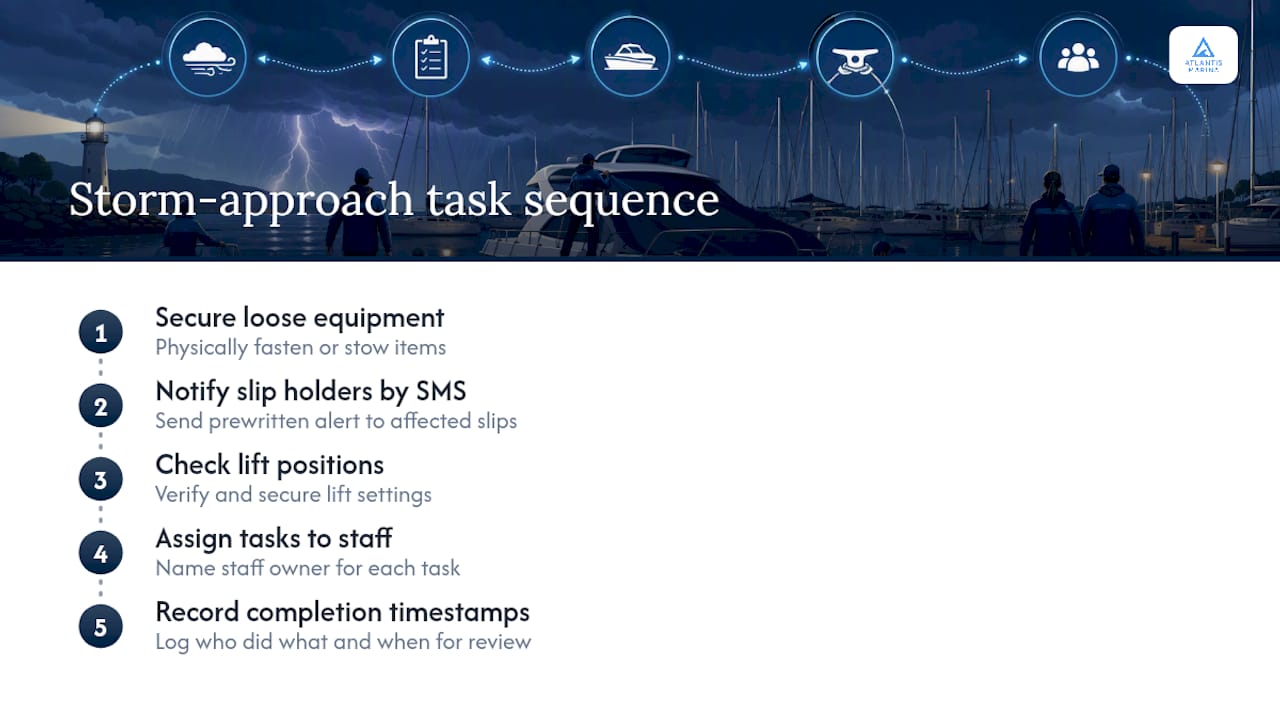
Once that SOP exists, software adds real value by turning it into an assignable, trackable task sequence. A storm-approach protocol might trigger tasks for securing loose equipment, notifying slip holders by SMS, and checking lift positions, each assigned to a specific staff member with a completion timestamp. That timestamp matters later: if an incident review happens, having a record of who did what and when protects the marina as much as it protects the boaters.
Staff training ties directly into this. A team that's been through Certified Marina Operator coursework or an equivalent program responds to an emergency task list with far more confidence than one seeing the protocol for the first time mid-crisis. Software can prompt the steps; it can't substitute for staff who already know why each step exists.
Environmental Compliance and Sustainability Task Tracking
Environmental compliance tasks tend to get skipped precisely because they're not urgent on any given day, until an inspection or a spill makes them urgent all at once. Fuel handling logs, bilge pump-out records, and waste disposal documentation all need recurring task entries with real due dates, not a mental note that "someone checks that."
Marinas operating near sensitive waterways often carry additional recordkeeping obligations tied to stormwater runoff and fuel containment. Treating these as recurring tasks with assigned owners, rather than annual scrambles before an audit, keeps a facility from discovering a gap at the worst possible time.
Sustainability tracking overlaps here in a practical way. Recording fuel dispensed, waste oil collected, and pump-out volumes isn't just good practice; it often feeds directly into the same compliance reports regulators expect. A task management system that logs these figures as they happen, rather than reconstructing them from paper receipts later, turns a compliance burden into a routine data entry.
The operational discipline is identical to everything else in this guide: define the recurring task, assign an owner, set a due date, and let the software surface it before it's overdue rather than after.
Incident and Accident Reporting Workflows
An incident report written an hour after the event is far more accurate than one written the next morning. That single fact should shape how a marina structures its reporting workflow.
The task itself needs three things: a simple intake form staff can complete from a phone or tablet dockside, mandatory fields for time, location, and people involved, and an automatic routing step that alerts a manager the moment a report is submitted. Waiting for someone to walk it to the office defeats the purpose.
Photo and video evidence matters more than most marinas initially plan for. A camera integration that captures footage around the time of an incident gives staff something more reliable than memory when insurance or liability questions come up later.
Reports shouldn't disappear into a folder once filed. A recurring review task, monthly or quarterly, that checks for patterns across incidents (the same slip, the same lift, the same time of day) turns individual reports into a genuine safety tool instead of a paperwork requirement.
Inventory and Supplies Management for Marina Operations
Ship store inventory rarely gets the attention that reservations and billing do, but running out of a common item during a busy weekend is a task-management failure with real revenue consequences. Fuel filters, life jackets, dock lines, and basic engine supplies need reorder triggers tied to actual sales velocity, not a manual count every few weeks.
Point-of-sale data, when it's connected to the same platform running reservations and billing, gives a clearer picture of what's actually moving. A reconciliation process built around real usage data replaces the weekly count-and-guess cycle that most smaller marinas still run.
Maintenance supplies deserve the same discipline as retail stock. Lift parts, dock hardware, and cleaning supplies for the facility itself often get tracked less carefully than what's sold at the counter, yet running short on a lift part during peak launch season causes far more disruption than an empty shelf in the ship store.
What I'd Tell Any Marina Manager Starting This Process
Staff buy-in beats feature lists every time. Start with one high-frequency task, reservations or billing, and measure the actual hours saved before expanding. The biggest pitfall isn't picking the wrong software; it's over-customizing workflows before a single boater has used the new system.
— John R
Ready to See This Running at Your Marina?
Everything covered here, reservations, automated billing, staff task lists, and smart lift control, runs as one connected system inside Atlantis Marina rather than as separate tools you have to reconcile by hand. If your team is still juggling a spreadsheet for waitlists and a separate app for billing, the marina management solution walks through how those pieces come together on one dashboard.
Operators evaluating a switch often start with reservations and billing since those carry the highest task volume, and Atlantis Marina's reservation software and billing automation are built to handle exactly that first phase without requiring a full system overhaul on day one. Facilities running lift operations can also look at smart lift control for the hardware side of task automation.
The next step is straightforward: request a demo or check current pricing to see how your specific task list, reservations, billing, maintenance, and staff coordination, would map onto the platform before committing to anything.
Sources
The Marina Industries Association publishes operations manuals and SOP templates, and its CMO certification program remains a standard credential for marina staff training.
- Marina Industries Association — Marina Operations System / MOS
- Microsoft Azure — What is the cloud?
- Efficient & profitable marina operation handbook — service blueprinting
FAQ
What Is the Best Marina Management Software?
The best option depends on your marina's size and priorities, but a strong platform unifies reservations, billing, staff task management, and hardware integrations in one cloud dashboard rather than requiring separate tools for each function. Atlantis Marina is built around that unified approach, covering everything from slip assignments to smart lift control.
What Is Marina Management?
Marina management covers the daily operational work of running a waterfront facility: slip reservations, billing, vessel and customer records, maintenance scheduling, safety protocols, and staff coordination. Modern marina task management typically pairs documented SOPs with cloud-based software to keep those tasks consistent and trackable.
Do Marinas Make a Lot of Money?
Marina profitability varies widely based on location, slip count, and services offered like fuel, ship store sales, and service appointments; well-run facilities with efficient billing collection and low vacancy tend to outperform those relying on manual processes. Reducing administrative time through task automation directly supports margins by cutting labor hours spent on paperwork.
What Does a Marina Do?
A marina provides docking, storage, and support services for boats, including slip rentals, fuel, maintenance, launch and lift services, and often retail and dining. Behind those visible services sits a constant stream of operational tasks, reservations, billing, safety checks, and maintenance, that determine how smoothly the facility actually runs.
How Do I Start Managing Marina Tasks More Efficiently?
Begin by mapping your highest-frequency manual tasks, usually reservations and billing, and pilot software on those before expanding to maintenance or inventory tracking. Industry guidance consistently favors this stepwise approach over attempting to automate every workflow at once.