
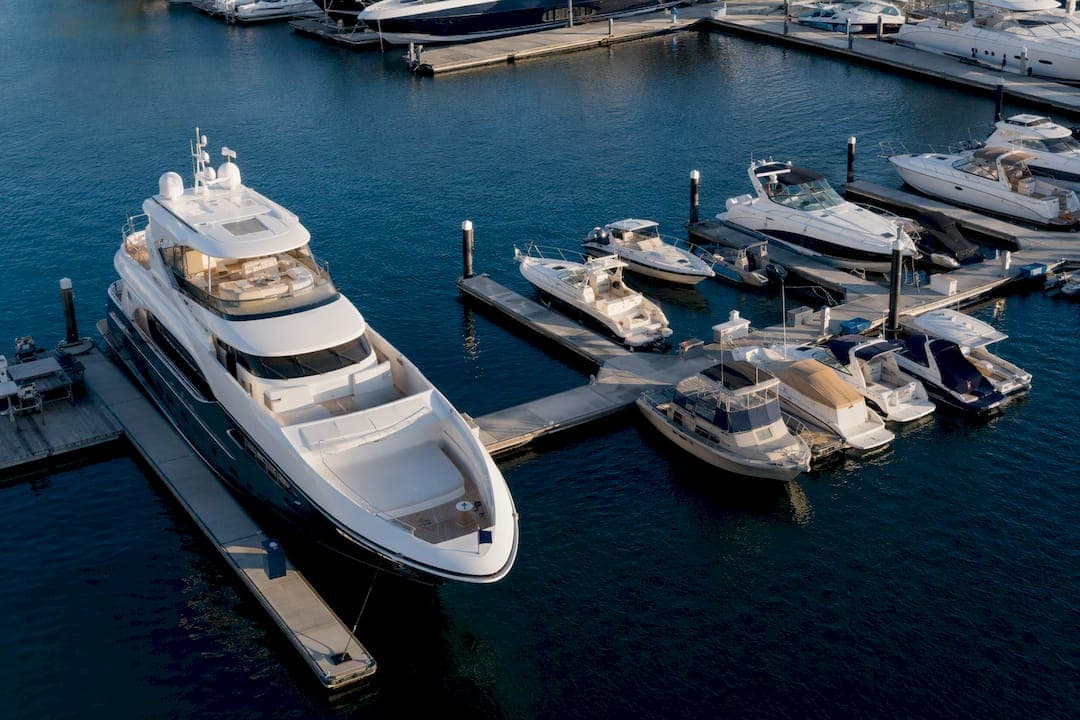
Maximizing marina occupancy starts with an honest audit of your current slip mix, followed by right-sizing your layout, automating reservations and waitlists, and piloting dynamic pricing on a small segment of inventory. Marina operators can support every one of those workflows in one operations platform. Operators who run this sequence typically see fewer vacancy days and steadier month-to-month revenue within a season.
TL;DR:
- Adjust your slip sizes and layout based on seasonal booking data to increase capacity by up to 20 percent without new construction.
- Pilot dynamic pricing on a small segment of slips, such as weekend reservations, and measure success through revenue per available berth rather than occupancy alone.
- Use automation for reservations, reminders, waitlists, and payments to reduce vacancy days and speed up fill times after cancellations.
- Maintain detailed, size-segmented occupancy and revenue metrics weekly during peak season to catch and address underperformance early.
- Focus on reconfiguration and automation before investing in capital upgrades like new docks or dredging, as these are slower, more costly, and less flexible options.
Table of Contents
- How Do You Calculate Your Marina Occupancy Rate?
- Audit Your Slip Mix and Layout to Fit Actual Demand
- What Pricing Strategy Closes Occupancy Gaps Fastest?
- Which Technology Features Actually Increase Fill Rate?
- How Should You Manage Waitlists and Last-Minute Cancellations?
- How Do You Market a Marina to Attract More Boaters?
- What KPIs Should You Track to Confirm Occupancy Is Improving?
- Author Perspective: Practical Trade-Offs for Operators
- Put These Tactics to Work With Atlantis Marina
- Sources
- FAQ
How Do You Calculate Your Marina Occupancy Rate?
Occupancy rate is occupied slips divided by total available slips, expressed as a percentage. Occupancy rate is calculated as occupied slips divided by total available slips, expressed as a percentage. For example, if many slips are occupied on a given day, your occupancy rate is high. That's the baseline math, but a single day's snapshot hides more than it reveals. A step-by-step occupancy calculation approach means tracking the number across categories and time periods, not just once.
Before you calculate anything, collect this data:
- Total slip capacity broken out by size category (30 ft, 40 ft, 50 ft plus, and so on).
- Occupied slips by category, separating permanent contracts from transient bookings.
- Average length of stay for each segment.
- Seasonal swings, since a marina running 90% in July and 45% in January needs a blended annual figure, not a single month reported as your rate.
Watch for two common data-quality mistakes: counting a slip as "occupied" when the contract is signed but the boat never arrives, and failing to separate size categories, which masks the fact that your 25-foot slips sit empty while 45-foot slips have a waiting list.
Audit Your Slip Mix and Layout to Fit Actual Demand
Most marinas lose occupancy not because demand is weak but because slip sizes don't match the boats trying to book them. A 60-foot slip sitting empty while three 35 foot boats wait on a list is a layout problem, not a marketing problem. Start by mapping your vessel-size distribution against your actual slip inventory, including fairway width and swing radius constraints that limit how tightly you can pack a basin.
Layout adjustments that typically recover usable capacity without new construction include:
- Reconfiguring finger piers to break up oversized slips into two smaller, high-demand berths.
- Reassigning slip categories based on twelve months of booking data instead of the original dock design.
- Removing dead space between poorly matched slip sizes that neither fits a small boat nor serves a large one efficiently.
- Applying mooring-placement logic that accounts for vessel length and swing radius, which research on mooring optimization shows can meaningfully increase the number of boats a given footprint accommodates.
A thoughtfully redesigned layout can add roughly 10 to 20% more usable slips within the same footprint. Reach for capital upgrades, like new floating docks or basin dredging, only after you've exhausted the reconfiguration options; most marinas find operational resizing gets them most of the way there.
Pro Tip: Run the size-distribution audit every off-season. Boat sizes trending in your market shift year to year, and a slip mix that fit five years ago may now be your biggest occupancy leak.
What Pricing Strategy Closes Occupancy Gaps Fastest?
Pricing is the fastest lever to pull once your layout is right, but it only works when you separate two very different customers: the long-term contract holder who values stability and the transient boater who responds to price and availability in real time. Blending these into one rate card leaves money and slips on the table.
Effective pricing tactics include:
- Keeping long-term contract rates predictable, since research on demand-focused pricing shows renewal friction, not price, is usually what drives permanent tenants away.
- Piloting dynamic pricing on a defined transient segment first, such as weekend slips in a single size category, and measuring success against revenue per available berth (RevPAB) rather than raw occupancy alone.
- Offering shoulder-season promotions or multi-night packages to fill slips that would otherwise sit vacant between peak weekends.
- Setting guardrails so promotional rates never undercut existing contract pricing, which protects the base you're trying to grow around.
A 4 to 8 week pilot on one slip category is enough to see whether dynamic pricing moves the needle before rolling it marina wide.
Which Technology Features Actually Increase Fill Rate?

Software closes the gap between "we have an open slip" and "a boater booked it" faster than any manual process can. Technology-driven occupancy gains come from removing friction at every step a boater takes, from first search to signed contract.
The workflow that consistently reduces vacancy days looks like this:
- A boater finds and reserves a slip online, without a phone call or email back and forth.
- Automated reminders confirm arrival details and reduce no-shows.
- Mobile check-in lets the boater confirm arrival from their phone, and staff verify the account instantly.
- If a reservation cancels, an automated waitlist rule fills the opening without a dockmaster manually calling down a list.
Atlantis Marina's operations dashboard puts reservations, billing, and facility status in one screen instead of scattered across spreadsheets and paper logs. Payment automation through Stripe and ACH processing means a filled slip converts to booked revenue without manual invoicing, and QR-code check-in through a boater app lets staff confirm the right customer and vessel in seconds. A built-in AI assistant can answer routine boater questions about availability and billing directly on your website, freeing staff to handle exceptions instead of repeat questions.
Pro Tip: Measure fill lead time, the days between a slip opening and a new boat occupying it. If that number is climbing, your waitlist process needs automation before your pricing needs adjustment.
How Should You Manage Waitlists and Last-Minute Cancellations?
A cancellation only costs you revenue if it stays empty. Automated waitlist rules should prioritize by a defined logic, whether that's seniority, best size fit, or highest revenue potential, so staff aren't making judgment calls under time pressure.
Practical tactics that convert cancellations quickly:
- Send SMS and email alerts the moment a slip opens, with a one-click booking link instead of a callback requirement.
- Set a safe overbooking threshold for transient inventory based on historical no-show rates, not guesswork.
- Offer short-term discounted rates on slips that have sat open more than 48 to 72 hours to avoid a zero-revenue day.
- Route waitlist assignments through a documented workflow so nothing depends on one staff member's memory. Atlantis Marina's waitlist management tools and dockmaster waitlist workflow guidance both walk through this in more detail.
How Do You Market a Marina to Attract More Boaters?
Filling slips today doesn't help if the pipeline runs dry next quarter. Local partnerships, digital visibility, and retention programs work together to keep demand steady rather than spiky.
Channels and tactics worth prioritizing:
- Partnerships with boat dealers, yacht clubs, and marine service providers who refer boaters looking for a home slip.
- Membership or loyalty programs that reward multi-year contract renewals with priority slip selection or service discounts.
- Referral incentives for current tenants who bring in a new long-term customer.
- Event-driven promotions, like a raft-up weekend or a boat show tie-in, that draw transient traffic during slower shoulder periods.
Retention matters as much as acquisition here: a marina that keeps its contract renewal rate high spends less effort refilling the same slips every year.
What KPIs Should You Track to Confirm Occupancy Is Improving?
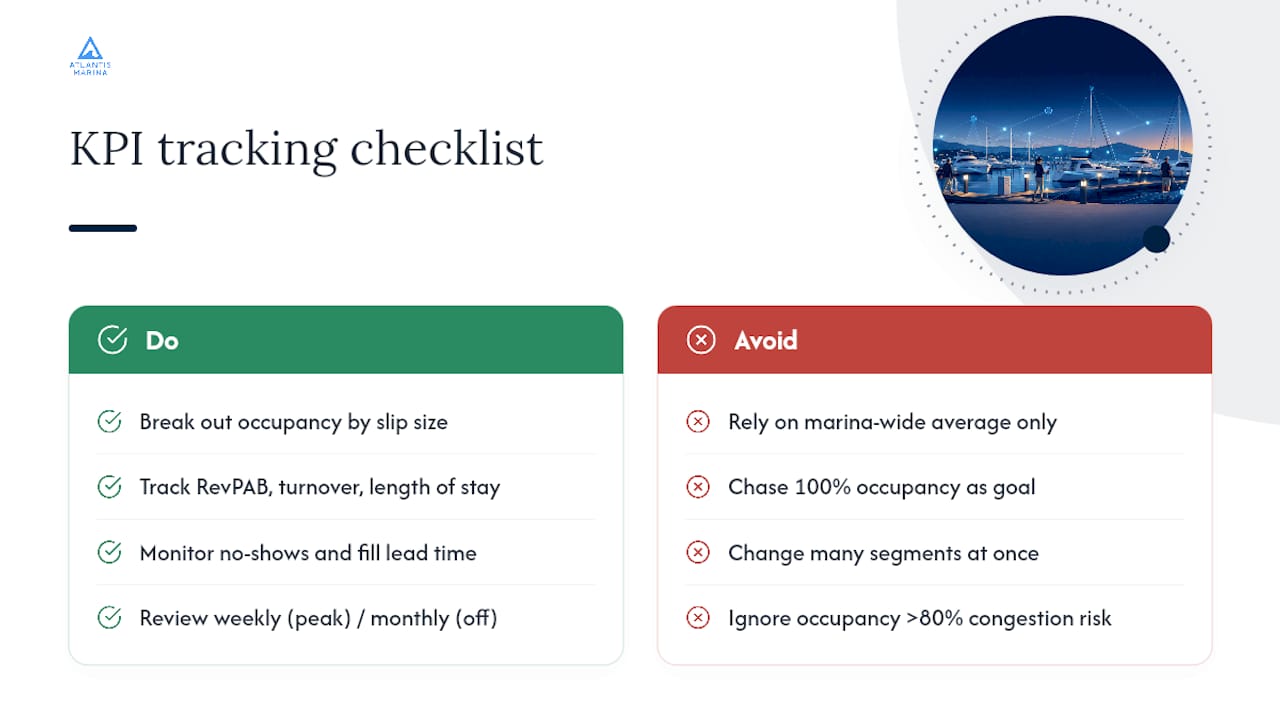
Track occupancy rate broken out by slip size, not just a marina-wide average, since a healthy overall number can hide a saturated large-slip category and a half-empty small-slip category. Add RevPAB to measure revenue per available berth, turnover rate, average length of stay, no-show rate, and fill lead time after a cancellation.
Review these weekly during peak season and monthly in the off-season, with a simple alert rule such as flagging any size category that drops below your target occupancy band for two consecutive weeks. Industry benchmarks suggest targeting 60 to 70% berth occupancy as a sustainable operating range rather than chasing 100%, since occupancy above roughly 80% tends to create congestion and service strain. Run pricing or layout changes as small pilots, one segment at a time, so you can attribute the result to the actual change instead of seasonal noise.
Author Perspective: Practical Trade-Offs for Operators
The instinct at most marinas is to reach for capital projects first: new docks, dredging, expansion. That's usually backwards. Layout reconfiguration and automation are cheaper, faster, and reversible if they don't work, while a new dock is a multi-year commitment either way. Balance contract stability against transient upside rather than chasing one at the expense of the other. This month, do three things: run the occupancy audit by slip size, automate your waitlist, and pilot dynamic pricing on one segment.
— John R
Put These Tactics to Work With Atlantis Marina
Everything covered here, from occupancy audits to waitlist automation to dynamic pricing pilots, maps directly to workflows built into some marina management platforms. The platform replaces the spreadsheet-and-phone-call approach with one system: online reservations that capture bookings around the clock, automated waitlist rules that fill cancellations without a staff member working the phone, and payment automation through Stripe and ACH that turns a filled slip into collected revenue without manual invoicing.
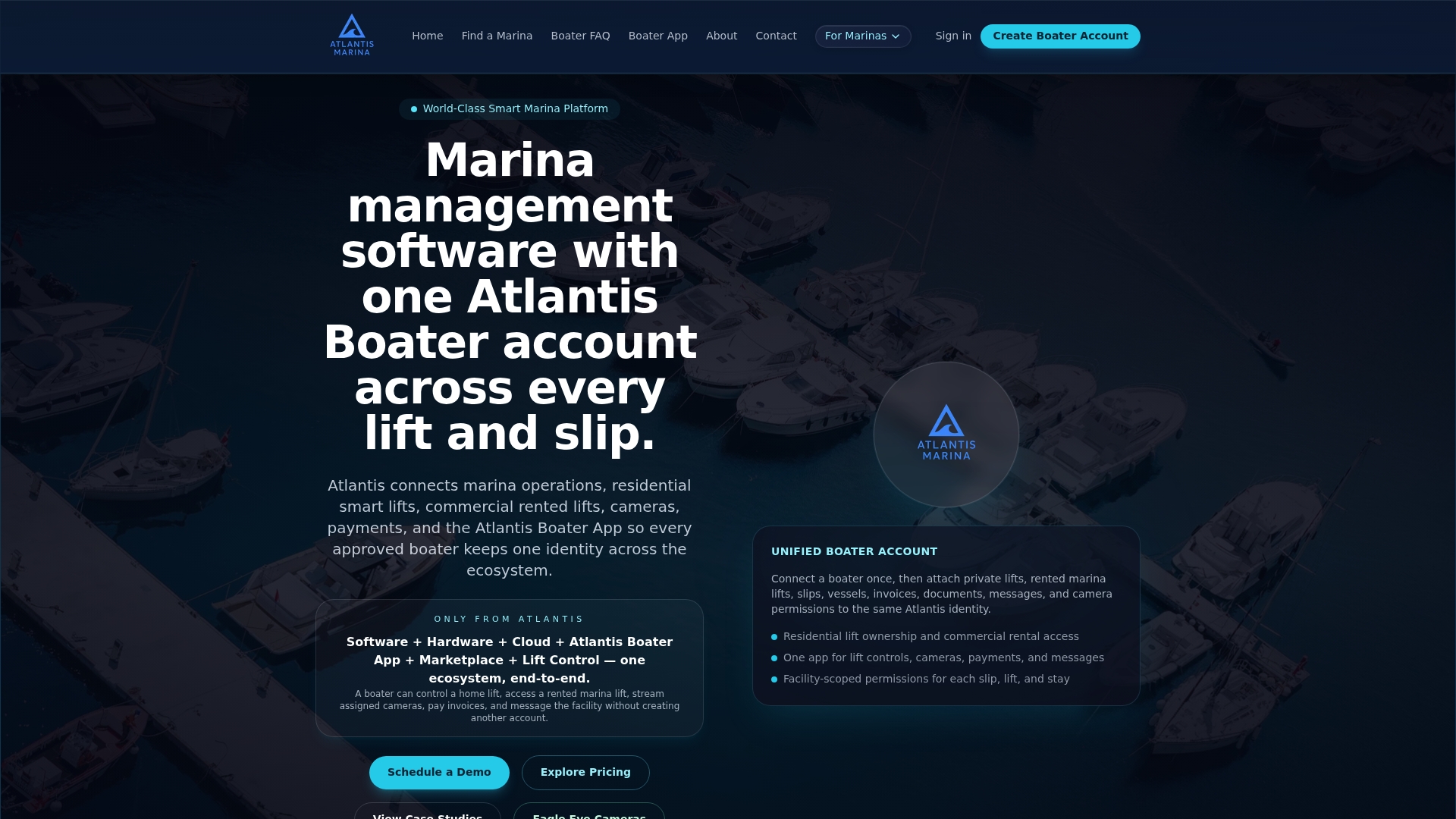
The operations dashboard gives dockmasters one screen for reservations, billing, and facility status, while reservation software handles boater self-service from first inquiry to signed contract. AI assistants can answer routine boater questions on your site so staff spend less time on repeat calls and more time on the exceptions that need judgment. Operators running this software stack may report faster fill times on canceled slips and less manual billing work at month's end. Visit Atlantis Marina's sales page to see the platform on your own slip data and book a demo.
Sources
- Maximizing Marina Slip Revenue with Smarter Dock Layout Design
- 7 Best Tips for Optimising Berth Utilization in Ports and Terminals
- 5 Ways to Boost Marina Occupancy with Technology | LockTrust
FAQ
What Is the 1/3 Rule in Boating?
The 1/3 rule refers to fuel management, using one third of fuel to travel out, one third to return, and one third held in reserve. It's a boater safety practice, not a marina occupancy metric.
How Profitable Is Owning a Marina?
Profitability varies widely by location, slip count, and vessel mix, but marinas that keep occupancy in the 60 to 70% operational sweet spot while controlling contract churn tend to post more predictable margins than those chasing peak-season highs alone.
How Many People Can Be on a 22-Foot Boat?
Passenger capacity depends on the manufacturer's rated capacity, listed on the boat's capacity plate, not the length alone. Always check the specific vessel's plate rather than estimating from size.
What Is the Number One Unspoken Rule on a Boat?
Respecting the captain's authority and following posted dock and safety rules tops most boaters' informal etiquette lists, and it directly affects how welcome a transient boater feels at your marina, which shapes whether they return or book elsewhere.
How Often Should a Marina Recalculate Its Occupancy Rate?
Weekly during peak season and monthly in the off-season, broken out by slip size category rather than a single marina-wide number, gives operators enough signal to catch a size-mismatch problem before it costs a full season of bookings.