
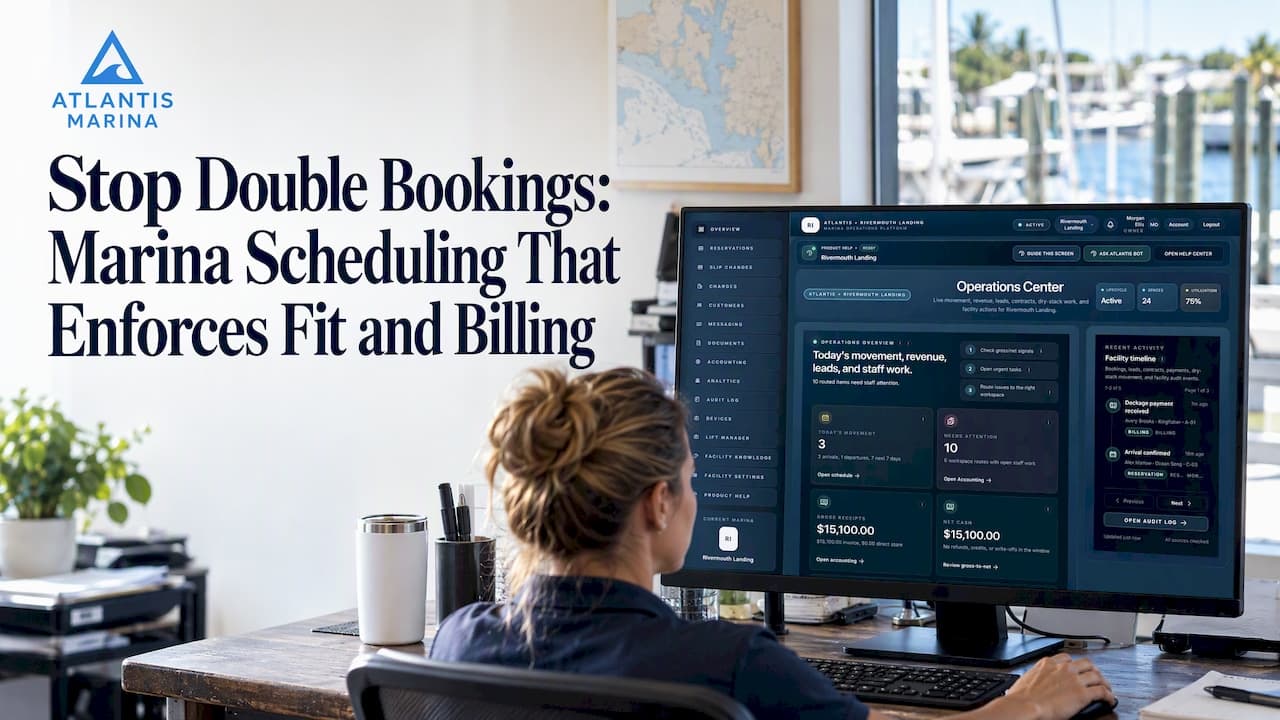
Service scheduling works best as a single operational layer inside your marina management platform, one that ties reservations, maintenance, vendor appointments, staff tasks, and billing together instead of running them as separate tools. Marinas that unify these functions cut down on double-booked berths, missed work orders, and manual billing cleanup. Some marina management platforms already package this layer, giving operators a working example of what integrated scheduling looks like in practice.
TL;DR:
- Require a rules engine that checks vessel length, beam, and draft, ranks suitable slips, and waitlists requests when no berth fits; availability alone is insufficient.
- Separate booking status from readiness flags for prepared, occupied, or blocked slips, and connect completed maintenance jobs to vendor approvals and invoices.
- Clean vessel and berth records, define approval and billing rules, then pilot one dock or shift and wait four to six weeks for reliable metrics.
- Before signing, require tokenized payments with PCI DSS evidence, role based access, encryption, audit logs, open APIs, and exportable data with clear offboarding terms.
- Atlantis Marina lists Micro at $150 monthly and Small at $300, plus a 3% fee on digital payments processed through the platform.
Table of Contents
- Why scheduling is an operations problem, not a calendar problem
- Core features to require from service scheduling software
- Implementation checklist: plan, pilot, train, measure
- Sample workflows for reservations, maintenance, vendors, and staff
- Integration and security rules worth requiring
- What matters most once the rollout starts
- How Atlantis Marina brings this layer together
- FAQ
- Sources
- Primary sources and RFP references
Why scheduling is an operations problem, not a calendar problem
A marina calendar only tells you when something is booked. It does not tell you whether a 45-foot sailboat with a 6-foot draft actually fits the berth you just assigned it, or whether the dock power pedestal is working, or whether last week's permit renewal cleared. Scheduling failures at marinas almost always trace back to unmanaged constraints rather than a lack of calendar slots.
The constraints that matter fall into a few categories:
- Berth fit: vessel length, beam, and draft against the physical slip and any seasonal water-depth changes.
- Timing overlap: arrival and departure windows, turnaround buffers, and block bookings that span multiple days.
- Readiness: utility status, pump-out availability, and whether the slip has been cleaned or inspected since the last tenant left.
- Permit and compliance status: whether the vessel's registration, insurance, or marina agreement is current.
Public procurement language backs this up directly with helpful resources on custom-fit boat graphics kits and wraps that can assist in marking berths during pilot programs. Clay County's RFP for marina management software lists automated assignment, waitlist management, and calendar views as core functional requirements, not optional add-ons, which signals that even government-run marinas treat scheduling as a rules-driven operation rather than a simple booking grid. A dock map with live status flags (prepared, occupied, blocked) turns those constraints into something a dockhand can act on in seconds, rather than something an office manager has to reconstruct from three spreadsheets.
Core features to require from service scheduling software
A scheduling system earns its place in your stack only if it enforces constraints automatically and connects to billing without a second data entry step. Use this as a baseline when evaluating or specifying a platform.
- A rules engine for berth fit and automated assignment, including waitlist handling when no suitable slip is open.
- Operational status flags and dock-map visibility that show prepared, blocked, and occupied states in real time, not just booked versus free.
- A work-order system that links maintenance jobs to assets, vendor approvals, and the correct billing path.
- Mobile workflows for staff, with QR-code check-in and role-based permissions so each team member sees only what their job requires.
- Billing automation, covering e-sign contracts, autopay, Stripe or ACH processing, and QuickBooks sync so a completed job creates a billed invoice without manual reconciliation.
- Open APIs and multi-facility support, so the system scales past a single dock or property as your operation grows.
Dock scheduling design guidance frames this well: the software should rank berth alternatives by fit and timing risk, not just display open slots, and status flags need to represent readiness separately from booking state.
Pro Tip: Ask any vendor to demonstrate what happens when a vessel's dimensions exceed every open slip. A platform that only shows a blank calendar rather than ranked alternatives will create manual work every time.

Implementation checklist: plan, pilot, train, measure
Rolling out scheduling software in one step across an entire marina is how pilots fail. A phased approach keeps disruption contained and gives staff time to trust the new workflow before it becomes mandatory.
- Inventory and clean your data first. Vessel dimensions, berth specs, and contract terms need to be accurate before any rules engine can act on them.
- Define rules and approval lists before turning on automation. Decide berth-fit tolerances, vendor approval criteria, and billing splits in writing.
- Map every integration. Payments, accounting, POS, and gate access all need to be tested, not assumed to work out of the box.
- Pilot on one dock or one shift. Choose a slice of operations busies enough to stress-test the rules without risking the whole marina.
- Train staff and document exceptions. Every "what if" a dockhand raises during the pilot becomes a documented procedure.
- Set measurable targets and revisit them. Track occupancy accuracy, check-in time, and the share of invoices generated without manual edits.
Supporting resources on yacht club maintenance scheduling and dockmaster task scheduling walk through how daily readiness checks and maintenance windows fit into this same rollout sequence.
- Keep the pilot small enough that one manager can review every exception by hand.
- Expand to a second dock only after the first month's metrics are stable.
Sample workflows for reservations, maintenance, vendors, and staff
Concrete workflows make the abstract rules engine tangible. Here is how four common scheduling scenarios should run end to end:
- Reservation to dock: a boater books online, the system checks vessel dimensions against the slip, confirms readiness, and the boater scans a QR code on arrival to trigger a status update to occupied.
- Maintenance: a staff member or boater reports an issue, the system schedules a service window against the asset record, assigns a vendor, and completion triggers an invoice automatically.
- Vendor appointment: intake rules route the request to an approved provider list, the marina confirms the assignment, and billing splits between marina and vendor are applied without manual tracking.
- Staff handoff: outgoing and incoming shifts exchange a mobile task list with confirmations built in, and any unresolved item escalates to a supervisor instead of getting lost.
Each of these flows depends on the same underlying principle: a status change in one part of the system (check-in, job completion, approval) should update every connected record, not just the one screen the staff member happens to be looking at.
Integration and security rules worth requiring
Scheduling software touches payments, vessel records, and facility access, so the technical and compliance bar needs to be explicit before you sign a contract.
- Tokenized payment processing with PCI-DSS compliance evidence from the platform or its payment processor, so cardholder data never sits unencrypted in marina systems.
- Open APIs for accounting, POS, and gate control, plus import and export tools for data portability if you ever switch providers.
- Role-based access and audit logs, with encryption in transit and at rest and a stated uptime guarantee.
- Exportable data formats such as CSV or JSON, with offboarding terms spelled out in the contract rather than left to a support ticket.
RFP 39-26 from Clay County lists PCI-DSS payment handling, role-based access, encryption, and API integration as explicit technical requirements for marina management software, which gives smaller operators a ready template even without running a formal procurement process.
What matters most once the rollout starts
The biggest trade-off in scheduling rollouts is speed versus completeness: pilot small, but insist on composable integrations from day one so the system can grow past that first dock without a rebuild. Most pitfalls trace back to incomplete vessel data, vague vendor billing rules, or staff who were never walked through exception handling. A realistic one-marina pilot runs four to six weeks before the numbers stabilize enough to trust.
— John R
How Atlantis Marina brings this layer together
Marinas rebuilding scheduling from scratch do not need to stitch together five separate tools. Some marina management platforms unify reservations, maintenance work orders, vendor appointments, staff task lists, and billing automation in one cloud-based system, so a status change on the dock updates billing, inventory, and staff task lists at the same time.

- Boaters check in with QR codes through the Atlantis Boater App, which cuts manual lookups at the dock.
- Contracts, autopay, payment processing, and accounting sync run through the same billing layer that handles reservations and work orders.
- Smart lift controllers and camera integrations can connect physical infrastructure to the same scheduling records used in the platform.
Marinas planning a pilot dock or a full-season rollout can review plan tiers on our pricing page or start a conversation through our sales team to scope a demo around a single dock or shift.
FAQ
What does service scheduling mean for a marina operations platform?
It means one system handles slip reservations, maintenance work orders, vendor appointments, and staff tasks under shared rules for berth fit, timing, and billing. The goal is fewer manual handoffs between departments and fewer scheduling conflicts caught after the fact.
How does automated berth assignment actually work?
A rules engine checks a vessel's length, beam, and draft against open slips and ranks suitable options instead of just showing a blank calendar. When no slip fits, the system places the request on a waitlist rather than forcing staff to search manually, a workflow detailed in marina procurement requirements.
What is the difference between a booking status and a readiness flag?
A booking status shows whether a slip is reserved; a readiness flag shows whether it is actually prepared, blocked, or occupied right now. Dock scheduling design guidance treats these as separate fields because a booked slip is not always a usable one.
How much does Atlantis Marina cost for a small marina?
Plan pricing starts at $150 per month for the Micro plan and $300 per month for the Small plan, both listed on our pricing page, with Medium, Large, and Enterprise tiers available for larger operations. A platform fee of 3% applies to digital payments processed through the system.
Can vendor service appointments be billed separately from marina invoices?
Yes, when the platform supports approved-provider lists and configurable billing splits, vendor jobs can route payment to the vendor, the marina, or both without manual reconciliation. This requires defining the billing rules before vendors are added to the system, not after the first job is completed.
Sources
- RFP 39-26 Marina Management Software — Clay County
- How to build a dock scheduling platform for marinas — Computools
Primary sources and RFP references
- RFP 39-26 Marina Management Software, Clay County
- How to build a dock scheduling platform for marinas, Computools