
The most effective yacht club maintenance schedule combines time-based, usage-based, and condition-based triggers, runs through a centralized operations platform, and shifts your team from reactive firefighting to planned, predictable upkeep.
TL;DR:
- Build your schedule around three trigger types: calendar intervals, engine hours, and observed condition.
- Track one primary KPI: percentage of scheduled tasks completed on time each season.
- Centralized records protect asset value and satisfy insurers and buyers.
- Platforms like Atlantis Marina, guidance from The Yacht Maintenance Hub, and seasonal frameworks from Panacea Yacht Group give managers a proven foundation to start from.
Table of Contents
- Why proactive scheduling reduces downtime and protects your club's assets
- What every yacht club maintenance schedule must include
- Practical cadence templates you can adapt today
- How to prioritize work and avoid peak-season bottlenecks
- Digital tools and workflows that make scheduling manageable
- A ready-to-use maintenance checklist and logging template
- How to roll out the program and measure success
- Key Takeaways
- The scheduling mistake most clubs keep making
- Atlantis Marina handles the operational heavy lifting
- Useful sources
- FAQ
Why proactive scheduling reduces downtime and protects your club's assets
Reactive maintenance is expensive by design. You wait for something to fail, then pay emergency labor rates, absorb unplanned downtime, and scramble to reschedule boaters. Proactive preventative scheduling eliminates seasonal yard congestion and reduces the likelihood of catastrophic failure by catching wear before it compounds.
Logged records carry real financial weight. According to Panacea Yacht Group, consistent maintenance documentation serves as tangible proof of professional care that protects resale value and supports insurance claims. Insurers and valuers treat a complete service history as evidence of reduced risk, which can directly affect coverage terms and vessel appraisals.
Seasonal congestion is the most predictable bottleneck in marina operations. Every spring, clubs that run reactive schedules face the same crunch: multiple haul-outs, engine services, and safety inspections all competing for the same travel-lift slots and technician hours. Proactive scheduling spreads that load across the calendar.
What every yacht club maintenance schedule must include
A complete schedule requires four building blocks: a full asset inventory, defined task types, clear role ownership, and standardized record fields.
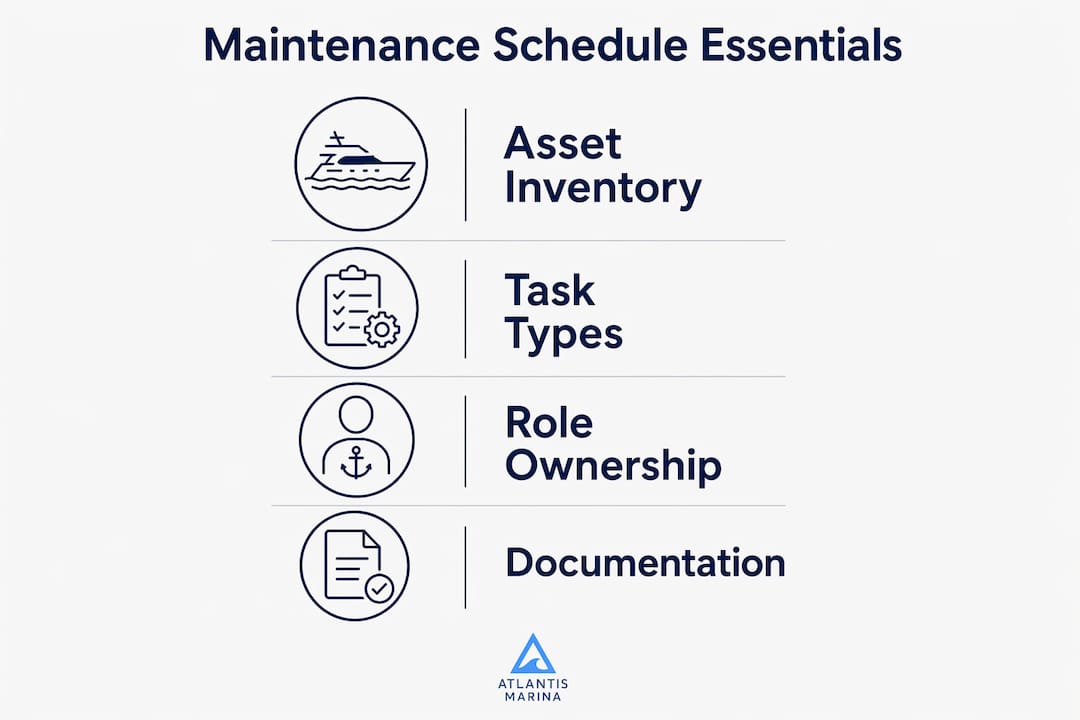
Asset inventory should capture every piece of equipment with manufacturer, model, serial number, and installation date. Graffico's marina infrastructure framework recommends technical registers covering docks, utility columns, water and electrical distribution, travel-lifts, and dry storage, with automatic alerts for upcoming work.
Task types fall into six categories:
- Routine/daily: fluid checks, bilge inspection, dock line condition
- Preventive/time-based: antifouling, safety equipment inspection, battery service
- Usage/hour-based: engine oil and filter changes, generator service, bow thruster intervals
- Condition-based: hose and belt replacement when wear appears on inspection
- Seasonal: spring commissioning, fall decommissioning, winterization
- Emergency: unplanned failures requiring immediate response
Role ownership prevents tasks from falling through the cracks. A compact matrix that keeps accountability clear:
| Task Category | Primary Owner | Secondary / Vendor |
|---|---|---|
| Daily dock checks | Dock staff | Dockmaster review |
| Preventive engine service | Contracted marine tech | Dockmaster sign-off |
| Electrical/utility systems | Facility manager | Licensed electrician |
| Haul-out coordination | Dockmaster | Travel-lift operator |
| Emergency response | Dockmaster | On-call tech |
Record fields for each completed task: task name, date, technician, hours spent, parts used with part numbers, vendor invoice number, photos, and notes. These fields are the minimum an insurer or valuer needs to accept a service history as credible.
Practical cadence templates you can adapt today
Pair time-based, usage-based, and condition checks for every asset based on its criticality to operations. The Yachtpedia maintenance frequency framework maps tasks across the full spectrum from daily to multi-year:

| Frequency | Example Tasks |
|---|---|
| Daily | Bilge check, fluid levels, dock line and fender inspection |
| Weekly | Battery voltage, bilge pump test, running gear visual |
| Monthly | Engine oil top-up, electrical connections, sail/rigging check |
| Quarterly | Wax topsides, cooling system flush, through-hull inspection |
| Semiannual | Haul-out, bottom paint, zinc anode replacement |
| Annual | Full engine service, impeller, fuel filters, safety gear certification |
| — | Standing rigging replacement, fuel hose replacement, deck hardware re-bedding |
For spring commissioning (typically March–April in northern U.S. climates), schedule haul-out inspection, engine service, antifouling application, and safety gear certification in that order, with at least two weeks of buffer before peak season. Fall decommissioning (October–November) should cover fuel stabilization, battery management, moisture control, and a full systems log update.
Attaching estimated costs to each recurring task turns the schedule into a financial planning tool. Adding a 10–20% contingency reserve to projected annual maintenance budgets protects against unplanned failures without disrupting planned intervals.
How to prioritize work and avoid peak-season bottlenecks
Not every task competes equally for your travel-lift or your best technician. A simple prioritization matrix keeps decisions consistent:
| Priority Level | Criteria | Response Window |
|---|---|---|
| Safety-critical | Affects life safety or seaworthiness | Immediate |
| Mission-critical | Prevents vessel from operating | Within a clearly defined SLA window |
| Preventive | Scheduled interval due | Within booking window |
| Optional/cosmetic | Appearance or comfort only | Scheduled at convenience |
Staggering haul-outs is the single most effective tactic for reducing spring congestion. Divide your fleet into groups and assign each group a two-week commissioning window. Pair that with a pre-season campaign in February, giving owners advance notice of their scheduled window and a booking deadline.
- Open booking windows 60–90 days before peak season.
- Maintain a documented waitlist with clear SLA commitments (e.g., confirmed slot within 48 hours of request).
- Reserve 15–20% of travel-lift capacity for emergency haul-outs.
- Brief owners on the booking policy in writing at the start of each season.
Pro Tip: Document your SLAs and booking window rules in a one-page policy that goes to every slip holder at renewal. Written expectations cut last-minute congestion complaints by removing ambiguity.
Digital tools and workflows that make scheduling manageable
Manual systems create gaps. Marinas relying on spreadsheets and phone calls commonly lose 12–18% of potential revenue through unbilled or untracked services. A centralized operations platform closes those gaps by automating work order creation, tracking parts inventory, and keeping every record in one place.
A practical workflow looks like this: a calendar or hour-based trigger fires a work order, the dockmaster assigns it to the right technician, the tech completes the task on mobile with a photo attached, the system logs completion and generates an invoice, and the record is immediately available for owner review or insurer audit.
Atlantis Marina brings these workflows together in one platform. The operations dashboard handles maintenance task assignment, vessel records, parts inventory, and vendor work orders. The Atlantis Boater App gives owners direct visibility into scheduled service windows and confirmation notifications, reducing inbound calls to dock staff. Atlantis Bot handles routine owner questions on the marina website, freeing staff for higher-value work. Smart IoT integrations feed engine-hour data and sensor alerts directly into the scheduling engine for condition-based triggers.
Pro Tip: Set reorder points for high-turnover parts (impellers, zincs, filters) and link them to work orders. When a work order closes, the system flags inventory below threshold automatically.
A ready-to-use maintenance checklist and logging template
Daily/weekly must-dos for marina-owned assets:
- Bilge inspection and pump test
- Dock line and fender condition check
- Fluid levels (engine oil, coolant, gear lube)
- Electrical panel and shore power connections
- Fuel dock and utility column visual inspection
Monthly:
- Battery voltage and connections
- Through-hull fittings and seacocks
- Fire extinguisher gauge check
- Anode condition assessment
Logging template fields (copy into your CMMS or spreadsheet):
| Field | Purpose |
|---|---|
| Task name | Identifies the work performed |
| Frequency | Scheduled interval |
| Due date | Trigger date or hour threshold |
| Completion date | Actual date completed |
| Technician | Name and certification |
| Hours spent | Labor tracking |
| Parts used | Part number, quantity, cost |
| Vendor invoice # | Audit trail |
| Photos attached | Visual proof of condition |
| Notes | Observations, follow-up items |
Attach invoices and photos to every record. A log entry without supporting documentation carries far less weight with an insurer or a buyer's surveyor. Structured vessel records that include vendor contact details and invoice numbers meet the minimum standard for audit readiness.
How to roll out the program and measure success
Start with a pilot covering one or two docks. Validate your task list, cadences, and record fields against real operations before scaling. A realistic rollout runs in three phases:
- Weeks 1–4: Inventory all assets, assign task types and frequencies, set up record fields in your platform.
- Weeks 5–8: Pilot on one dock, train staff on mobile task completion and photo documentation, run first work order cycle.
- Weeks 9–16: Iterate based on pilot feedback, scale to full club, onboard vendors and contracted techs.
Staff training checklist:
- Mobile task completion and photo attachment
- Work order creation and assignment
- Owner communication scripts for service notifications
- Emergency override protocol and escalation path
- Audit trail requirements (what must be logged, by when)
Track these KPIs from day one:
- Percentage of scheduled tasks completed on time
- Downtime hours per season
- Travel-lift utilization rate
- Maintenance cost per berth
- Open work order backlog count
Governance matters as much as the schedule itself. Designate one person (typically the dockmaster) to approve frequency changes and emergency overrides. Require written justification for any deviation from the published schedule, and keep that justification in the task record.
Key Takeaways
A proactive, mixed-trigger maintenance schedule is the single most effective way to reduce seasonal congestion, protect asset value, and satisfy insurers at a U.S. yacht club or marina.
| Point | Details |
|---|---|
| Use three trigger types | Combine time-based, usage-based, and condition-based tasks for every asset. |
| Log every task completely | Record tech, parts, photos, and invoice number to meet insurer and valuer standards. |
| Stagger seasonal work | Open booking windows 60–90 days early and divide the fleet into commissioning groups. |
| Track one primary KPI | Percentage of scheduled tasks completed on time reveals schedule health at a glance. |
| Atlantis Marina centralizes operations | The platform unifies maintenance tasking, vessel records, owner notifications, and billing in one dashboard. |
The scheduling mistake most clubs keep making
Most marina managers I've seen struggle with the same problem: they build a solid schedule on paper, then let it collapse under the weight of spring season pressure. The schedule exists, but nobody enforces it when the travel-lift queue backs up and owners are calling every hour.
The fix is not a better spreadsheet. It's governance. The clubs that run clean operations year after year are the ones where the dockmaster has explicit authority to hold the booking window, turn away last-minute haul-out requests, and require photo documentation before a work order closes. Without that authority written into the operating policy, the schedule is just a suggestion.
One pattern worth adopting: start your maintenance program with a single asset class, typically engines or zincs, before expanding. It builds staff confidence, surfaces gaps in your logging template, and gives you a defensible track record to show insurers within one season. Transparent owner communication throughout that process, including proactive notifications when service is scheduled and completed, cuts complaint volume noticeably. Owners who feel informed rarely escalate.
Atlantis Marina handles the operational heavy lifting
Running a tight maintenance program means fewer surprises, but it also means more moving parts to coordinate. Atlantis Marina gives yacht clubs and marinas a single platform to manage all of it: maintenance task scheduling, vessel records, parts inventory, vendor work orders, owner-facing service confirmations, and automated billing, without stitching together separate tools.
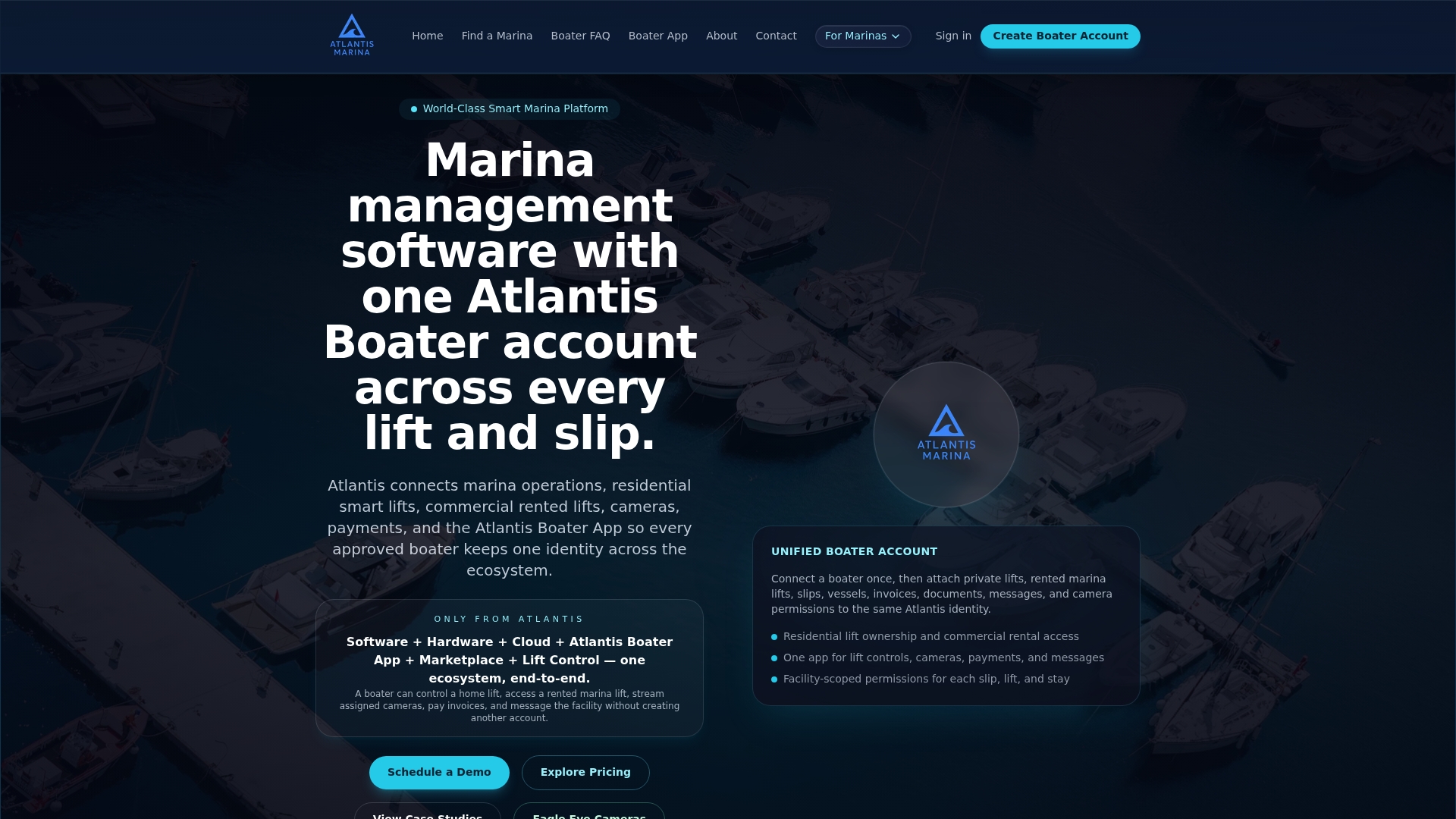
The operations dashboard gives dockmasters real-time visibility into open work orders, upcoming service intervals, and facility status. The Atlantis Boater App keeps owners informed at every step, reducing inbound calls and building trust. Atlantis Bot handles routine questions on your marina website so staff stay focused on the dock. And because the platform is cloud-based and mobile-ready, your team can complete, log, and photo-document tasks from anywhere on the property.
To get the most from a demo, bring your current asset inventory, a sample cadence list, and your peak-season booking calendar. Request a demo at Atlantis Marina and see how the platform fits your club's specific workflow.
Useful sources
The following primary sources informed this guide and are worth bookmarking for ongoing reference.
- The Yacht Maintenance Hub — Step-by-step schedule creation methodology, proactive vs. reactive rationale, and cadence frameworks for boat owners and managers.
- Panacea Yacht Group — Seasonal maintenance calendar covering spring commissioning, mid-season checks, fall decommissioning, and the insurer/valuer value of logged records.
- Yachtpedia — Maintenance frequency table and CMMS advantages overview for larger operations.
- Graffico — Marina infrastructure maintenance planning, technical registers, and the revenue impact of manual processes.
- Atlantis Marina — Platform documentation and feature guides covering operations dashboards, mobile workflows, and smart marina integrations.
FAQ
What is yacht club maintenance scheduling?
Yacht club maintenance scheduling is the process of planning, assigning, and tracking all upkeep tasks for club vessels and marina infrastructure on defined time-based, usage-based, or condition-based intervals, rather than responding to failures as they occur.
How often should a marina schedule haul-outs?
Most vessels require a haul-out at least once per year for bottom inspection, antifouling, and zinc replacement, with a more thorough out-of-water survey every two to three years depending on usage and hull material.
What records do insurers require for yacht maintenance?
Insurers and valuers typically require task name, completion date, technician identity, parts used, vendor invoices, and supporting photos. Panacea Yacht Group notes that consistent, complete logs serve as direct proof of professional care during claims and appraisals.
How does Atlantis Marina support maintenance scheduling?
Atlantis Marina's operations dashboard manages maintenance task assignment, vessel records, parts inventory, and vendor work orders in one platform, with the Atlantis Boater App delivering owner-facing service confirmations and Atlantis Bot handling routine staff and boater queries.
How do you reduce seasonal congestion at a yacht club?
Open booking windows 60–90 days before peak season, divide the fleet into staggered commissioning groups, reserve travel-lift capacity for emergencies, and communicate booking deadlines to slip holders in writing at the start of each season.