
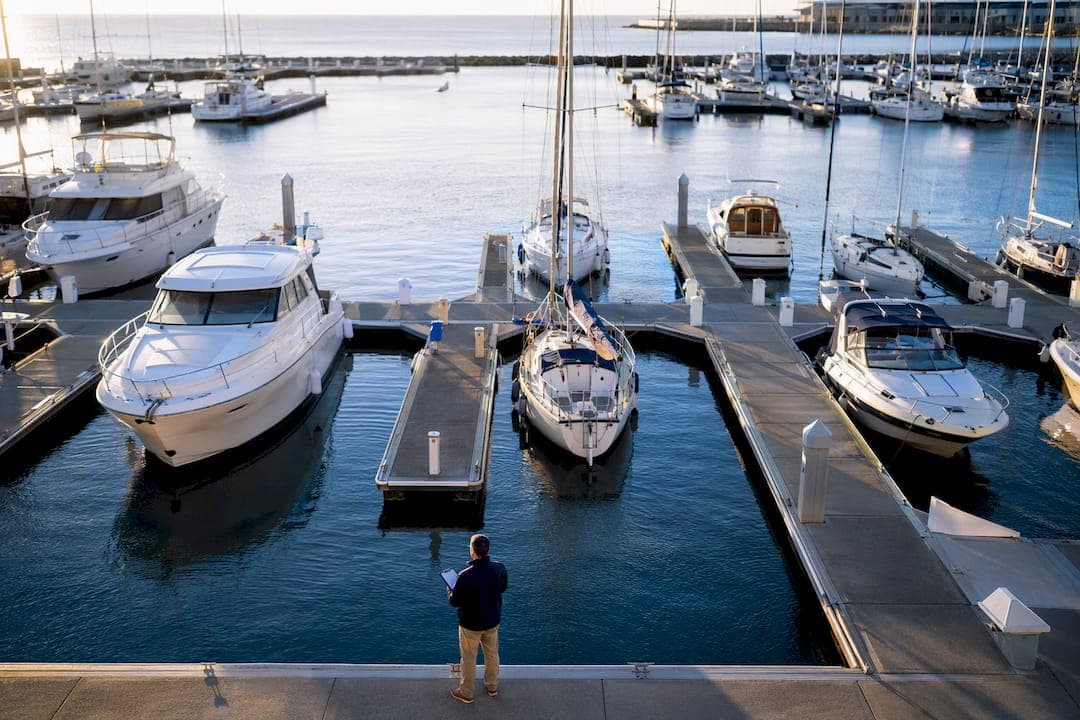
Adopt an operational-first slip assignment strategy: treat the marina as physical capacity, not a booking calendar. That means three things working together — waitlists segmented by size band, verified vessel and slip dimensions, and automated assignments backed by audit trails. Atlantis Marina exists to run exactly this model, replacing spreadsheets with a system that tracks capacity the way a dockmaster actually experiences it.
TL;DR:
- Marinas should model slips based on physical constraints like length, beam, draft, and utility capacity before applying reservation rules.
- A segmented waitlist by size and beam, with regular refreshes and documented reasons for declines, reduces favoritism and vacancy loss.
- Accurate vessel data must be verified both at application and on arrival, with real-time dock measurements preventing mismatches and double bookings.
- Automated assignment tools require a precise facility model and should include manual overrides with recorded reasons to maintain staff judgment.
- Real-time occupancy and environmental factors, such as tides and weather, must inform flexible slip reassignments to minimize congestion and safety risks.
Table of Contents
- What Is an Operational-First Slip Assignment Strategy?
- How Should Marinas Design and Run a Waitlist?
- Getting Vessel and Slip Data Right Before You Assign
- Automating Assignments Without Losing Staff Judgment
- Reducing Dock Congestion on Arrival and Departure Days
- Using Size Bands as a Pricing and Occupancy Signal
- How to Move From Spreadsheets to an Operational System
- Connecting Slip Assignments to Customer Records
- Handling Assignment Disputes Without Losing Trust
- Forecasting Seasonal Demand and Adjusting Assignments
- Regulatory and Safety Rules That Shape Assignments
- Why Tides and Weather Change What "Available" Means
- Comparing Technology Options for Slip Assignment
- The Gap Between Slip Assignment Advice and Slip Assignment Reality
- Putting the Strategy to Work With Atlantis Marina
- Sources
- FAQ
What Is an Operational-First Slip Assignment Strategy?
A calendar-only approach treats every slip like an interchangeable hotel room with a date range attached. It ignores the physical reality that a 45-foot sailboat with a 14-foot beam cannot go where a 28-foot center console fits perfectly. Marinas that manage assignments this way end up double-booking beam-constrained slips, missing utility mismatches, and shuffling boats on arrival day because nobody checked draft against a low-tide sounding.
An operational-first strategy inverts that. It models the facility as a set of fixed physical constraints first, then layers reservations and waitlists on top. According to research on boat slip management systems, a digital marina model has to account for berth dimensions, vessel specs, membership rules, utility access, and approval workflows before any allocation logic can work correctly.
Operators should model, at minimum:
- Length overall (LOA), beam, and draft for every slip
- Utility hookups: shore power amperage, water, pump-out access
- Fairway clearance and adjacent-slip conflicts
- Membership tier, contract type, and seasonal versus transient status
Written rules and auditable records matter here as much as the physical data. When boaters can see how and why an assignment was made, disputes drop. When they can't, every allocation looks arbitrary, even the fair ones.
How Should Marinas Design and Run a Waitlist?
A waitlist is a governance document, not a queue. Marina waitlist and slip allocation research makes the case plainly: without segmentation and regular refreshing, waitlists become a source of perceived favoritism and wasted vacancies alike.
Build the system in this order:
- Segment by size band and beam, not just LOA, since two 35-footers can need very different slip widths.
- Allow multi-band entries so a boater willing to take a smaller or larger slip isn't stuck behind a single narrow preference.
- Capture minimum required fields at signup: vessel dimensions, contact preference, deposit status, and a timestamp.
- Set a refresh cadence (a regular cadence is common) where inactive entries get flagged and contacted before removal.
- Document every decline and exception with a reason code, not a blank field.
- Publish position estimates so applicants can see roughly where they stand and how often slots in their band actually open.
That last step matters more than most operators assume. Publishing estimated positions and the underlying rules prevents the low-grade, persistent conflict that comes from boaters guessing at a black box.
Pro Tip: Keep a simple offer log, who was offered which slip, on what date, and how they responded, even for verbal offers. It becomes the record you point to the one time someone disputes the sequence.
Getting Vessel and Slip Data Right Before You Assign
Arrival-day surprises almost always trace back to one thing: unverified numbers. Owners routinely under-report length overall by a foot or two, either from habit or because they're quoting hull length instead of bow-to-stern with pulpits and platforms included. Beam gets rounded down. Draft gets guessed.
A defensible process requires:
- Requiring LOA, beam, and draft at application, not just at contract signing
- Measuring and recording usable slip dimensions, including finger pier length and piling spacing
- Confirming utility capacity against the vessel's actual shore power draw
- Re-verifying dimensions on the dock before finalizing, not just trusting the application
- Filing measurement notes, insurance documents, and the signed agreement together as evidence
Fast fact: Automated dock assignment systems that combine rule engines with real-time data have been shown to cut wait times and prevent double bookings that manual, spreadsheet-based verification routinely misses.
A verification checklist doesn't slow down onboarding. It prevents the far more expensive problem of moving a boat twice because nobody caught a beam mismatch until it was already tied up.
Automating Assignments Without Losing Staff Judgment
Automation only works if the underlying facility model is accurate. That's the core lesson from research on boat slip management systems: docks, zones, slip attributes, and utility maps need to exist digitally before any rule engine can assign correctly.
Once that model exists, the software should handle:
- Size-band matching that filters candidate slips automatically by LOA, beam, and draft
- Member priority and stay-rule logic that respects contract tiers and seasonal reservations
- Approval flows for exceptions that route to a manager instead of auto-confirming
- Real-time conflict detection that flags overlapping reservations before they become dock-side arguments
- Manual override with a logged reason, so staff judgment stays available without erasing the audit trail
AI-assisted dock assignment tools pair rule engines with live occupancy data specifically to catch these conflicts before a boat is already headed to a slip that's taken. This is where Atlantis Marina's operations dashboard does its work: real-time occupancy, reservation status, and billing status live in one view instead of three disconnected tools. Atlantis Bot answers routine boater questions about reservation status without pulling a dockmaster off the dock, and the Atlantis Boater App lets vessel owners submit dimensions, upload insurance documents, and sign contracts before they ever arrive.
Pro Tip: Never let automation auto-confirm a size-band exception. Route it to a human, log the reason, and let the override sit in the same audit trail as everything else.
Reducing Dock Congestion on Arrival and Departure Days
Congestion on a busy Saturday almost always comes from poor placement decisions made days earlier, not from the day itself. Placing boats without regard to departure timing forces staff into constant last-minute shuffling, which is exactly the friction an operational-first strategy is meant to eliminate.
The fix is placement logic tied to timing, not just availability:
- Place early-departure boats nearest the fairway so they can leave without crossing other slips
- Cluster similar departure windows on the same dock section to reduce staff movement
- Hold a small number of buffer or staging slips open for late or early arrivals
- Push reassignments to boaters and staff instantly, through app notifications rather than a dockside conversation after the fact
- Log every reassignment with a reason, and require staff overrides to include one
This approach reflects the same logic behind fairway-adjacent placement for early departures: fewer boats crossing paths means fewer delays and fewer damaged fenders.
Using Size Bands as a Pricing and Occupancy Signal
Each size band behaves like its own submarket. A queue in the 40 to 45 foot band while 25 foot slips sit empty isn't a scheduling quirk, it's a pricing signal.
Treat that band as underpriced relative to demand. Persistent vacancy in another band usually means the opposite: rates are too high for what boaters in that range are willing to pay, or the slip inventory in that band outpaces actual demand.
Track these reports by band, not marina-wide:
- Occupancy rate
- Average vacancy time before a slip re-fills
- Decline rate on offers made from the waitlist
Fast fact: A queue in one size band alongside vacancy in another is a clear signal that pricing, not availability, is the actual problem.
Marinas that only look at overall occupancy miss this entirely.
How to Move From Spreadsheets to an Operational System
Migrating off spreadsheets doesn't need to disrupt a season if it's sequenced correctly.
- Audit and clean existing data: slip specs, tenant records, waitlist entries, and any conflicting versions across files.
- Model the facility in software: docks, zones, slip dimensions, utility maps, and reserved or blocked slips.
- Configure assignment rules and pilot on a single dock before rolling out marina-wide.
- Train staff on overrides and recordkeeping so the audit trail habit forms before go-live, not after a dispute.
- Roll out fully and monitor occupancy, decline rate, and vacancy time for the first full season.
Pro Tip: Pilot on your most complicated dock, not your easiest one. If the rules survive the dock with mixed size bands and tight utility access, they'll survive everywhere else.
Operators managing more than one property should sequence this rollout location by location; the multi-property management guide covers how to stagger configuration across a portfolio without pausing operations at any single site.
Connecting Slip Assignments to Customer Records
Slip assignment decisions don't happen in isolation from billing history, communication preferences, or contract status. A boater who's three payments behind shouldn't move to the top of a waitlist the same week, and a long-tenured member with a clean record deserves priority handling that a disconnected spreadsheet can't reflect.
This is where slip assignment logic needs to draw directly from customer account data rather than a separate list maintained by hand. Contract type, autopay status, document compliance (insurance, registration), and communication history all inform whether an assignment should proceed automatically or get flagged for review.
Atlantis Marina folds this together by design: customer accounts, billing status, documents, and slip assignments live in the same record instead of across four disconnected tools. When a boater updates insurance through the Boater App or a payment status changes, that update is visible to whoever is making the next assignment decision, not buried in an inbox.

The practical benefit shows up in day-to-day speed. A dockmaster deciding between two waitlist candidates for the same slip can see, in seconds, which one has a signed contract on file and current documents, and which one has an open billing issue. That single view replaces what used to be three separate lookups across email, a spreadsheet, and a filing cabinet.
Marinas running loyalty or membership tiers benefit even more directly: assignment priority tied to account status stops requiring a manual cross-check every time, because the priority rule and the account data sit in the same system.
Handling Assignment Disputes Without Losing Trust
Disputes are inevitable in any allocation system, but how they get resolved determines whether a boater stays a customer or leaves a bad review. The single biggest driver of dispute severity isn't the decision itself, it's whether the marina can explain the decision with a record.
A written, auditable offer sequence, recording who was offered what, when, and how they responded, turns a "why did they get that slip and not me" conversation into a five-minute lookup instead of a standoff. Marinas without that record are stuck relitigating decisions from memory, which almost always makes the situation worse.
Prioritize disputes this way:
- Safety and access issues first. A boater who can't get to their vessel because of a placement error gets immediate attention.
- Billing-linked disputes second. These escalate fast if not addressed within the same business day.
- Waitlist position disputes third. These benefit most from published rules and position estimates, since the answer is usually already documented.
- Preference disputes last. A boater who simply wanted a different view or a shorter walk to the parking lot gets a straightforward, polite explanation of the rule that applied.
Staff should have a single documented path for logging a complaint, resolving it, and recording the outcome, ideally in the same system holding the offer records. That consistency is what turns disputes into routine service tickets instead of recurring conflicts with the same handful of tenants.
Forecasting Seasonal Demand and Adjusting Assignments
Slip demand isn't flat across a calendar year, and treating it as if it were leads to two predictable failures: overbooking peak months and leaving slips empty during shoulder seasons that could have been filled with short-term transient traffic.
AI-powered scheduling approaches can forecast demand by synchronizing booking channels and matching historical patterns to upcoming vessel-to-slip requests, giving operators a lead-time advantage instead of reacting to a full dock in June.
Practical forecasting steps for most marinas:
- Compare occupancy and decline rates by month against the prior two seasons, not just last year alone
- Flag size bands where seasonal transient demand consistently outpaces permanent slip turnover
- Reserve a small percentage of inventory in high-demand bands specifically for peak-season transient bookings
- Adjust waitlist refresh timing ahead of the season where historical decline rates spike, since boaters who declined in a slow month often accept in peak season
Forecasting doesn't eliminate the need for the waitlist and verification rules covered earlier. It simply tells you when to expect pressure on specific bands so staff aren't caught improvising in July.
Regulatory and Safety Rules That Shape Assignments
Slip assignment isn't purely an operational decision. It intersects with fire code clearance requirements, Americans with Disabilities Act (ADA) accessibility obligations for a percentage of slips at many public and municipal facilities, fuel dock proximity rules, and utility load limits that vary by dock section.
Assignment rules need to encode these constraints the same way they encode beam and draft, not as a separate manual check. A slip that's technically the right size but violates a fire lane clearance requirement isn't a valid option, no matter where it sits on the waitlist.
Key compliance points operators should build into their assignment logic:
- ADA-compliant slip designation and the rule that these slips get offered to qualifying boaters first, documented the same way any other exception is documented
- Fire code and emergency access clearance between vessels and along fairways, which varies by local jurisdiction and needs verification against the facility's actual permit, not a generic standard
- Utility load limits per dock section, since shore power circuits have finite capacity and an assignment that overloads a circuit is a safety issue, not just an inconvenience
- Environmental permits tied to specific slip locations, particularly near sensitive shoreline or protected habitat zones
None of this replaces a local fire marshal's or harbor authority's specific requirements. Marinas should treat these as facility-specific compliance obligations verified against their own permits and local code, not generic industry defaults.
Why Tides and Weather Change What "Available" Means
A slip that's perfectly usable at high tide can be unsafe for a deep-draft vessel at low tide. Draft verification, covered earlier as a data accuracy issue, becomes a live operational variable the moment tidal range enters the picture.
Marinas in tidal waters need assignment rules that account for minimum clearance at the lowest expected tide during a boater's stay, not just the depth at the moment of assignment. A vessel drafting 5 feet assigned to a slip that reads fine at high tide can find itself grounded six hours later.
Weather adds a second layer of flexibility that a rigid assignment system can't handle well:
- Storm staging may require temporarily relocating vessels away from exposed fairways
- High-wind events change which slips are safe for wide-beam vessels near open water
- Seasonal ice or freeze conditions in northern climates can close entire dock sections temporarily
An operational-first system handles this by keeping slip status flexible and re-assignable in real time, rather than locking every reservation into a fixed slot months in advance. The same real-time occupancy view that catches a double-booking should be the tool that flags a slip needing temporary reassignment ahead of a forecasted storm.
Comparing Technology Options for Slip Assignment
Marinas generally land in one of three technology tiers, and the right one depends less on marina size and more on how much operational complexity the facility actually carries.
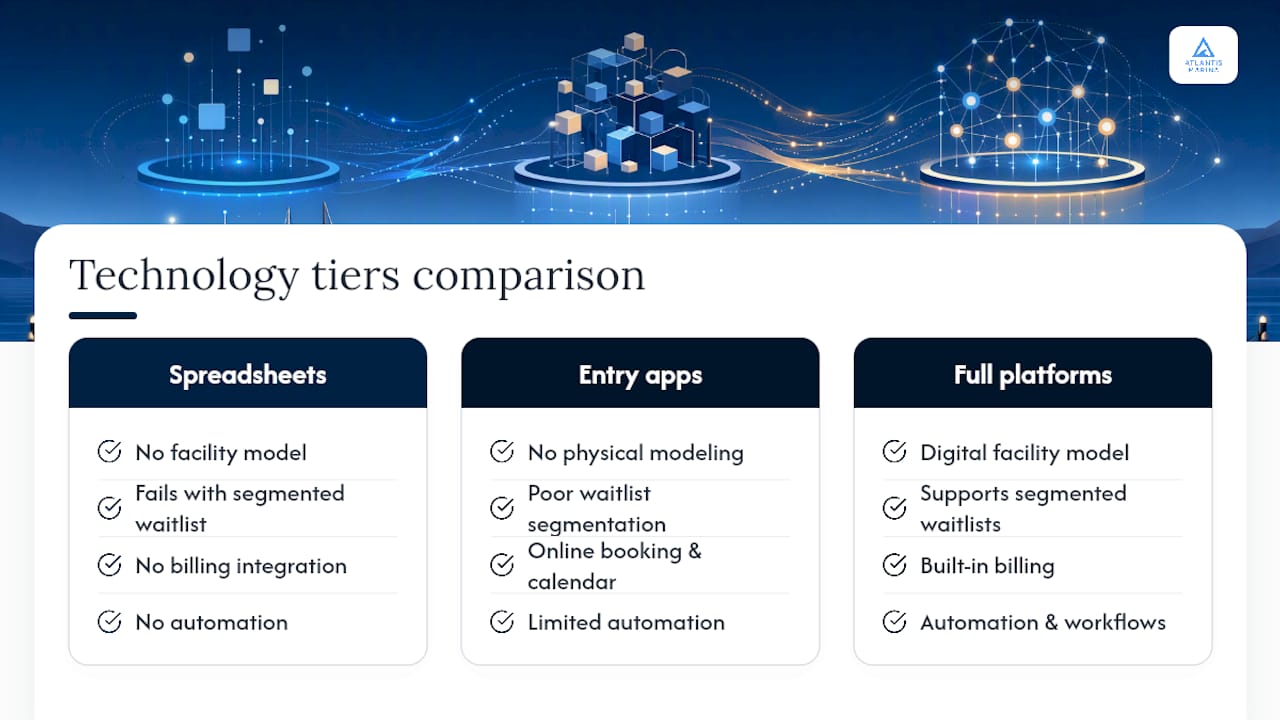
Spreadsheets and paper logs work for very small, single-dock operations with few size-band variations and low turnover. They break down fast once a waitlist needs segmentation or a marina runs more than a couple of dozen slips.
Entry-level reservation apps add online booking and calendar visibility but often stop there, treating the marina as a set of interchangeable time slots rather than a facility with physical constraints. This is the calendar-only trap described earlier, and it tends to surface as double bookings once a marina scales past simple, uniform slip inventory.
Full operational platforms model the facility digitally first, then build reservations, billing, and automation on top of that model. This is the approach Automated Dock Assignment With AI research points to as the difference between reactive scheduling and genuine capacity management.
Atlantis Marina sits in this third tier, built specifically for marinas that need slip assignment, billing automation, boater self-service, and real-time occupancy tracking working from one shared facility model rather than three disconnected tools bolted together after the fact.
The Gap Between Slip Assignment Advice and Slip Assignment Reality
Most advice on this topic treats slip assignment as a scheduling problem. It isn't. It's a capacity management problem wearing a scheduling costume, and that distinction explains almost every recurring conflict marinas deal with, from double bookings to waitlist disputes.
The overlooked piece is recordkeeping. Marinas obsess over the assignment decision itself, size bands, priority rules, pricing, while treating the record of that decision as an afterthought. That's backwards. The decision quality matters less than most operators think, because a reasonable rule applied inconsistently still generates complaints. A good rule applied with a visible, auditable trail generates almost none, even when someone doesn't get the outcome they wanted.
Atlantis Marina's approach reflects this: an operations dashboard that ties assignment decisions to the same record as billing and customer status, so nothing gets resolved from memory. Marinas that adopt this operational-first mindset typically report faster arrival-day turnarounds and far fewer repeat disputes over the same handful of contested slips, because the explanation is already sitting in the system when someone asks for it.
— John R
Putting the Strategy to Work With Atlantis Marina
Everything in this guide, size-band waitlists, verified vessel data, automated assignment with audit trails, is exactly what Atlantis Marina was built to run day to day. Instead of stitching together a spreadsheet, a separate booking app, and a paper waitlist, marinas get one digital facility model that drives reservations, automated assignments, billing, and boater communication from a single source of truth.
The Marina Management Solution covers the operational core described throughout this guide: slip and reservation management, waitlist segmentation, and rule-based assignment with manual override logging built in. Billing runs on autopay, Stripe, and ACH processing so revenue collection doesn't depend on someone chasing a check. On the boater side, the Atlantis Boater App lets vessel owners submit dimensions, upload insurance documents, sign contracts, and track their waitlist position without a phone call, which is the transparency this guide argues actually prevents disputes.
If your marina is still running assignments from a spreadsheet and a clipboard, the next step is straightforward: request a demo and see how the operations dashboard maps to your specific dock layout and size-band mix.
Sources
- How to Run a Marina Waitlist & Slip Allocation System
- How to Develop a Boat Slip Management System for Marinas
- Automated Dock Assignment With AI In Marina Management | PySquad
- AI-Powered Scheduling and Resource Optimization for Marina Management | AI Business OS
FAQ
What Is the Core Principle of a Slip Assignment Strategy?
Model the marina as physical capacity, LOA, beam, draft, and utilities, before layering reservation and waitlist logic on top, rather than treating slips as interchangeable calendar slots.
How Should a Marina Segment Its Waitlist?
Segment by size band and beam, allow multi-band entries for flexible boaters, and refresh entries on a set cadence so stale requests don't block active demand.
What Vessel Data Should Marinas Verify Before Assigning a Slip?
Require LOA, beam, and draft at application, then re-verify on the dock before finalizing, since owners commonly under-report these figures by a foot or more.
Can Software Automate Slip Assignments While Keeping Staff Control?
Yes. Platforms like Atlantis Marina use rule engines for size-band matching and priority logic while still allowing manual overrides, as long as every override is logged with a reason.
How Do Tides and Weather Affect Slip Assignment Flexibility?
Draft clearance needs to account for the lowest expected tide during a stay, and storm or freeze conditions require the ability to reassign slips in real time rather than locking reservations months in advance.