
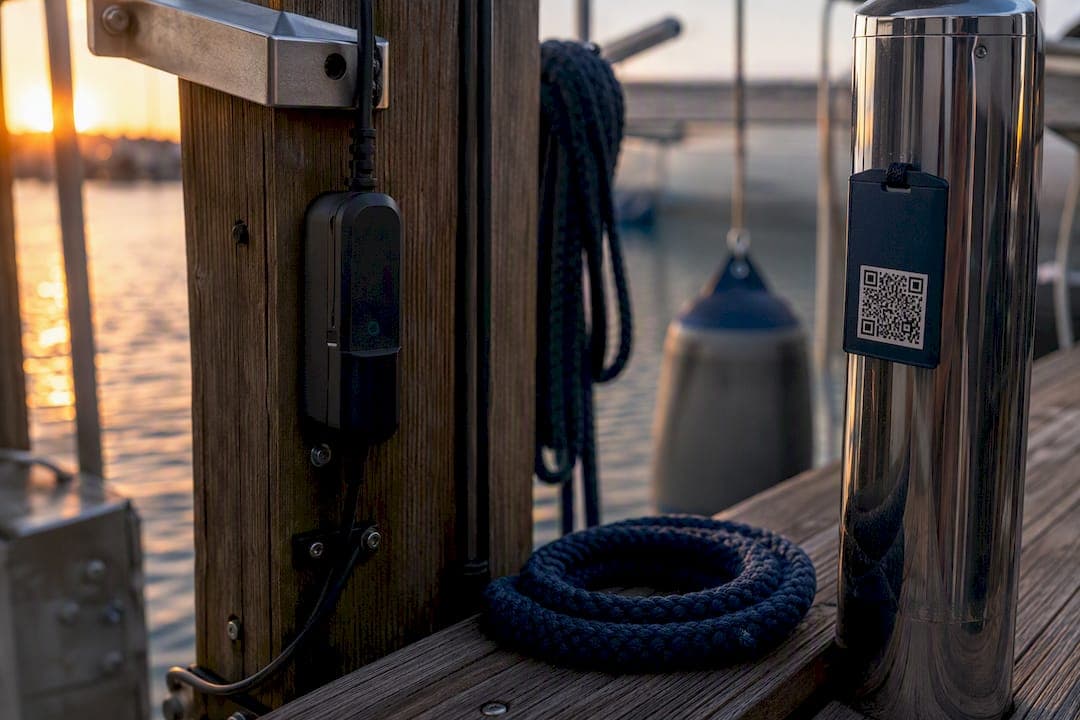
"Prince William marina" in this guide means marina management software: a cloud-based operations and smart waterfront platform, not a physical dock address. The verdict upfront: Atlantis Marina is built for exactly this need, unifying reservations, billing, and smart-hardware control in one system. If you run a marina and want to see it firsthand, the fastest path forward is scheduling a demo or requesting sandbox access.
- What it is: a cloud platform covering slip management, payments, and boater self-service
- Who it's for: owners, operators, dockmasters, and multi-property marina groups
- Core integrations to verify: Stripe, QuickBooks Online, and marine hardware APIs
- Evaluation horizon: ask any vendor for several years of peak-season performance data
Key Takeaways
A marina platform earns its price only when it survives 2 to 3 peak seasons with fast support response, proven integrations, and transparent data ownership.
| Point | Details |
|---|---|
| Verdict on the platform | Atlantis Marina unifies reservations, billing, and smart-hardware control in one cloud system. |
| Prioritize workflows first | Roll out booking and payment automation before adding mapping or hardware integrations. |
| Demand multi-year proof | Ask any vendor for several years of peak-season incident and support records before signing. |
| Pair reservations with mapping | A GIS layer like Atlas prevents shadow spreadsheets tracking depth and infrastructure separately. |
| Next step with Atlantis Marina | Request a demo or sandbox access to test QuickBooks Online sync and the boater app firsthand. |
Table of Contents
- What Does Atlantis Marina Actually Do?
- Which Marinas Get the Most Value From This Platform?
- How Do Core Features Map to Daily Workflows?
- What Does Onboarding and Pricing Actually Look Like?
- What Should You Ask Vendors During a Demo?
- Why Does Spatial Mapping Matter for Marina Infrastructure?
- What Proof Should You Request Before Signing?
- A Dockmaster's Honest Take
- Get Hands-On With Atlantis Marina
- Sources
- FAQ
What Does Atlantis Marina Actually Do?
Atlantis Marina is a cloud-hosted operations platform built to replace clipboards, spreadsheets, and disconnected legacy software with one connected system. Marina operators run daily work through a single dashboard instead of switching between a booking tool, a separate billing system, and a paper maintenance log.
The platform covers:
- Reservation and berth management, including waitlists and auto-assignment
- Online booking and payments for transient and seasonal boaters
- Automated billing and invoicing with QuickBooks Online sync
- Maintenance and work orders with asset history
- A boater self-service app for contracts, documents, and messaging
- Ship store point-of-sale integrated with customer accounts
- Smart boat lift and sensor integrations with remote monitoring
- QR-code check-in workflows linked to reservations and billing status
- An operations dashboard with analytics and occupancy reporting
Pro Tip: Before your first demo, list every spreadsheet or side system your team currently uses for slip tracking, billing, or maintenance. That list becomes your feature checklist.
Payment processing runs through Stripe and ACH, and revenue syncs to accounting automatically rather than through manual reconciliation at month end.
Which Marinas Get the Most Value From This Platform?
Fit depends less on marina size than on operational complexity. A marina management software buyer's guide notes that vessel-aware booking, prorated invoicing, and per-berth utility metering separate real marina platforms from generic booking tools, and different operators lean on different pieces of that stack.
- Small seasonal marinas: prioritize fast online booking and payment capture over deep infrastructure mapping
- Year-round full-service marinas: need billing automation, work orders, and utility metering working together
- Dry-stack operations: depend on launch queue management and lift integration more than dockside mapping
- Multi-property marina groups: require centralized reporting and consistent billing rules across locations
If your slip inventory changes often, or your infrastructure includes power pedestals and pump-out stations, spatial mapping features matter more than they do for a single-dock operation running a handful of seasonal contracts.
How Do Core Features Map to Daily Workflows?
Feature lists mean little until you see them running against a real dock day. Here's how the pieces connect to what your staff actually does.
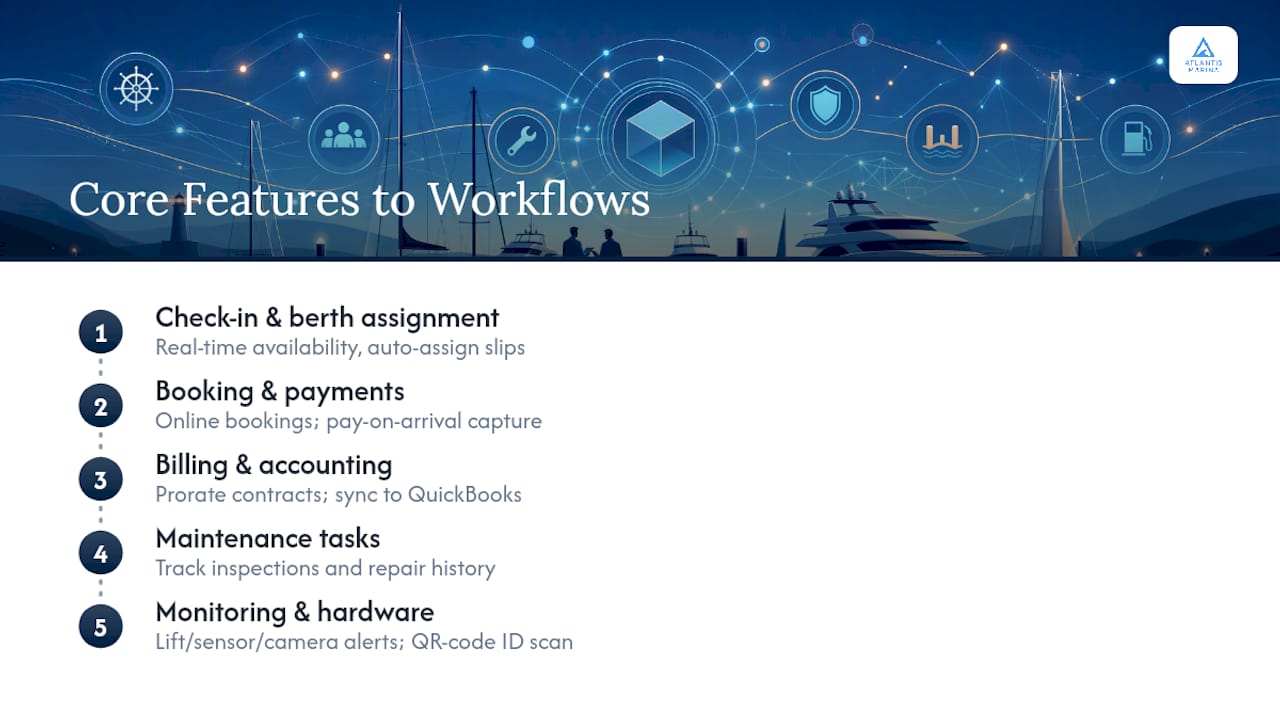
Berth and slip management handles availability in real time, auto-assigns arrivals based on vessel length, beam, and draft, and flags compatibility issues before a boat ever reaches the fuel dock. Online booking and payments capture transient stays and pay-on-arrival transactions without a staff member manually entering a credit card. Billing and invoicing manages recurring seasonal contracts, prorates mid-month arrivals, and syncs every transaction to QuickBooks Online so your bookkeeper isn't re-entering numbers. Maintenance and work orders track inspection schedules and asset repair history per slip or per lift. The boater app handles contract e-signature, document upload for insurance and registration, and two-way messaging with staff.
Smart hardware extends the system past software alone. Boat lift controllers, sensors, and cameras connect through the platform for remote monitoring and mobile alerts, and QR-code passes let staff scan a boater's account for instant identification at check-in, the ship store, or a service appointment, pulling up reservation and billing status without a manual lookup.
Pro Tip: Roll out booking and payment automation first. It solves the most frequent daily friction. Add spatial mapping and hardware integrations in your second season once staff are comfortable with the base system.
What Does Onboarding and Pricing Actually Look Like?
Implementation typically moves through discovery, data import, a pilot period, staff training, and go-live, followed by ongoing support.
- Discovery: map your current slip inventory, customer records, and existing contracts
- Data import: migrate slips, customers, and active contracts into the new system
- Pilot or sandbox: test workflows against a sample of real reservations before full rollout
- Staff training: walk dockmasters and front-desk staff through daily tasks
- Go-live: switch over with support monitoring the transition
- Post-launch support: ongoing help desk access, especially through your first peak season
Pricing generally combines a subscription tier based on marina size and feature needs, a platform fee applied to digital payments processed through the system, and optional add-ons for smart lift hardware or POS equipment. Cloud-based pricing shifts cost from heavy upfront capital spending to a predictable monthly operating expense, which is one reason cloud has become the practical default for most modern marinas, rather than on-premise servers.
Long-term performance matters more than the sales pitch. Software Advice's product notes on Atlas point to peak-season support responsiveness over multiple years as the real test of a platform, not how smooth the first month looks.
Pro Tip: Ask for a pilot that runs through one full high-volume weekend, not just a quiet Tuesday. That's when you actually learn how support performs under pressure.
What Should You Ask Vendors During a Demo?
Bring a written checklist into every demo call and capture answers on paper, not memory. Vague verbal reassurances don't hold up during an RFP comparison later.
- What does feature coverage look like across reservations, billing, operations, and spatial mapping?
- Which payment, accounting, and hardware integrations are proven, not just theoretical?
- Is hardware compatible with our existing boat lifts, sensors, and cameras?
- Can the platform scale to a second property without a rebuild?
- What is the SLA for uptime, and what's the backup and data export policy?
- Can we get sandbox access before committing?
- Ask for peak-season incident response times, not just general support hours
- Request references from marinas of similar size and season length
- Ask specifically for Stripe and QuickBooks Online integration proof, not a generic "we integrate with accounting software" answer
- Confirm what happens to your data if you ever switch platforms
Write the answers down. A vendor who won't commit to specifics in writing is telling you something.
Why Does Spatial Mapping Matter for Marina Infrastructure?
Reservation and billing software solves half the problem. The other half is knowing exactly where your infrastructure sits and what condition it's in, which is where a GIS layer like Atlas comes in.
Marinas need to track slip boundaries, water depth by berth, power pedestal locations, pump-out stations, and dredging history, along with environmental overlays and wayfinding for guests. Spatial mapping use cases include bathymetric overlays for depth visualization and infrastructure tagging that a spreadsheet simply can't represent.
- Keep shared reference IDs (slip numbers, customer IDs) consistent between your reservation system and the mapping layer
- Import bathymetric data so depth changes are visible, not assumed
- Use mapping for dredging documentation and maintenance routing
- Apply the same maps to emergency response planning during storms or high water
Operators who skip this step often end up running a separate map or spreadsheet outside their main system, which drifts out of sync with real conditions over time.
What Proof Should You Request Before Signing?
Marketing pages tell you what a platform claims. References tell you what it delivers. Ask for both before committing budget.
Request case studies from marinas comparable to yours in size and season length, along with uptime and SLA figures in writing. Ask for incident logs covering peak seasons over a 2 to 3 year window, not just the vendor's best month. Sandbox access and a recorded demo walkthrough let your team test workflows before your board sees an invoice.
Most reviews of marina platforms focus heavily on billing and reservations. Far fewer address infrastructure tracking, depth management, or maintenance records, according to Atlas's review of what operators actually need. Ask directly for examples in those weaker-covered categories.
Watch for red flags: vendors who won't share peak-season references, SLAs written in vague language, no clear data export option, or platform payment fees buried in fine print rather than stated upfront.
- Occupancy and revenue capture rates by season
- Payment capture rate for transient stays specifically
- Average incident resolution time during your busiest months
- Written backup and export policy
A Dockmaster's Honest Take
Solve your worst daily pain first. For most marinas that's booking and payment capture, not the flashiest integration on a sales sheet. Ignoring infrastructure tracking in favor of shiny reservation features is how operators end up running shadow spreadsheets years later.
Before you sign anything, ask for a pilot that runs through a full high-volume weekend. That's the only real test of how support behaves when it counts.
Get Hands-On With Atlantis Marina
Everything in this guide, from berth assignment to QuickBooks Online sync to smart lift control, maps directly to what Atlantis Marina already runs for marinas today. Instead of stitching together a booking tool, a separate accounting system, and a paper maintenance log, you get one dashboard, one boater app, and one AI assistant, Atlantis Bot, handling routine staff and boater questions so your team isn't answering the same reservation question five times a day.
The platform's smart-hardware support, covering boat lift controllers, cameras, and sensor integrations, is what genuinely sets it apart from software that only handles bookings and invoices. If the checklist in this guide matches your daily reality, the next step is straightforward: schedule a demo or request sandbox access through the Atlantis Marina sales page and see your own slip layout running in the system before you commit to anything.
Sources
Further reading on evaluation frameworks and platform comparisons:
- Marina Management Software Reviews: What Operators Actually Need | Atlas
- Comparing Cloud vs. On-Premise Marina Management Software
- Marina management software common pitfalls (SourceForge summary)
FAQ
What does "prince william marina" mean in this context?
In this guide, it refers to cloud-based marina management software, specifically the Atlantis Marina platform, not a physical marina location.
How long does onboarding take?
Timelines vary by marina size, but most implementations move through discovery, data import, a pilot period, staff training, and go-live before full support kicks in.
What integrations should I confirm before buying?
Confirm proven support for Stripe payment processing, QuickBooks Online accounting sync, and compatibility with your existing boat lift and sensor hardware.
Why does peak-season performance matter more than onboarding smoothness?
A smooth first month says little about how a platform holds up under real pressure; 2 to 3 years of peak-season support records are a far stronger signal.
Does Atlantis Marina support multi-property marina groups?
Yes, the platform is built for remote management and multi-property scalability, covering everything from single small marinas to larger enterprise waterfront groups.