

Real-time marina reporting is defined as the automated, continuous aggregation of operational data from reservations, billing, maintenance, and guest services into a unified dashboard that updates without manual input. The role of real time marina reporting goes far beyond replacing spreadsheets. It gives dockmasters and marina operators the live visibility they need to make faster decisions, catch revenue leaks before they compound, and deliver the kind of guest experience that keeps boaters coming back. Automated systems reduce manual data collection time by 85–90%, which means your staff spends more time on the dock and less time reconciling numbers at a desk. This guide covers how these systems work, which KPIs matter most, and how to put real-time data to work every single day.
How does real-time reporting transform marina operational workflows?
Traditional marina reporting is fragmented by design. Occupancy lives in one spreadsheet, billing in another, and maintenance logs on a clipboard somewhere near the fuel dock. Disconnected systems force staff to re-enter the same data across multiple platforms, which wastes time and introduces errors at every handoff.
Automated real-time reporting replaces that fragmentation with a single data layer. When a boater completes a reservation, the slip map updates instantly. When a payment clears, the billing ledger reflects it without anyone touching a keyboard. Maintenance requests logged by dock staff appear on the operations dashboard in seconds. The result is a facility where every team member sees the same current picture.

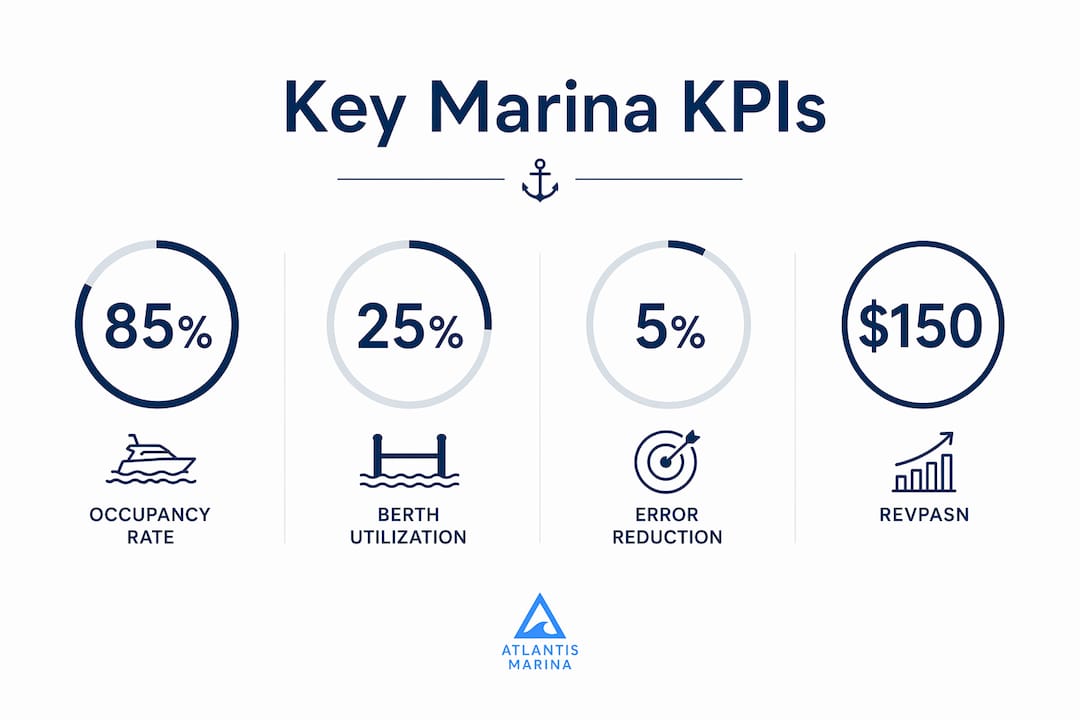
Manual reporting error rates run between 5–10% due to human mistakes. Automated systems nearly eliminate those errors. That difference matters most during peak season, when a single misassigned slip or a missed payment can cascade into a guest complaint and a lost renewal.
Real-time reporting improves the following operational tasks directly:
- Slip assignment and availability: Live occupancy maps prevent double-booking and show open slips the moment a vessel departs.
- Billing and payment reconciliation: Automated payment posting removes the end-of-day reconciliation grind.
- Maintenance scheduling: Work orders tied to vessel records surface the right tasks at the right time.
- Guest communication: Automated SMS and email triggers send arrival confirmations and departure reminders without staff intervention.
- Fuel and ship store inventory: Point-of-sale transactions update stock counts in real time, reducing over-ordering and stockouts.
Pro Tip: Verify that your reporting platform updates data continuously rather than on a scheduled batch cycle. A system that syncs every four hours is not real-time reporting. It is delayed reporting with a modern interface.
What KPIs should marina operators track with real-time reporting?
Occupancy rate is the metric most marina operators watch. It is also the most misleading one on its own. Tracking RevPASN and ancillary revenue alongside occupancy gives a far more accurate picture of profitability. A marina running at 95% occupancy with low fuel sales and no service revenue may be less profitable than one at 80% occupancy with strong ancillary income.
Real-time reporting makes it practical to track these KPIs daily rather than monthly. The table below outlines the metrics that matter most, how frequently they should be reviewed, who owns them, and what they actually measure.
| KPI | Review Frequency | Owner | Operational Impact |
|---|---|---|---|
| Berth utilization rate | Daily | Dockmaster | Measures slip demand and guides pricing decisions |
| Revenue Per Available Slip Night (RevPASN) | Weekly | Marina manager | Combines occupancy and rate to show true revenue efficiency |
| Ancillary revenue ratio | Weekly | Operations lead | Tracks fuel, service, and retail income as a share of total revenue |
| Net operating income margin | Monthly | Ownership/finance | Measures overall profitability after operating expenses |
| Maintenance cost per slip | Monthly | Facilities manager | Identifies aging infrastructure before it becomes a capital expense |
Marinas using automated real-time reporting increase berth utilization by 15–25% through proactive occupancy management and demand forecasting. That improvement compounds quickly across a full season.
Weekly KPI huddles drive accountability far more effectively than monthly reviews. When leadership meets around live dashboard data every week, problems surface in time to fix them rather than after the damage is done. Assign a clear owner to each KPI and hold that person accountable for the trend, not just the number.
What are the common challenges in implementing real-time reporting?
The biggest barrier to real-time reporting is not technology. It is data silos created by legacy systems that were never designed to talk to each other. A marina running separate platforms for reservations, billing, and maintenance will struggle to build a unified dashboard without first solving the integration problem.
Connected systems reduce time spent stitching data together, which frees leadership to focus on growth rather than data cleanup. The practical path forward is to audit every platform currently in use and identify where data enters the system more than once. Every duplicate entry point is a potential error and a guaranteed time drain.
Data latency is a subtler problem. Sync intervals must align with operational needs to prevent decisions based on hours-old data. A dockmaster assigning slips from a dashboard that refreshes every two hours is not working with real-time information. That gap causes the same coordination failures that manual reporting does, just with a better-looking interface.
Common pitfalls to avoid during implementation:
- Assuming all integrations are equal: API connections vary in reliability and update frequency. Confirm sync intervals in writing before committing to a platform.
- Skipping staff training: A dashboard no one uses is not an improvement. Budget time for hands-on training before go-live.
- Migrating all systems at once: Phased rollouts reduce risk. Start with the area causing the most time loss or revenue leakage, then expand.
- Ignoring mobile access: Dockmasters work on the dock, not at a desktop. A mobile-ready operations platform is a requirement, not a bonus feature.
- Treating the dashboard as a reporting tool only: Real-time data has the most value when it triggers action, not just observation.
Pro Tip: Start your integration with billing and reservations. These two systems generate the most reconciliation work and the most errors. Connecting them first delivers visible time savings within the first week and builds staff confidence in the new system.
How to use real-time marina reporting for daily decisions and guest experience
Real-time data changes how dockmasters manage arrivals. AIS integration provides vessel position updates roughly every 20 seconds, which means a dockmaster knows a 65-foot trawler is 12 minutes out before the captain calls on the radio. That lead time allows the team to prepare the slip, alert fuel staff, and pull the guest's account before the vessel reaches the breakwater.
Slip availability monitoring works the same way. When a vessel departs and the slip status updates automatically, the next reservation in the queue can be confirmed and the guest notified without any manual step. That kind of frictionless coordination is what separates a well-run marina from one that feels chaotic during a busy weekend.
Automated dashboards provide continuous updates on occupancy, revenue, and maintenance status. That continuous visibility supports dynamic pricing decisions, maintenance scheduling based on actual vessel activity, and accurate forecasting for staffing and inventory. The marina operations dashboard becomes the single source of truth for every operational decision made that day.
Operators who want to maximize the value of their reporting systems should follow these steps:
- Define your KPI set before going live. Know which metrics you will track and who owns each one before the system is turned on.
- Set dashboard alerts for threshold breaches. Configure notifications when occupancy drops below a target rate or when a maintenance item goes unresolved past a set deadline.
- Tie guest communications to data triggers. Automate arrival confirmations, departure reminders, and service follow-ups based on reservation and billing events.
- Review the dashboard at the start of every shift. Make it a non-negotiable part of the dockmaster handoff so every shift starts with current information.
- Use weekly KPI data to adjust pricing and staffing. Real-time trends over a rolling seven-day window reveal demand patterns that monthly reports miss entirely.
Key Takeaways
Real-time marina reporting delivers its full value only when integrated systems, disciplined KPI reviews, and mobile-ready tools work together to replace manual workflows with live, accurate data.
| Point | Details |
|---|---|
| Automation cuts manual work | Automated reporting reduces data collection time by 85–90%, freeing staff for guest service. |
| Track RevPASN, not just occupancy | Berth utilization alone is misleading; RevPASN and ancillary revenue reveal true profitability. |
| Sync frequency determines real-time value | Batch-cycle systems are not real-time; confirm continuous sync intervals before selecting a platform. |
| Start integration where it hurts most | Connect billing and reservations first to deliver fast, visible time savings and reduce errors. |
| Weekly KPI huddles drive accountability | Regular leadership reviews of live data surface problems early and keep teams aligned on targets. |
What I've learned about real-time reporting after years on the dock
Most marina operators I've worked with install a reporting dashboard and then wait for it to change their business. It does not work that way. The dashboard is a tool. The discipline to use it consistently is what actually moves the numbers.
The "visibility gap" is real. Operators who check their dashboard once a week are not running a real-time operation. They are running a weekly operation with a better-looking report. The value of live data comes from acting on it the same day, sometimes the same hour.
I've also seen operators focus entirely on occupancy and miss the revenue story underneath it. A marina can be full and still underperform because ancillary revenue is untapped and pricing is flat. RevPASN is the metric that exposes that problem. Once operators start tracking it weekly, pricing conversations get sharper and faster.
The human element matters more than most technology vendors admit. Automation protects your staff's time for the work that actually requires a person: greeting a first-time boater, resolving a billing dispute with empathy, or making a judgment call on a slip assignment during a storm. The dockmaster's role does not shrink with better reporting. It gets more focused on the things that technology cannot do.
— John R
Atlantis Marina brings real-time reporting to every part of your operation
Atlantis Marina gives dockmasters and marina operators a single cloud-based platform where reservations, billing, maintenance, occupancy, and guest communications update in real time across every screen.
The marina management platform connects slip assignments, automated billing through Stripe and ACH, QuickBooks Online sync, and live occupancy maps into one operations dashboard. Atlantis Bot handles boater questions around the clock, while the Atlantis Boater App keeps guests informed with automated SMS and email updates. Whether you manage a single facility or a multi-property group, Atlantis Marina replaces fragmented tools with one connected system built for the way marinas actually operate. See the full platform at Atlantis Marina and find out what real-time operations look like in practice.
FAQ
What is real-time marina reporting?
Real-time marina reporting is the automated, continuous collection and display of operational data from reservations, billing, maintenance, and guest services in a unified dashboard. It updates without manual input, giving operators an accurate picture of facility status at any moment.
How does real-time reporting reduce errors in marina operations?
Manual reporting carries error rates of 5–10% due to human data entry mistakes. Automated real-time systems nearly eliminate those errors by pulling data directly from source systems without manual re-entry.
Which KPIs matter most for marina profitability?
Revenue Per Available Slip Night (RevPASN), ancillary revenue ratio, and net operating income margin are the most critical profitability metrics. Occupancy rate alone does not capture whether a marina is generating strong revenue from each available slip.
How often should marina operators review their reporting dashboards?
Dockmasters should review the dashboard at the start of every shift. Leadership teams should hold weekly KPI huddles using live data to catch performance trends early and assign accountability for improvements.
What is the biggest mistake marinas make when adopting real-time reporting?
The most common mistake is selecting a platform that runs on batch-cycle data syncs rather than continuous updates. A system that refreshes every few hours delivers delayed information, which causes the same coordination failures as manual reporting.