
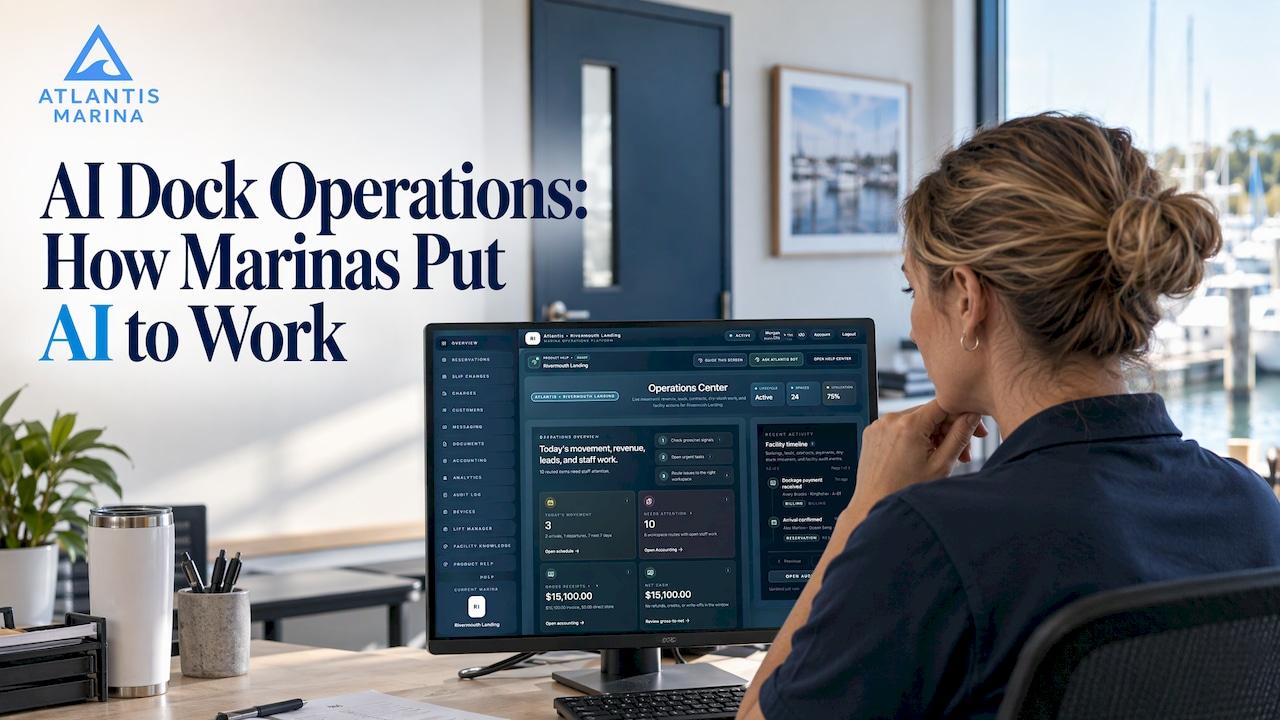
AI dock operations means using software to read the data a marina already produces (reservations, occupancy, payments, calls, sensor readings) and turn it into recommendations or drafted actions that staff confirm. It works when one system holds that data. It stalls when slips live in one tool, billing in another and lift or camera alerts in a third. That is why we built Atlantis Marina as one cloud platform for marina operations, with the AI assistant, billing, boater self-service and smart hardware sharing the same records.
TL;DR
- AI dock operations is a decision-support layer on top of your records: forecasting slip occupancy, answering routine questions, drafting billing and restocking actions, and flagging sensor events.
- The data foundation comes first. AI is only as useful as the reservation, vessel, payment and device data behind it.
- Keep staff in the loop. The best-supported approach in the industry is AI as a co-pilot, with staff confirming actions that touch money, access or safety.
- Start with one workflow, prove the result, then expand.
- Since July 16, 2025, a Coast Guard cybersecurity rule applies to regulated facilities, and connected systems make passwords, patching and access control part of dock operations.
Table of Contents
- What AI dock operations actually means
- Where AI helps most on the docks
- What the numbers say, and how to read them
- Data comes first
- Keeping staff in control
- Security and compliance for connected docks
- A pilot plan that works
- Perspective
- What Atlantis Marina costs
- FAQ
- Sources
What AI dock operations actually means
Ordinary automation follows a fixed rule: send a reminder three days before a payment is due, charge the card on file on the first of the month. AI handles the work where no single rule fits. It reads a customer's question and finds the right reservation, weighs occupancy against weather and demand to suggest a price, or spots that a sensor pattern on a lift looks unusual.
In practice, marinas use both together. Rules do the predictable work. AI covers the judgment-heavy, repetitive tasks that eat the dockmaster's day.
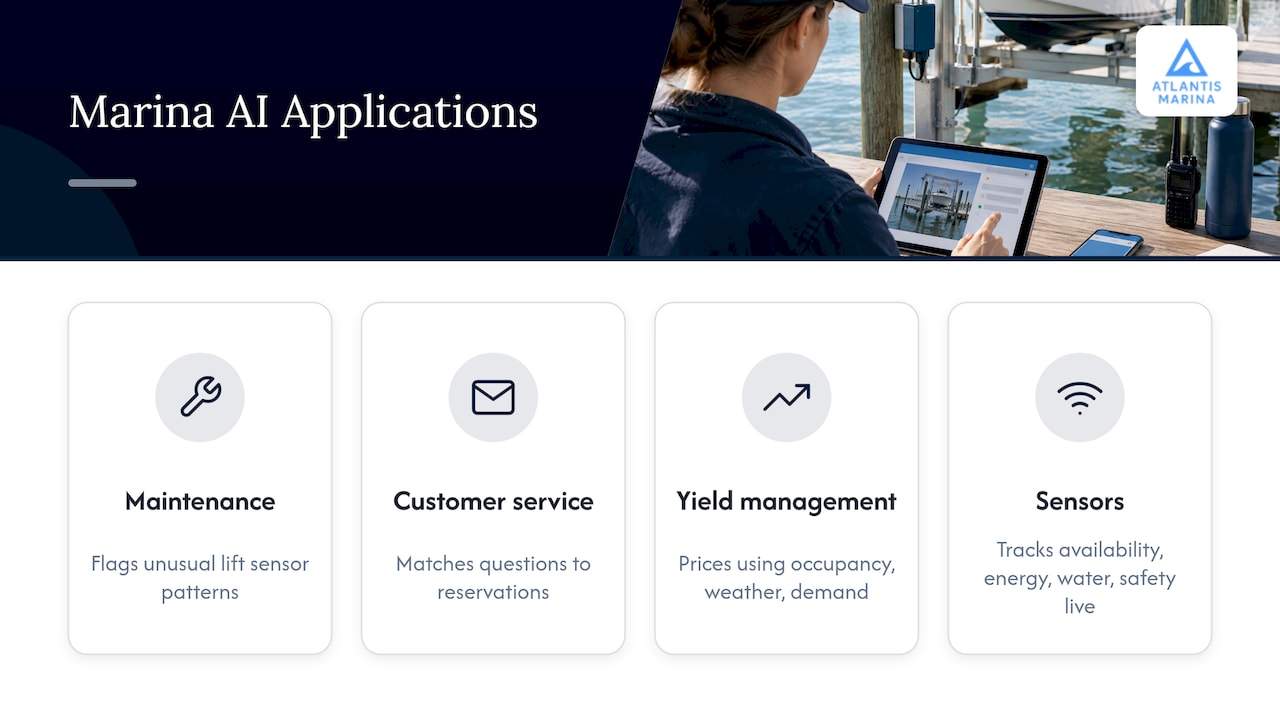
The Association of Marina Industries describes the real-world examples that its "From Docks to Data" session covers: predictive maintenance, proactive automated customer service, yield management, and AI-enabled sensors on berths, utilities and equipment that give real-time visibility into availability, energy and water use, and safety conditions.
Note the word "dock" in the keyword. It does not mean the physical act of tying up a boat. Skippers still handle approach, lines and prop control, and docking a boat in wind is a seamanship skill. AI dock operations is about everything the marina does around the berth: who is assigned where, who has paid, what is connected, and what needs attention next.
Where AI helps most on the docks
Slip assignment and occupancy forecasting
Trade Only Today reported in February 2026 that AI can forecast slip occupancy, automate billing and improve compliance checks. Boating Industry's January 2026 coverage adds that operators expect AI to optimize berth allocation, forecast demand and recommend pricing, with one multi-site operator describing analysis of slip demand, occupancy, weather and revenue trends in real time.
For a dockmaster, the practical value is fewer empty slips and fewer double-handled assignments. Atlantis Marina manages slip assignments, reservations, waitlists, vessel records and facility maps in one place, so a recommendation starts from the real state of the docks. Our guide to AI scheduling for marinas shows how to pilot one workflow and keep staff in control.
Calls, messages and lead response
Speed of response is measurable. Alliance Marine CEO Colin Kiley told the AMI 2026 conference that call tracking showed 30% of calls at some locations went to an answering machine, and that calls returned within two hours closed at 60% versus 40% at 24 hours, as reported by Trade Only Today.
That is the case for an assistant that answers on your website around the clock. Atlantis Bot answers boater and prospect questions on marina websites, so a transient asking about availability at 9 p.m. gets a response while the interest is fresh. For a broader view of how AI agents handle inquiries, see this overview of AI customer service agents. Our own customer communication tools guide covers email, SMS and messaging in the marina setting.
Billing and payments
Billing is the most rule-bound part of the dock office, which makes it a good first target. In Atlantis Marina, contracts are signed with Atlantis E-Sign, and autopay, Instant Pay, Stripe and ACH processing, refunds and adjustments, and QuickBooks Online sync keep revenue billed, collected and booked without manual entry. Atlantis Bot helps staff with reservation and billing questions, with staff-confirmed actions.
Ship store and inventory
Restocking is a forecasting problem. Atlantis Bot helps staff with ship store restocking, and the platform includes ship store POS. Our article on AI inventory forecasting for marinas explains why a forecast figure is a planning input, not a promise.
Boat lifts, cameras and utilities
This is where marina software and hardware meet. Atlantis Marina supports smart boat lift controllers, remote monitoring, AUX device control, sensor and camera integrations, mobile alerts and access workflows, plus a handheld Dealer Tool Kit for lift setup and diagnostics. When a sensor event lands in the same account as the vessel, the slip and the customer, staff see what happened and who it concerns. Read how to turn dock security sensor triggers into vessel-linked records and the guide to IoT sensor integration for boat lifts.
The scale of connected infrastructure elsewhere shows where the industry is heading. D-Marin has installed more than 2,200 digitalized pedestals across 26 sites and uses over 10,000 boat sensors monitoring batteries, temperature and bilge levels, according to Marina World.
What the numbers say, and how to read them
Trade Only Today's 2026 report lists benefits operators have cited: 12 to 15 hours saved weekly in coordination, 12 to 18% revenue increases at some marinas from demand-based pricing, and fewer collisions and dock damage from assisted docking.
Treat these as ranges from specific operators, not forecasts for your marina. Your result depends on your occupancy mix, your pricing starting point and how clean your data is. Set your own baseline before you start: hours spent on reservation questions per week, days to collect invoices, empty-slip nights per month. Then measure the same three after 60 to 90 days.
Data comes first
Elite Dynamics CEO Jamaine Campbell told AMI 2026 that a solid business strategy and a solid data strategy are where AI pays off, while tactics alone give short-lived benefits, per Trade Only Today. Brunswick's Will Sangster made a similar point about infrastructure: marinas should adopt gradually and invest in reliable high-speed internet.
A short readiness list for a dock office:
- Vessel records: dimensions, owner, insurance and registration on file for every boat.
- Slip data: accurate sizes, utilities and status for every berth.
- Payments: one billing record per customer, not one per spreadsheet.
- Devices: lifts, cameras and meters reachable over a stable network.
- Communications: messages logged against the customer account.
Atlantis Marina keeps vessel records, documents, customer accounts, billing and connected devices in the same system, and the Atlantis Boater App and web portal let boaters upload insurance and registration documents and sign contracts themselves. Fewer re-keyed entries means a cleaner base for every AI feature. See the role of marina software integrations for how the pieces connect.
Keeping staff in control
The consistent message from marina leaders is that AI assists and people decide. Pick a Pier CEO Idan Cohen put it this way in Marina World: AI must be a co-pilot, not an autopilot. Professor Moshe BenBassat adds that AI should take repetitive, low-value tasks so staff can focus on high-touch service, and recommends starting small, solving clear problems and proving value.
A workable control model for any marina:
- Suggest, then confirm. AI drafts; a named staff member approves anything involving money, refunds, access or safety.
- One owner per workflow. A person, not a team, answers for the results.
- Review a sample weekly. Read ten assistant conversations and ten drafted actions.
- Log everything. Every action should trace to a customer, vessel and time.
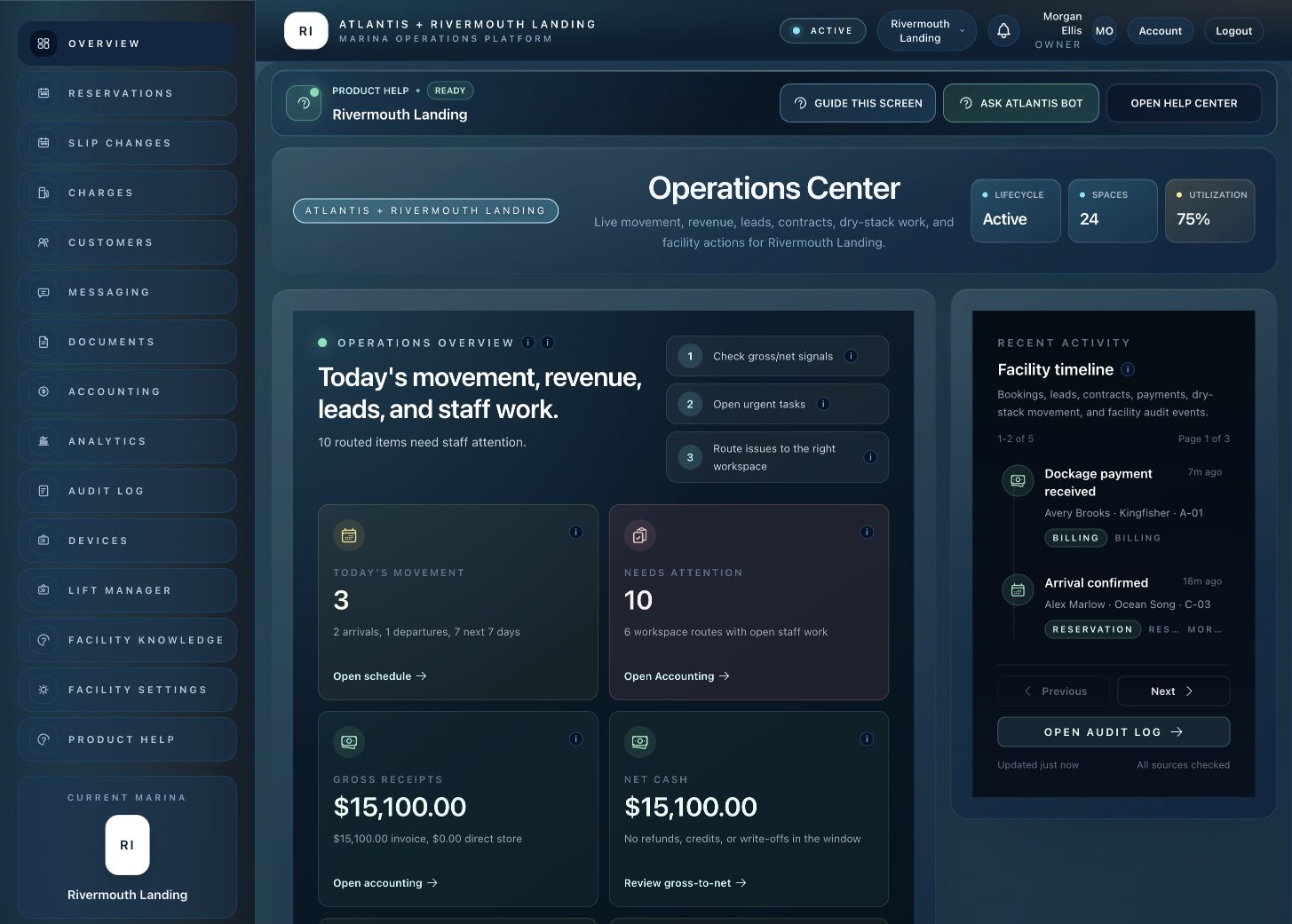
Atlantis Bot is designed around staff-confirmed actions, which fits this model directly. An operations view helps too: the marina operations dashboard features guide describes what to put on one screen. For more use cases, read our AI marina operations use cases guide and the AI-assisted marina operations operator guide.
Security and compliance for connected docks
The more your docks connect, the more your cyber hygiene matters. In December 2025 testimony to a House subcommittee, Coast Guard officials stated that the service's cybersecurity rule for facilities and U.S. vessels took effect July 16, 2025, requiring cybersecurity plans and setting a baseline framework to prevent, detect and respond to cyber threats. The same testimony reports that 2024 assessments found weak passwords, exposed services and unpatched systems common in commercial IT and operational technology, and notes that AI use in port logistics presents new attack vectors.
The rule applies to facilities regulated under the Maritime Transportation Security Act, which includes some marinas and not others. If you are unsure whether your facility is covered, confirm with your Coast Guard Captain of the Port. For every marina, the useful takeaways are the same:
- Use strong, unique logins and multi-factor authentication for staff accounts.
- Keep device firmware and software updated.
- Limit who can trigger lift, gate or camera actions.
- Keep customer data inside your operations platform. Trade Only Today flags the risk of public AI tools using inputs to train external models, so do not paste customer records into them.
A pilot plan that works
Both the research and common sense point to the same sequence:
- Pick one workflow with clear volume, such as after-hours inquiries or invoice follow-up.
- Baseline it for two to four weeks.
- Turn on the assistant with staff confirmation for every action.
- Review weekly, correcting answers and tightening rules.
- Expand to the next workflow: waitlist, restocking, lift alerts.
Perspective
Most marinas do not have an AI problem. They have a data-in-five-places problem. When reservations, vessel records, payments, lifts and cameras all live in separate tools, any assistant, human or software, spends its time hunting for context.
That is why we built Atlantis Marina as one account-based system. A boater's account travels with them across the Atlantis Marina Network. Their vessel, documents, contract and payments sit with the slip, and the same context reaches smart lift controllers, cameras and utility monitoring. Atlantis Bot works from that shared context, and its actions are staff-confirmed.
Our view is simple: the dockmaster stays in charge, and the platform removes the retyping, the chasing and the guessing. Start with the workflow that costs you the most hours, and let the rest follow.
John R
What Atlantis Marina costs
Plans are tiered by marina size, as published on our pricing page: Micro at $150 per month, Small at $300, Medium at $500 and Large at $900, with Enterprise quoted on request. Add-ons include Eagle Eye smart cameras and utility monitoring at $30 to $150 per month each, the dry-stack operations add-on at $79 to $299 per month, automated fuel operations at $50 per month, and premium smart lift automation at $1 per month per lift. Atlantis setup is a one-off $100 to $1,000, and a 3% platform fee applies per transaction.
If you run a dry stack, a lift facility or a multi-property group, start with the Atlantis Marina software overview and see which plan fits your size.
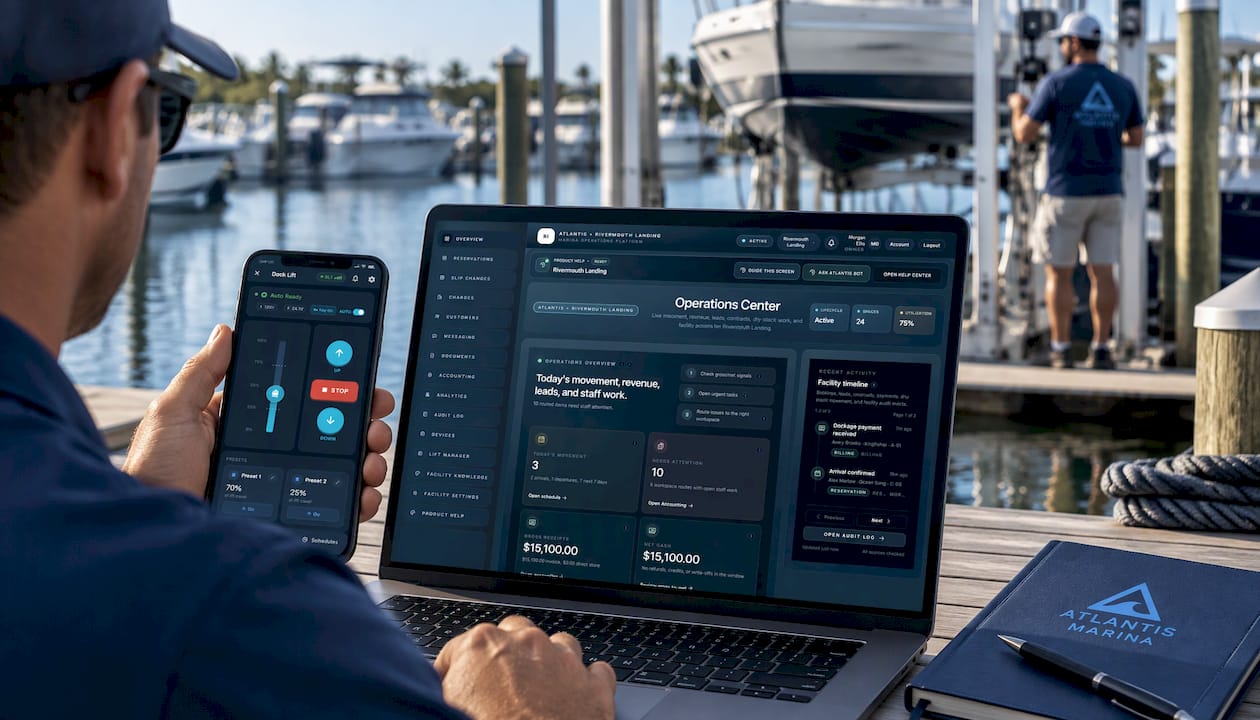
Boaters, meanwhile, get a single app and web portal for reservations, documents, payments and messages, which keeps the data your AI relies on complete from the first booking.
FAQ
What are AI dock operations?
They are the day-to-day marina tasks that AI supports: answering inquiries, forecasting occupancy, drafting billing and restocking actions, and flagging sensor or camera events. Staff review and confirm the actions that matter.
Will AI replace dockmasters or marina staff?
No. Boating Industry's coverage quotes an industry voice saying AI will not replace marina staff, and other leaders describe it as a co-pilot. It handles repetitive work so staff spend time on service, safety and the docks themselves.
Where should a marina start?
Start with one workflow that has steady volume, such as after-hours inquiries, invoice follow-up or ship store restocking. Measure a baseline, run it for 60 to 90 days with staff confirmation, then expand.
Does the Coast Guard regulate AI at marinas?
There is no AI-specific marina rule in the testimony we reviewed, but the Coast Guard's cybersecurity rule for regulated facilities took effect July 16, 2025. Check with your Captain of the Port whether your facility is covered.
What data does AI need?
Accurate vessel records, slip data, payment history, device connections and logged communications. The more of it that lives in one system, the better the results.
Sources
- Association of Marina Industries: From Docks to Data
- Trade Only Today: AI for Marinas, Hype, Hope & Help
- Boating Industry: The evolving expectations for marinas
- Marina World: Unlocking the future smart marina
- Marina Dock Age: Boating Intelligence technology
- U.S. Coast Guard testimony to the House Transportation Subcommittee, Dec. 16, 2025