
A marina intake form must collect owner ID, vessel registration, and a certificate of insurance that names the marina before staff process a slip request. The form also needs vessel specs, an emergency contact, the intended use (transient, seasonal, or liveaboard), and payment or deposit intent. Once staff verify every item against the original documents, collect the deposit, and get a signed contract, onboarding is complete.
TL;DR:
- Marina intake forms require verification of the vessel's measurements, insurance dates, and that the Certificate of Insurance lists the marina as additional insured.
- Special forms and verification steps are necessary for liveaboard applicants to ensure compliance with local occupancy restrictions.
- An effective workflow includes immediate follow-up on missing documents, digital signatures, and automated renewal reminders to minimize delays.
- Hosted forms and portals should specify accepted file types, keep layouts mobile-friendly, and include clear contact information for applicant questions.
- Commercial and transient vessels need tailored verification procedures, with separate intake forms and document checks reflecting their different operational requirements.
Table of Contents
- What Documents Do Marina Intake Forms Actually Require?
- Field-Level Template: The Intake Form Fields Every Marina Should Include
- Legal, Insurance, and Residency Essentials to Capture
- From Application to Signed Contract: The Intake Workflow
- Where to Find Sample Forms and How to Host Yours
- How Do You Update or Correct Information After Intake?
- How Should Marinas Handle Commercial Vessels and Transient Boats?
- Who Should Applicants Contact With Questions?
- Why Standardized Intake Forms Pay Off Operationally
- How Atlantis Marina Automates the Intake Process
- Sources
- FAQ
What Documents Do Marina Intake Forms Actually Require?
Every marina intake form rests on three non-negotiable documents: a government-issued photo ID, vessel registration or U.S. Coast Guard documentation, and a Certificate of Insurance (COI) that lists the marina as additional insured. Beyond that core trio, most operators layer in proof of residence, trailer or CF numbers, and sometimes a reference letter from the applicant's previous marina.
Before approving any application, staff should work through a short verification pass:
- Match the name on the photo ID against the name on the vessel registration or USCG documentation.
- Confirm vessel measurements (length overall, beam, draft) against what the berth can actually hold.
- Check the COI's effective and expiration dates, and confirm it names the marina as additional insured.
- Look up local liveaboard or occupancy permit restrictions before accepting a liveaboard applicant.
Municipal marinas often add extras that private operators borrow freely. Berkeley's berth rental application requires a signed acknowledgement of marina rules alongside its document checklist, and Ventura West Marina's slip application asks for a reference letter, a color photo of the vessel, and a recent utility bill. Larger vessels sometimes warrant a survey before staff sign off on berth fit.
Pro Tip: Keep a laminated version of this checklist at the front desk. Staff turnover is common in marina operations, and a physical reference prevents a new hire from approving an application with an expired COI.
Field-Level Template: The Intake Form Fields Every Marina Should Include
A clean intake form organizes into six sections, each with its own required and optional fields.
- Owner information. Full legal name, mailing address, physical address (no PO boxes), phone, email, and driver's license or ID number.
- Vessel information. Vessel name, make and model, length overall, beam, draft, registration or USCG number, and trailer ID if applicable.
- Insurance. Insurer name, policy number, coverage type, liability limits, and a COI upload field.
- Use and occupancy. A single-select field for transient, seasonal, liveaboard, or commercial use, since each triggers different verification steps.
- Payment. Deposit amount, payment method, and an autopay consent checkbox.
- Emergency contact and berth preference. A secondary contact name and phone number, plus preferred slip size or location.
Mark the COI and registration fields as mandatory file uploads, and accept PDF or JPEG files under roughly 10 MB so mobile photo uploads don't fail. Registration number fields should include a basic format check, since a typo here is one of the most common intake mistakes. Rule and ordinance acknowledgement should require a separate initial field, not just a signature at the bottom, so consent to specific liability language is unambiguous rather than assumed.
Legal, Insurance, and Residency Essentials to Capture
A COI naming the marina as additional insured protects the facility if the vessel causes damage to a dock, another boat, or a third party. Staff should record the insurer's name, the policy number, and both the effective and expiration dates directly on the intake form, then flag any COI expiring within 30 days for follow-up.
Residency verification is a standard operational practice at many U.S. municipal marinas, not a formality. Berkeley's berth application uses a three-group proof-of-residence table, typically accepting items such as:
- A utility bill dated within the last 60 to 90 days
- A current bank or credit card statement showing the applicant's address
- A signed lease or mortgage statement
PO boxes are commonly rejected across these forms because they don't establish a physical address. Insurance minimums vary by facility. Port Toronto's client intake form asks for a very high liability coverage amount, well above what many smaller U.S. marinas require, so confirm the applicable minimum locally rather than assuming a single national standard. For liveaboard applicants, the form should include a permit acknowledgement field and route the application to a manager for approval where local ordinances restrict overnight occupancy. Track COI details the same way you'd track any insurance document tied to a lease or contract.
From Application to Signed Contract: The Intake Workflow
A repeatable intake workflow keeps applications from stalling in an inbox.
- Receive the application through a web portal, email, or in-person paper form.
- Run the staff verification checklist, confirming ID, registration, and COI details match.
- Request missing items immediately rather than waiting for a full review cycle.
- Collect the deposit and first month's payment, typically through a card or ACH transfer.
- Send the contract for e-signature once documents and payment clear.
- Onboard the vessel and file every document under one customer record.
Kennedy Point Marina's intake process follows this same pattern: applicants prepare digital copies of ID, registration, and insurance in advance, then staff follow up with questions before issuing a digital dockage contract. That follow-up step is where most delays happen, and it's also where digital tools save the most time. Mobile photo uploads let boaters submit registration and insurance documents from their phones, e-signature tools eliminate the printed-and-mailed contract, and autopay setup through Stripe or ACH removes the need to chase a first payment manually.
Pro Tip: Set an automatic reminder 30 days before every COI expiration date. A lapsed policy discovered after an incident is far more expensive than a five-minute renewal email.
One customer record per owner, with linked vessel records and document expiration dates, keeps renewals auditable instead of scattered across separate files. Good document management practices turn this into a system rather than a scramble every renewal season.
Where to Find Sample Forms and How to Host Yours
Municipal marinas publish some of the most detailed sample forms available, and they're a reasonable starting point to adapt for a private facility. Beyond Berkeley and Ventura West, Long Beach's Marina Forms page hosts a full library of downloadable PDFs, and Virginia Beach's Form Center offers a transient dockage registration form worth studying for language on short-term stays.
Three hosting options exist, each with tradeoffs:
- A fillable PDF is easy to print and email but hard to verify quickly since staff must open every attachment manually.
- A website form accepts direct uploads and cuts down on email back-and-forth, though it still requires manual review.
- An integrated boater portal keeps a persistent account with saved documents, which speeds up renewals and repeat submissions.
Whichever format you choose, state accepted file types, keep the layout mobile-friendly, and list a direct contact for submission questions.
How Do You Update or Correct Information After Intake?
Boaters change insurers, sell vessels, and move address more often than staff expect, so an intake form isn't a one-time document. Most marinas handle corrections through a simple update request, either by email or through the same portal used for the original application, rather than requiring a brand-new intake form.
The update itself should follow the same verification standard as the original submission. If an owner reports a new insurance policy, staff should confirm the new COI still lists the marina as additional insured before replacing the old one in the file, not simply swap documents on request. The same logic applies to registration changes after a vessel sale or a new trailer.
A single customer record per owner makes this far easier, since staff update one file instead of hunting through paper folders or duplicate digital entries. Keep a short audit trail of what changed and when, especially for insurance and registration updates, since that trail matters if a dispute or claim comes up later. Set a policy for how quickly staff must process update requests, ideally within a few business days, and communicate that timeline to boaters so they aren't left guessing whether a change went through. Renewal reminders should also trigger automatically rather than depend on someone remembering to check expiration dates manually.
How Should Marinas Handle Commercial Vessels and Transient Boats?
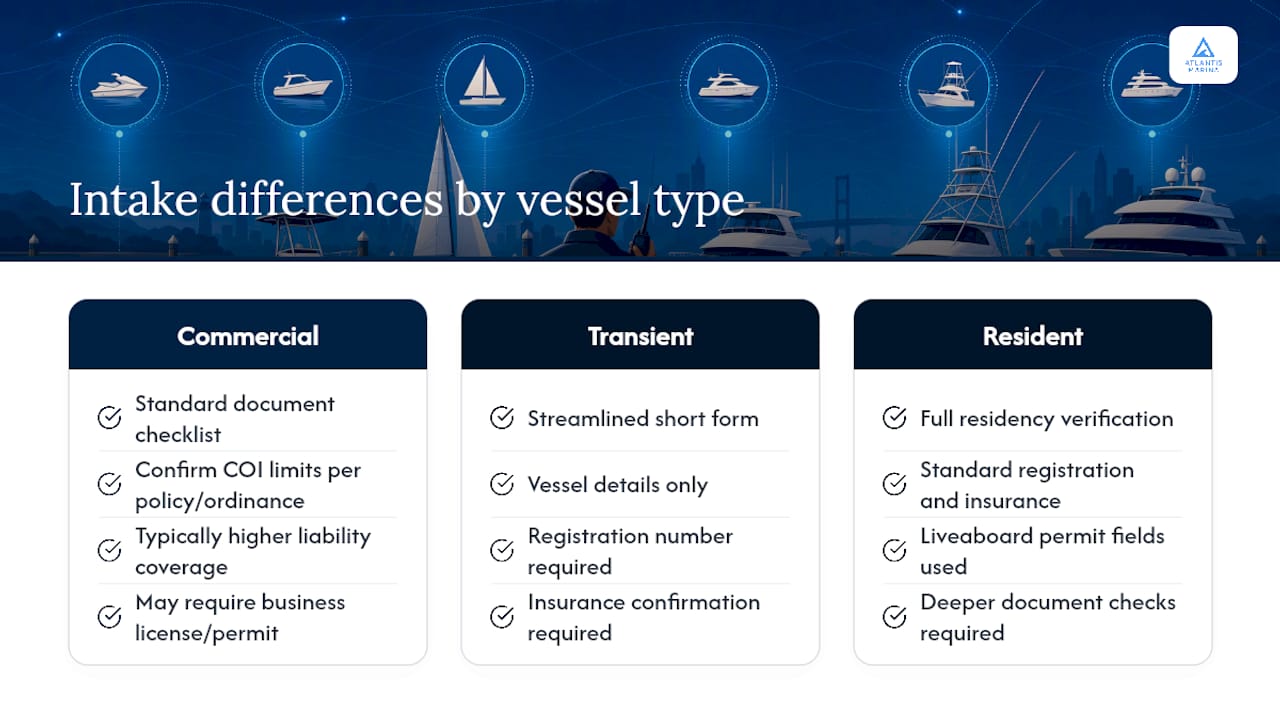
Commercial vessels and transient boats need the same document checklist as long-term residents, but the verification details shift. Commercial operators typically carry higher liability coverage than recreational boaters, so staff should confirm the COI limits match what the marina's insurance policy or local ordinance requires for commercial activity, not just apply the standard minimum. Commercial applicants may also need to provide a business license or operating permit alongside the standard registration and insurance documents.
Transient boats present a different challenge: speed matters more than paperwork depth. A boater pulling in for one or two nights isn't going to complete a full residency verification, and requiring one creates friction that drives transient traffic to a competing marina. Most transient dockage forms, like the one Virginia Beach publishes, streamline down to vessel details, registration number, insurance confirmation, and length of stay, skipping the deeper residency and liveaboard permit fields entirely.
Both cases benefit from a flag in the customer record noting the vessel type, so staff don't accidentally apply liveaboard rules to a commercial charter or ask a weekend transient for a utility bill. Keep separate short-form versions of your standard intake form for each category rather than forcing every applicant through the same long form.
Who Should Applicants Contact With Questions?
Applicants run into the same handful of questions repeatedly: which documents to upload, why a submission is on hold, and how long approval takes. A well-designed intake form should list a direct phone number and email address for the dockmaster's office or front desk, not just a generic contact form that routes to an unmonitored inbox.
Posting expected turnaround time on the form itself, even a rough estimate like "two to three business days," cuts down on status-check calls significantly. If the marina uses a portal for submissions, include a short note on where applicants can check their application status without calling in. For after-hours emergencies unrelated to a pending application, list a separate emergency contact so routine paperwork questions don't compete with time-sensitive calls for attention.
Why Standardized Intake Forms Pay Off Operationally
Standardized intake forms cut onboarding time because staff aren't reconstructing a checklist from memory for every applicant. They also catch insurance and registration gaps before a boat ever touches the water, which is cheaper than discovering a lapsed COI after an incident. Automated renewal reminders, autopay, and e-signature tools compound that benefit by reducing late payments and administrative rework. The operational case for consistency is straightforward: fewer missed documents, fewer awkward phone calls, and a smoother first impression for every new boater.
— John R
How Atlantis Marina Automates the Intake Process
Atlantis Marina replaces the mix of paper forms, email attachments, and spreadsheet tracking most marinas rely on with one connected intake system. Boaters submit vessel details, upload their COI and registration through the boater portal, and sign contracts electronically with Atlantis E-Sign instead of printing and mailing paperwork back and forth.
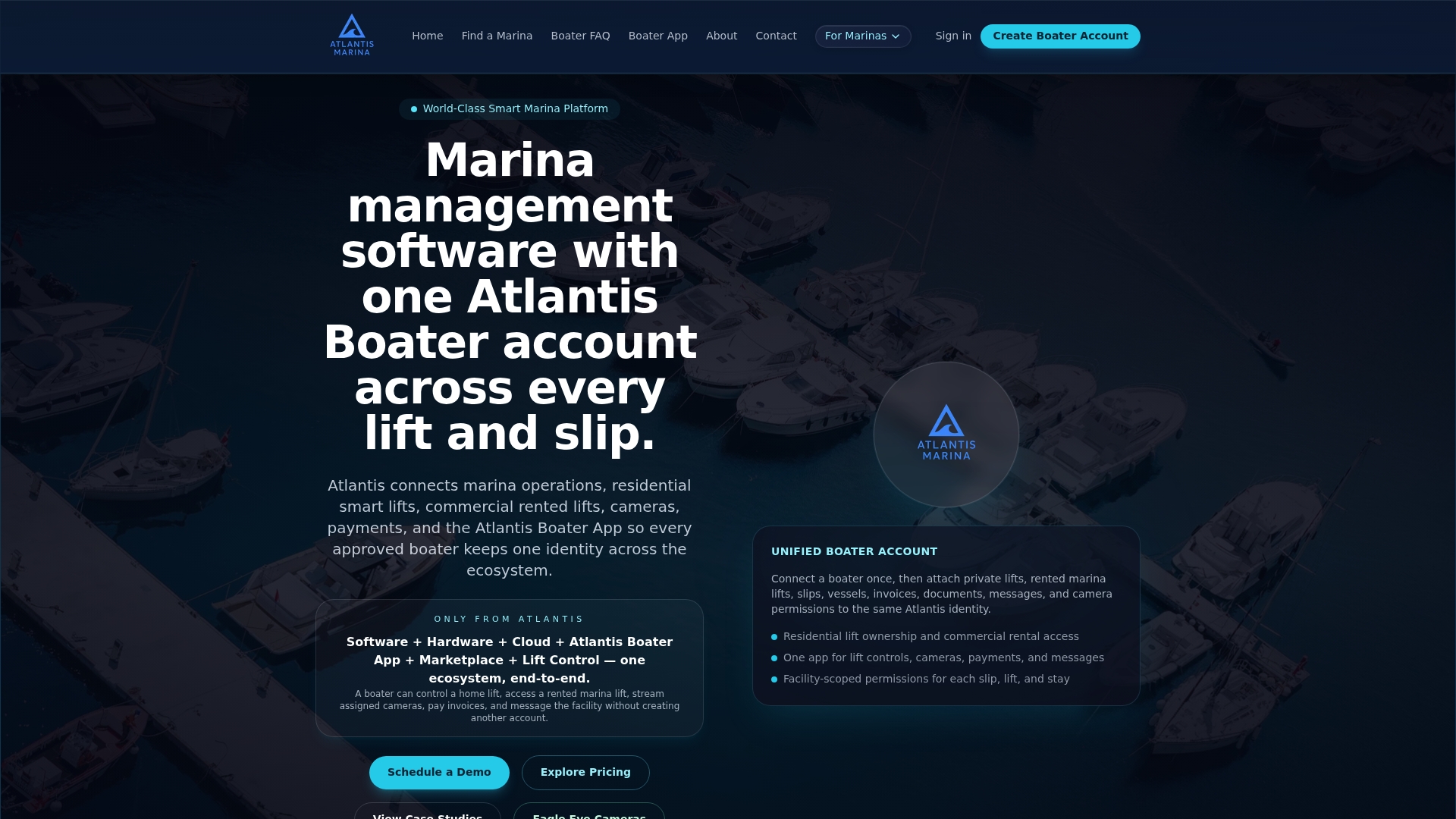
Behind the scenes, staff work from a single customer record per owner, with COI expiration alerts that fire automatically instead of relying on someone remembering to check a spreadsheet. Autopay and Instant Pay handle deposits and monthly billing through Stripe and ACH, and every document, contract, and payment ties back to the same vessel record across every property in a marina group. For document tracking specifically, that means registration and insurance renewals stop falling through the cracks between seasons.
Plans scale from the Micro tier at around $150 per month up through Enterprise pricing available on request, so a small marina and a multi-property group can both run intake through the same system. Visit the Atlantis Marina sales page to request a demo and see how intake and onboarding run on your own dock.
Sources
- Berkeley Marina Fillable Berth Rental Application (PDF)
- Dockage Intake Form - Kennedy Point Marina
- Application/Slip Renter Information Sheet - Ventura West Marina (PDF)
- Marina Forms — City of Long Beach
FAQ
What Documents Belong on a Marina Intake Form?
A government-issued photo ID, vessel registration or USCG documentation, and a Certificate of Insurance naming the marina as additional insured are the three core requirements. Most forms also collect proof of residence, vessel specifications, and emergency contact information.
What If a Boater Doesn't Have a Traditional Proof of Residence?
Many marinas accept a signed lease, a recent bank statement, or a mortgage statement as alternatives to a utility bill. PO boxes are typically rejected outright since they don't confirm a physical address, so staff should ask for a second acceptable document instead.
Are E-Signatures Acceptable for Marina Contracts?
Yes. E-signature tools like Atlantis E-Sign are standard practice for dockage and slip contracts and remove the delay of printing, signing, and mailing paperwork. Most marinas now issue digital contracts as the final step after document verification and deposit collection.
How Much Insurance Coverage Should a Marina Require?
Coverage minimums vary by facility and jurisdiction, so there's no single fixed number, though some larger ports require $2 million or more in liability coverage. Confirm your marina's own minimum against local requirements rather than copying another facility's figure.
What Does Atlantis Marina Cost for a Small Marina?
Atlantis Marina's Micro plan starts at around $150 per month, with Small, Medium, Large, and Enterprise tiers scaling up based on marina size and features. Current pricing details for every tier are available on the Atlantis Marina pricing page.