
Standardizing marina operations means running a process inventory, ranking workflows by risk and frequency, and digitizing the controls for the ones that matter most first. Done right, this cuts exceptions, speeds up billing close times, and leaves an auditable trail insurers and inspectors both trust. Follow the NPS Marina Standards as your baseline and expect measurable gains, fewer missed inspections, faster reconciliation, cleaner records, within 90 days using a platform like Atlantis Marina to hold the evidence.
TL;DR:
- Standardizing marina workflows should start with prioritizing high-risk tasks like fuel spills and slip management, allocating ownership, checklists, and evidence types first.
- Implementing fixed routes for daily dock inspections, with photo evidence and automated work orders, helps identify issues early and improves record retention.
- Automated reservation, billing, and document management systems reduce manual errors and ensure compliance with safety and environmental standards.
- Using a connected management platform that consolidates operations, safety, and infrastructure data accelerates a 90-day standardization process and maintains an evidence trail.
- Tracking key performance indicators such as inspection completion rates, exception closure times, occupancy accuracy, and billing discrepancies indicates successful standardization progress.
Table of Contents
- What Does It Mean to Standardize Marina Operations?
- How Do You Standardize Daily Dock Inspections?
- Which Administrative Systems Reduce Operational Errors?
- What Safety and Fuel Compliance Standards Should Marinas Follow?
- How Should Marinas Structure Staffing and Training?
- Which KPIs Prove Standardization Is Working?
- How Does Atlantis Marina Support a 90-Day Standardization Rollout?
- How Do Marinas Track Regulatory Compliance Beyond Signage?
- How Do You Write SOPs Specific to Marina Tasks?
- What Role Does Marina Management Software Play in Standardization?
- What Customer Service Standards Should Marinas Set?
- How Should Marinas Schedule Maintenance and Track Equipment Lifecycle?
- Author Perspective: What Actually Slows Down a Standardization Rollout
- Standardize Marina Operations With One Connected Platform
- Sources
- FAQ
What Does It Mean to Standardize Marina Operations?
Standardizing marina operations starts with a process inventory: list every recurring workflow, from slip turnovers to fuel dock openings, and rank each one by how often it happens and how much damage it causes when it fails. A fuel spill or a double-booked slip carries more weight than a slow ship store restock, so those go first.
Once you know your priority order, assign a single owner to each workflow and attach three things: a one-page checklist, a defined evidence type (photo, signature, timestamp), and an escalation rule for when something goes wrong. Review cadence matters too. High-risk items get monthly reviews; lower-risk ones can wait for a quarterly pass.
A practical rollout looks like this:
- Inventory every recurring task across dock operations, fuel service, and administration.
- Score each task on frequency and consequence of failure.
- Assign an owner and build a one-page checklist, not a binder.
- Define what evidence counts as proof of completion.
- Set an approval and escalation path for exceptions.
- Schedule a review date, weekly for high-risk tasks, quarterly for the rest.
Pro Tip: Don't write the manual first. Standardize three workflows, watch how staff actually use them for two weeks, then expand. A framework built on real behavior beats one built on a whiteboard.
How Do You Standardize Daily Dock Inspections?
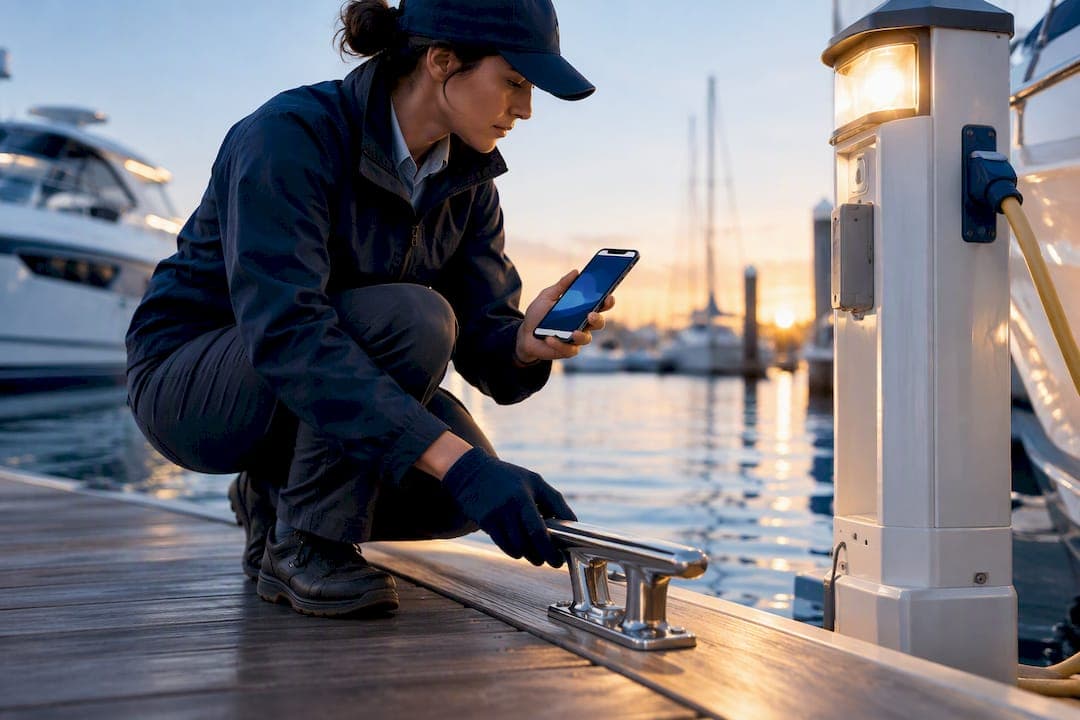
Daily dock checks work best as a fixed route, not a wander. Staff should hit the same cleats, lines, decking, and utility connections in the same order every time, because a repeatable path is what makes gaps visible.
A standardized dock walk generally follows this sequence:
- Scan for trip hazards, loose decking, and damaged cleats along the fixed route.
- Check utility lines, shore power connections, and posted signage at each slip.
- Log unsafe or unregistered vessels using a QR check-in tied to the vessel record.
- Photograph any exception on the spot and trigger an automated work order.
- Close the route in the log, timestamped, so the next shift knows what's already covered.
The advantages of this structure show up fast:
- Photo evidence turns a verbal complaint into a documented, time-stamped record.
- QR check-ins pull up vessel and account details, so nobody wastes time on a manual lookup.
- Auto-generated work orders mean fewer things get remembered instead of tracked.
A digitized dock walk with photo evidence and automated work orders surfaces leaks, loose lines, and electrical issues before they become claims. Retention matters here too. Keep logs long enough to reconcile against maintenance records and spot recurring failures at the same slip.
Which Administrative Systems Reduce Operational Errors?
Reservations and billing are where most manual errors quietly compound, one double-booked slip or missed invoice at a time. Centralizing slip assignments in a single system of record eliminates the spreadsheet-versus-whiteboard conflict that causes double bookings in the first place.
Billing works the same way. Automated invoicing, autopay, and payment processing through Stripe or ACH close the gap between a service rendered and revenue collected, while a QuickBooks Online sync keeps the books current without rekeying numbers.
Document control rounds this out:
- Store certificates of insurance, SPCC plans, contracts, and incident reports in one searchable system.
- Use version control so the current SPCC plan is never confused with last year's draft.
- Set access permissions so only authorized staff can edit contracts or compliance documents.
- Track expiration dates on COIs and licenses with automatic alerts before they lapse.
Document management built for marina operators removes the guesswork of which folder holds the current version, and reservation-to-billing automation removes the manual reconciliation step entirely.
What Safety and Fuel Compliance Standards Should Marinas Follow?
Fuel dock operations carry the highest liability of any marina workflow, and the standards reflect that. The NPS Marina Standards call for posted shutdown procedures, SPCC-compliant spill kits, and absorbent boom staged within reach of the dispensing area, not stored across the property.
A standardized fuel dock SOP typically covers:
- Posted, step-by-step shutdown instructions visible at the pump.
- Spill kits and absorbent boom staged at the point of dispensing, checked weekly.
- Signage consistent with NFPA-303 guidance, including NO SMOKING notices at every fuel point.
- Posted emergency contacts for the Coast Guard, local fire response, and facility management.
- Trained fuel attendants with documented sign-off, not informal on-the-job coaching.
Marina safety guidance from the Corps of Engineers and National Water Safety Congress ties inspection, maintenance, and fuel dispensing practices directly to documented training and logged drills, not just posted signage.
Insurers increasingly ask for drill logs and incident records as proof of an active safety program, not just a policy binder that sits on a shelf.
How Should Marinas Structure Staffing and Training?
Every high-risk role needs a one-page SOP, not a lengthy manual nobody reads under pressure. Fuel attendants, dock attendants, and managers each need role-specific procedures covering their exact daily tasks and what to do when something deviates from normal.
Training works on a cadence: onboarding for new hires, quarterly refreshers for existing staff, and scheduled drills for spill response and emergency shutdown. The Marina Industries Association training and certification framework gives operators a structured way to document competency instead of relying on memory.
- Write one-page SOPs for fuel attendants, dock attendants, and shift managers.
- Run onboarding training before any staff member works unsupervised.
- Schedule quarterly refreshers and log every sign-off with a date and signature.
- Track simple KPIs like inspection completion rate and average exception close time.
Clear escalation paths matter as much as the training itself. Staff need to know exactly who to call when a checklist item fails, not just that they should "report it."
Which KPIs Prove Standardization Is Working?
A standardization program without measurement is just a nicer-looking binder. The KPIs that actually matter are the ones tied to money and risk: occupancy accuracy, inspection completion rate, exception closure time, and billing discrepancies caught before they hit a customer's statement.
- Occupancy accuracy: how often slip assignments match the actual vessel present.
- Inspection completion rate: percentage of scheduled dock walks completed on route and on time.
- Exception closure time: average hours between a logged issue and its resolution.
- Billing discrepancies: number of invoice corrections needed per billing cycle.
Review these weekly on a dashboard, quarterly at a management level, and roll every finding into an annual audit of the full operations manual. The Marina Operations System offers a useful template structure for that annual review if you're starting from scratch.
Pro Tip: If exception closure time keeps creeping up, the problem is rarely staff effort. It's usually a checklist item that's unclear or an escalation path nobody actually follows. Fix the document before you fix the person.
How Does Atlantis Marina Support a 90-Day Standardization Rollout?
Mapping the framework to actual tools is where most standardization efforts either take hold or quietly die. Three workflows make a realistic first 90 days.
- Digitize dock walks. Replace the paper clipboard with QR check-ins and photo evidence tied directly to vessel records, feeding straight into the operations dashboard.
- Automate reservation-to-billing. Use e-signed contracts through Atlantis E-Sign, then let autopay and Stripe or ACH processing handle collection without manual invoicing.
- Log fuel dock SOPs digitally. Record shutdown checks, spill kit inspections, and training sign-offs in one document system instead of a logbook in a drawer.
Each workflow maps to a specific capability: the operations dashboard for daily task tracking, document management for compliance records, and smart lift and camera integrations for facilities layering in device automation. By day 90, expect a baseline you can measure against: inspection completion rates near full compliance, billing discrepancies dropping toward zero, and an evidence trail ready for any insurer request.
How Do Marinas Track Regulatory Compliance Beyond Signage?
Posted NO SMOKING notices and NFPA-303 signage satisfy the visible layer of compliance, but regulators and insurers increasingly want proof of ongoing tracking behind that signage. That means dated inspection logs, SPCC plan reviews, and documented corrective actions when something falls short of standard.
Regulatory reporting in a marina context usually spans a few distinct threads. Environmental compliance requires periodic SPCC plan reviews and spill kit inventory checks, each logged with a date and the reviewer's name. Fuel-handling records need to show not just that fuel was dispensed, but that the dispensing equipment was inspected on schedule. Incident reports, anything from a minor dock injury to a near-miss spill, need their own retention system separate from routine maintenance logs, since insurers and regulators may request them years after the fact.
Version control matters more here than almost anywhere else in marina operations. A compliance officer or inspector asking for "the current SPCC plan" needs confidence that the document they receive is the one currently in force, not a superseded draft still floating around in someone's inbox. Marinas that centralize document control with clear versioning and access permissions avoid the scramble that happens when an inspection is scheduled with two days' notice.
The practical fix is treating compliance tracking as a live system rather than a filing exercise. A centralized document system with expiration alerts on permits, insurance certificates, and inspection due dates turns regulatory reporting from a scramble into a scheduled task, which is exactly what auditors want to see.
How Do You Write SOPs Specific to Marina Tasks?
A marina SOP fails when it tries to cover too much ground in one document. The ones that actually get followed are narrow, one page, and built around a single task: opening the fuel dock, processing a slip transfer, handling a dry-stack launch request.
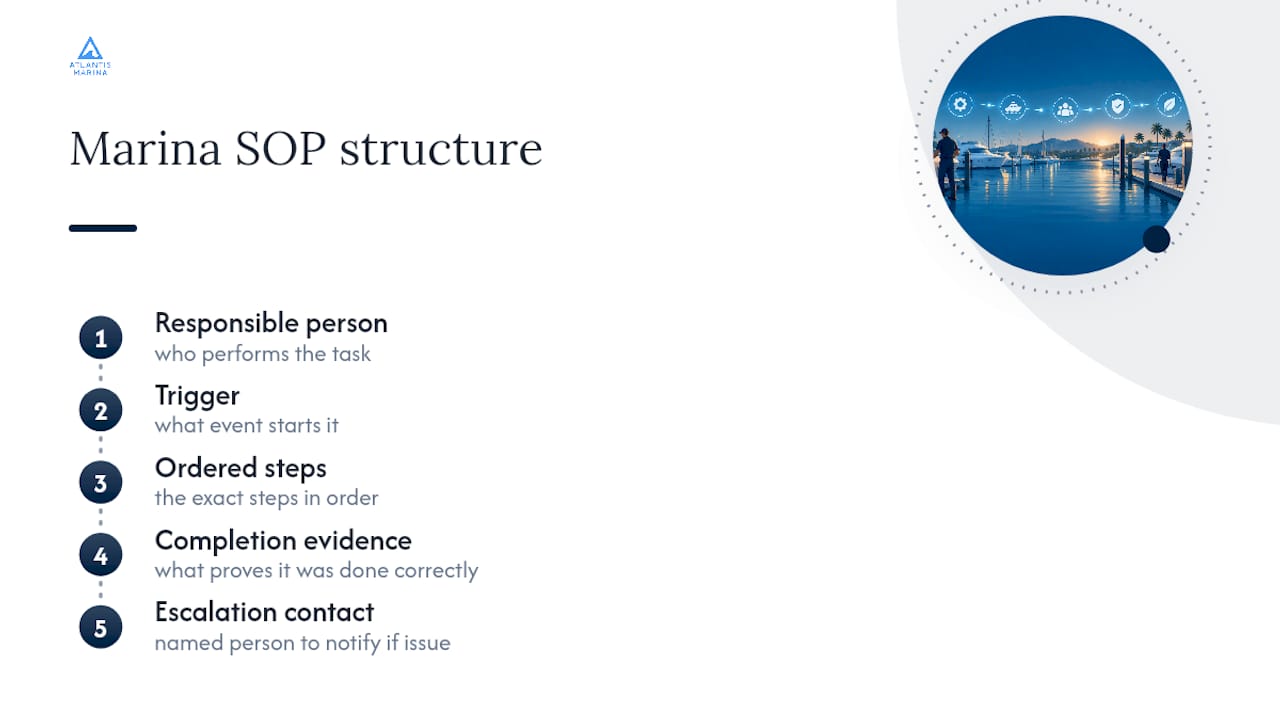
Start every SOP with the same skeleton: who performs the task, what triggers it, the exact steps in order, what evidence proves it was done correctly, and who to escalate to if something goes wrong. That last part gets skipped constantly, and it's the piece that turns a checklist into an actual control. Without a named escalation contact, an exception just sits until someone notices.
Marina tasks that benefit most from a documented SOP tend to share two traits: they happen often, and a mistake creates either safety risk or revenue leakage. That points squarely at fuel dock operations, dock walk inspections, slip assignment and transfer, dry-stack launch and retrieval sequencing, and incident reporting after any injury or spill.
Documentation format matters less than consistency. Whether you use a laminated card at the fuel dock or a mobile checklist through an operations app, every SOP across the facility should follow the same structure so staff aren't relearning a new format every time they switch tasks. The Marina Operations System template structure works well as a starting skeleton, and the Corps of Engineers safety guidelines offer language you can adapt directly into inspection and maintenance SOPs rather than writing from scratch.
What Role Does Marina Management Software Play in Standardization?
Paper checklists and spreadsheets cap out fast once a marina grows past a handful of slips, because nothing in that setup talks to anything else. A reservation made on one sheet doesn't automatically update the billing sheet, and a maintenance note scrawled on a clipboard never makes it into the customer's file.
Marina management software fixes this by putting reservations, billing, documents, and inspection records into one connected system instead of five disconnected ones. When a boater books a slip, that reservation should automatically populate the billing schedule, trigger the contract for e-signature, and update the occupancy map, all without a staff member retyping the same information three times.
Automation tools extend this further into daily operations. QR-code check-ins mean staff never manually search for a customer record; scanning the code pulls up the account, vessel details, billing status, and any open documents in seconds. Automated work orders generated from a failed dock walk item remove the step where an exception gets mentioned verbally and then forgotten by the next shift.
The bigger shift is connecting software to physical infrastructure. Smart boat lift controllers, remote monitoring, and camera integrations turn "check on that" into a task someone can verify from a phone without walking the dock. That's a meaningful jump from a system that just tracks data to one that actually manages the facility's connected infrastructure. Marinas adopting this kind of platform typically see the biggest gains not in any single feature, but in how few times staff have to re-enter the same information across different tools.
What Customer Service Standards Should Marinas Set?
Guest experience in a marina context is really a series of small, repeatable moments: check-in, billing clarity, response time to a maintenance request, and how quickly a question gets answered. Standardizing these moments matters as much as standardizing dock inspections, because inconsistent service is what drives a transient boater to book somewhere else next season.
Check-in is the first test. A boater arriving after a long transit shouldn't wait at the dock while staff hunt for a paper reservation. A digital account that travels with the customer, complete with vessel details, insurance documents, and reservation history already on file, turns check-in into a two-minute process instead of a ten-minute one.
Response time is the second standard worth setting explicitly. Define a maximum response window for maintenance requests, billing questions, and general inquiries, then track whether staff actually hit it. A marina that promises "prompt" service without a defined number has no way to know if it's delivering on that promise.
Communication channels should be consistent too. Boaters expect a mix of email, text, and in-app messaging depending on the urgency, and staff should have one place to see every conversation tied to an account rather than hunting across email threads and text messages separately. An AI assistant that answers routine boater questions on reservation status or billing frees staff to spend their time on requests that actually need a human judgment call.
Guest experience protocols also need a feedback loop. Track complaints and compliments the same way you track maintenance exceptions, logged, categorized, and reviewed monthly, so patterns in service gaps show up before they show up in online reviews.
How Should Marinas Schedule Maintenance and Track Equipment Lifecycle?
Maintenance scheduling fails most often not from lack of effort, but from lack of a system that remembers what was done and when. A boat lift serviced eighteen months ago on a sticky note in someone's desk drawer is functionally the same as a lift that's never been serviced, because nobody can verify the history.
Standardized maintenance scheduling starts with an asset list: every boat lift, fuel pump, shore power pedestal, and piece of dock hardware gets a record with installation date, expected service interval, and last service date. That record needs to live somewhere staff actually check, not in a binder that gets updated once a year during an audit scramble.
Preventive maintenance intervals should follow manufacturer guidance where it exists, and a conservative default schedule where it doesn't. Fuel dispensing equipment, given its safety profile, generally warrants tighter intervals than general dock hardware. Smart lift controllers and remote monitoring systems help close this gap by flagging unusual load patterns or motor behavior before a full failure happens, turning a scheduled inspection catch into an automatic alert instead.
Equipment lifecycle management extends beyond simple maintenance into replacement planning. Tracking the age and repair history of major assets, lifts, pumps, electrical infrastructure, lets a manager budget for replacement before a piece of equipment fails at the worst possible time, usually a holiday weekend at peak occupancy. A maintenance log tied to the same system that tracks dock walk exceptions and work orders means one dashboard shows the full picture instead of three disconnected spreadsheets competing for attention.
Author Perspective: What Actually Slows Down a Standardization Rollout
The biggest mistake I see is writing the manual before proving anything works. Start with three workflows, get frontline staff to help design the checklists, and let them find the gaps you'd never notice from an office.
Skip the document-first trap. A policy with no owner and no attached checklist just becomes shelf-ware. Every workflow needs a name attached to it and a way to see, in photos or logs, that it actually happened. That evidence trail is what convinces insurers and boards to fund better tools once they see it working.
— John R
Standardize Marina Operations With One Connected Platform
Atlantis Marina removes the manual steps that make standardization fragile in the first place. Instead of a checklist in one app, billing in a spreadsheet, and documents in email attachments, everything lives in one system built specifically for marina workflows.
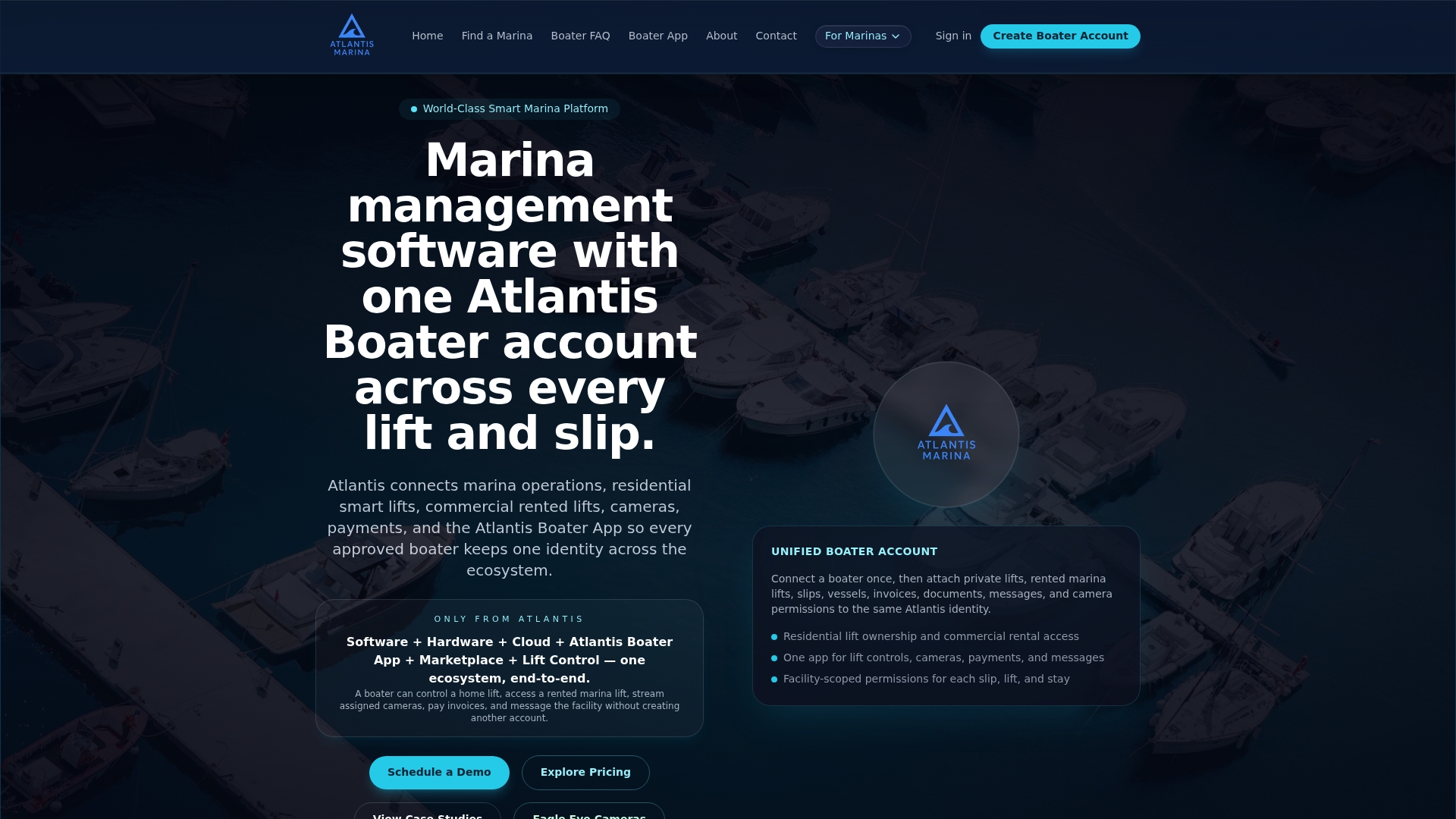
The platform covers the exact controls this article walks through: contracts signed and stored through Atlantis E-Sign, autopay with Stripe and ACH processing so billing discrepancies stop before they start, document management with version control for SPCC plans and COIs, QR-code dock walks with photo evidence, automated work orders for exceptions, and a single operations dashboard tying occupancy, maintenance, and billing analytics together. Smart lift and camera integrations extend that same standardization to the physical dock itself.
Pricing scales with facility size, from the Micro plan starting at $150 per month up through Large at $900 per month, with Enterprise pricing available on request; see the full breakdown on the pricing page. If you're ready to see how the framework in this article maps to your own facility, request a demo and walk through your highest-risk workflows with the team directly.
Sources
- Marina standards (NPS)
- Marina Industries Association — training & certification
- Guidelines for the safe operation and maintenance of marinas
- Marina Operations System (MOS) — Marina Industries Association resource
FAQ
What Is the First Step to Standardize Marina Operations?
Start with a process inventory: list every recurring workflow and rank it by frequency and risk. Attach a one-page checklist, an owner, and an evidence requirement to your top three or four workflows before building anything larger.
How Long Does It Take to Standardize a Marina's Workflows?
A focused rollout on high-risk workflows, dock walks, fuel SOPs, and reservation-to-billing, typically shows measurable results within 90 days. Full facility-wide standardization, including an annual operations manual audit, usually takes six to twelve months.
What Should a Marina Operations Manual Include?
An operations manual should cover safety and environmental procedures, emergency response, inspection and maintenance routines, and communication protocols, reviewed at least annually. The Marina Operations System offers a template structure many facilities adapt directly.
How Much Does Atlantis Marina Cost?
Atlantis Marina's plans range from $150 per month for the Micro tier to $900 per month for the Large tier, with Enterprise pricing available on request. Full details are listed on the pricing page.
What KPIs Show That Standardization Is Working?
Track inspection completion rate, exception closure time, occupancy accuracy, and billing discrepancies per cycle. Improvement in these four numbers over a few months is the clearest sign a standardization program is taking hold.