
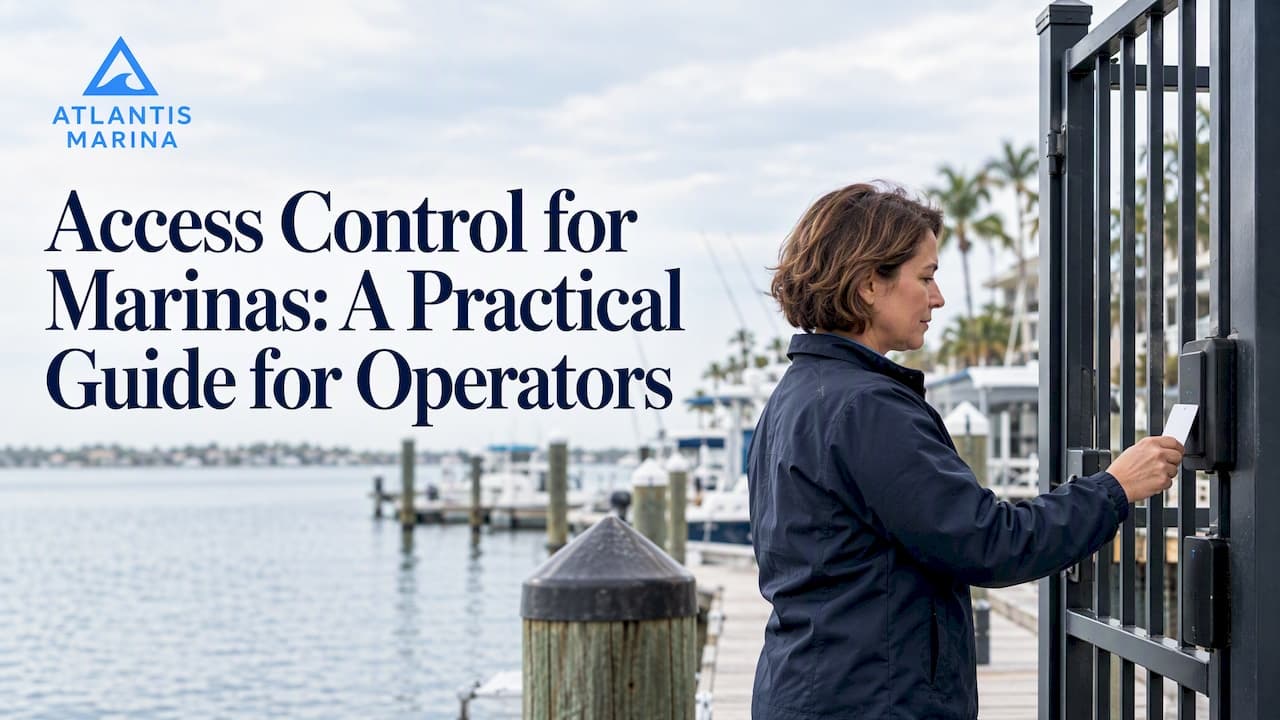
Marina access control is the set of rules and tools that decide who can enter which part of your property, when, and for how long. The hardware is the visible part: gates, readers, keypads, fobs and phone credentials. The part that determines whether it works is administrative: who gets approved, how permissions follow the contract, and how fast access disappears when a slip lease ends. This guide covers how to plan it, what to compare, and how to connect it to the rest of your operation.
TL;DR
- Map every access point first (parking, dock gates, launch ramps, storage yards, fuel, lifts, restrooms, service areas) and give each its own rule. One credential for everything is the most common design mistake.
- Treat access as a lifecycle: approve, issue, review, revoke. CISA guidance calls for verifying authorization before entry and promptly removing access when it is no longer needed.
- Tie permissions to the account record (contract, payment status, insurance, vessel) so they change when the account changes, not when someone remembers.
- Plan for outages. Connected gates, cameras and lifts are operational technology, and you need a tested manual fallback.
- Layer access control with cameras, lighting, alarms and trained staff. Credentials alone do not secure a waterfront.
Table of Contents
- What access control means at a marina
- Start with a site map, not a hardware catalog
- Separate permissions by zone
- Run access as a lifecycle
- Connect access to your management system
- Layer access control with the 5 Ds
- Lifts, fuel and utilities are access points too
- Plan for cyber and outage risk
- How to compare marina access control options
- Perspective: access control is an account problem
- What Atlantis Marina offers
- A rollout plan that works
- FAQ
- Sources
What access control means at a marina
A marina is not an office building. It has a public-facing parking lot, a water edge, expensive movable property, seasonal tenants, transient guests, contractors, fuel and shore power, and often a restaurant or ship store open to the public. Access control has to separate all of those groups without making a boater wait at a gate in the rain.
In practice, a U.S. marina controls entry to zones such as:
- Parking lots and vehicle gates
- Pedestrian dock gates and individual pier gates
- Launch ramps
- Dry stack and storage yards
- Fuel docks and utility areas
- Boat lifts and lift controls
- Restrooms, showers and laundry
- Service shops and staff-only areas
Credentials can be cards, fobs, PINs, QR codes, mobile credentials or license-plate recognition, alone or combined. Common workflows include seasonal berth-holder rights, role-based permissions, temporary contractor and guest access, automatic expiration, remote revocation and digital event logs.
Start with a site map, not a hardware catalog
Before you request a single quote, walk the property and list every place a person or vehicle can get in. CISA's planning guidance for waterfront-type facilities frames access around threats, assets, credentials, vehicle controls, barriers and visitor processing. That guide is written for dams, not marinas, but the sequence transfers directly: know what you protect and from whom, then pick the tools.
For each access point, write down:
- Who needs to pass. Slip holders, dry stack customers, staff, vendors, transient guests, delivery drivers, emergency responders.
- When. 24/7, seasonal, business hours, event-only, single day.
- What it protects. Vessels, fuel, lift controls, cash, records.
- What happens when it fails. Does the gate fail open or closed? Who can override it at 2 a.m.?
- What the site physically allows. Civil, electrical, drainage and communications work can matter as much as the reader you choose. Trenching to a remote pier gate, power at the ramp, and cellular or Wi-Fi coverage on the docks all affect cost and reliability.
This exercise usually reveals a few surprises: a side gate propped open for the fuel truck, a service door that never got a lock, or a contractor code that has not changed in years.
Separate permissions by zone
The detail most often missed is permission separation. A parking credential should not automatically open the launch ramp, a dock gate or a technical area. A marina-specific parking and access guide makes the same point: parking, dock gates and launch permissions should stay distinct.
A simple permission matrix keeps this manageable:
| Role | Parking | Dock gate | Launch ramp | Fuel / utility | Staff areas |
|---|---|---|---|---|---|
| Annual slip holder | Yes | Own pier | Per contract | No | No |
| Seasonal slip holder | Season dates only | Own pier | Per contract | No | No |
| Dry stack customer | Yes | No | Yes | No | No |
| Transient guest | Stay dates only | Assigned pier | No | No | No |
| Contractor | Work window | As required | No | As required | Limited |
| Staff | Yes | All | Yes | Yes | By role |
Your own matrix will differ. The point is that every cell is a decision someone made, not a default.
Run access as a lifecycle
CISA's minimum governance model is plain: verify authorization before entry, enforce controls at every physical access point, secure and periodically inventory keys or other access devices, and remove access promptly when a person no longer requires it. The agency also lists role-based authorization and, where risk warrants, two forms of identification as enhancements (CISA Catalog of Recommendations).
For a marina, that translates into a repeating cycle:
- Approve. A signed contract, verified vessel details and current insurance trigger access, not a verbal okay at the dock office.
- Issue. Assign credentials to a named person and a specific account. Log physical fobs and cards.
- Review. Audit active credentials at least every season. Look for departed staff, ended leases, and contractors whose jobs finished.
- Revoke. Remove access the day a lease ends, a payment default is escalated per your policy, or a credential is lost. Change keys or combinations after loss, compromise, transfer or termination.
This is where most marinas struggle. The gate hardware is rarely the weak point. The spreadsheet that says who should have access is.
Connect access to your management system
Standalone access systems create a second list of people to maintain. Every time a boater signs a lease, moves slips, cancels, or falls behind on payments, someone has to update the gate system by hand. Integration removes that duplicate work.
When you evaluate how access control fits with your marina software, ask:
- Does the credential change automatically when a reservation, contract or slip assignment changes?
- Can permissions expire on a date without staff action?
- Can staff revoke a credential remotely from a phone or browser?
- Is there a searchable event log tied to the customer account, not just a door number?
- Can the same account record show vessel, documents, billing and access in one place?
This is the approach we take at Atlantis Marina. Our platform keeps slip assignments, reservations, vessel records, customer accounts, documents, billing and connected infrastructure in one cloud-based system, with access workflows, camera and sensor security integrations and mobile alerts alongside the day-to-day operations work. You can see how the pieces fit in the marina management software overview or the marina management solution page.
Why the account record matters
A boater who signs a contract electronically, uploads insurance and registration, and pays through the portal has already given you everything needed to decide whether they should have access. When that record is the source of truth, access follows it. Our customer portal explainer for managers walks through what the boater sees and what staff control.
Billing is part of the same chain. Automated invoicing, autopay and payment processing mean you know quickly when an account is current, and marina billing software keeps those records and your accounting in sync. Whatever your policy is for delinquent accounts, the data to apply it consistently should live in one place.
Layer access control with the 5 Ds
Access credentials are one layer. The widely used 5 Ds framework describes the others: deter, detect, deny, delay and defend. In the COSE summary of the framework, visible lighting, fencing and signage deter; cameras and sensors detect; credentials and locks deny; gates and barriers delay; and trained staff, security personnel and law enforcement defend. It is a layered-security model, not a product spec.
Applied to a marina:
| Layer | Marina example |
|---|---|
| Deter | Lighting on docks and lots, posted rules, visible cameras, fenced perimeter |
| Detect | Cameras at gates and fuel docks, motion sensors, mobile alerts |
| Deny | Readers and locks on dock gates, ramps, restrooms and lift controls |
| Delay | Gates, barriers, controlled vehicle lanes |
| Defend | Trained staff, an incident procedure, a call list for local law enforcement |
The weakest layer sets your real security level. A good reader on a gate that people can walk around does little. A camera nobody watches does not detect anything in time.
Where cameras fit
Cameras do two jobs for access control: they verify who used a credential, and they record what happens at points with no reader. If you are planning that layer, our guides on camera integration for waterfront properties, a camera integration walkthrough for managers and Eagle Eye marina cameras cover placement, integration and what operators should expect.
Lifts, fuel and utilities are access points too

Gates are not the only thing worth restricting. A boat lift that anyone can operate is an access problem and a safety problem. Fuel docks, pumpouts and shore power pedestals carry cost and environmental risk.
Atlantis supports smart boat lift controllers, remote monitoring, AUX device control and mobile alerts, plus a handheld Dealer Tool Kit for lift setup and diagnostics. If lifts are part of your operation, start with smart boat lift control, or watch how a GEM or TECH lift can be controlled from a phone. Treat lift permissions the way you treat dock gates: assigned to named users, logged, and revocable.
Plan for cyber and outage risk
Once gates, cameras, lifts, pumps and payment systems connect to cloud software, access control becomes part of your operational technology. CISA's port facility cybersecurity infographic warns that degraded or disrupted systems that identify and direct facility personnel can cause congestion or closure until restored, and that compromise of maritime IT or operational technology can disrupt operations and damage equipment. Ports are larger than most marinas, but the dependency is the same.
A practical checklist:
- Define safe local behavior. Decide what each gate does when the network or power drops, and confirm life-safety egress is never blocked.
- Keep a manual fallback. Mechanical keys or override codes, stored securely, with a written procedure and a drill at least once a season.
- Use least-privilege administration. Few people should be able to change permissions. Give everyone else the minimum their job needs.
- Protect backups and recovery. Know how you would restore your access list if a system failed.
- Ask vendors direct questions. Where is data hosted, how are admin accounts protected, how are updates delivered, and what is the outage behavior?
If your insurer, municipality or lender has security requirements for the property, confirm them before finalizing the design.
How to compare marina access control options
You will usually choose among a few types of solution: standalone gate and keypad systems, access platforms built for parking and multi-tenant buildings, and marina management software that integrates access with accounts, billing and devices. Judge them on the same criteria:
- Marine durability. Outdoor ratings, corrosion resistance, temperature range, and mounting on docks and posts.
- Credential flexibility. Fobs and cards for people who want them, mobile or PIN access for guests, and plate recognition where vehicles are the main point.
- Zone and schedule control. Separate rules for parking, docks, ramps and service areas, with expiration dates.
- Account integration. Does it read from your reservations, contracts and billing, or do you re-enter everything?
- Remote management. Add, change and revoke from anywhere, with alerts.
- Audit trail. Event logs you can search by person and date.
- Resilience. Behavior during outages, and the vendor's backup and recovery practice.
- Total cost. Hardware, installation, trenching or power work, software subscription and your staff time.
The best system for a 40-slip yacht club with one dock gate is not the best for a multi-property group with dry stack, lifts and a fuel dock. Match the tool to your site map.
Perspective: access control is an account problem
We see marinas spend heavily on readers and then lose control through process. The gate opens for someone whose lease ended in August, the fob list lives in one spreadsheet, the billing list lives in another, and nobody can say who last went through the fuel dock gate.
Our view is that access should be a consequence of the customer account, not a separate project. When the contract, vessel record, insurance documents, payments, messaging and connected devices sit in one cloud platform, staff make one change and the downstream permissions follow. That is the reason we built Atlantis Marina as a bridge between marina management software and smart marine technology rather than a set of disconnected tools. It cuts manual entry, shortens the gap between a business decision and a physical permission, and gives dockmasters one place to look when something goes wrong.
We also think hardware should stay honest about its limits. Cloud systems need a plan for the day the network is down, and we encourage every operator to keep a tested manual fallback.
— John R
What Atlantis Marina offers
Atlantis Marina is a cloud-based marina operations and smart waterfront management platform for marinas, yacht clubs, dry stack operators, boat lift facilities and multi-property groups. Published plans run from Micro at 150 $ per month, Small at 300 $ per month, Medium at 500 $ per month and Large at 900 $ per month, with Enterprise available without a published price. Eagle Eye smart cameras are listed at 30-150 $ per month, utility monitoring at 30-150 $ per month, and a dry-stack operations add-on at 79-299 $ per month. Setup is a one-off 100-1000 $. See current details on the pricing page, take the 7-minute platform tour, or look at marina software with free onboarding.
A rollout plan that works
- Week 1: Inventory. Map access points, list current credentials and compare them to active accounts. Remove what should not exist.
- Week 2: Define roles and zones. Build the permission matrix and decide expiration rules for seasonal, transient and contractor access.
- Week 3: Clean the account data. Make sure contracts, vessel records, insurance and contact details are current. Access follows this data.
- Weeks 4 to 6: Pilot one gate. Start with the highest-traffic dock gate, test fallback behavior, then expand.
- Ongoing: Review. Audit credentials every season, review event logs after incidents, and retrain staff when procedures change.
Boaters are more accepting of access rules when they are explained up front. Tell them what credential they will get, how guests are handled, and how to report a lost fob or phone.
FAQ
What is the best access control for a marina?
The best option is the one that matches your site map and connects to your customer accounts. Look for marine-rated hardware, separate permissions for parking, docks and ramps, remote revocation, and a searchable log. A system tied to your reservations and contracts saves the most staff time.
What are the 5 Ds of access control?
They are deter, detect, deny, delay and defend. Lighting and signs deter, cameras and sensors detect, credentials and locks deny, gates and barriers delay, and trained people respond. A marina should use all five layers rather than rely on readers alone.
Can marina access control integrate with management software?
Yes, and it should. Integration lets contracts, slip changes and account status drive permissions automatically instead of through manual updates. Ask any vendor exactly which records sync, how fast, and what happens if the connection drops.
What credentials work best for marina gates?
It depends on the user. Annual slip holders often prefer a fob or phone credential, guests do well with time-limited PINs or QR codes, and parking areas may suit plate recognition. Whatever you choose, assign credentials to named accounts and set expiration dates for temporary users.
Sources
- CISA Catalog of Recommendations, physical access control
- CISA Dams Sector Active and Passive Vehicle Barriers Guide
- CISA Port Facility Cybersecurity Risks
- COSE: The 5 Ds of security for your business